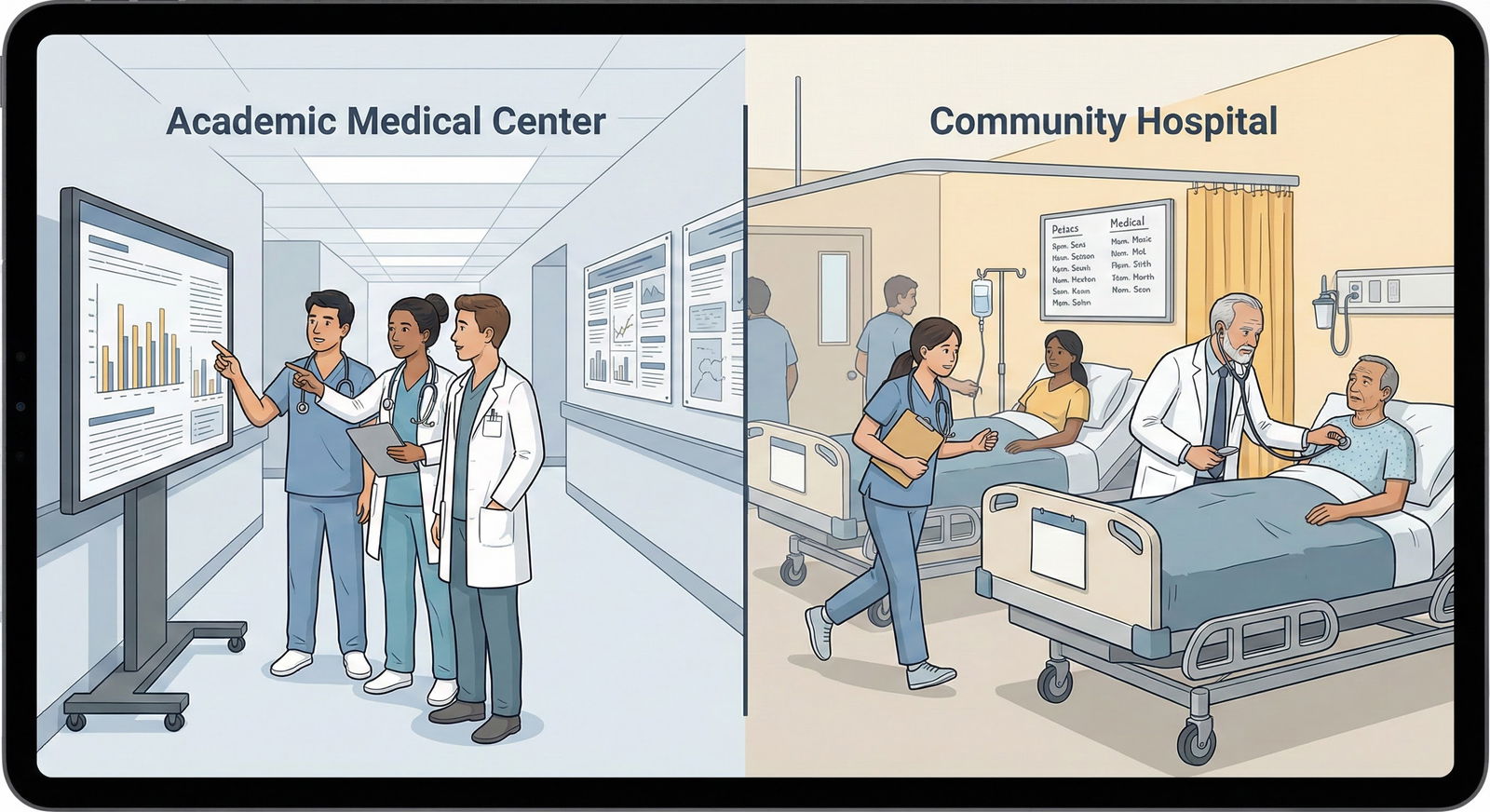
The way most students “choose” between community and academic residency training is backwards. They chase prestige or geography and only later realize the day‑to‑day work style doesn’t fit them at all.
You’re smarter than that. You’re asking the right question: Where will I actually thrive—community or academic?
Let’s answer it directly.
The Core Difference (That Actually Matters)
Forget branding. Forget the hospital website.
The real difference between community and academic training comes down to this:
In academic programs, patient care, teaching, and research all compete for your time.
In community programs, patient care and efficiency completely dominate your time.
If you want:
- Layers of learners (students, interns, juniors, seniors), formal teaching, conferences, and potential research—lean academic.
- High-volume clinical exposure, more autonomy faster, and fewer “extra” academic obligations—lean community.
Everything else you’ll hear is just a variation on that theme.
Step 1: Brutally Honest Self-Assessment
Here’s the part people skip and regret later.
Ask yourself, and answer in writing:
- Do I enjoy teaching enough that I’d happily prep a talk after a 12-hour shift?
- Do I get energy from reading papers, discussing trial design, or being in journal club?
- Do I want a future at a big academic center, fellowship at a top institution, or a niche within a specialty?
- How do I feel about meetings, committees, and evaluation forms? (Because academic programs live on these.)
- When I’m tired, what do I default to: reading/learning more… or finishing work and disappearing?
If your gut answers look like:
- “Yes, I like teaching, and I’ve actually done it and enjoyed it.”
- “I read things beyond what I’m forced to.”
- “Fellowship at a big name center sounds appealing.”
You likely lean academic.
If your gut answers look more like:
- “I’d rather see more patients than sit in another conference.”
- “I learn best by doing, not by sitting in a lecture.”
- “I want to be a really good clinician and go home.”
You likely lean community.
Let me be very clear: neither is “better.” They’re just built for different personalities and goals.
Step 2: Compare Training Environments Side by Side
Here’s how the environments usually split in reality, not brochure-speak.
| Feature | Community Program | Academic Program |
|---|---|---|
| Primary focus | Clinical care & efficiency | Clinical care + teaching + research |
| Learner layers | Fewer (often just residents/APPs) | Many (students, interns, residents, fellows) |
| Research expectations | Minimal to optional | Expected or strongly encouraged |
| Teaching obligations | Informal bedside teaching | Formal and informal, plus presentations |
| Autonomy trajectory | Often earlier, more direct | Slower, more supervised initially |
If you want to see it as a quick decision path:

| Step | Description |
|---|---|
| Step 1 | Start |
| Step 2 | Academic training |
| Step 3 | Community training |
| Step 4 | Apply to both types |
| Step 5 | Want research and teaching central to career |
| Step 6 | Prefer high volume clinical and autonomy |
| Step 7 | Undecided or mixed goals |
Now let’s dig into the dimensions that truly change your daily life.
Dimension 1: Your Career Goals After Residency
This is the single biggest driver.
If you strongly want:
- Competitive fellowship (cards, GI, heme/onc, ortho subspecialty, etc.)
- Academic career with protected time
- Leadership in education (program director, clerkship director)
- Research or QI career
Then you’re usually better off with academic training, or a very academically oriented community program that is explicit about its fellowship outcomes.
If you want:
- Community practice
- Hospitalist work without extra academic expectations
- Outpatient practice with faster independence
- Possibly a smaller fellowship where clinical reputation matters more than name brand
Then a community program can be perfect.
Here’s the nuance people miss: For many fellowships, community residents match just fine if:
- The program has a track record of matching into that fellowship.
- You have strong letters and some scholarly activity (doesn’t have to be R01-level research).
If a community PD shrugs when you ask, “Where have your graduates matched for the last 5 years?” that’s a problem.
Dimension 2: Your Learning Style and Tolerance for Structure
Academic training is often:
- Meeting-heavy: morning report, noon conference, grand rounds, morbidity & mortality, journal clubs.
- Evaluation-heavy: 360 evals, milestone meetings, CCC reviews.
- Teaching-heavy: students and junior learners attached to you constantly.
Community training is often:
- Patient-heavy: higher volume, faster turnover, less time in mandatory conferences.
- Hands-on: fewer learners in the way, more direct procedures and decision-making.
- Less bureaucratic (not zero—just less).
Ask yourself: On a particularly bad week, would I rather:
A) Go to well-run conferences, hear smart people talk, teach a student, and maybe see fewer patients?
or
B) Skip conferences, just take care of patients, finish my list, and go home?
If you’re an A person, academic will feel natural.
If you’re a B person, community will feel more comfortable.
Dimension 3: Research and Scholarly Activity
Let me be blunt.
If you:
- Have never voluntarily worked on a project,
- Think RedCap sounds like a Marvel character,
- Hate writing more than you hate pre-rounding at 5 am,
you probably don’t want a heavily research-oriented academic program.
On the other hand, if:
- You already have posters, abstracts, or publications,
- You like dissecting Kaplan–Meier curves or trial methodology,
- You enjoy asking, “Why do we do it this way?” and then actually chasing the answer,
an academic environment will give you fuel and structure to build that side of your career.
At interview:
- In community programs, ask: “What counts as scholarly activity here, and how many residents actually do projects each year?”
- In academic programs, ask: “How is research time protected? How many residents graduate with publications or presentations?”
If the reality doesn’t match the marketing, trust the reality.
Dimension 4: Autonomy, Supervision, and Safety Net
There’s a difference between supervision and micromanagement.
Academic programs:
- Often have more layers: interns → juniors → seniors → fellows → attendings.
- You may run your plan up multiple chains before anything happens.
- Autonomy builds more slowly but with more scaffolding.
Community programs:
- Fewer layers, sometimes just you + attending or APPs.
- You might be the only resident at 2 am in the ED with one attending.
- Autonomy can be higher, earlier. Great for some people. Terrifying for others.
You know yourself. If you:
- Learn fast by doing and don’t panic when you’re the one making the call, community autonomy can accelerate your growth.
- Prefer more discussion, feedback, and backup as you build confidence, academic may feel safer and more supportive.
Neither style is objectively better. What is bad is a mismatch between your need for structure and the program’s culture.
Dimension 5: Culture, Politics, and Pace
Culture matters more than “community vs academic,” but the two often correlate.
Academic programs:
- More formal hierarchies. Titles matter.
- More politics—promotion committees, division chiefs, subspecialty turf wars.
- More exposure to subspecialty care and complex patients.
Community programs:
- Often more “flat” cultures. You know everyone’s name.
- Hospital leadership and residents interact more directly.
- Pace can be fast and relentless clinically, with less white space in the day.
Use your audition rotations and interviews wisely:
- Do residents talk about burnout in a resigned tone at both types of places? Or do some seem supported while others seem abandoned?
- Does leadership know residents by name and specific goals, or just as “PGY-2s”?
How to Decide Practically: A Simple Framework
Here’s a concrete 4-step process that works.
1. Rank these 5 priorities from 1–5:
- Fellowship competitiveness
- Long-term academic career
- Early autonomy and clinical independence
- High research involvement
- Strong teaching environment
High fellowship + academic career + research → weight academic more.
High autonomy + clinical independence → weight community more.
Strong teaching can exist in both; you’ll need to ask and observe.
2. Assign yourself on this spectrum (honestly)
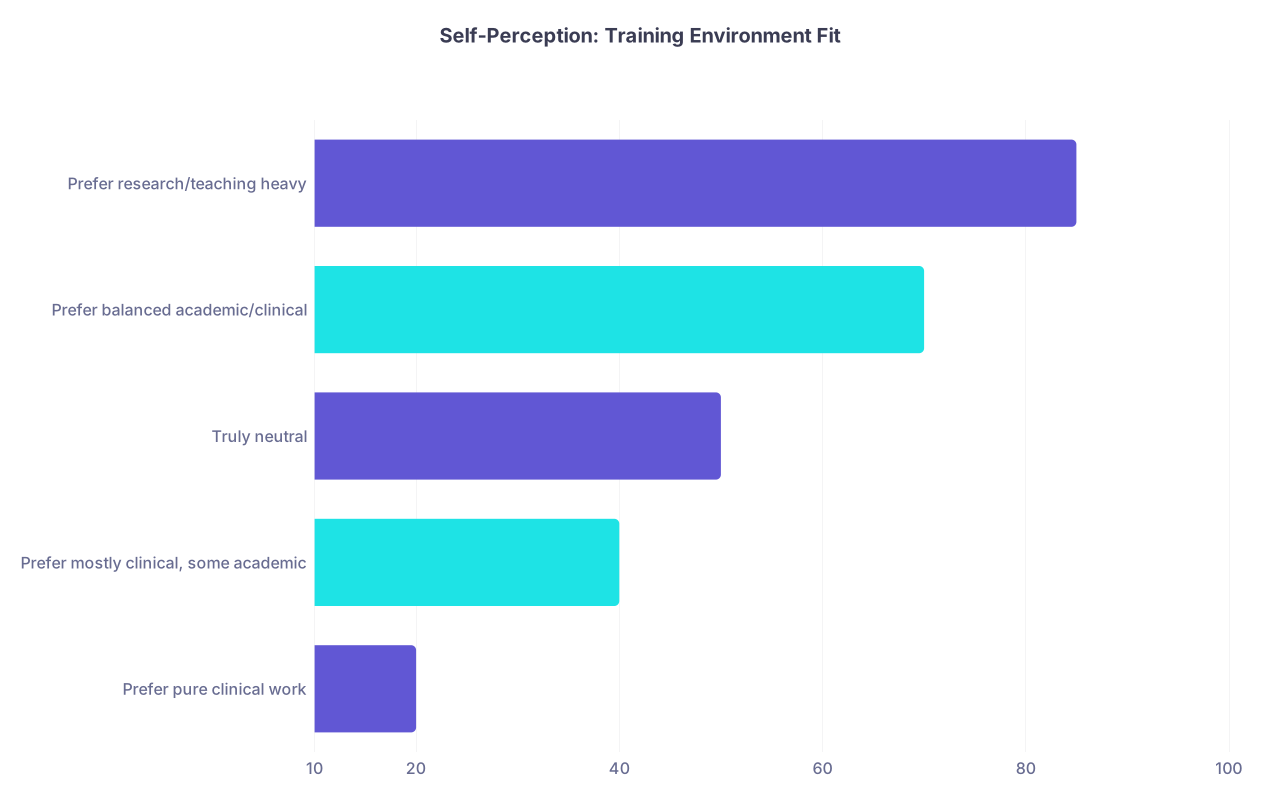
| Category | Value |
|---|---|
| Prefer pure clinical work | 20 |
| Prefer mostly clinical, some academic | 40 |
| Truly neutral | 50 |
| Prefer balanced academic/clinical | 70 |
| Prefer research/teaching heavy | 85 |
Where do you actually sit—not where you think you “should” be?
3. Apply broadly to both types if you’re not sure
You’re not signing a contract with your ERAS filter.
For someone undecided, I like a mix like:
- 40–60% community-leaning programs
- 40–60% academic-leaning programs
weighted by geography and competitiveness.
4. On interview day, ask targeted, uncomfortable questions
Things like:
- “What percentage of your graduates go into fellowship vs community practice?”
- “How often are conferences cancelled due to clinical demands?”
- “Who actually does most of the procedures—residents, fellows, or attendings?”
- “How early do you feel comfortable letting interns manage their own patients?”
Then compare what residents say in the lounge to what PDs say in the official session. That discrepancy tells you more than any website.
Example Profiles: Who Fits Where
To make this concrete, here are typical “fits” I’ve seen.
Likely Better Suited for Academic Training
- You were the M4 who:
- Led small group teaching for M1s.
- Volunteered for QI projects.
- Actually read the primary literature after major trials.
- You’re considering:
- Cardiology, GI, heme/onc, neuro subspecialties, academic EM, academic surgery.
- You don’t mind:
- Regular conferences, education requirements, committee work.
- You do mind:
- Being somewhere with no students or fellows, where everyone just “gets the work done and goes home.”
Likely Better Suited for Community Training
- You were the M4 who:
- Loved busy ED shifts or wards where you saw a ton of patients.
- Felt annoyed when long lectures cut into your clinical time.
- Preferred direct feedback from one attending over big formal teaching sessions.
- You’re considering:
- Community internal medicine, FM, EM, surgery, hospitalist work, or outpatient-focused careers.
- You don’t mind:
- High patient volume and being the primary decision maker.
- You do mind:
- Endless meetings, institutional politics, feeling like a tiny cog in a huge academic machine.
Reality Check: Common Myths You Should Ignore
Let’s quickly kill a few bad ideas.
“Academic programs are always better.”
No. They’re just louder on social media and more represented in conferences. Plenty of community-trained physicians are better clinicians and happier humans.“You can’t match good fellowships from community.”
False. You can, but you need:- Strong mentorship
- Solid letters
- Some scholarly activity
That depends on the specific program, not the label.
“Community programs don’t teach.”
Wrong. Some community programs have outstanding teaching cultures precisely because residents are the engine of care. Some academic programs neglect teaching because everyone’s chasing grants. You have to assess individually.
Quick Comparison: What Your Week Might Look Like
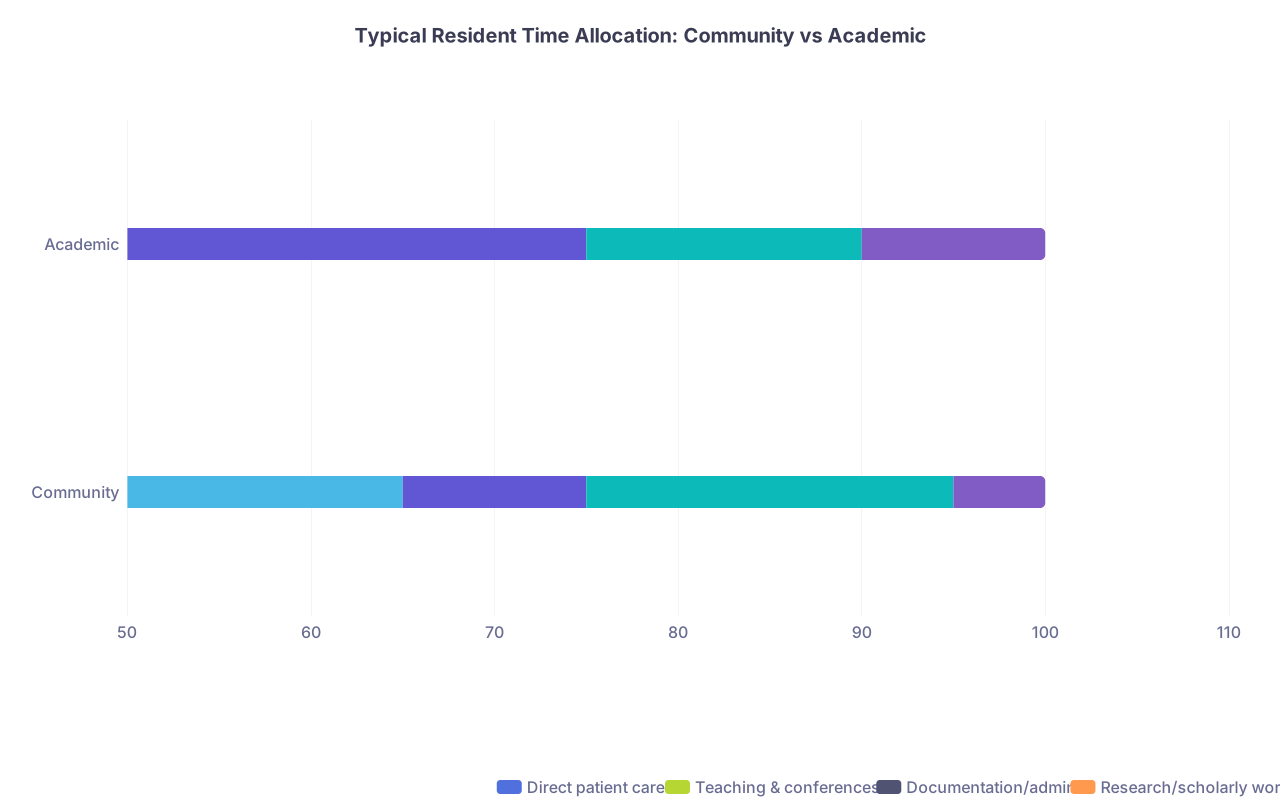
| Category | Direct patient care | Teaching & conferences | Documentation/admin | Research/scholarly work |
|---|---|---|---|---|
| Community | 65 | 10 | 20 | 5 |
| Academic | 50 | 25 | 15 | 10 |
These aren’t exact numbers, but they’re directionally true. If the academic bar looks appealing, that’s your answer. If the community bar does, that’s your answer.
Putting It All Together on Your Rank List
Final step: you’ve interviewed, you’ve seen both worlds. Now what?
Use a simple scoring system (yes, literally):
| Factor | Weight (1-5) | Program A Score (1-5) | Program B Score (1-5) |
|---|---|---|---|
| Match to career goals | |||
| Teaching quality | |||
| Clinical volume/autonomy | |||
| Research opportunities | |||
| Culture and support |
You can adjust this for:
- Community-leaning priorities (increase weight for autonomy, clinical volume).
- Academic-leaning priorities (increase weight for research, teaching, fellowship outcomes).
Do the math, then listen to your gut. If they disagree, ask yourself why. That “why” is usually your real answer.
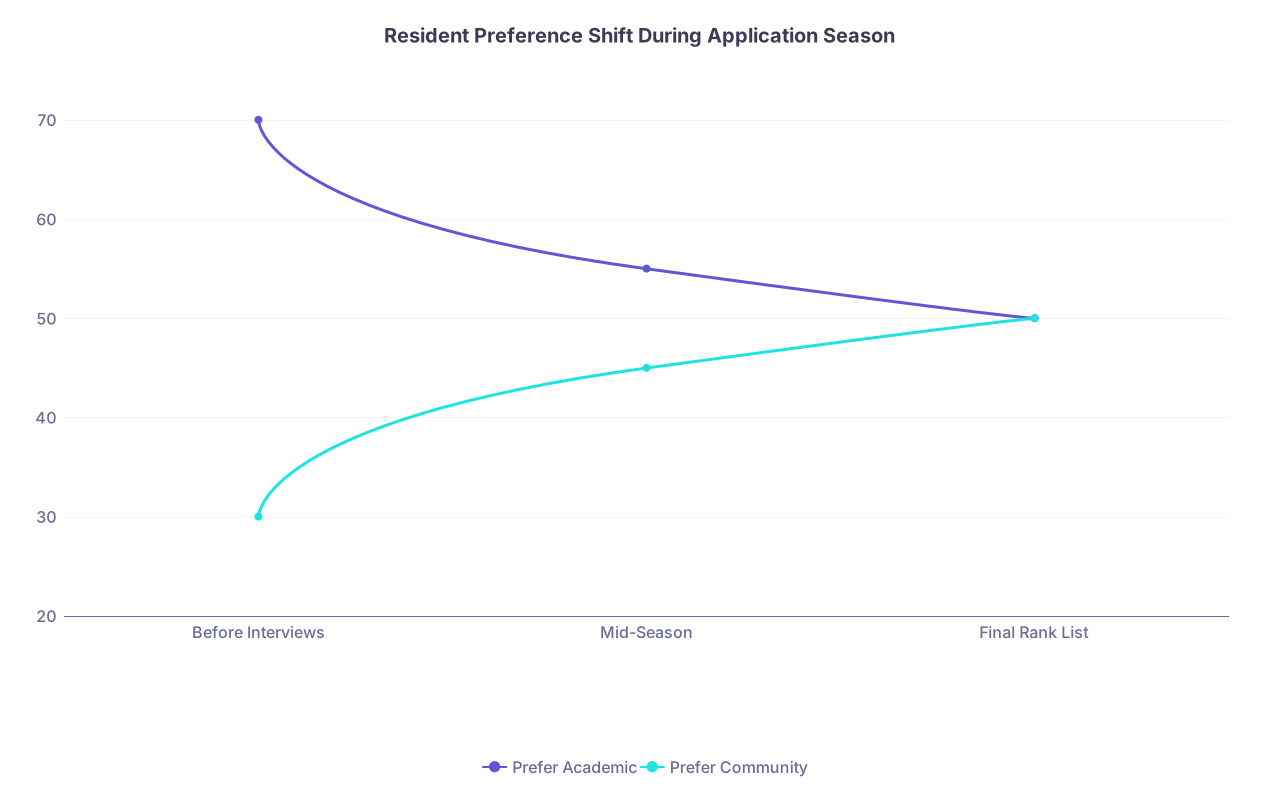
| Category | Prefer Academic | Prefer Community |
|---|---|---|
| Before Interviews | 70 | 30 |
| Mid-Season | 55 | 45 |
| Final Rank List | 50 | 50 |
People change their minds as they see real programs, not just labels. You’re allowed to do the same.
FAQ: Community vs Academic Residency Training
1. Can I start in community and move into academic medicine later?
Yes, but you’ll need to build an academic profile: teaching experience, QI or research, maybe an academic-leaning fellowship. Plenty of hospitalists and specialists at academic centers trained in community programs, then added fellowships and projects along the way. Program reputation matters less than your individual track record.
2. Is it harder to get a competitive fellowship from a community program?
Often, yes—but not impossible. It’s harder if:
- The program rarely sends people to that fellowship.
- There’s minimal research or mentorship.
Look at actual fellowship match lists, not just what the PD says. If your target field isn’t represented, you’re pushing uphill from that program.
3. Do community programs really give more autonomy?
In many cases, yes. You’ll often be the primary decision-maker earlier, especially on nights and in smaller hospitals. The flip side is less buffer—fewer fellows and residents above you. You have to be comfortable owning decisions and calling for help early when needed.
4. Are academic programs always busier or more malignant?
No. Some academic programs are very humane and resident-centered. Some community programs are absolute grindhouses with brutal volume and no support. “Academic vs community” doesn’t predict malignancy; leadership and culture do. That’s why talking to current residents is non-negotiable.
5. If I hate research, should I avoid all academic programs?
Not necessarily. There are academic programs where research is available, not demanded. But if every faculty member talks about grants, labs, and R01s, and residents all have multiple publications, you’ll stand out—in a bad way—if you refuse to engage at all. Aim for a clinically heavy academic program or a hybrid community-affiliated academic center.
6. Will being at a community program hurt my chances if I want to teach later?
No. Many community-trained physicians teach students and residents at community-based medical schools or as volunteer faculty. If you enjoy teaching and seek out opportunities, you can absolutely build an educator career without pure academic residency training. You might just need to be more intentional about seeking roles.
7. I’m truly 50/50—what should I do?
Then apply to both. On interview days, pay attention to how you feel at each place: Do you light up hearing about research resources or about autonomy and high patient volume? After interviews, ask yourself: “If I matched here tomorrow, would I be relieved or disappointed?” Your emotional reaction is often more accurate than your spreadsheet.
Key takeaways:
- Match your training environment to your career goals and your temperament—clinical volume vs academic structure is the real divide.
- Ignore the label and interrogate reality: culture, autonomy, teaching, research, and fellowship outcomes at each specific program matter more than “community” or “academic.”