You’re PGY-0. It’s August–September. You’re staring at ERAS, trying to build a program list, and this thought will not leave your head:
“I’m good with patients. My evals say I’m one of the strongest clinicians in the class. But my research is… meh. One poster. No pubs. One half-finished QI project. Do I even have a shot at academic programs? Or should I lean hard into community?”
This is exactly the tension: strong clinician, weak researcher, and now you have to choose what kind of residency environment you’re aiming at — community vs academic, and all the hybrids in between.
Let’s sort this out in a way that actually helps you pick programs, not just “understand the differences.”
1. Be Honest About Your Profile (and Your Story)
First move: get brutally clear about what you’re bringing to the table. Not your fantasy version. The real one.
Here’s what “strong clinician, weak researcher” usually looks like on paper:
- Clerkship evals: “Excellent bedside manner,” “Reliable, takes ownership,” “Thinks clinically beyond their level.”
- Shelf/Step: Anywhere from average to strong. Maybe one weak score but overall competent.
- Research:
- 0–1 posters, maybe at a school/local conference
- No first-author pub, possibly no pubs at all
- Nothing that screams “future physician-scientist”
And inside your head, one of these is true:
- You do not like research. You’d rather see patients, be on the wards, do procedures, and go home.
- You’re neutral on research. You’ll do it if needed, but it’s not your identity.
- You’ve had bad mentorship or circumstances. You might like research, but you’ve never really had a shot.
Those 3 scenarios matter more than your CV line count. Because they determine what settings will actually fit you.
Let me be blunt:
- If #1 is you (you actively dislike research), a hardcore academic powerhouse will grate on you. You can match there, but you’ll be swimming against the current every year.
- If #2 is you (neutral), you have a lot of flexibility. You can exist happily in many “academic-community hybrid” programs that care more about patients than PubMed.
- If #3 is you (bad circumstances), then you want optionality: a place where you can build research skills if you decide to, but not get crushed for being late to the party.
Keep that in mind as we walk through the types of programs you’re choosing between.
2. Know What “Academic” vs “Community” Actually Means
People throw these words around like they’re binary. They’re not.
There’s a spectrum:
| Program Type | Research Pressure | Clinical Autonomy | Brand/Name Power |
|---|---|---|---|
| Pure Academic Powerhouse | Very High | Variable | Very High |
| Academic-Community Hybrid | Moderate | High | Moderate-High |
| Large Community with University Tie | Low-Moderate | High | Moderate |
| Pure Community Hospital | Low | High | Low-Moderate |
Pure academic powerhouse
Think: MGH, Hopkins, UCSF, Brigham, Michigan, Penn, Duke.
What it feels like on the inside:
- Constant talk about grants, K awards, R01s, “productive mentors,” “protected time.”
- Residents with >5 pubs, first-author in good journals, often with research years.
- Unspoken (sometimes spoken) message: The best residents go into academia.
If your research is weak, but your scores and letters are strong, you can still apply. But understand the fit: if you go there, you’ll be expected to become more “researchy” whether you like it or not.
Academic-community hybrid
Think: university-affiliated but not top-10, or strong regional programs.
Examples (varies by specialty and region):
University of Colorado community affiliates, UMass, Oregon Health & Science’s community partners, strong university-associated community hospitals.
On the inside:
- Research is present, but not the oxygen of the program.
- A few faculty are research-heavy, the majority are clinically focused.
- Residents match into fellowships but also into hospitalist and community jobs.
This is the sweet spot for many “strong clinician, weak researcher” applicants who still want options.
Large community with university tie
These are places that:
- Have a university name somewhere on the badge.
- May send a few residents to fellowships every year.
- Have some QI / basic research, but it’s not required for survival.
If your main goal is: “Become a superb clinician and maybe do a fellowship, but I’m not trying to be faculty at Harvard,” these programs are often ideal.
Pure community programs
No med school attached. Sometimes smaller. Sometimes very busy.
Inside:
- Heavy clinical work, often high autonomy.
- Minimal structured research infrastructure.
- QI and case reports exist, but you hustle for them; no one is handing you NIH-funded projects.
If you hate research, or you know you want to be a bread-and-butter clinician in a community setting, this is not “settling.” It’s alignment.
3. Figure Out Where You Actually Want to End Up
Before you pick programs, pick a direction.
Ask yourself, and answer honestly:
In 10 years, do I picture myself:
- Seeing a full panel of patients in a clinic or hospitalist role?
- On faculty at a university, giving talks, doing studies?
- In private practice focusing on procedures and income?
- In a subspecialty fellowship where research may or may not matter?
Is there any part of me that wants:
- To teach med students and residents?
- To be known as “that person who runs X clinic” more than “that person on PubMed”?
- To have academic titles (Assistant Professor) even if I’m not a big researcher?
You don’t need a detailed 20-year plan. But you do need directionally:
- “I want academic options and maybe a fellowship at a decent place.”
- vs.
- “I want solid training and a good job; research is not my path.”
Because your program type will either open or close certain doors.
4. How Research-Weak Clinicians Should Think About Each Path
Let’s get specific: here’s how I’d advise you depending on your goals and your actual CV.
Scenario A: You’re clinically strong, research weak, but want competitive fellowship
Say you’re applying IM or Peds, you want cards, GI, heme/onc, etc.
You cannot completely ignore research. But you also don’t need to fake being a lab rat.
What to do:
Prioritize academic-community hybrids or strong university-affiliated community programs where:
- Many residents match into fellowships.
- Research is available but not mandatory to breathe.
- There are known fellowship “pipelines.”
De-emphasize:
- Ultra-small community programs that send almost no one to competitive fellowships.
- Places where the website shows zero scholarly activity.
You’re betting that during residency you can:
- Pick up 1–3 moderate research or QI projects.
- Get on 1–2 pubs or meaningful abstracts.
- Combine that with strong clinical letters and solid in-training exam performance.
That is realistic at a hybrid program. It’s much harder at a tiny pure community program with no infrastructure.
Scenario B: You’re clinically strong, research weak, and want to be a community clinician
Family med, IM, EM, surgery, etc., with the goal of a good job, decent lifestyle, and maybe teaching a bit.
You do not need a heavy academic center.
Your best fit:
- Large community or academic-community hybrids where:
- Residents graduate feeling comfortable and autonomous.
- Faculty rave about the clinical volume and hands-on experiences.
- Research is optional and mostly QI/case series.
You can happily skip:
- Places where half the interview day is about T32 grants and NIH funding.
- Programs that subtly (or openly) look down on community practice.
You’re not worse than anyone. You’re just choosing to train where the skill you value — clinical care — is the main currency.
Scenario C: You’re clinically strong, research weak, but secretly curious about academia
This is the “late bloomer” group.
Maybe you had bad mentorship, a weak research environment, or life stuff. You’re not anti-research. You just haven’t been in the right room yet.
For you, the main thing is: keep doors open without making yourself miserable.
Your best play:
- Aim for programs where:
- There is legit research happening (not just one random poster a year).
- They don’t screen out applicants with low research output.
- You see residents with your kind of profile (strong clinically, not pre-loaded with 20 pubs) who still matched into fellowships or junior faculty roles.
You can apply to some pure academics as reaches. Just do not build a list entirely of places that would rather you be a post-doc than a resident.
5. How to Read Between the Lines on Program Websites
This is where most applicants fail. They skim websites and think, “Looks nice.” That’s not enough.
You’re trying to answer one question:
“Does this place want someone like me — strong clinician, low research — and will I thrive here?”
Look for these clues.
Red flags for research-heavy programs (if that’s not you)
- Mission statement full of words like “innovative research,” “investigator,” “scholarship” but very little about “clinical excellence.”
- Every resident bio: “I love translational research in…”, “I completed an MPH/PhD…”
- PD letter or video: more talk about publications than patient care.
You walk into that environment, and you’re starting in a cultural deficit. They won’t say it out loud, but you’ll feel it.
Green flags for clinically-oriented but still solid programs
- Website explicitly says some version of:
- “Our primary focus is training excellent clinicians.”
- “We value education, patient care, and resident wellness.”
- Resident bios that show:
- Some research, yes, but also primary interests in teaching, QI, global health, leadership, advocacy.
- Fellowship match lists with:
- A mix of academic fellowships and strong community jobs.
- Not just “Top-5 program or bust.”
If you see multiple residents with weak pre-residency research who now have decent scholarly output → that’s a good sign the program will help you grow instead of judging you for where you started.
6. How to Present Yourself in Your Application
You cannot change your past research volume in September. But you can frame your story correctly.
You’re not “weak researcher.” You’re “clinically anchored.”
In your personal statement
Do not whine about research. Don’t rant: “I hate research.” Bad look.
Instead, emphasize:
- Concrete clinical moments that shaped you:
- “I was the only student who sat with the COPD patient at 2 am.”
- “My attending said, ‘You think like a resident already.’”
- Your pattern of ownership:
- “I called families, followed up on tests, and was the person the intern could trust.”
- If asked about research, frame it as:
- “I’ve had limited exposure, but when I was involved in [project], I realized I enjoyed asking practical questions that improve care.”
You’re selling: reliability, patient-centeredness, teachability.
In your ERAS experiences
Don’t bury your strengths under generic text.
For your best clinical experiences (sub-I, acting internship, key clerkship):
- Be specific:
- “Managed daily care plans for 8–10 medicine patients with the intern.”
- “Led goals-of-care discussions under supervision.”
- “Created a handoff template that was adopted by the team.”
For your minimal research:
- List it honestly. Don’t oversell.
- “Assisted with data collection and basic literature review for a QI project on [topic].”
That’s it. You’re not here to pretend to be a budding NIH scholar.
In interviews
When they ask about research:
If you’re neutral/curious:
- “Most of my exposure has been limited, but I enjoyed the parts that directly impacted patient care, like QI. I’d be interested in building more experience if the right mentorship is there.”
If you really don’t like it but are trying to be professional:
- “My passion has always been bedside medicine and teaching. I see research more as a tool — for example, QI or outcomes projects — that can make us better clinicians. I don’t see myself in a lab, but I’d engage with meaningful projects that influence how we care for patients.”
You’re telling them: I’m not a research headache, but I’m also not signing up to live in Excel.
7. Building Your Program List: A Practical Breakdown
You want something actionable. Here it is.
Let’s say you’re applying to a moderately competitive specialty (IM, Peds, FM, EM, Psych) with:
- Solid but not insane board scores.
- Strong clinical letters.
- Weak research.
A reasonable distribution:
- 10–20%: Reach academic programs (if you want some shot at them).
- 40–60%: Academic-community hybrids / strong university-affiliated community.
- 20–40%: Solid community programs with good clinical volume.
If your Step scores or class rank are on the lower side, shift more towards hybrids and community.
If you know you want community practice: you can make 60–70% of your list community or hybrid and sprinkle in a few academics for optionality.
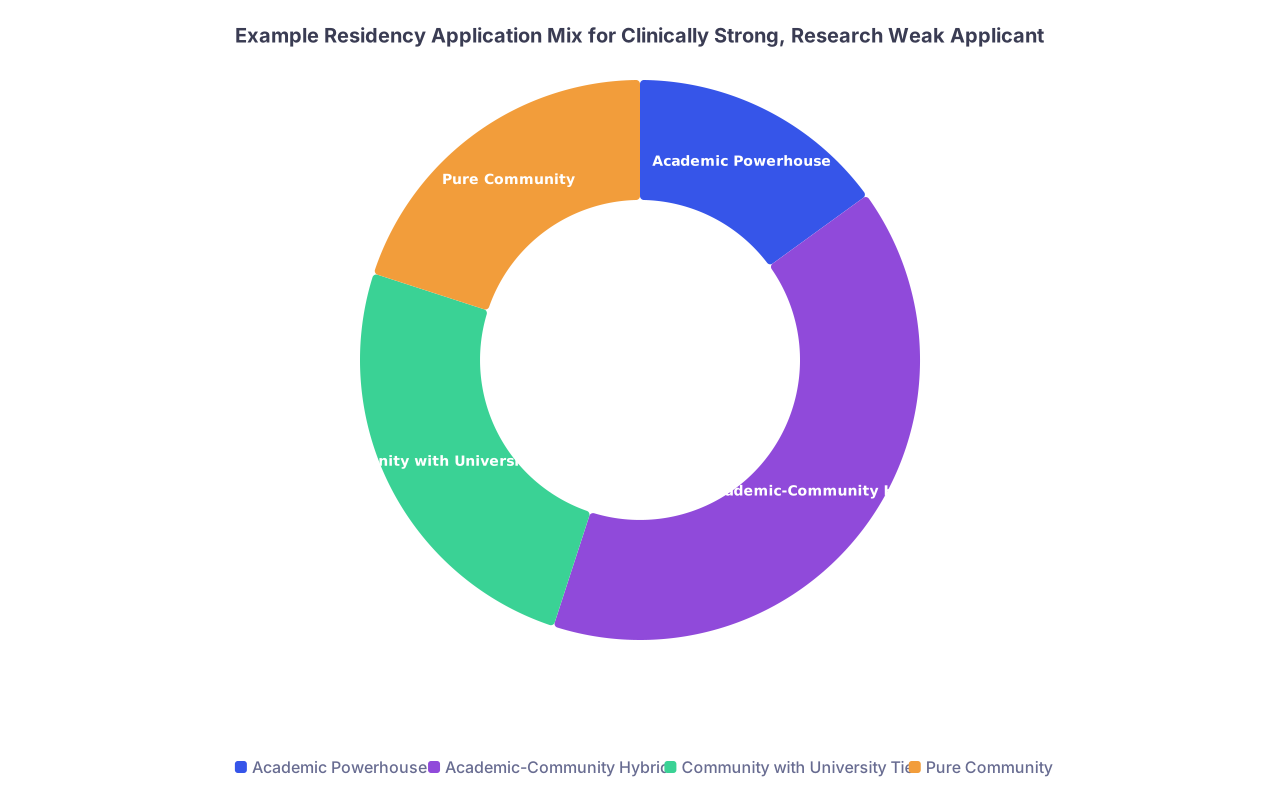
| Category | Value |
|---|---|
| Academic Powerhouse | 15 |
| Academic-Community Hybrid | 40 |
| Community with University Tie | 25 |
| Pure Community | 20 |
8. Questions You Should Ask on Interview Day
Use interview day to verify: “Is this place going to respect my strengths or punish me for not being a researcher?”
Here’s what to ask residents and faculty.
To residents:
- “How many residents here are really research-focused vs clinically focused?”
- “If someone comes in without much research, do they still match well into fellowships or jobs?”
- “How does the program support residents who don’t want an academic career?”
To PDs/faculty:
- “How do you see the balance between clinical training and research in this program?”
- “If a resident is a strong clinician but not excited by research, how can they still be successful here?”
- “Can you share examples of alumni who are thriving in community or primarily clinical roles?”
Watch how they answer:
- If they get awkward or dismissive about non-research tracks → they aren’t your people.
- If they can name several alumni who are thriving clinically and seem proud of them → they value what you bring.
9. Hidden Pitfalls You Want to Avoid
I’ve watched applicants fall into the same traps year after year.
Trap 1: Applying almost exclusively to big-name academic programs “just to see”
If your research is thin, and your application doesn’t scream “academic star,” weighting your list too heavily towards top-10 places is how you end up with 3 interviews and a terrifying January.
You’re not obligated to aim only at prestige. Aim at fit.
Trap 2: Overcorrecting and applying only to tiny community programs
You panic about being research-weak, assume academics won’t want you, and send 80 applications to small community programs with little track record of fellowships or strong outcomes.
Then in PGY-2, you suddenly want cards, and you realize your program has almost no one in that pipeline.
Keep some range in your list unless you’re absolutely certain.
Trap 3: Telling programs “I hate research” on interview day
They hear: “I’m inflexible and will complain about any scholarly requirement.”
You can be honest about your preferences without setting yourself on fire. Use language like “clinically focused,” “patient care centered,” “interested in QI and outcomes” instead of “research is useless.”
10. What This Looks Like in Real Life: Two Quick Examples
Example 1: The IM applicant who wanted cards but had no pubs
- Step 2: 240s.
- Research: One poster, no papers.
- Strengths: Glowing clinical letters, top comments: “natural on the wards.”
If he’d only applied to big-name academics, he’d probably have been screened out at many.
Instead:
- Applied to a mix: mid-tier academic IM programs, strong community/university-affiliated, and a handful of pure community.
- Matched at a solid academic-community hybrid.
- During residency, got on 2 clinical research projects, 1 QI, ended up with 2 pubs and a couple of abstracts.
- Matched into a good cardiology fellowship at a regional academic center.
He used residency to “catch up” in research without needing to pretend he’d always been a researcher.
Example 2: The FM applicant who truly hated research
- Strong in clinic, loved continuity, loved OB and procedures.
- Absolutely no interest in writing papers, ever.
- Tried a research project in med school, hated every minute.
She:
- Focused her list on community FM programs and some university-affiliated but clinically heavy FM residencies.
- Picked a program where everyone talked about OB numbers, procedure logs, and community outreach, not publications.
- Now runs a busy community FM practice with OB and is faculty at a community-based residency. Zero pressure to produce RCTs.
If she’d gone to a research-obsessed FM program, she would’ve spent three years feeling like the “non-serious” resident. Instead, she matched environment to identity.
11. One Concrete Step To Take Today
Do this today, not “later.”
Open a blank page and create three columns:
- Column 1: “I want mostly this” – Clinical vs academic balance in 10 words or less.
- Column 2: “My actual profile” – Boards, research volume, key strengths in brutal honesty.
- Column 3: “Program types that fit” – Pick from: pure academic, hybrid, large community with tie, pure community.
Then:
Pick 5 programs of each type you’re considering and spend 5–10 minutes on each website. For every program, answer:
- How do they talk about research vs clinical care?
- Do residents look like me?
- Where do their grads go?
If the answers don’t match your three columns, cross it off.
Do not open ERAS again until you’ve done that exercise. It’ll save you from blind, prestige-driven clicking and push you toward programs where your strength — being a strong clinician — actually matters.