What do you actually do when you’re a PGY-2 in a big-name academic program, everyone assumes you’re “going for fellowship,” but you’re quietly sure you want a normal community job and have no idea how to get there without tanking your reputation?
Let’s walk through that exact situation. Because it’s more common than anyone admits on morning rounds.
You matched into the flashy academic program. NIH funding. Subspecialty clinics for everything. Every other attending talks about trials, R01s, and “where you’re thinking of doing fellowship.” At some point, you realized: that’s not you. You want to see patients, have a life, maybe live near family, and not spend your 30s chasing publications you do not care about.
You’re not stuck. But you do need a plan.
Step 1: Get brutally clear on what you actually want
Before you tell anyone anything, you need a specific picture of your end game. “Community practice” is too vague. I’ve watched residents blow up conversations with attendings because they walked in with, “I think I maybe kind of want community?” and walked out more confused.
Spell it out:
- Outpatient only? Inpatient + outpatient mix? Pure hospitalist?
- Size of hospital/health system: small community, regional center, big private system?
- Location priorities: near family, specific state, cost of living, school systems, etc.
- Lifestyle: shifts vs continuity clinic, call vs no call, nights vs no nights.
- Money vs time: Would you trade $40–60k/year for fewer nights/weekends?
Even roughly.
This matters because academic mentors will ask. And the ones who can actually help you need to understand what you’re trying to build, not just what you’re running away from.
If you’re really early (PGY-1), you don’t have to have a perfect answer, but at least be able to say something like: “I’m leaning toward outpatient general cardiology in a mid-sized community hospital in the Midwest, ideally with a sane call schedule.”
This is also when you realize: you do not have to finish residency in an academic program to end up in community. Most of the time, staying put is fine and may even help your marketability. The pivot is about direction, not necessarily changing residencies.
Step 2: Understand how community vs academic looks from the employer side
You’re used to seeing things from the residency bubble. Community groups see you very differently.
Quick reality snapshot:
| Factor | Academic Center Focus | Community Group Focus |
|---|---|---|
| CV | Publications, pedigree | Work ethic, fit, references |
| Skills | Niche procedures, research | Bread-and-butter competence |
| Teaching | Required/valued heavily | Optional, occasional |
| Productivity | Balanced with academics | Central to job stability |
| Prestige | Program name matters | Reputation of *you* locally |
Community groups are not impressed that you rounded with “big names” if you can’t efficiently manage a service, dictate notes that don’t suck, and communicate well with nurses and families. They care about reliability, not h-index.
So your “pivot” is literally:
- Do great clinical work where you are.
- Translate your academic baggage into something community people actually value.
- Start building a different set of connections.
Step 3: Decide what you’re not going to do anymore
This is where you reclaim your time and realign your signaling.
Look at your current situation:
- Are you embedded in a research project you hate?
- On a “scholarly track” you never asked for?
- Being pushed to apply for a fellowship you don’t want?
You don’t have to burn it all down, but you do need to quietly stop feeding parts of the machine that drag you in the wrong direction.
For example:
- Finish what you’ve started (papers, QI projects) if they’re near completion, because burning bridges is dumb.
- Stop saying yes to new academic projects that don’t help your community goals.
- Drop leadership roles that are prestige-only and time-sinks, especially if they’re academic-career signaling (e.g., “Research Chief” when you want community outpatient).
Then redirect that time into:
- Extra elective time in community-oriented rotations (if available).
- Moonlighting in community hospitals (huge for skill-building and contacts).
- Learning high-yield, bread-and-butter skills: efficient admits, safe discharges, managing common primary care issues or standard inpatient problems.
Step 4: Have “the conversation” with the right people (and skip the wrong ones)
You don’t need to make a residency-wide announcement that you’re not doing fellowship. In fact, please do not.
But you do need 2–3 people in your corner who understand where you’re headed.
Who to talk to:
- A program director or associate PD who is known to be reasonable and non-judgmental.
- A community-oriented faculty member (often the one who did community then came back to academia).
- If your specialty has a known “job placement” person or chief who actually cares about real-world jobs, use them.
How to frame it:
You are not “dropping out of academics” or “settling.” You’re choosing a different endpoint.
Something like:
“I’ve spent the last year really thinking about what I want my career to look like. I’m leaning solidly toward community practice rather than an academic or research career. I want to optimize my remaining residency time so I’m as clinically strong and employable as possible for that path. I’d appreciate your advice on electives, networking, and potential employers.”
That’s it. Clear. Adult. Future-focused.
What not to do:
- Do not go in hot complaining about how much you hate research or conference.
- Do not make it sound like you think community is “easier” or a backup.
- Do not trash talk fellowship or specific faculty.
You want your PD thinking, “This resident is mature, knows what they want, and will represent our program well in the community,” not, “Here’s another burned-out PGY-2 ranting about work-life balance.”
Step 5: Rebuild your “brand” inside your academic program
Yes, you have a brand. Even if no one said it out loud.
In academic programs, residents get mental labels:
- “Future cardiologist, research type”
- “Solid clinician, not academic”
- “Quiet but reliable”
- “Barely hanging on”
You want to shift your label to something like: “Very strong clinician, excellent with patients and staff, will be great in community.”
How?
Clinical excellence with efficiency. Academic centers tolerate slower workflows because of teaching and complexity. Community does not. Use senior years to:
- Tighten your notes: focused, organized, not five pages of fluff.
- Learn to run a list smoothly, anticipate discharges, avoid pointless delays.
- Get comfortable making decisions without three subspecialty consults on speed dial.
Be visibly good to work with.
- Nurses: be responsive, respectful, and consistent. Word spreads. I’ve literally seen community job offers come through nurses’ cousins and friends.
- Consultants: be clear, concise, and not helpless.
Teaching—but the right kind.
- You don’t need to be a chalkboard superstar.
- You do want people saying: “When they’re on, the team runs well and students learn how to manage real patients.”
Your PD will happily vouch for you to community groups if they’re proud of you as a clinician, even if you didn’t publish a thing.
Step 6: Build actual community exposure before graduation
Here’s where most academic residents screw up: they decide “community” in PGY-3 March, then frantically email recruiters with zero real-world community exposure. That’s late.
Start earlier if you can (mid-PGY-2 is ideal).
Ways to get community exposure while still in residency:
Community electives
If your program has affiliations with community hospitals or clinics, take them. And on those rotations:- Show up as if every attending is a future employer—which they might be.
- Ask questions about how jobs actually work: compensation models, call structures, patient mix.
- Stay in touch after the rotation (one email every few months is plenty).
Moonlighting
If allowed by your program and you’re ready skill-wise, community moonlighting is gold:- You learn how smaller hospitals actually function.
- You see what it’s like without 24/7 subspecialty backup.
- You meet hospitalists, ED docs, and administrators who hire.
Rural/critical access stints
Even short exposures (2–4 weeks) teach you how to manage without constant CT surgery down the hall. Good for your confidence and your CV.
Step 7: Start the job hunt like a professional, not a panicked resident
Community job searches are faster and messier than fellowship applications. You’re dealing with:
- Recruiters (some helpful, some useless)
- Hospital-employed groups
- Private practices
- Mega-systems with 20 open positions
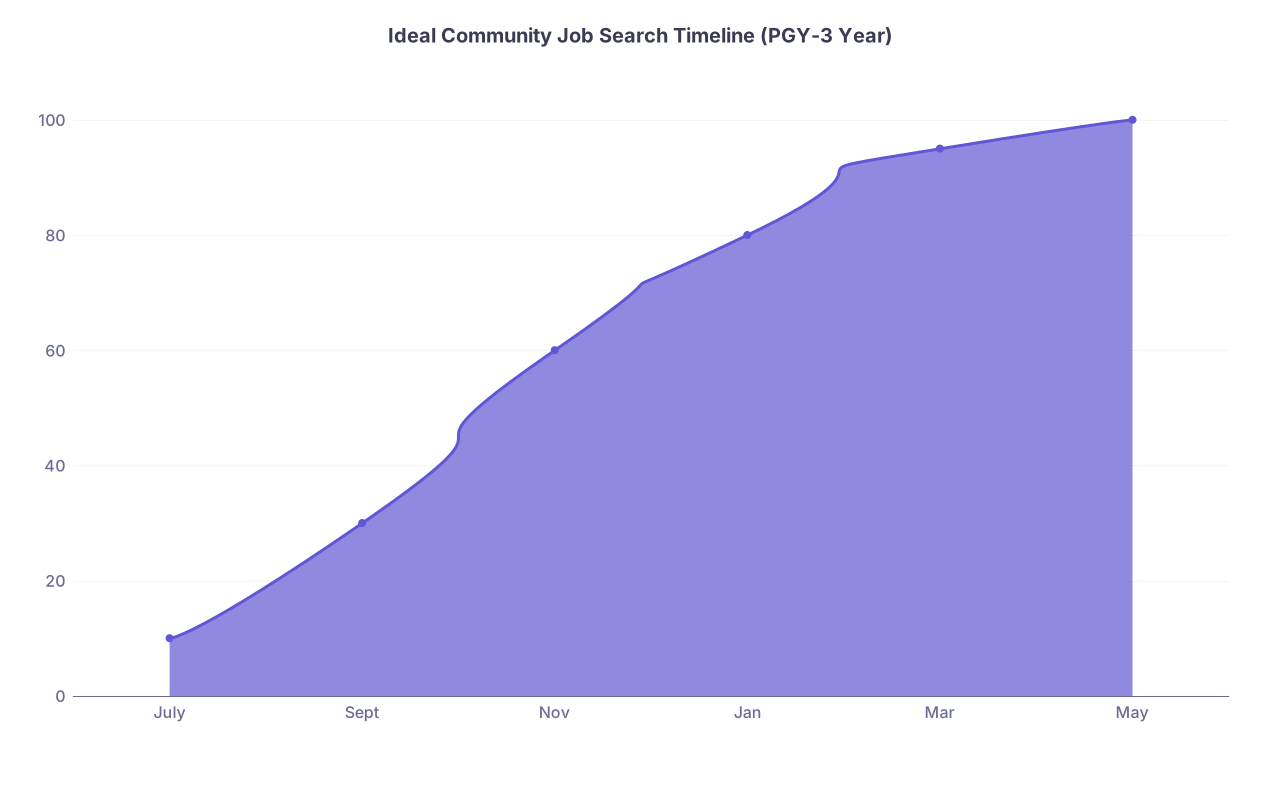
Rough timeline if you’re finishing residency in June:
| Category | Value |
|---|---|
| July | 10 |
| Sept | 30 |
| Nov | 60 |
| Jan | 80 |
| Mar | 95 |
| May | 100 |
(Think of the values as “percent of job search work completed.” By January, you should be ~80% done.)
Concrete plan:
July–September (PGY-3, or last year):
Decide on geography. Get your CV in shape. Quietly tell mentors you’re job-hunting for community positions.September–November:
Start contacting:- Hospital systems in your target region (website job portals + physician recruiter emails).
- Groups where former residents work (ask your seniors where they went).
- The community attendings you’ve rotated with.
November–January:
Site visits, interviews, second looks. Compare offers realistically—do not just chase raw salary. Look carefully at call, staffing, support, RVU demands.January–March:
Negotiate contracts, sign, start credentialing and licensing if moving states.
Yes, you can get a job if you start late. You’ll just have fewer choices and more pressure.
Step 8: Rewrite your academic CV for community eyes
Your current CV probably screams “applying for fellowship.”
Community employers want to see something simpler and more practical.
Restructure:
- Keep basic info: education, residency, medical school.
- Condense or demote research:
- One short section titled “Scholarly activity” with just major publications or posters.
- Delete 90% of the irrelevant stuff like “Journal club presentation, 2022.”
- Emphasize:
- Clinical strengths (ICU competent, high-volume general medicine, comfortable with X procedures).
- Leadership that actually means something in practice (chief resident, quality/safety roles).
- Teaching, framed as communication and collaboration.
Example pivot language:
Instead of:
“Primary investigator on prospective observational study of cytokine profiles in sepsis.”
Use:
“Participated in sepsis outcomes project; contributed to protocol development that reduced door-to-antibiotic times on medicine units.”
That reads as: “This person knows systems and outcomes,” not “This person wants R01s.”
Step 9: Manage the social/fellowship expectations pressure
The weirdest part of this pivot is social, not logistical.
You’ll get:
- Co-residents: “You’re not even applying for fellowship? Why not?” said with that slightly stunned, slightly judgey tone.
- Faculty: “You’re fellowship material; you’re selling yourself short.”
- Parents/in-laws: “But Dr. So-and-so did cardiology fellowship…”
Here’s the blunt truth: a decent community job as an attending will pay you more and often treat you better than three extra years of fellowship grind, if you actually don’t want subspecialty work.
You are not obligated to:
- Add 3+ years of training
- Move your family again
- Spend your 30s doing niche work you don’t enjoy
Just so other people can feel impressed.
Your stock answer can be:
“I seriously considered fellowship, but after doing more rotations and talking to people in both paths, community practice clearly fits my long-term priorities and the kind of medicine I actually enjoy. I’d rather be excellent at that than half-hearted about an academic or subspecialty path.”
Say it calmly. Then change the subject.
Step 10: Use your academic connections strategically—not resentfully
I’ve seen residents go full rebel: “Academia isn’t for me, so I’m just going to disengage and ignore these people.” That’s a mistake.
Your academic attendings:
- Know tons of people who left for community.
- Get recruitment emails constantly.
- Sit on hospital boards and in professional societies with community leaders.
Instead of treating them as the “other side,” use their reach.
Specific asks:
- “Do you know of any former residents who are in community in [state/region] I could talk to?”
- “Have you heard anything about [Hospital System X] as a place to work?”
- “Would you be comfortable serving as a reference and speaking to my clinical strengths?”
Most will be happy to help, as long as you haven’t spent two years eye-rolling at conferences and bailing on responsibilities.
Step 11: Check your skills against what community actually needs
You don’t want to be the academic-trained doc who shows up and can’t handle bread-and-butter problems without a consult army.
Ask yourself honestly:
Am I comfortable being the final answer on:
- Chest pain without immediate cardiology?
- Sepsis management from ED admit to ICU transfer?
- Common chronic diseases in outpatient (DM, HTN, COPD, depression)?
Do I know basic billing and coding structure, or am I clueless?
(You don’t have to be an expert, but some exposure helps.)Can I run a list or clinic day efficiently without constant hand-holding?
If you see big gaps:
- Use your remaining electives to plug them.
- Ask attendings to let you “run the show” more while they supervise.
- Find someone in a community-adjacent role to go over practicalities: discharge documentation, handoffs, follow-up planning that actually works in the real world.
Step 12: Make peace with leaving prestige on the table
This is the quiet piece no one talks about.
Walking away from big-name academic careers feels like “wasting your pedigree” to some people. Especially in places where everyone worships NIH funding and grand rounds invites.
Here’s my take, after watching this play out repeatedly: prestige doesn’t hug your kids goodnight, it doesn’t fix your back after another 28-hour call, and it doesn’t guarantee you enjoy the actual day-to-day of your job.
Community work is not “less than.” It’s just different:
- You’ll likely see higher patient volumes.
- You’ll be responsible for more decisions personally.
- You’ll have more autonomy in some ways and fewer toys in others.
- You’ll be closer to “normal people” medicine.
If that sounds like what you actually want, yes—pivot. Even if your program quietly (or not so quietly) values RCTs over RVUs.
Final sanity check: When not to pivot (yet)
You might think you want community, but be in a bad headspace right now:
- Burned out mid-year.
- Furious about one toxic attending or rotation.
- Exhausted from boards/family/personal stuff.
Don’t make a permanent career decision based on a temporary mess.
You might want to delay a hard pivot if:
- You’ve never actually spent time in a well-run community setting.
- You’re curious about fellowship but just scared of more training.
- You’re early PGY-1 and still figuring out which parts of medicine you genuinely like.
In those cases, the play is: get more data, not more drama. Do community electives, talk to fellows who are genuinely happy, shadow in a clinic you think you might enjoy. Then choose.
Key points to walk away with
- You can absolutely finish an academic residency and go straight into community practice; the pivot is about clarity, branding, and connections, not changing programs.
- Use your remaining residency time to become a strong, efficient clinician, get real community exposure (electives, moonlighting), and rebuild your CV and mentor network around your actual goals.
- Treat community practice as a deliberate, high-value choice—not a consolation prize—and talk about it that way with program leadership, colleagues, and future employers.