
The belief that “only academic residents match top-tier fellowships” is lazy, outdated, and flat‑out wrong.
The real pattern is harsher and more interesting: fellowships care much more about what you’ve done and who will vouch for you than about whether your residency hospital calls itself “academic” or “community.” The academic vs community label is a proxy. And like all proxies, it works until you actually look at the data.
Let’s break this myth with what actually shows up in track records and fellowship selection behavior.
What “Top-Tier Fellowship” Actually Means (And Why People Get This Wrong)
People throw around “top-tier” like it’s a Hogwarts house.
In practice, when residents say “top-tier fellowship,” they usually mean one or more of:
- Big-name NIH-heavy institutions (MGH, Brigham, UCSF, Hopkins, Penn, Duke, Stanford, etc.)
- Historically prestigious clinical fellowships with strong job placement and subspecialty reputations
- Programs that regularly place graduates into academic careers or competitive jobs (e.g., structural cardiology, complex IBD, advanced IBD, advanced endoscopy, critical care at marquee centers)
They do not mean: “ranked #23 vs #41 on some random US News list.” Fellowship directors aren’t that impressed by US News either.
Here’s the first uncomfortable truth: those “top” fellowships do take a lot of residents from big academic residencies. But that doesn’t mean they only take academic residents. It means the pipeline is skewed, not exclusive.
You’ve probably heard something like:
“If you’re not at a university program, forget MGH GI or BWH cards.”
I’ve heard this exact sentence in morning report. It sounds convincing—until you pull their alumni PDFs and read the fine print.
What Track Record Data Actually Shows
Let’s look at what’s visible in the wild: program websites, alumni lists, and published fellowship outcomes.
No, there isn’t a single unified national database that cleanly labels “community vs academic” and fellowship outcomes. But there are patterns you see over and over once you start actually looking instead of repeating gossip.
1. Community and hybrid programs do place people into big-name fellowships
Check the fellowship match pages of strong community or “hybrid” programs (community with strong academic ties). You’ll routinely see:
- Cardiology → Cleveland Clinic, Mayo, BWH, Duke
- GI → UCSF, Michigan, Penn, Mount Sinai
- Heme/Onc → MD Anderson, MSKCC, Dana-Farber
- Pulm/CC → Columbia, Northwestern, Stanford
Not 20 people a year. But consistently 1–3 a cycle from mid‑sized, non‑household-name residencies.
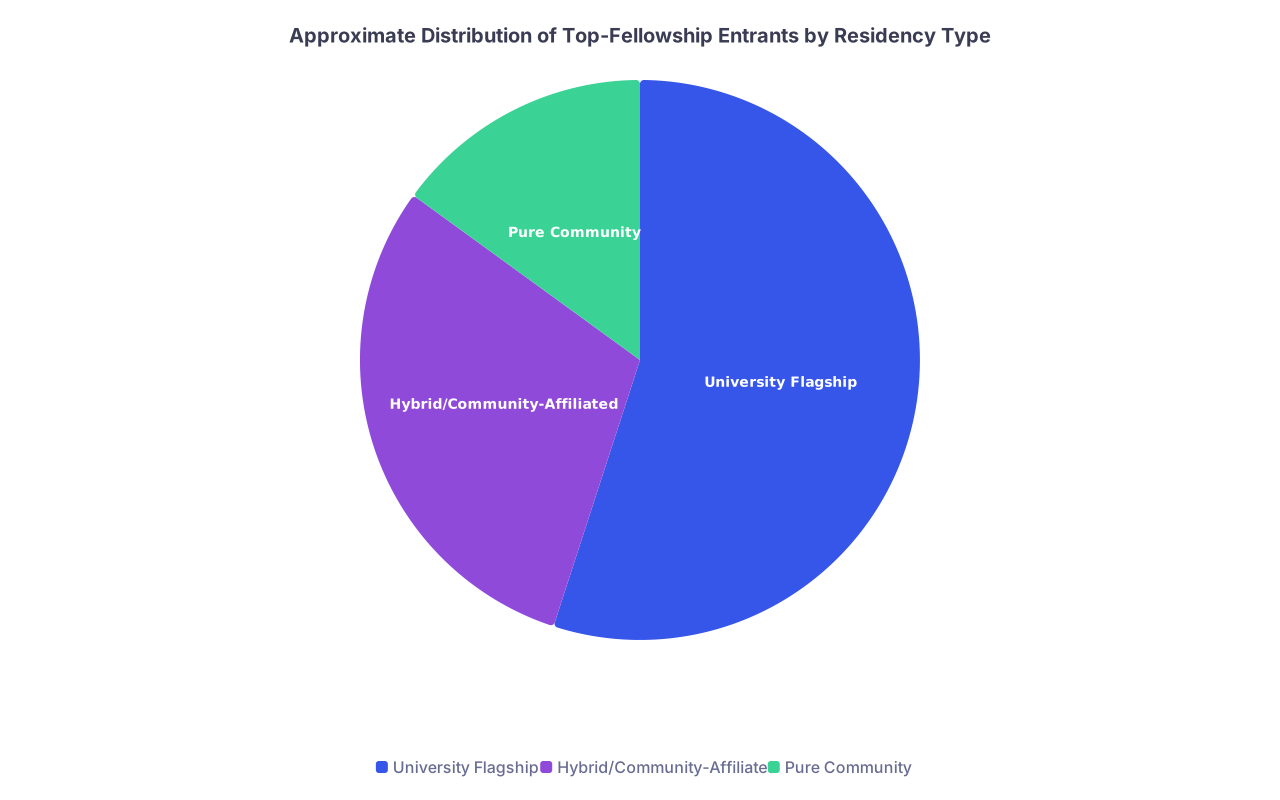
| Category | Value |
|---|---|
| University Flagship | 55 |
| Hybrid/Community-Affiliated | 30 |
| Pure Community | 15 |
That rough breakdown mirrors what program directors will quietly tell you: big university IM programs produce the majority, but a non-trivial portion of top spots come from community or hybrid residencies.
The myth says “0%.” Reality is more like 30–45% when you count hybrids and strong community affiliates.
2. Fellowship directors heavily favor known entities, not just “academic brands”
Here’s what actually moves the needle:
- Known letter writers with a track record of “when I say this resident is a star, they are”
- Prior trainees from your residency who did well at that fellowship
- Demonstrated scholarly output (not necessarily R01-level research; even solid QI/clinical projects)
- Performance in away rotations or virtual electives
- Your Step/Level scores only when used as a filter in extremely flooded applicant pools
If a fellowship has had three rock-star fellows from a community program in the last decade, they will happily take more. I’ve seen this with places like Mayo, Cleveland Clinic, and some UCSF and Michigan subspecialty services: they remember good past residents; they don’t care that the sending program is “community” on paper.
The Hidden Variable: “Community” Is Not One Thing
Lumping all “community programs” together is where people go off the rails. There are at least three very different beasts hiding under that label.

| Program Type | Typical Research Infrastructure | Fellowship Name Recognition | Common Misconception |
|---|---|---|---|
| University Flagship | High | Very High | Only route to top fellowships |
| Hybrid/University-Affiliated | Moderate to High | Moderate to High | Seen as 'community', but similar outcomes |
| Pure Community | Low to Moderate | Low | 'No chance at academics' |
1. University flagship programs
Think: big university hospitals with NIH grants, MD/PhD faculty, subspecialty divisions for everything.
Yes, they place a lot of residents into elite fellowships. Because:
- They attract high-stat students
- They have entrenched research pipelines
- Their faculty sit on fellowship selection committees nationally
- They’ve built decades of “brand” and alumni networks
But note the causality error: top students cluster there and then match top fellowships. That does not prove the label “academic” is the magic ingredient.
2. Hybrid / university-affiliated community programs
These are the sleepers. Large community hospitals with:
- Medical school affiliations (e.g., regional campuses)
- On-site subspecialists who publish and present
- Access to university IRB, biostats, and sometimes joint conferences
- Residents rotating at the main university hospital for certain services
On paper: “community.” In practice: they behave like second-tier academic programs. These are the programs that consistently sneak people into big-name fellowships, especially when:
- The PD is well-connected
- Alumni have done well at those fellowships before
- The resident actually took advantage of the infrastructure
3. Pure, small community programs
These are the ones people are thinking of when they say “you can’t match top-tier from community.”
Fewer subspecialty attendings. Sparse research. Often no GI or cards fellowship on site. Less formal exposure to big-name academics.
Here the odds are lower for a top-10 NIH-type fellowship. Not zero. But the burden of proof is completely on you to build a compelling academic profile.
What Actually Distinguishes Residents Who Match Big-Name Fellowships
Let me be blunt: when you look at actual CVs of people who matched “top” programs, the patterns aren’t mysterious.
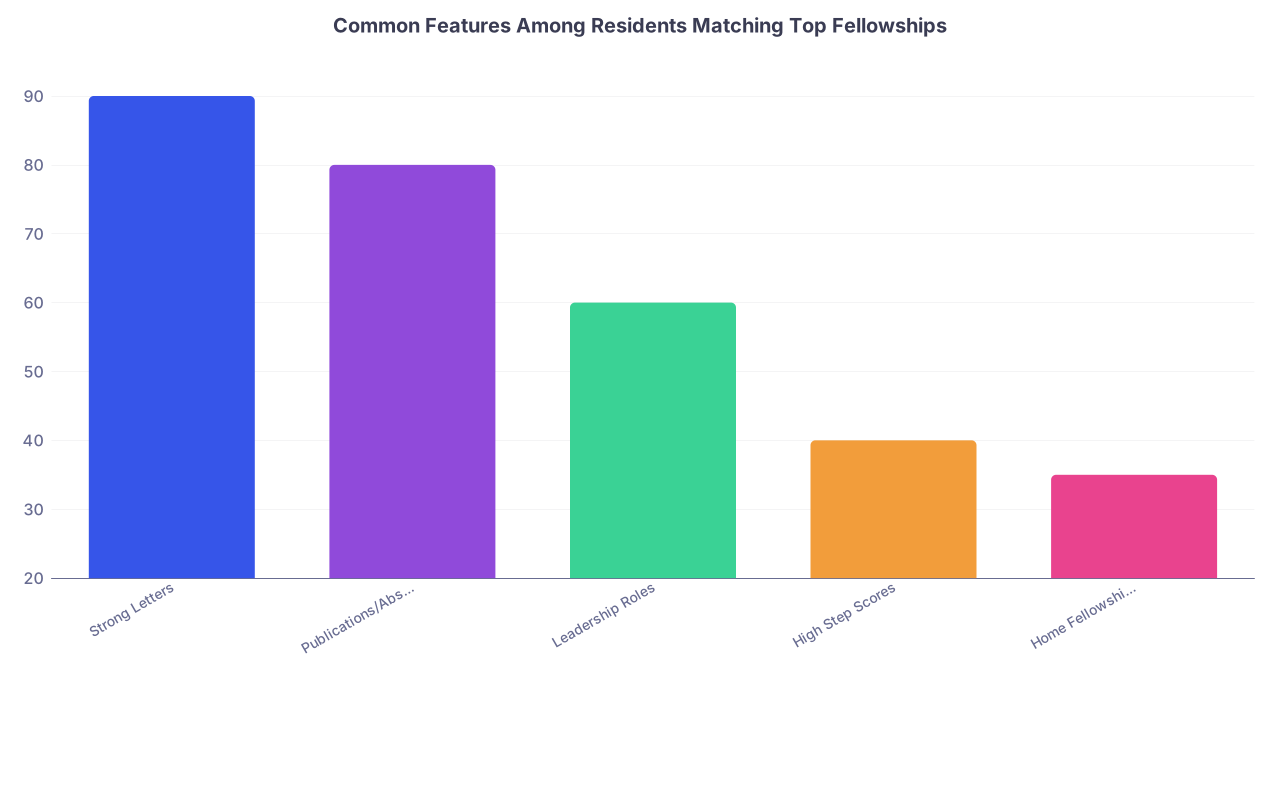
| Category | Value |
|---|---|
| Strong Letters | 90 |
| Publications/Abstracts | 80 |
| Leadership Roles | 60 |
| High Step Scores | 40 |
| Home Fellowship in Specialty | 35 |
Approximate pattern you’ll see if you review a few dozen profiles:
- Strong, specific letters from known subspecialists
The generic “hardworking, a pleasure to work with” letter from an unknown attending at an unknown hospital is death. From any program type.
A resident at a community affiliate who works with a cardiologist who:
- Trains fellows
- Publishes even modestly
- Knows people at national meetings
…can absolutely get a letter that carries more weight than a lukewarm note from a random assistant professor at a mega-academic center.
- Evidence of scholarly productivity
Again, not just RCTs in NEJM.
Things that matter:
- Abstracts at national conferences (ACC, AASLD, ASCO, ATS, ACG, etc.)
- Retrospective clinical studies
- Chart reviews with real methodology
- QI projects with data and outcomes
- Case reports + presentations as a baseline, then something a step above
Residents from community programs who match top fellowships almost always have this. They didn’t coast.
- Clear subspecialty focus
People who match competitive spots usually show a narrative:
- Multiple rotations / electives in the field
- Longitudinal project in that domain
- Maybe a poster at the relevant national meeting
- Mentors specifically in that specialty
Not “I did one GI rotation and decided I like endoscopy.”
- Professional reputation and performance
This is the piece students underweight. PD-to-PD emails and calls are powerful:
“We’ve sent three fellows to you in the last 10 years; this one is the best of the bunch.”
You don’t get that without being consistently excellent on the wards.
Where Community Residents Actually Get Crushed
There are structural disadvantages. Pretending otherwise is delusional.

| Category | Value |
|---|---|
| Access to Research Mentors | 90 |
| On-site Subspecialty Divisions | 95 |
| Existing Pipeline to Elite Fellowships | 85 |
| National Name Recognition | 95 |
(Imagine that bar at 100 for a flagship academic; many community programs are more like 30–50 on those same scales.)
Here’s where community and smaller hybrids pay a tax:
- Less default exposure to fellowship directors
At big academic centers, fellowship PDs and faculty see you on their inpatient services. You’re a known quantity.
At community sites, they don’t see you. You’re pixels and PDFs.
- Weaker brand recognition
If a fellowship committee has never heard of your hospital, they’ll anchor on:
- Board scores
- Publications
- Letters
- Any prior trainee they’ve had from your program
Without those, you look “unproven.” Academic name gives you the benefit of the doubt. Community name doesn’t.
- Fewer built-in scholarly pipelines
At many university programs:
- There’s a ready-made template: plug into Dr. X’s lab, write Y-type project, present Z poster at national meeting.
- Chief residents and seniors show you “this is the combo that worked for me.”
At community programs without that, you spend 6–12 months just figuring out who even has IRB access and how to get data.
If your program doesn’t have a GI or cards fellowship, you lose:
- The “home-field advantage” of matching where people already know you
- Obvious mentors and letter writers in your subspecialty
- Guaranteed exposure to that field beyond a single elective
Residents from such programs can still match good fellowships, but they’re starting from behind.
How Community Residents Actually Break Into Top Fellowships
This is where the myth really dies. Because the playbook is very clear among those who’ve pulled it off.

| Step | Description |
|---|---|
| Step 1 | Start PGY1 at Community Program |
| Step 2 | Find Academic Mentor |
| Step 3 | Join Project in Subspecialty |
| Step 4 | Present at Regional or National Meeting |
| Step 5 | Do Away or Affiliate Rotation |
| Step 6 | Secure Strong Letters |
| Step 7 | Targeted Applications to Top Fellowships |
Patterns I’ve seen repeatedly:
- Leverage affiliations ruthlessly
If your community program has any academic affiliation:
- Rotate at the main university hospital for your target subspecialty
- Treat that month like a stealth audition rotation
- Ask explicitly: “I’m very interested in GI; is there a project I could join?”
Those residents often get letters that carry identical weight to the “home” university residents. The letterhead doesn’t say “this person is from a community program so discount them.”
- Go where the mentors are, even virtually
If there’s truly no one locally:
- Join multi-center or registry projects where local data is collected but analysis happens at a big center
- Work with faculty who have adjunct appointments at universities
- Use virtual collaborations (yes, people still do Zoom research meetings across institutions)
Fellowship PDs care that you’ve worked with people in the field who can speak the language, not that they share your hospital badge.
- Aim for national exposure, not just internal praise
Poster at regional ACP is nice. Poster at ACC, CHEST, DDW, ASCO, ATS is currency.
I’ve watched a community resident with two ACC abstracts get interviews at several brand-name cardiology programs mainly because their name was already semi-familiar from the abstract book and a hallway conversation.
- Optimize letters, not just CV lines
Ask letter writers who:
- Actually know you and your work
- Have some academic footprint
- Are willing to be specific (“top 5% of residents I have worked with in 15 years”)
A sharp, detailed letter from a mid-level subspecialist who publishes occasionally is better than a vague letter from “famous name” who barely remembers you.
When Does It Make Sense To Avoid Community If You Want Elite Fellowships?
Here’s where I’ll be brutally direct.
If your goals are:
- Super-competitive subspecialty (cards, GI, heme/onc, sometimes pulm/CC)
- At the handful of highest-profile U.S. fellowships
- And you have the option between:
- A solid university program with known fellowship pipelines, vs
- A small, unaffiliated community program with no research, no subspecialty depth
You’d be foolish to pick the second one and then complain that “community residents can’t match top-tier fellowships.” You chose a path with real structural obstacles.
On the other hand, if you’re choosing between:
- Mid-tier university program with mediocre reputation in your target subspecialty
- Strong hybrid/community-affiliated program with a PD who has a great match track record and actual mentorship
Then the decision is far less obvious. A lot of residents in that second bucket end up matching very impressively—because they’re not lost in a sea of 50 IM residents competing for a couple of projects.
The Bottom Line: What the Data and Track Records Actually Say
Strip away the mythology and here’s what’s left:
Top-tier fellowships do not only take academic residents. They take mostly academic residents because of self-selection and infrastructure—but motivated community and hybrid residents break in every year.
The decisive factors are track record and advocacy, not the marketing label on your hospital. Strong letters from known subspecialists, tangible scholarly output, and visible performance matter far more than “university” on your badge.
“Community vs academic” is a crude tool. The real distinction is between programs with functional academic pipelines and those without. If you’re at the latter and want a top-tier fellowship, you have to consciously build your own pipeline—projects, mentors, and visibility—because no one is going to do it for you.