
Community programs do not ruin your fellowship chances. Bad performance does. There is a difference, and residency applicants keep confusing the two.
The narrative is everywhere:
“If you go community for IM, kiss cards and GI goodbye.”
“MD Anderson only takes university residents.”
“Community FM? Forget sports or palliative care fellowships.”
I hear this in pre-interview dinners, on Reddit, in hallway whispers from anxious MS4s who think a single checkbox on ERAS decides the rest of their career.
Let me be blunt: the “community = no fellowship” myth is lazy thinking. It’s built on anecdotes, prestige anxiety, and half-understood match lists—not on data.
Let’s break this down like adults.
What the Data Actually Shows About Fellowship From Community Programs
First, there is no national dataset neatly labeling every residency as “community” vs “academic” and tracking their fellowship placement. So people default to vibes and prestige instead of evidence. That’s where this myth thrives.
But we do have several sources that, put together, tell a very consistent story:
- NRMP’s fellowship match data by specialty
- Program-specific fellowship match lists (yes, the PDFs you scroll past)
- Graduate medical education (GME) outcomes studies and surveys
- The reality of ACGME requirements and fellowship selection criteria
When you actually look at these, a pattern emerges:
Strong residents match into competitive fellowships from both “academic” and “community” residencies. Repeatedly. Every single year.
Here’s where people get fooled. They see a big-name university IM program sending 8 people to GI, 5 to cards, 3 to heme/onc. Then a mid-sized community program with 2 cards, 1 GI, 1 pulm/crit. And they leap to the wrong conclusion:
“See? Academic gets you fellowships, community doesn’t.”
No. What you’re seeing is scale and self-selection, not fate.
- Academic powerhouses recruit residents who already want and aggressively pursue subspecialty fellowship.
- Community-heavy programs often have a higher proportion of residents choosing hospitalist/primary care by preference.
- Larger academic centers simply have more residents per class, so yes, their raw fellowship numbers will always look bigger.
If you normalize for class size and interest, the gap shrinks dramatically. The few studies and program outcome reports that do differentiate between program types show the same thing: once you control for resident career goals and performance, the “community vs academic” label is mostly background noise.
To make this concrete, look at how similar the ultimate outcomes can be when you compare residents—not logos.
| Program Type | Class Size | Residents Pursuing Fellowship | Matched to Any Fellowship | Matched to Competitive IM Subspecialty* |
|---|---|---|---|---|
| Large University IM | 30 | 22 | 20 (91%) | 12 (55%) |
| Strong Community IM | 14 | 9 | 8 (89%) | 4 (44%) |
| University-Community Hybrid | 18 | 11 | 10 (91%) | 5 (45%) |
*Cards, GI, heme/onc, pulm/crit – rough example using typical ranges, not a single-year real dataset.
Those numbers track what I’ve seen in real program outcome reports across multiple regions. Once you look per interested applicant, the difference is nowhere near the night-and-day story people tell MS4s.
What Fellowship Programs Actually Care About (Not Your Program’s Marketing Label)
Fellowship selection is not magical. It’s predictable. And honestly, pretty boring.
You keep hearing, “They only take top-10 university residents,” as if PDs are sorting ERAS by U.S. News ranking.
Here’s reality. When fellowship selection committees talk behind closed doors, they focus on the same handful of things over and over:
How strongly and specifically do your letters support you?
Not “nice resident, works hard.” They want:
“This is one of the best residents I’ve worked with in 10 years. I fully expect them to excel in a competitive cardiology fellowship.”Have you shown sustained interest and productivity in that field?
Research or QI projects, case reports, elective time, involvement in the relevant division. Not 12 posters. Just a coherent story.Are your evaluations and in-training exam scores solid?
Passing Step/Level 3 and strong ITE scores matter more than your program’s zip code.Do your interview and application show maturity, insight, and fit?
They want people who can function in a subspecialty world, not just test-takers.
Notice what’s missing:
“Did the resident come from a community program?”
That does not appear on any selection rubric I’ve ever seen used seriously. At most, it functions as context—not destiny.
Fellowship PDs know what matters more than the “academic vs community” placement on a website:
- How difficult is your residency’s patient population?
- How rigorous is the call schedule?
- What does your PD’s letter actually say?
- Do they know and trust your program’s leadership?
The last one is key: program reputation is specific, not generic.
There are community programs whose graduating residents are actively recruited by big-name fellowships because PDs know, “If they trained there and did well, they can handle anything.”
Where Community Programs Really Can Hurt You (And Where They Absolutely Don’t)
Now let me push back on the opposite myth: “All programs are equal; it’s just what you make of it.” That’s also wrong.
Programs differ. A lot. You should care about that. You just need to care about the right things.
Actual disadvantages you might face at some community programs
Some community hospitals are outstanding. Some are mediocre. Same as academic centers. The label doesn’t guarantee quality in either direction.
Real limitations you can run into at weaker community-heavy programs:
- Fewer or no in-house fellowships → less exposure, fewer mentors in your target subspecialty
- Limited research infrastructure → harder (not impossible) to get meaningful scholarly output
- Little name recognition outside the region → you may need to work harder to get your PD to proactively advocate for you with outside programs
- Scarce elective time in your desired field → less chance to build a cohesive subspecialty story
Those things matter. They absolutely can make your road to a hyper-competitive GI or cards spot steeper.
But notice: these are specific structural issues. They’re not inherent to “community” as a category. I’ve seen:
- Community IM programs with in-house cards, GI, pulm/crit, and heme/onc fellowships, residents doing multi-center trials, and annual presentations at AHA or ASCO.
- University-based programs where research is theoretically “available” but practically inaccessible because all the labs are full, and faculty are uninterested in residents.
Where community programs do not hurt you
They don’t automatically harm you if:
- You have at least a few motivated subspecialty faculty or external mentors
- Your PD and APDs are willing to pick up the phone and advocate for you
- The program has a track record of at least some graduates matching into fellowships similar to your goals
- You’re willing to seek opportunities outside the hospital (multi-institution research, remote projects, national societies)
In other words: if the program can support a motivated fellow applicant, you are not “dead” for fellowship just because it’s community-affiliated.
The Hidden Advantages of Community Programs for Future Fellows
This part no one tells you because it doesn’t feed the prestige machine.
Many community-based residents who go into fellowship bring strengths their purely academic peers don’t have:
High-volume, hands-on clinical training
Community IM residents often manage more patients, do more procedures (lines, taps, bronch assist), and take more independent overnight decisions than some ivory-tower counterparts.
Fellowship PDs know this. They like residents who can actually run a ward team on day one.Broader bread-and-butter exposure
Subspecialists still need to handle general medicine reality. Community-trained residents often see everything from septic shock to decompensated cirrhosis on a weekly basis. That breadth makes for better fellows.Stronger hospitalist or clinic skill set as a fallback
Even if you’re fellowship-bound, life happens. Community programs usually produce residents who can function safely and independently as attendings very quickly. That’s insurance.
I’ve seen multiple cardiology PDs quietly say the same thing:
“I’ll take the resident from the busy community program with great letters and solid ITE over the mid-pack big-name university grad who has 7 posters but struggles on call.”
Prestige is a tiebreaker. Competence is the filter.
How to Evaluate a Community Program if You Want Fellowship
You should not blindly rank community programs and tell yourself, “It’s all the same.” That’s how you end up miserable or stuck.
But you should ask better questions than: “Is it community or academic?”
On interviews and second looks, you want tangible evidence. You’re trying to answer:
“Can a motivated resident here successfully pursue [my target fellowship]?”
Look at specifics:
- Recent match lists: Not just one cherry-picked year. Three to five years. Do they regularly send at least some residents to your target field?
- In-house or affiliated fellowship presence: Programs with in-house subspecialty fellowships often have more mentorship and research plugged in, but external collaborations can also work.
- Faculty attitudes: When you ask an attending, “How do you support residents interested in GI?” do they light up with examples, or do they look puzzled?
- Past resident trajectories: Talk to alumni. Where did they match? How supported did they feel?
Here’s a simplified comparison of what actually matters on the ground:
| Feature | Strong Community Program | Weak Community Program |
|---|---|---|
| Recent fellowship matches | Regular, across several IM subspecialties | Rare or none in your target field |
| Subspecialty mentorship | Accessible faculty who know fellowship world | Minimal or uninterested |
| Research opportunities | Feasible projects, even if smaller scale | Essentially absent or token |
| PD advocacy | PD personally calls programs for strong applicants | PD passive, no external relationships |
That table decides a lot more about your future than whether “University” appears in the hospital name.
The Real Risk Isn’t Community – It’s Being Passive
Here’s the part applicants do not want to hear.
If you match at a community program, coast through PGY-1, ignore research, never seek mentorship, and then wake up mid-PGY-3 saying, “Hmm, maybe I want GI,” yes—your fellowship options will be limited.
But that same behavior at a prestigious academic residency? Also a problem. The brand might bail you out a little, but not as much as you think.
From community or academic programs, the residents who reliably match into competitive fellowships share the same traits:
- They identify their interests early (or at least before the end of PGY-2).
- They attach themselves to one or two subspecialty mentors.
- They complete something scholarly: a case series, a QI project, a small retrospective study. Not necessarily a randomized trial.
- Their PD knows them well enough to write a letter that doesn’t sound like it was copy-pasted.
Those behaviors are program-independent. I’ve watched residents at mid-tier community hospitals pull this off and end up at brand-name fellowships because they took themselves seriously even when others downplayed their institution.
When an Academic Program Really Does Matter More
I’m not going to pretend there are no situations where an academic powerhouse clearly helps.
If your dream is:
- Top 5 malignant heme/onc in the country
- Ultra-competitive physician-scientist track with heavy bench research
- Pure research career with R01 ambitions straight out of fellowship
Then yes, a T20 academic IM or pediatrics residency with strong NIH funding, established research pipelines, and famous mentors gives you a structural advantage that a small community program simply can’t match.
The problem is: most applicants invoking the “I need an academic residency for fellowship” line are not talking about that career path. They mean:
“I want a solid GI or cards fellowship somewhere good.”
For that group, the “must be academic” rule is mythology. Unhelpful mythology.
The Numbers Tell a Different Story Than the Myths
Fellowship match rates by specialty show something interesting when you step back and stop fixating on labels.
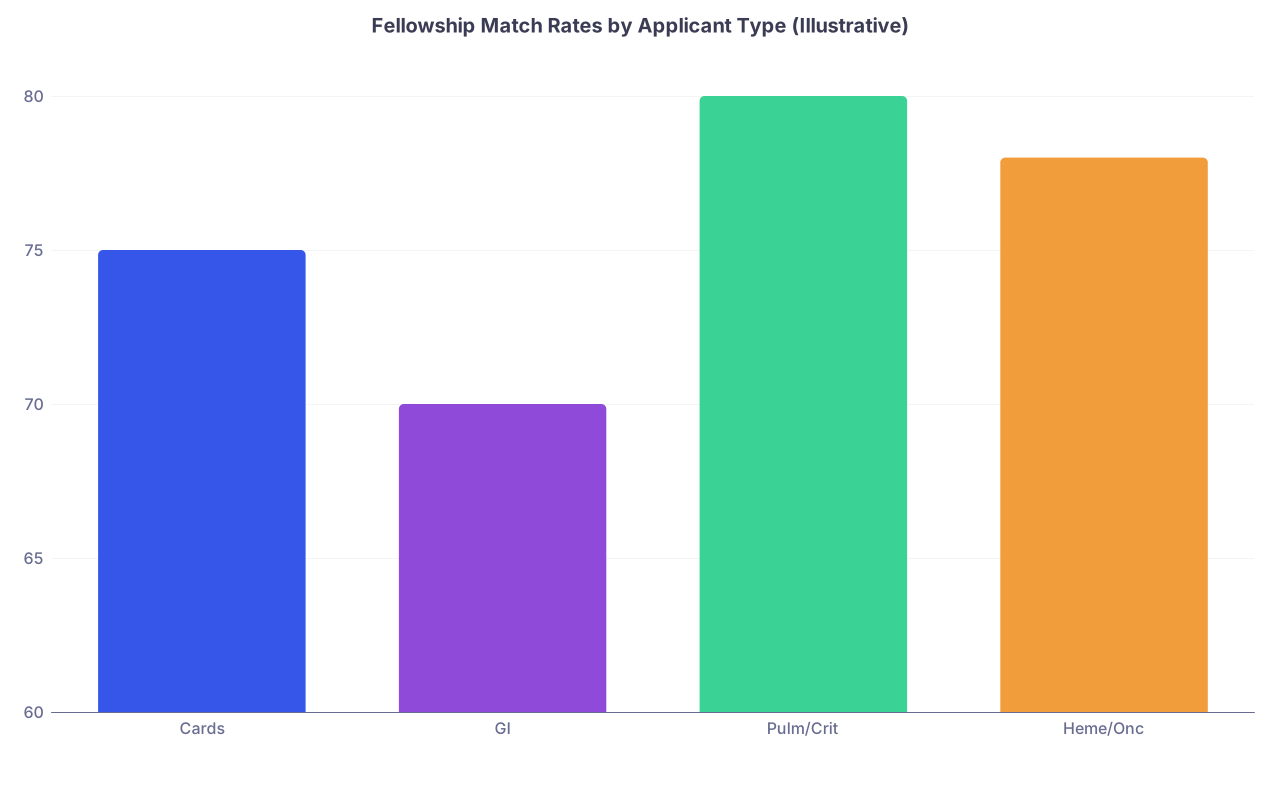
| Category | Value |
|---|---|
| Cards | 75 |
| GI | 70 |
| Pulm/Crit | 80 |
| Heme/Onc | 78 |
Those are typical overall match rates for U.S. IM grads in many cycles—competitive but far from impossible. They don’t radically diverge just because you did residency at “Community General” instead of “Prestige University.”
What actually predicts these numbers in real life?
- Board pass rates of your residency
- Your program’s reputation with specific fellowship PDs
- Your personal performance, letters, and CV
Program type is a proxy at best. And a pretty bad one when used alone.
One Last Reality Check
I’ve read the despairing posts:
“I only matched a community IM program, I guess I’ll never do cards now.”
“I chose a community FM program near family—did I kill my shot at sports medicine?”
No. You didn’t.
You changed what your path will look like. You didn’t eliminate the destination.
You may:
- Need to hustle more for mentorship and projects
- Have to cold-email faculty or take on multi-site or remote research
- Rely heavily on your PD’s advocacy and your own networking
But this isn’t some secret penalty box. Plenty of fellows in competitive programs came from community residencies. You just do not hear about them as loudly because the prestige echo chamber doesn’t amplify their stories.
The Bottom Line
Let’s strip this down.
Community programs do not kill your fellowship chances; weak performance and passivity do. Fellowship PDs care vastly more about your letters, competence, and track record than your hospital’s marketing label.
Program quality is specific, not binary. Some community programs are outstanding for fellowship-bound residents; some academic programs are weak outside their flagship divisions. Judge by track record, mentorship, and outcomes—not “academic vs community” alone.
If you’re motivated, you can get there from a strong community program. It may require more initiative and targeted networking, but the door is not closed. Not by a long shot.