The belief that “community program = research graveyard” is lazy, outdated, and wrong for most applicants.
People say it all the time on interview trails and Reddit: “If you care about research, you have to go academic.” Then they repeat some half-remembered rumor about fellowship directors only respecting big-name university programs. Meanwhile, I’ve watched community residents walk into GI, heme/onc, and cards at name-brand institutions with stronger research portfolios than some academic residents.
So let’s tear this apart properly.
The Myth: Community Programs Kill Your Research Career
The dominant myth goes roughly like this:
If you match into a community residency, you’ll:
- Have no research infrastructure
- Never publish anything meaningful
- Be filtered out of competitive fellowships
- Spend three years “just doing clinical work”
And the supposed flip side:
If you go to an academic program, research opportunities will fall from the ceiling. You’ll be handed projects, first-author papers, and automatic credibility.
Reality: both of these extremes are nonsense.
Yes, there are differences between community and academic programs. But the research gap is much smaller and more nuanced than applicants think. The real difference is structural: who builds the machine, and how much of it is already running when you arrive.
Let me show you what the data – and actual match outcomes – say instead of vibes and rumors.
What the Data Actually Shows About Research and Match
Start with something objective: fellowship and match outcomes.
Look at NRMP and specialty society data over the last several years. You consistently see three patterns:
- Residents from both academic and community programs match into competitive fellowships.
- Research productivity within a program is wildly variable between residents.
- A small number of residents at any program generate most of the publications.
The idea that “community = no research, academic = tons of research” just does not match the numbers.
You can find community-based internal medicine programs sending residents every year to:
- Cards at Cleveland Clinic, Mayo, major university hospitals
- Heme/onc at big NCI-designated centers
- GI at highly ranked academic programs
What do those residents usually have? Not 30 publications. Often something like 3–8 peer-reviewed outputs: case reports, retrospective studies, QI projects, maybe a multicenter collaboration.
And their peers across town at the “big university program”? Same specialty, similar fellowship destinations, with… 3–8 outputs.
The spread is wide at both program types. At both, you’ll see:
- A few residents with 15+ items, mostly because they started in med school or had a prior PhD/MPH
- A middle bulk with 3–8 real, citable pieces
- A non-trivial group with 0–1, even at “research-heavy” academic centers
The critical point: where you train doesn’t predetermine your research output. It shifts the effort required to build it.
To make this concrete:
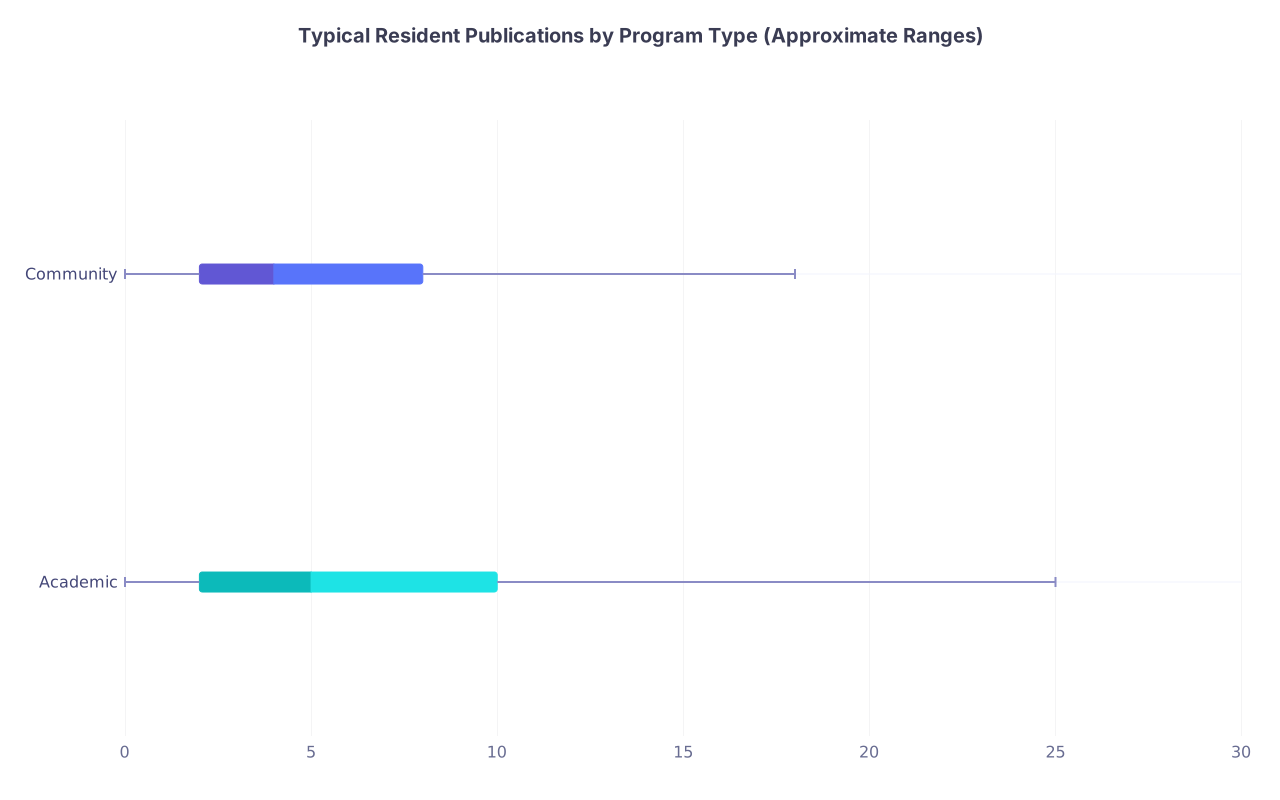
| Category | Min | Q1 | Median | Q3 | Max |
|---|---|---|---|---|---|
| Academic | 0 | 2 | 5 | 10 | 25 |
| Community | 0 | 2 | 4 | 8 | 18 |
Same median. Slightly higher tail at academic centers. Completely overlapping distributions.
The myth confuses average environment with guaranteed outcome.
How Research Really Differs: Structure, Not Destiny
The fundamental difference between community and academic programs isn’t “research vs no research.” It’s how much is pre-built for you.
At Academic Programs
You’re walking into a house that’s mostly furnished. Typical realities:
- Established labs, PIs with a CV longer than your ERAS application
- Dedicated research cores, statisticians, IRB offices that actually answer email
- Pre-existing data sets, ongoing trials, and pipelines where you can plug in
- Sometimes formal research tracks or protected time (though less than advertised)
You still have to hustle. I’ve watched interns at big-name institutions go three years with zero publications because they never pushed past, “I’m kind of interested in research.” The infrastructure doesn’t drag you across the finish line if you’re passive.
But if you’re proactive, it’s easier to get volume and to attach yourself to higher-impact projects.
At Community Programs
You’re often walking into a house that has electricity and running water, but you might be assembling the furniture yourself.
Realities at many mid-to-large community programs:
- Clinical QI and case reports are abundant and frankly underutilized
- Access to academic partners through affiliated med schools or teaching hospitals
- Attendings who did fellowship at major universities and still have old collaborators
- Increasing use of multi-center registries, especially in IM, EM, cards, critical care
What’s usually weaker:
- Fewer NIH-funded labs on-site
- Less formal infrastructure for clinical trials
- Less automatic “plug-and-play” project assignment
- Sometimes clunky IRB processes if they’re not used to residents initiating projects
But again, that doesn’t equal “no research.” It means more of the burden is on you to create or organize projects instead of just joining existing ones.
This difference is why you’ll hear completely opposite stories from different community residents:
- One says, “No one here does research, it’s impossible.”
- Another from the exact same program matches into a top heme/onc fellowship with eight publications and three oral presentations.
Same program. Different level of initiative and navigation.
The Quiet Advantages of Community Programs for Research
Here’s the part no one tells you because it doesn’t fit the simplistic narrative: community programs have some underrated research advantages.
1. Cleaner Clinical Access
Community residents often have more direct continuity with patients, simplified systems, and fewer competing trainees.
That makes certain kinds of projects easier:
- Retrospective chart reviews on common conditions (HF, COPD, sepsis)
- Process-improvement and QI around throughput, readmissions, ED flow
- Practical clinical questions that academic centers overcomplicate
At a big academic hospital, that same project might need five committees, three departments, and someone guarding the data warehouse like it contains state secrets.
In a motivated community setting? One engaged attending, an IRB chair who knows you by name, and you’re collecting data in a month.
2. Less Competition for Each Project
At academic programs, you’re competing with:
- Residents
- Fellows
- Med students
- Research assistants
- Sometimes postdocs
You might be resident #7 asking the same cardiology attending for a project.
At community programs, the exact same attending (who did fellowship at that fancy academic center) may be thrilled anyone is interested. You want that TAVR outcomes project? Take it. Please.
I’ve seen community residents become the “research person” in an entire department simply because they showed up consistently and followed through.
3. QI That Actually Counts
Fellowship directors are not stupid. They know what resident life looks like. A well-designed QI project that changes practice and gets presented at a regional or national meeting can count as much (or more) than slapping your name as 7th author on some unrelated basic science paper.
Community programs are swimming in real, solvable QI problems:
- Antibiotic stewardship
- Order-set redesigns
- Handoff standardization
- Readmission pathways
If you actually carry one of these through:
- IRB or institutional approval if needed
- Pre/post data
- Implementation and education
- Abstract → poster → maybe manuscript
You’ve produced exactly the kind of “resident-appropriate” scholarship that fellowship PDs like to see.
Where Community Programs Really Can Hold You Back
Now for the part people get half-right.
There are absolutely situations where a community program will limit your research runway. You should recognize these honestly before you rank anything.
Red flags if you care about research:
- No one in leadership can answer, “What research have residents done in the last three years?” with specifics.
- Residents you meet look confused when you say you want to do research. Not skeptical. Confused.
- Zero residents with more than 1–2 outputs despite multiple people applying to competitive fellowships.
- No conferences, no posters, no journals on anyone’s CV when you ask them directly.
For some very research-heavy fellowship paths (physician-scientist tracks, serious bench work, long-term outcomes research), this matters. If you want to be a funded investigator, yes, being at a strong academic center with established labs and mentors is a huge advantage. No myth there.
But that’s 5–10% of applicants, not everyone who “wants research.”
Most applicants mean:
- “I want to match into a solid fellowship”
- “I want my CV to look credible”
- “I want to do some meaningful projects that aren’t fluff”
For that group, a mid-to-strong community program with demonstrated resident scholarship is more than enough.
The Questions You Should Actually Be Asking on Interview Day
Instead of: “Are you academic or community?”
You should be asking questions that reveal the real research culture and outcomes.
Here’s the difference between smart and lazy questions:
| Type | Question |
|---|---|
| Useless | Do residents have research opportunities? |
| Useless | Is this a research-friendly program? |
| Smart | Can you name 2–3 recent resident projects and where they were presented or published? |
| Smart | How many residents in the last graduating class had at least one peer-reviewed publication? |
| Smart | Do you have dedicated mentors or a research director who meets with residents? |
| Smart | How is research time built into the schedule, if at all? |
If the PD or residents cannot give you specifics, that tells you far more than whether the program is “community” or “academic.”
And then look at outcomes:
- Where did their recent grads match for fellowship?
- Do those grads have actual citations/posters you can find? (Yes, you can stalk PubMed and CVs.)
- Are there med students and residents presenting at national meetings?
I’ve seen relatively unknown community programs where:
- 50–60% of residents applying to fellowship match every year
- Multiple posters at ACP, CHEST, ACC, ATS
- 2–4 peer-reviewed outputs for many residents
And I’ve seen very “prestigious” academic programs where the fellowship match is strong because of name recognition, but most residents have minimal research beyond a couple of case reports.
Strip away the label and look at outcomes.
How Much Research Do You Actually Need?
Let’s kill another myth while we’re here: that you need a massive publication list to match into good fellowships.
If you’re not going into a research-focused career, the bar is lower than the forums make it sound.
For many medicine subspecialties (cards, GI, heme/onc, pulm/crit), a credible, focused portfolio looks like:
- 2–5 peer-reviewed items (case reports, retrospective analyses, QI papers)
- 1–3 posters or oral presentations at regional/national meetings
- A clear story: “I got interested in X, did Y projects, and can talk intelligently about them.”
That is very achievable at a solid community program that actually supports interested residents. And very out of reach at both community and academic programs if you never drive the process.
If you want a visual of how much “real” difference program type makes on output for a typical resident aiming at a standard fellowship:
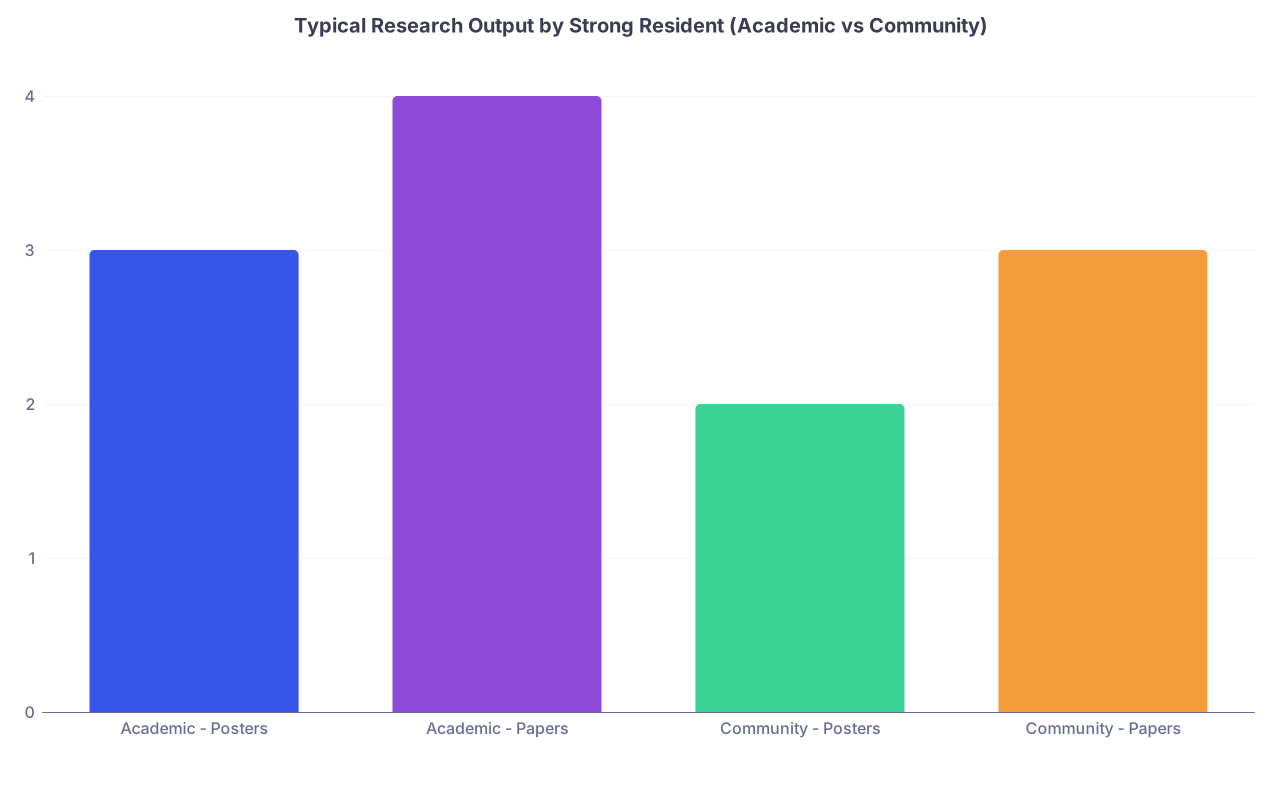
| Category | Value |
|---|---|
| Academic - Posters | 3 |
| Academic - Papers | 4 |
| Community - Posters | 2 |
| Community - Papers | 3 |
Not identical. But not life-or-death different either.
The Real Myth to Kill: “Program Type Determines Outcome”
Here’s the uncomfortable truth that applicants hate, because it puts responsibility back on them:
- Program type influences your default environment.
- Your behavior determines your actual outcome.
If you:
- Show up early in PGY-1 saying, “I want projects, I’ll do the grunt work.”
- Follow through, respond to email, handle revisions.
- Present at local meetings, then push to regional/national.
- Turn at least some posters into manuscripts.
You can be research-productive almost anywhere that has even a minimal academic culture.
If instead you:
- Wait for someone to hand you the perfect project
- Don’t respond to feedback for weeks
- Ghost mentors midway through data collection
- “Mean to write that paper” for 18 months
Then no level of academic pedigree is going to rescue your CV.
Bottom Line: Myth vs Reality
Strip away the noise, and here’s where we land:
Myth: Community programs kill research careers.
Reality: Strong residents at solid community programs routinely build competitive research portfolios and match into top fellowships. The distributions heavily overlap with academic programs.Myth: Academic programs automatically make you research-productive.
Reality: They give you more infrastructure and higher ceilings, but you still have to drive your own output. Plenty of academic residents graduate with minimal scholarship.Myth: Program label (“community” vs “academic”) should drive your rank list if you care about research.
Reality: Concrete evidence of resident output, mentorship, and your own initiative matter far more than the branding of the hospital.