
The worst fellowship mistakes are not bad scores or weak letters. They are bad timing and late pivots.
You can come from a pure community program and match a competitive academic fellowship. You can come from a top academic residency and still need a fourth year or research gap because you woke up in PGY‑3. The difference is not pedigree. It is when you pivot and how deliberately you use each month.
Let me walk you through this, point by point in time.
Big Picture: Year‑by‑Year Fellowship Pivot Strategy
Before we zoom into months and weeks, you need the frame. Community and academic residencies are not the same sport when it comes to fellowship timing.
| Feature | Community Residency | Academic Residency |
|---|---|---|
| Built‑in research | Limited / optional | Expected / structured |
| Access to big‑name mentors | Few, need to seek externally | Many, but competitive |
| Exposure to niches | Less (depends on affiliations) | More (subspecialty clinics, conferences) |
| Default path | Generalist practice | Fellowship or academic career |
| Timing flexibility | Must be proactive early | Slightly more forgiving, still tight |
Here is the core rule:
- In a community program, you must act one year earlier than you think.
- In an academic program, you can act “on time,” but procrastination will still hurt you.
PGY‑1: Decide If Fellowship Is Real, Not Theoretical
At this point you should not be “choosing a fellowship.” That is premature. But you must decide whether you are fellowship‑curious or almost certainly generalist. That single decision changes your entire year.
First 3 Months of PGY‑1 (July–September)
You are drowning in EMR passwords and order sets. Fine. Still:
At an academic program, by September you should:
- Know the names of:
- Your department’s program director
- At least two faculty in your possible interest area (e.g., cardiology, heme/onc).
- Attend at least one divisional conference outside your core residency (e.g., cardiology cath conference, tumor board).
- Quietly observe who gets talked about as “our fellowship‑bound residents.”
- Know the names of:
At a community program, by September you should:
- Identify whether there is:
- An affiliated academic center (same system or regional partner).
- Any subspecialist who is fellowship‑connected (trained at big‑name places, sits on committees, still publishing).
- Ask your chief residents, point‑blank:
“Which graduates in the past 5 years matched X fellowship, and how did they do it?”
- Identify whether there is:
This is reconnaissance. Not commitment yet. But if you do not know the map, you cannot time the pivot.
Months 4–6 of PGY‑1 (October–December)
At this point you should:
Pick a direction, not a destination.
Example: “Likely cards / pulm / crit care” is enough. You do not need “advanced HF transplant” yet.Start a low‑stakes project:
- Academic program: ask a subspecialist, “Do you have a case I can help write up?”
- Community program: if your attendings are not academically active, ask, “Is there an interesting case we can co‑write with someone at [affiliated university]?”
Your goal is one active project on the board by December. Even if it never publishes, it teaches you pacing and shows faculty that you are serious.
Months 7–12 of PGY‑1 (January–June)
This is where the divergence begins.
In an academic residency, by June of PGY‑1 you should:
- Have:
- 1 case report or QI project underway.
- Attended at least 2–3 subspecialty conferences.
- Scheduled PGY‑2 rotations that align with your interest (electives, subspecialty clinic).
- Have:
In a community residency, by June of PGY‑1 you should:
- Have explicitly asked at least one mentor:
“If I want [X fellowship], when should I start applying, and what are my options coming from this program?” - Identify:
- Whether prior residents needed a research year.
- Whether they did away electives at academic centers.
- If your program has weak fellowship placement, you should already be thinking:
- “Do I pivot out after PGY‑1 to a more academic residency?”
This is rare, but I have seen smart people transfer after realizing their current hospital has zero infrastructure for cards or GI.
- “Do I pivot out after PGY‑1 to a more academic residency?”
- Have explicitly asked at least one mentor:
PGY‑2: This Is When You Actually Pivot
By July 1 of PGY‑2, if you are still talking about fellowship “maybe someday”, you are behind. The application cycle creeps up faster than you think.
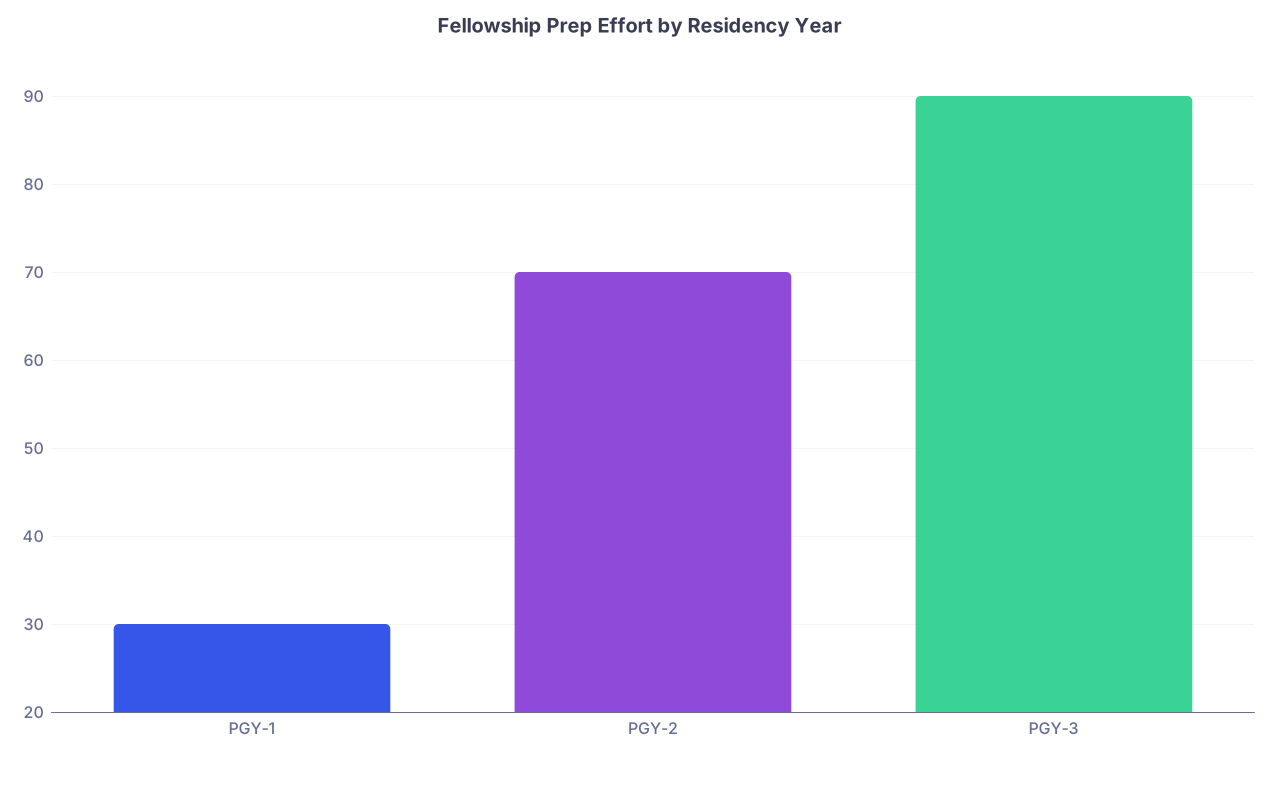
| Category | Value |
|---|---|
| PGY-1 | 30 |
| PGY-2 | 70 |
| PGY-3 | 90 |
Months 1–3 of PGY‑2 (July–September)
At this point you should be doing different things depending on your environment.
If You Are in an Academic Residency
You pivot into visibility:
- Tell your program leadership:
- “I am planning to apply for [X fellowship]. I would appreciate advice on timeline and key people to work with.”
- Secure:
- A primary mentor in your subspecialty.
- One to two projects with realistic timelines:
- Case series, retrospective chart review, or QI with potential abstract by spring.
- Protect time:
- Try to line up electives in your field in the last half of PGY‑2 or early PGY‑3.
- Join teaching, journal club, or divisional activities in that field.
Your pivot here is from “interested resident” to “known fellowship applicant.”
If You Are in a Community Residency
You pivot outward:
- Identify external academic partners:
- Prior graduates’ fellowship programs.
- Nearby university hospitals with your target subspecialty.
- Email examples you should actually send:
- “I am a PGY‑2 at [Community Hospital]. I am interested in [X field] fellowship and would like to explore any opportunities to assist with ongoing projects or possibly do an elective with your group.”
By September of PGY‑2, in a community setting you should have at least:
- One academic tie (mentor or project) at:
- An academic center, or
- A research‑active subspecialist, even if private practice but publishing.
- A rough sense of:
- “Am I competitive to go straight from here to fellowship?”
or - “Do I need an intermediate academic year (chief year, hospitalist with research, or formal research year)?”
- “Am I competitive to go straight from here to fellowship?”
Months 4–6 of PGY‑2 (October–December)
This is the “no illusions” phase.
At this point you should:
- Formally evaluate your competitiveness:
- USMLE/COMLEX or in‑training scores.
- Any publications/abstracts.
- How strong your letters could be if you applied in ~9 months.
In an academic program, if you are aiming for a competitive fellowship (cards, GI, heme/onc), by December of PGY‑2 you should:
- Have at least:
- One submitted or accepted abstract.
- One additional project in progress.
- Have done at least one elective in your target field or have it scheduled early in PGY‑3.
- Be on the radar of key faculty who will likely write your letters.
In a community program, by December of PGY‑2 you should:
- Know, honestly:
- Can I apply on‑cycle directly from residency?
- Do my mentors recommend a research year or hospitalist year at an academic center first?
- If an interim step is likely, you pivot your search:
- Start monitoring academic hospitalist postings.
- Ask your PD,
“Where have residents gone for hospitalist or research positions that then led to fellowship?”
Months 7–12 of PGY‑2 (January–June)
Now you move from planning to execution.
At this point you should:
Lock in letters:
- Academic: tell your main mentors by late spring,
“I will apply for [X fellowship] this upcoming cycle; would you be comfortable writing a strong letter?” - Community: same thing, but often with fewer subspecialists, so be strategic. You may need:
- PD letter.
- One strong subspecialist letter (even from an away elective).
- One hospitalist or generalist who can comment on your day‑to‑day performance.
- Academic: tell your main mentors by late spring,
Schedule away electives if needed:
- Community residents, especially, should aim for:
- 1 month at target fellowship institution by early PGY‑3.
- This is not optional for some fields. I have watched community residents match GI or cards almost entirely because they crushed an away month.
- Community residents, especially, should aim for:
PGY‑3: Application Year — No More “Maybe”
By the time PGY‑3 starts, your pivot is not abstract. You are committed. Or you are not applying that year.
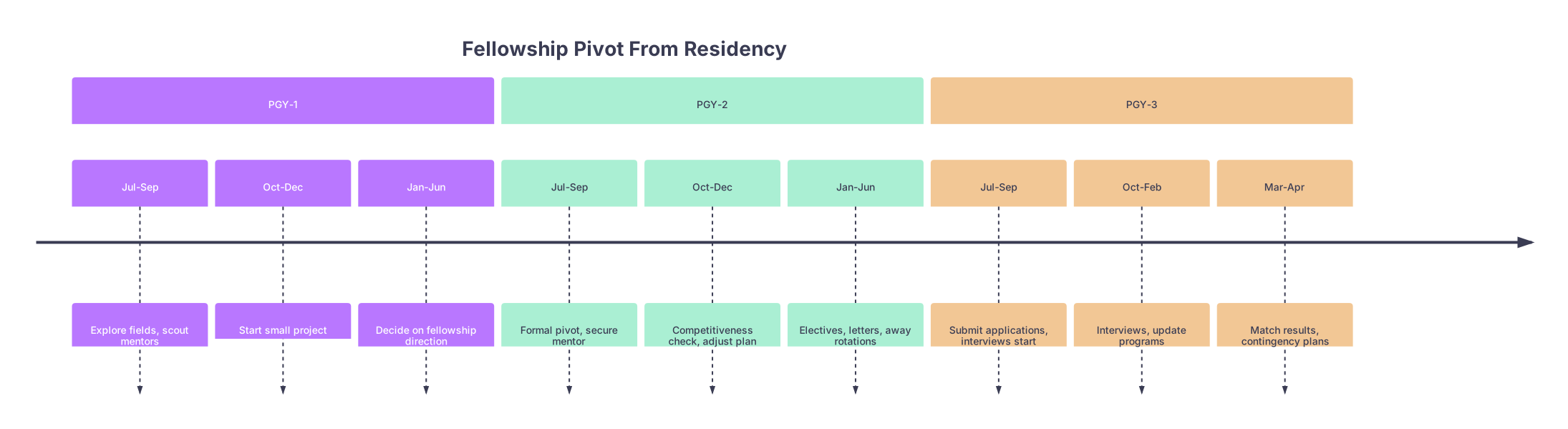
| Period | Event |
|---|---|
| PGY-1 - Jul-Sep | Explore fields, scout mentors |
| PGY-1 - Oct-Dec | Start small project |
| PGY-1 - Jan-Jun | Decide on fellowship direction |
| PGY-2 - Jul-Sep | Formal pivot, secure mentor |
| PGY-2 - Oct-Dec | Competitiveness check, adjust plan |
| PGY-2 - Jan-Jun | Electives, letters, away rotations |
| PGY-3 - Jul-Sep | Submit applications, interviews start |
| PGY-3 - Oct-Feb | Interviews, update programs |
| PGY-3 - Mar-Apr | Match results, contingency plans |
Months 1–3 of PGY‑3 (July–September)
The ERAS season for most internal medicine subspecialty fellowships opens July; many programs start reviewing soon after. Other specialties have slightly different calendars, but the principle is the same.
At this point you should:
- Have your personal statement and CV done before July.
- Submit your applications early in the season, especially from community programs where you need every signal of seriousness.
- Coordinate with your PD to:
- Update your rank list of realistic programs.
- Decide if you will also apply to:
- Community‑based fellowships.
- Academic fellowships only.
- A mix, depending on competitiveness.
Difference in pivot focus:
Academic resident:
- You are leaning on your institution’s name, faculty networks, and your research output.
- You aim higher: more academic‑heavy list, including your home institution.
Community resident:
- You are selling:
- Clinical volume and autonomy.
- Any academic productivity.
- Strong letters from people who can say, “This resident works like a fellow already.”
- You strategically apply wider, including:
- Programs known to appreciate community backgrounds.
- Places where your external mentor has influence.
- You are selling:
Months 4–8 of PGY‑3 (October–February)
Interviews and shifting probabilities.
At this point you should:
- Track:
- Who interviews you (academic vs community fellowships).
- Where you are getting traction.
If you are:
An academic resident getting mostly academic interviews:
- Good. Stay the course.
- Pivot inside that world:
“Do I want a hard‑core research‑heavy spot or a clinically strong academic‑community hybrid?”
A community resident getting:
- Mostly community fellowship interviews:
- Accept reality. That is your path this cycle.
- Rank for fit and future opportunities (some community fellowships still place people into academic jobs later).
- Very few interviews:
- Time for the pivot away from immediate fellowship.
- Start securing backup: hospitalist work, chief year, or research year at an academic center where you can reset and re‑enter the match stronger.
- Mostly community fellowship interviews:
PGY‑4+ / Gap Years: Using a Deliberate Step, Not Just “I Did Not Match”
For some of you, the smartest pivot is not to force an underpowered application from a community program. It is to build an intermediate step.
Common patterns I have seen work:
- Community residency → Academic hospitalist → Fellowship
- Community residency → Research year at academic center → Fellowship
- Community residency → Chief resident (especially at program with new academic partnerships) → Fellowship
At this point you should be thinking in 12‑ to 24‑month arcs:
- Year 1 (PGY‑4):
- Maximize research output, conference presentations, and subspecialty clinic exposure at an academic center.
- Become the “go‑to” person for that field on the hospitalist team.
- Year 2 (Fellowship application):
- Apply with:
- Stronger letters from academic subspecialists.
- Multiple abstracts or a publication.
- Clear narrative: “I intentionally spent a year as an academic hospitalist focusing on X to prepare for fellowship.”
- Apply with:
Micro‑Timeline: What To Do This Month if You Are…
Here is the very practical piece you probably wanted from the start.

Scenario 1: PGY‑1 in a Community Program, Fellowship‑Curious
This month you should:
- Identify one subspecialist who is even remotely academic.
- Ask them:
- “What did prior residents from here do to get into your field?”
- “Can I help with a case write‑up or small project?”
- Start a simple habit:
- One article per week in your potential field.
- One note on interesting cases you might turn into something later.
Scenario 2: PGY‑2 in an Academic Program, Late to Decide on Fellowship
This month you should:
- Email your PD and one subspecialist:
“I have decided to pursue [X fellowship]. I know I am a little late in planning; can we meet to map out what I must do in the next 6–9 months to be a viable applicant?” - Rapid‑fire actions:
- Join any ongoing project where they just need a workhorse.
- Schedule an elective in that subspecialty within the next 3–4 months.
- Start logging meaningful cases and reading around them.
Scenario 3: PGY‑3 in a Community Program, Weak Fellowship Interest Until Now
If you are just waking up to fellowship in early PGY‑3 from a community setting, your pivot is two‑stage:
- Stage 1 (this year):
- Maximize strong rotations, leadership, bedside teaching.
- Network aggressively with any visiting faculty or external sites.
- Accept that direct fellowship entry this cycle may be a long shot unless your field is less competitive or your application is otherwise outstanding.
- Stage 2 (PGY‑4):
- Aim for an academic hospitalist or research position at a place with the fellowship you want.
- Treat that year like residency PGY‑2 for fellowship timing: early projects, visible mentorship, clear signaling.
When To Pivot From Community to Academic (or Vice Versa)
Sometimes the pivot is not just “apply vs not apply.” It is where you launch from.
You should seriously consider pivoting to an academic environment before applying if:
- You are in a small community program with:
- No track record of matching in your field.
- No active faculty in that subspecialty.
- No meaningful research support.
- Your target fellowship is very competitive (cards, GI, heme/onc, certain surgical subspecialties) and:
- Your scores are average.
- Your CV has little academic content so far.
In that case, the timeline usually looks like:
- PGY‑2: Realization and planning.
- PGY‑3: Finish residency strong, secure academic PGY‑4 position.
- PGY‑4: Build the fellowship‑ready CV.
- Next cycle: Apply with real academic heft.
On the flip side, you might lean into a community fellowship even from an academic residency if:
- You care more about:
- Hands‑on procedural volume.
- Lifestyle and geographic stability.
- Shorter commute from day one.
- Your academic output is modest, and you are tired of chasing publications.
The pivot then is conceptual, not temporal. You still must hit the same deadlines. You just target a different tier and style of programs.
One Concrete Action Today
Open your calendar and pick a 30‑minute slot in the next 7 days. In that time, send two emails: one to your PD and one to a subspecialist in the field you are even slightly considering. Ask for a 15‑minute meeting to discuss your fellowship timeline. That single step will force you to stop “thinking about” a pivot and start living on an actual clock.