The biggest lie you were sold about residency is that you must “make it work” no matter how bad the fit is. You do not. But the timing of what you do next is everything.
You are a PGY-1. You think you chose the wrong training environment—community vs academic mismatch, or just the wrong style of program. This is fixable, but only if you move in a structured, time-bound way.
Below is the timeline I use when walking interns through this mess: month-by-month in PGY-1, then week-by-week once you decide you might need to switch, then what each key milestone should look like.
First 3 Months (July–September): Reality Check, Not Panic
At this point you should distinguish normal PGY-1 misery from a true environment mismatch.
July: Orientation and Shock
Your job in July is not to decide if you matched wrong. Your job is to collect data.
You should be asking yourself concrete questions:
What is actually bothering me?
- Lack of teaching?
- Malignant culture?
- Patient volume chaos?
- Zero exposure to research / academic activities?
- Or just being new and overwhelmed?
How does my program type contribute?
- Community program:
- Heavy service, fewer structured didactics.
- Limited subspecialty exposure in-house.
- Less research infrastructure.
- Academic program:
- More layers (students, multiple residents, fellows).
- More conferences, expectations for research/QA.
- Possibly more bureaucracy and politics.
- Community program:
At this point you should:
Keep a simple daily log for 2–3 weeks:
- One line per day: rotation, hours, what felt off, what felt right.
- Note specific incidents: “Attending shut down questions during rounds,” “No protected didactics this week,” or “Great teaching from fellow.”
Identify: “Wrong training environment” vs “Wrong specialty.”
- If you dread the core clinical work (clinic, OR, wards), that is a specialty issue.
- If you like the work but hate the structure, resources, or culture, that is environment.
Do not say anything about “switching programs” to anyone official yet. You are too early, and your read on the program is incomplete.
August: Pattern Recognition
By August, the shock phase is easing. At this point you should be looking for stable patterns, not single bad days.
You should:
Compare reality to what you thought you were getting:
- If you are in a community program:
- Are there actually robust didactics, or is “weekly noon conference” a myth?
- Are there academic tie-ins (university-affiliated clinics, visiting professorships)?
- If you are in an academic program:
- Are you actually getting teaching, or just buried under scut while fellows run the show?
- Is research accessible, or only for the chosen few?
- If you are in a community program:
Talk quietly with trusted senior residents:
- Ask: “Hey, PGY-1 has been rough. How different does PGY-2 feel here?”
- Ask directly: “How would you describe this as a community/academic style program?” (You will hear phrases like “workhorse community shop,” “pseudo-academic,” “research-heavy,” etc.)
Start a pros/cons list sorted by changeable vs non-changeable:
- Changeable: one bad attending, one toxic rotation, uneven schedule.
- Non-changeable: program culture, absence of subspecialty services, no research infrastructure, geography, union/non-union status.
At this point you are not making decisions; you are clarifying the problem.
September: First Formal Gut Check
By late September, you have enough experience to say, “This is probably just intern year” vs “This might be the wrong environment entirely.”
This is the month to do a structured self-assessment:
| Feature | Community Program Tilt | Academic Program Tilt |
|---|---|---|
| Teaching on rounds | Limited, variable | Frequent, structured |
| Research opportunities | Sparse | Built-in / expected |
| Autonomy in care | High, earlier | Slower, with layers |
| Conference schedule | Minimal / inconsistent | Regular, protected |
| Subspecialty exposure | Often off-site | In-house services |
Ask yourself:
- Did I pick a community program but actually crave academic structure, research, and conferences?
- Did I pick an academic program but really want autonomy, procedures, and less bureaucracy?
- Do I see any path within this program to fix the mismatch? (Electives at academic center, research with outside mentors, etc.)
If your answer is, “No, this structure will never give me what I want,” flag it. But still do not blow anything up. You need to survive the first 6 months cleanly to have options.
Months 4–6 (October–December): Quiet Recon and Strategy
At this point you should test whether you can bend the environment before you try to leave it.
October: Controlled Experiments
This is the first month where you start changing small things:
You should:
- Seek out best-case rotations/attendings:
- Ask seniors which rotations are actually educational.
- Try to trade to those blocks if possible.
- Plug into any existing academic threads:
- Journal club.
- QA project.
- Grand rounds / case conferences, especially if your community program is affiliated with a university.
- For academic residents who want more autonomy:
- Volunteer for procedures.
- Take primary responsibility for plans on rounds.
- Ask chiefs how autonomy ramps up in PGY-2.
You are basically asking: “If I optimize my position here, does it become tolerable, or still wrong?”
November: First Honest Conversation (Carefully Chosen)
By November, if you still feel misaligned, you need data from someone with power.
At this point you should:
- Identify one safe mentor:
- Often a chief resident you trust.
- Or a faculty member known to be supportive and discreet.
- Have a frank, but not dramatic conversation:
- Focus on training fit, not complaining.
- Example: “I am realizing I may be more academically oriented than I understood as a student. I want to maximize learning here, but I am also trying to understand what people do if they eventually decide to pursue a more academic environment.”
Notice: You are not saying “I want to transfer.” You are exploring.
From that conversation you want:
- A read on how others have navigated:
- Rotations at other institutions.
- Research with outside collaborators.
- Fellowships at large academic centers after community residency.
- Quiet intel on:
- How PD responds to transfer conversations.
- Whether people have successfully transferred out before.
December: Decision Point #1 – Adjust vs Explore Exit
By end of December, your choice is:
- Stay and adapt, and build academic/community exposure in other ways
- Seriously explore transferring, either in-program (to a different track) or out-of-program (to a different institution or type: community ↔ academic)
This is a real fork.
At this point you should:
- Write down exactly what you want that your current environment cannot give:
- “I need more formal research infrastructure.”
- “I need higher acuity, more complex pathology.”
- “I need less bureaucracy and more direct patient care.”
- Decide your target direction:
- Community → Academic.
- Academic → Community.
- Or academic-lite → “true” academic, etc.
If you are still undecided, fine. But you should set a hard internal deadline: By end of March, I either commit to staying or I initiate a transfer plan.
Months 7–9 (January–March): If You Might Transfer, Move Deliberately
Once you are in the new year, time matters. If you want to switch environments for PGY-2 or PGY-3, you cannot wait until June.
January: Quiet Market Research
At this point you should learn what is realistically possible, not daydream about “better programs.”
You should:
Research programs that match your desired environment:
- Community residents seeking academic: look at university-based residencies or strong hybrid programs.
- Academic residents seeking community: look at unopposed community programs, regional medical centers, county hospitals.
Identify:
- Do they ever take transfers?
- Are there open PGY-2/PGY-3 positions? (Check program websites, FREIDA, specialty society listings.)
Start discreetly updating your CV:
- Include early PGY-1 experiences, presentations, QA projects.
- Clean, professional, ready to send on short notice.
This month is recon only. No mass emailing.
February: Confirm Internal References and Performance
If you want to move, you need clean evaluations and at least one local ally.
At this point you should:
Make sure your performance is solid:
- No professionalism flags.
- No major remediation.
- If there are issues, address them now with your PD or advisor.
Line up potential letter writers:
- At least one attending who can say, “This person is high-performing and not running from failure.”
- Ideally someone who understands your environment mismatch reasoning.
You cannot transfer successfully if your current program sees you as a problem child. You want them to see you as “strong but misaligned,” not “failing.”
March: Decision Point #2 – Initiate Transfer or Fully Commit
By end of March, you must decide: Am I actually trying to leave, or am I staying and optimizing where I am?
If you decide to initiate a transfer, your steps become week-by-week.
If You Decide to Transfer: Week-by-Week Plan (Spring PGY-1)
This is where timing and tact matter. You can absolutely burn bridges if you do this poorly.
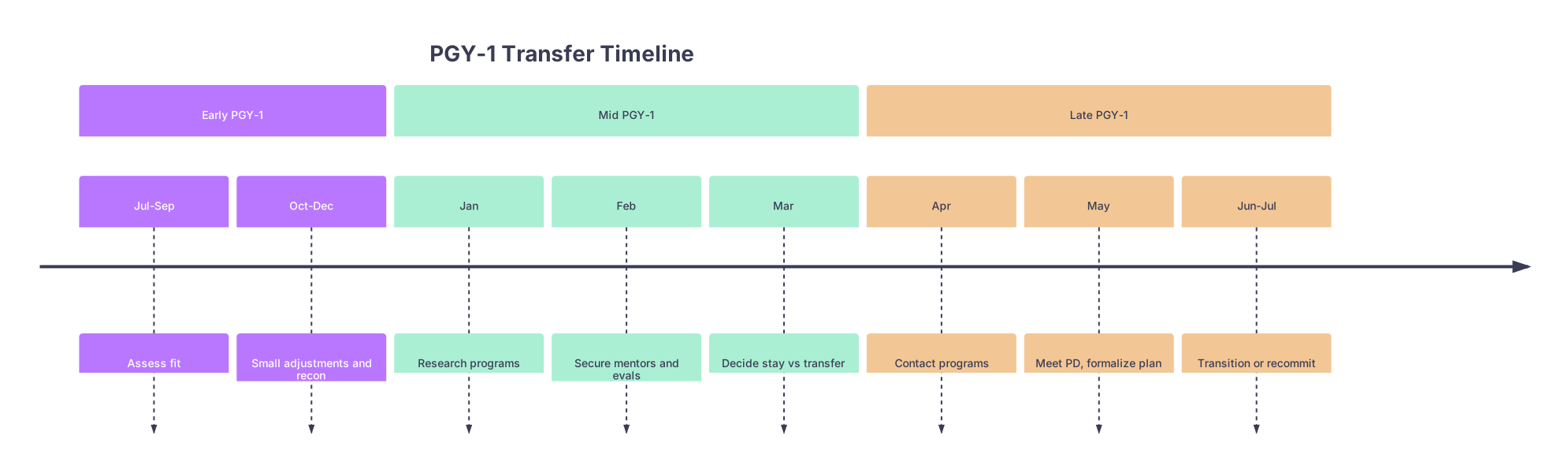
| Period | Event |
|---|---|
| Early PGY-1 - Jul-Sep | Assess fit |
| Early PGY-1 - Oct-Dec | Small adjustments and recon |
| Mid PGY-1 - Jan | Research programs |
| Mid PGY-1 - Feb | Secure mentors and evals |
| Mid PGY-1 - Mar | Decide stay vs transfer |
| Late PGY-1 - Apr | Contact programs |
| Late PGY-1 - May | Meet PD, formalize plan |
| Late PGY-1 - Jun-Jul | Transition or recommit |
Week 1–2 (Early April): Targeted Outreach
At this point you should:
Create a short, professional email template to PDs of target programs:
- Who you are (name, specialty, current PGY-1 program, type of program).
- Why you are reaching out (interest in potential PGY-2 position if available).
- One or two non-toxic lines about environment mismatch:
- Example: “I am currently in a strong community program but am seeking a more research-oriented academic environment aligned with my long-term goals in subspecialty X.”
- Attach CV and brief paragraph from your mentor/letter writer if possible.
Send to a small, realistic list first (3–5 programs), not to every top-10 name you can think of.
You are fishing for:
- “We may have an opening.”
- “We sometimes take transfers; keep in touch.”
- Or: “We do not accept transfers.” (Good to know, move on.)
Week 3–4 (Late April): Internal Disclosure (Carefully Timed)
Once a program shows actual interest, not before, you need to involve your PD.
At this point you should:
- Schedule a meeting with your PD:
- Do not blindside them after an offer.
- Do not make it sound like you hate your current program.
Frame the conversation around:
- Training alignment:
- “I have realized I am more suited to a [community/academic] environment, particularly because of [teaching style, research goals, autonomy needs].”
- Respect:
- “I am grateful for the training I am receiving here. I want to explore whether another environment might be better aligned before I get further along.”
You want your PD to:
- At minimum, not sabotage you.
- At best, support you with a letter or at least confirm your standing.
Managing the Community vs Academic Angle Specifically
This is where residents make predictable mistakes. They misinterpret what is “wrong.”
If You Are in a Community Program Craving Academic
At this point you should not assume you must leave to have an academic career. That assumption is lazy and wrong.
First, maximize what you have:
- Ask explicitly for:
- Elective rotations at a nearby academic center.
- Participation in ongoing QA or research projects, even small ones.
- Show up at:
- Grand rounds at your affiliated university.
- Regional or national society meetings with case reports.
](https://cdn.residencyadvisor.com/images/articles_svg/chart-common-paths-from-community-to-academic-careers-2913.svg "Common Paths from Community to Academic Careers")
| Category | Value |
|---|---|
| Fellowship at academic center | 55 |
| Research during residency | 20 |
| Post-residency academic job search | 15 |
| [Additional research year](https://residencyadvisor.com/resources/community-vs-academic-residency/gap-year-timing-using-research-time-to-switch-between-settings) | 10 |
If, after pushing all of that, you still feel constrained—no realistic path to research, no nearby academic tie-ins, minimal teaching—then yes, consider switching to an academic or hybrid program.
But do not burn a community spot just because it “doesn’t feel fancy enough” three months in.
If You Are in an Academic Program Craving Community
Academic programs often underestimate how suffocating they can feel if you want autonomy and straightforward clinical practice.
At this point you should:
- Look for high-autonomy clinical rotations:
- County hospitals.
- Community affiliates.
- Talk to graduates who went straight into practice:
- Ask how well your current training is preparing you for their jobs.
- Ask what they would have wanted more of.
If your daily life is endless bureaucracy, tiny slices of patient care, and being the lowest rung under fellows and students, you may be genuinely in the wrong environment.
Transferring to a strong community program can be the right move if your goal is:
- Bread-and-butter clinical excellence.
- Faster autonomy.
- Less research/publishing pressure.
Day-by-Day Micro-Adjustments While You Decide
While all this strategic planning happens in the background, you still have to get through each day without falling apart.
At this point you should anchor to a few simple daily habits:
- One thing you will learn today:
- A skill, a differential, a management algorithm.
- One relationship you will strengthen today:
- Senior, nurse, attending who could become a reference.
- One element you will document today:
- Case for your log, example for your CV, an incident that illustrates culture.
None of this is busywork. This is raw material for:
- Your narrative if you stay: “Here is how I grew in a challenging environment.”
- Your narrative if you leave: “Here is why the environment mismatch was real, and here is how I still performed.”
Visual Overview of Milestones
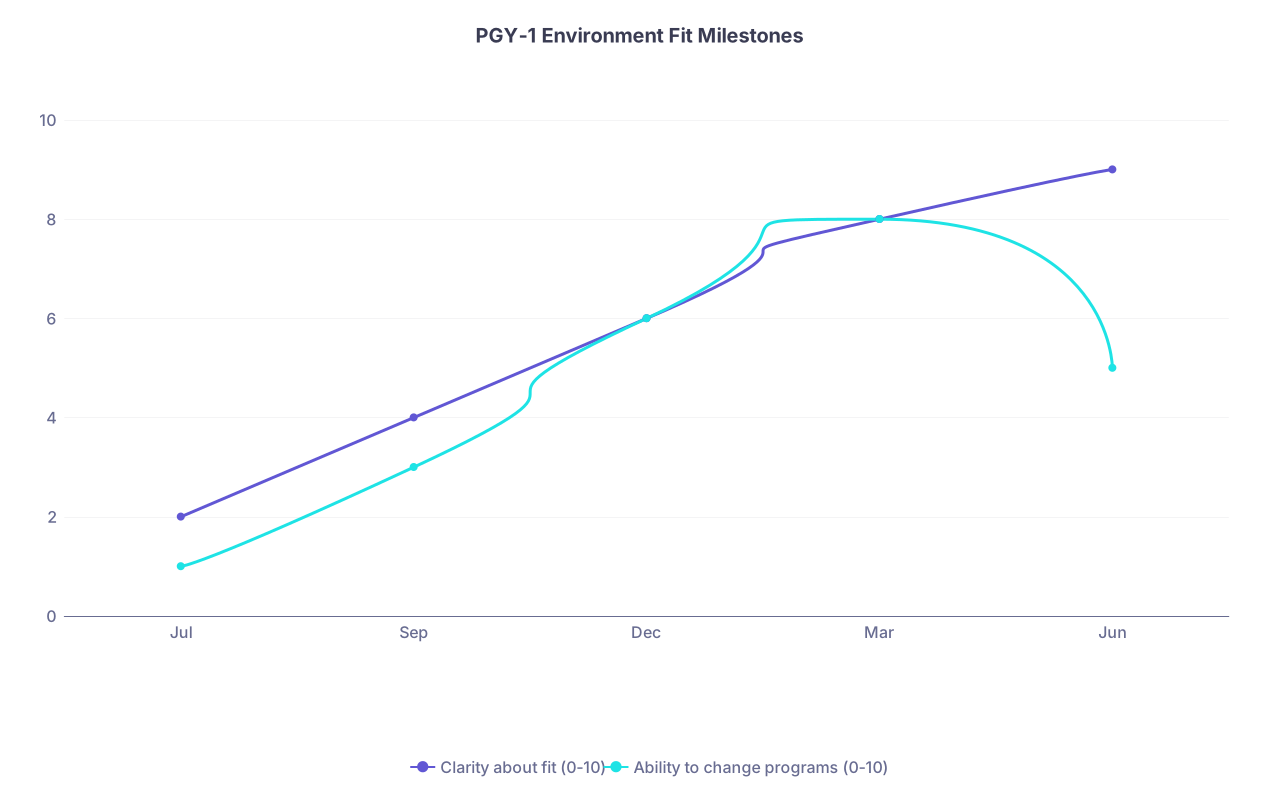
| Category | Clarity about fit (0-10) | Ability to change programs (0-10) |
|---|---|---|
| Jul | 2 | 1 |
| Sep | 4 | 3 |
| Dec | 6 | 6 |
| Mar | 8 | 8 |
| Jun | 9 | 5 |
Notice the pattern: your clarity increases as the year goes on, but your external flexibility peaks mid-year, then drops when positions fill and contracts lock in.
If You Decide To Stay: Reframing by End of PGY-1
Not everyone should transfer. In fact, most should not.
If, by June, you choose to stay in your current environment, you need a PGY-2 reframe:
At this point you should:
Define 2–3 concrete goals that use your environment’s strengths:
- Community:
- High procedure volume.
- Broad undifferentiated pathology.
- Close attending relationships.
- Academic:
- Subspecialty depth.
- Research and teaching roles.
- Complex, rare cases.
- Community:
Map how you will plug the gaps:
- Community resident who wants academic:
- Dedicated research mentor, away electives, national conferences, academic-minded fellowship.
- Academic resident who wants community-style autonomy:
- Moonlighting (when allowed), community rotations, extra procedural training.
- Community resident who wants academic:
You do not have to love every aspect of your environment. You do have to leverage it intentionally.
Final Takeaways
- You must separate normal PGY-1 pain from a true environment mismatch by about 6 months into the year, not 2 weeks.
- If you are going to explore a move between community and academic programs, your practical window is January–May of PGY-1, with careful, staged conversations.
- Whether you stay or switch, the key is deliberate use of your environment—stop waiting for the “ideal program” and start engineering the training path that matches who you actually are.