
The worst residency decisions come from people who’ve only seen one side of medicine and assume it’s the whole universe. Do not be that person when you rank community vs academic programs.
If you’re in the residency application phase and still torn between community and academic training, you need structure. Not vibes. A month‑by‑month plan that deliberately exposes you to both worlds before you certify that rank list.
Below is exactly that plan.
Big Picture: Your 12-Month Window
Let me anchor you first. Most people considering community vs academic are:
- Late MS3 into MS4
- Or taking a research/transition year
- Or already in the ERAS / Match cycle and trying to refine preferences
So I’ll frame this as a 12‑month cycle that runs from early MS4 (or equivalent) through Match Day, focused specifically on experiencing, comparing, and deciding between community and academic rotations and programs.
To make it concrete, I’ll assume:
- ERAS submission in September
- Interviews October–January
- Rank list due late February
- Match Day March
Then I’ll work both backward and forward around that.
Months −12 to −9: Set Up Your Exposure (Planning Year / Late MS3)
At this point you should stop “keeping an open mind” and start designing your year like an experiment. Hypothesis: “I’ll figure out if I prefer community or academic training by comparing specific, structured experiences.”
Month −12: Reality check and inventory
At 12 months before ERAS (often spring MS3):
Audit what you’ve actually seen.
- How many large academic centers?
- How many true community hospitals (no fellows, few or no residents, limited subspecialties)?
- Any hybrid sites (community programs with academic affiliations)?
Identify your bias:
- If your core clerkships were at a big university hospital, you’re probably overestimating how “essential” constant teaching and research are.
- If you trained mostly at a community site, you might think academic centers are bloated, slow, and obsessed with RCTs over real life.
Make a concrete exposure target:
- Minimum:
- 2+ months academic rotations (home or away)
- 2+ months community rotations (home-affiliate, away, or sub‑I)
- Minimum:
Write it down. This is your exposure quota.
Month −11: Map rotations against that quota
Now you start playing chess with your schedule office.
At this point you should:
- Meet with:
- Your specialty advisor (e.g., IM, EM, surgery)
- Your dean / advising office
- Show them your goal: “I need both academic and community exposure to make a smart decision between program types.”
Design a tentative layout:
- Early MS4 (pre-ERAS):
- 1 academic sub‑I / audition
- 1 community sub‑I / audition
- Mid MS4 (interview season):
- Shorter electives, lighter rotations for travel
- Late MS4 (post‑rank list):
- Optional extra community or academic block if you’re still torn, but at that point it’s more for insight than for applications.
Month −10: Lock down key away rotations
Away rotations are currency. Use them strategically.
At this point you should:
- Pick 1–2 target academic programs
- Pick 1–2 target community or community-heavy programs
Then:
- Apply for:
- VSLO/VSAS away rotations at an academic powerhouse (think major university or tertiary care center in your specialty)
- A true community program where you could realistically see yourself training
Your goal is not to “show face” everywhere. Your goal is to experience both ecosystems deeply enough that your brain can tell them apart when you’re ranking programs.
Months −9 to −6: Deep Dive Rotations Before ERAS
Now you move from planning to actually living these differences day by day.
Month −9: First major exposure – usually academic
Usually, schools put you on an academic sub‑I first (often at your home program).
At this point you should be:
Observing the academic feel systematically:
- How often are there:
- Morning reports
- Noon conferences
- M&M conferences
- Grand rounds
- Who actually shows up? Residents? Attendings? Just interns forced to be there?
- How often are there:
Watching the workflow:
- Layers: interns → residents → fellows → attendings
- How many people must sign off before a decision happens?
- Are notes and orders heavily scrutinized? By whom?
Tracking the patient mix:
- High acuity?
- Rare zebras?
- Multi-organ transplant, LVADs, ECMO, or advanced cancer protocols?
Daily checklist on this rotation:
- End of each day, jot 3 bullets:
- One thing you liked about the academic structure
- One thing you disliked
- One moment that would not happen at a community hospital (e.g., 20‑person rounding team, research consent on patients, fellow taking over complex procedure)
Those notes will save you later when programs start blending together.
Month −8: Community rotation #1 – strip away the safety net
Next, you need a real community month. Preferably where:
- There are few or no fellows
- Attendings are closer to the front line
- Less constant subspecialty backup
At this point you should:
Compare autonomy:
- Are attendings letting you (and residents) “own” more of the patient from start to finish?
- Are decisions made faster because there are fewer layers?
Watch teaching vs throughput:
- Is teaching more “on the fly” between cases?
- Fewer formal didactics, more “see this patient, let’s talk in the hallway”?
Notice case volume and efficiency:
- Are you seeing more bread‑and‑butter cases per day?
- Is documentation leaner? Shorter notes, simpler order sets?
Week-by-week focus on this community month:
- Week 1: Just watch. Don’t judge. Get used to the pace.
- Week 2: Start asking, “Where do residents from here end up? Fellowships? Jobs?”
- Week 3: Ask an upper-level why they chose this community program or this site. Write those reasons down.
- Week 4: Explicitly compare this month to last month’s academic sub‑I in your notes: autonomy, education, lifestyle, mentorship.
Months −7 to −5: ERAS Season + Targeted Rotations
Now you’re getting close to application timing. Your experiences should start steering your actual application strategy.
Month −7: Refine your application strategy (academic-heavy vs community-heavy list)
You’ve now seen:
- At least one academic month
- At least one community month
At this point you should:
Categorize what you prefer so far:
- More structured teaching vs more hands-on autonomy
- High‑acuity tertiary-center chaos vs high-volume bread‑and‑butter
- Subspecialty depth vs broad general practice
Build an initial target mix of programs:
- Example: 40% academic, 40% community, 20% hybrid
- Or if you’re clearly leaning one way: 70% your preferred style, 30% other style as reality check
| Preference Lean | Academic Programs | Community Programs | Hybrid Programs |
|---|---|---|---|
| Strong academic | 15 | 5 | 5 |
| Balanced | 10 | 10 | 5 |
| Strong community | 5 | 15 | 5 |
You’re not locking anything yet, but you are stopping the aimless “I’ll see how it goes.” Now you’re testing a deliberate plan.
Month −6: Final pre‑ERAS rotation choices
This month should be strategic:
If you’re still unsure:
- Do one more rotation of the “other” type.
- Example: if you just did academic IM and liked it, spend this month at a strong community IM site before applications go in.
If you’re leaning hard one way:
- Do another audition in that environment to:
- Get strong letters that match your eventual program type
- Show consistency in your story
- Do another audition in that environment to:
At this point you should also:
- Identify which letter writers are community vs academic.
- Community letters often emphasize: work ethic, independence, efficiency, “ready for day 1”.
- Academic letters often emphasize: clinical acumen, teaching ability, research potential.
You’ll want both if you’re genuinely open to both program styles.
Month −5: ERAS Submission Month
Now the paperwork needs to reflect the reality you’ve observed.
At this point you should:
Finalize your program list partition:
- Tag each target program as:
- Academic
- Community
- Hybrid (community-based but university affiliated, moderate research, maybe a fellowship or two)
- Tag each target program as:
Calibrate expectations:
- Academic programs often:
- Care more about research, academic interest, exam scores, letters from known faculty
- Community programs often:
- Care more about clinical performance, teamwork, grit, and genuine interest in community practice
- Academic programs often:
Shape your application accordingly:
Personal statement angle:
- If you’re truly undecided, you can emphasize:
- Love of teaching
- Interest in broad clinical exposure
- Openness to both academic and community career paths
- If you’re truly undecided, you can emphasize:
Program-specific signals:
- In any supplemental essays, don’t lie. If you loved your community rotations, say so. If you thrive on academic discussion and research, say that where it fits.
Months −4 to −2: Interview Season – Real-Time Comparison
Here’s where people blow it: they treat interviews like isolated events instead of a structured comparison experiment. You’re going to do the opposite.
Month −4: First wave of interviews – focus on program ecosystem
At this point you should:
- Label each interview before you go:
- “Strong academic” (university hospital, multiple fellowships, heavy research)
- “Strong community” (single main hospital, limited or no fellows)
- “Hybrid”
On each interview day, track:
1. Teaching culture
- Who actually runs teaching?
- Fellows vs attendings vs residents
- Are conferences well‑attended or ghost town?
- Are cases discussed in depth or speed‑run?
2. Resident autonomy
- Do residents present and make plans, or do attendings micromanage?
- Do residents do procedures vs fellows taking them?
3. Patient population + resources
- Academic:
- Transplants, rare oncologic cases, complicated multi‑morbid patients
- Community:
- High volume of diabetes, COPD, heart failure, routine procedures, urgent surgical cases
Month −3: Mid‑season – pattern recognition
By now, your notes matter. If you didn’t start taking them, start now.
At this point you should:
- After every interview, spend 10 minutes on a structured reflection:
- 3 things that felt very academic (even in community-leaning programs)
- 3 things that felt very community (even in university settings)
- 1 moment where you thought, “I would/would not want to practice in this environment every day.”
Use a simple grid to force pattern recognition:
| Program | Type (Self-Described) | Felt More Like | Autonomy (1-5) | Academics (1-5) |
|---|---|---|---|---|
| A | Academic | Academic | 2 | 5 |
| B | Community | Community | 4 | 2 |
| C | Hybrid | Academic | 3 | 4 |
You’re trying to answer:
“Do I prefer practicing where I feel slightly stretched academically or slightly stretched clinically and operationally?”
Month −2: Late-season – calibrate your future self
This is where the romanticism needs to die and reality steps in.
At this point you should:
- Talk to PGY3+ residents at both community and academic programs and ask:
- Where did graduates go?
- Fellowship match list
- Community jobs
- Hospitalist / generalist vs subspecialty
- What do they wish they’d known about the community vs academic choice?
- Where did graduates go?
Ask very direct questions:
For academic programs:
- “If I decide I never want to do research or be faculty, will I still be happy here?”
- “Do community or private jobs respect graduates from here, or see them as too subspecialized?”
For community programs:
- “How realistic is it to match a competitive fellowship from here?”
- “How supported were you in research/QI if you wanted it?”
Month −1: Rank List Construction – Converting Experience to Decisions
You’re done “exploring.” Now you decide.
At this point you should:
Sort your interview programs into three stacks:
- Clear academic
- Clear community
- True hybrid
For each stack, answer:
- Academic stack:
- Am I willing to trade some autonomy and possibly heavier bureaucracy for deeper subspecialty exposure, research, and academic reputation?
- Community stack:
- Am I willing to trade some structured teaching and name recognition for earlier autonomy, efficiency, and more hands-on clinical time?
- Hybrid stack:
- Is this actually the best of both worlds, or just mediocre at both?
- Academic stack:
Use a simple weighting for each program:
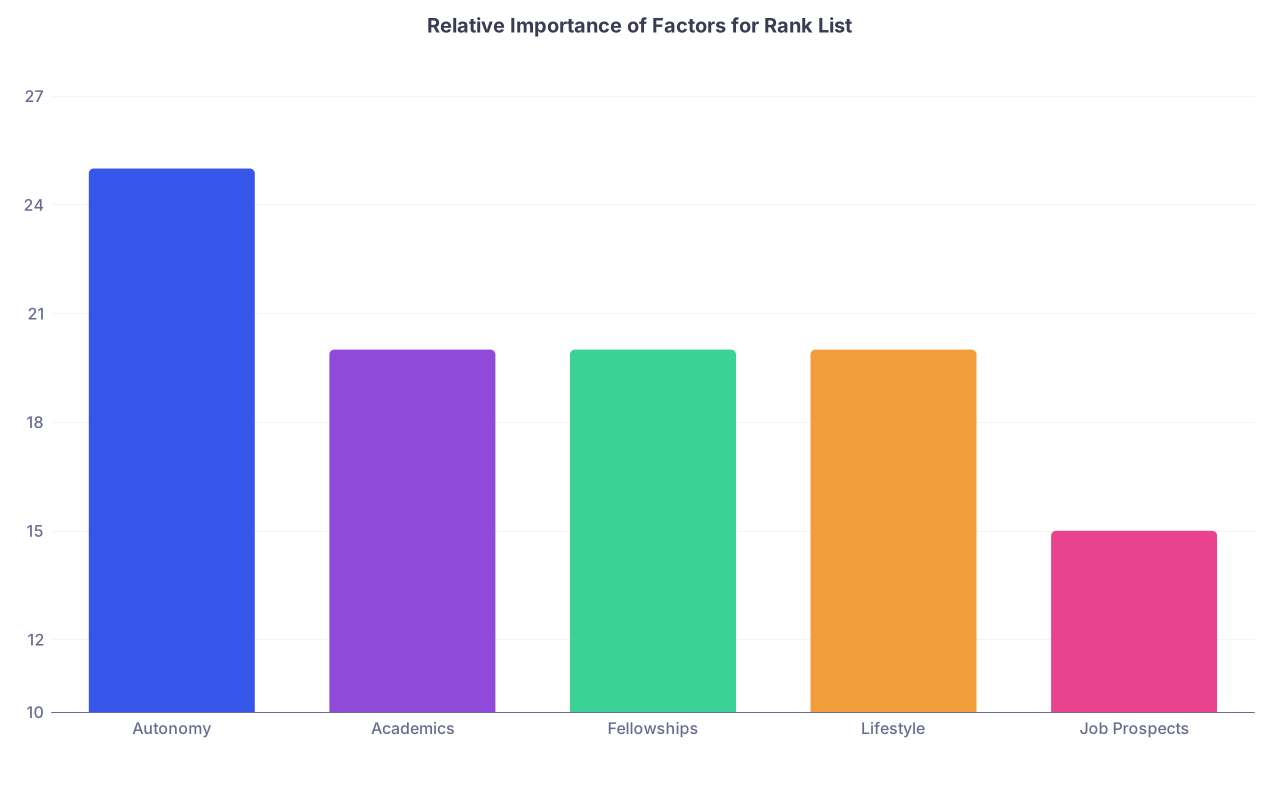
| Category | Value |
|---|---|
| Autonomy | 25 |
| Academics | 20 |
| Fellowships | 20 |
| Lifestyle | 20 |
| Job Prospects | 15 |
Define your own weights. Then, for each program, rate:
- Autonomy (1–5)
- Academic strength (1–5)
- Fellowship pipeline (1–5)
- Lifestyle (1–5)
- Job outcomes (1–5)
Multiply, total, and see where your gut disagrees with your score. Spend time on those conflicts. That’s usually where your real preference (community vs academic) is hiding.
Match Month and After: Decompression and Honest Debrief
Match Month: Accept the type you chose (or got)
Once you match—academic, community, or hybrid—you’re not done learning from this. You just move into “make the most of what you got” mode.
At this point you should:
- If you matched academic but still crave community exposure:
- Look for community elective sites, outside rotations, or community moonlighting later.
- If you matched community but want academic options later:
- Get involved in quality improvement, small research projects, teaching med students, present at regional/national meetings.
Post‑Match Months: Capture lessons for the next generation (and for yourself)
While everything’s still fresh, do one final debrief for yourself:
- What did you think community vs academic meant before all this?
- What did your rotations actually show you about:
- Workflow
- Mentorship
- Learning style
- Career trajectories
That reflection will guide how you steer your own residents and students one day.
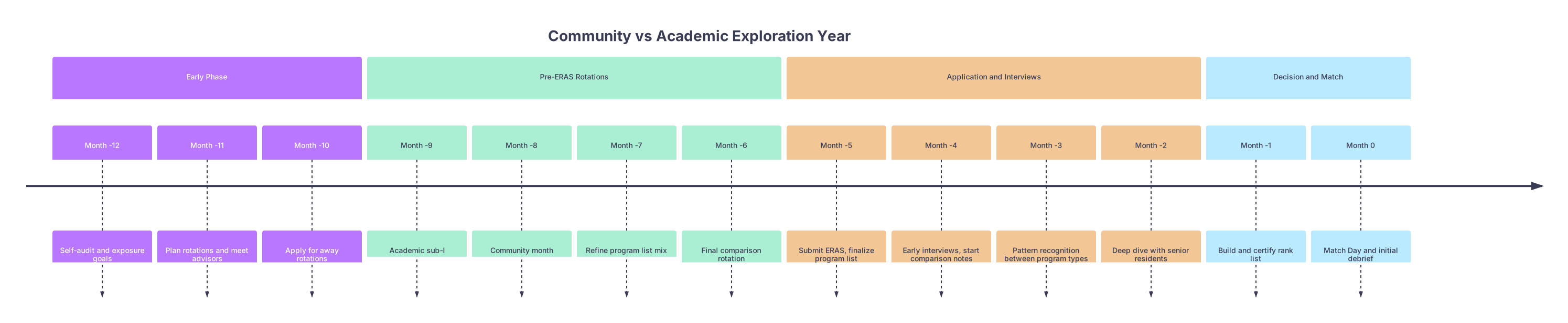
| Period | Event |
|---|---|
| Early Phase - Month -12 | Self-audit and exposure goals |
| Early Phase - Month -11 | Plan rotations and meet advisors |
| Early Phase - Month -10 | Apply for away rotations |
| Pre-ERAS Rotations - Month -9 | Academic sub-I |
| Pre-ERAS Rotations - Month -8 | Community month |
| Pre-ERAS Rotations - Month -7 | Refine program list mix |
| Pre-ERAS Rotations - Month -6 | Final comparison rotation |
| Application and Interviews - Month -5 | Submit ERAS, finalize program list |
| Application and Interviews - Month -4 | Early interviews, start comparison notes |
| Application and Interviews - Month -3 | Pattern recognition between program types |
| Application and Interviews - Month -2 | Deep dive with senior residents |
| Decision and Match - Month -1 | Build and certify rank list |
| Decision and Match - Month 0 | Match Day and initial debrief |
Key Takeaways
- You cannot think your way into knowing whether you prefer community or academic programs; you must plan and live both types of rotations, month by month.
- During interviews, treat each visit as data in an experiment: systematically compare autonomy, teaching, patient mix, and outcomes between community and academic environments.
- When you build your rank list, stop hand‑waving—define your priorities, score programs against them, then listen carefully where your gut and your scorecard disagree. That’s where your real preference lives.