The worst timing mistake residents make with research years is assuming any gap year is automatically helpful. It is not. The when and the where of that research year matter as much as the research itself—especially if you’re using it to jump from a community-heavy path to an academic program, or vice versa.
You’re not just “taking a year off.” You’re restructuring your trajectory in a system that really does care whether you look academic, community-focused, or confused.
Below is a timeline-driven guide: what to do 18 months out, 12 months out, all the way down to weekly priorities during the gap year, if your goal is to use research time to switch between community and academic settings for residency or fellowship.
18–24 Months Before Your Target Match: Decide Your Direction and Feasibility
At this point you should be brutally honest about what you’re switching to and what you’re switching from.
Step 1: Define your starting point (community vs academic profile)
Right now, list your current “brand”:
Coming from a community program:
- Strong: hands-on autonomy, procedural volume, real-world efficiency
- Weak: limited research output, fewer “big-name” letters, fewer national presentations
Coming from an academic program:
- Strong: access to research, subspecialty exposure, name recognition
- Weak: sometimes less autonomy, may look less “practice-ready” for certain community jobs
If you’re trying to:
- Move community → academic (e.g., fellowship at a big-name academic center)
- Or academic → community (e.g., be more attractive to high-volume community groups)
…your gap year has to be designed with that endpoint in mind. Not generic “research.”
Step 2: Decide if a gap year is actually needed
By now, you should ask three hard questions:
Are you changing specialties or just settings?
- Specialty switch (e.g., IM to rad onc): you almost certainly need a structured research year.
- Same specialty, setting change (community IM → academic cards fellowship): maybe yes, maybe no, depending on your Step scores, current CV, and letters.
Are your scores/metrics fatal for your goal without a major upgrade?
- Example: Step 1 pass, Step 2 CK 220, community IM, wants heme/onc at a top-20 academic program. A targeted research year at a heme/onc-heavy academic center can be the difference between auto-screened and seriously considered.
Are your gaps fixable without a year?
- Sometimes a couple of strong projects and better networking from within your current program beats disappearing for a year and coming back looking disconnected.
If the answer after these questions is still “I need the gap year,” then proceed.
12–18 Months Before Match: Lock the Timeline and Targets
At this point you should know which Match cycle you’re aiming for and roughly where you want to do research.
Timeline basics
You need to align three things:
- When you start the research year
- When you’ll be submitting ERAS
- How long you’ll have to produce usable outcomes (posters, abstracts, letters)
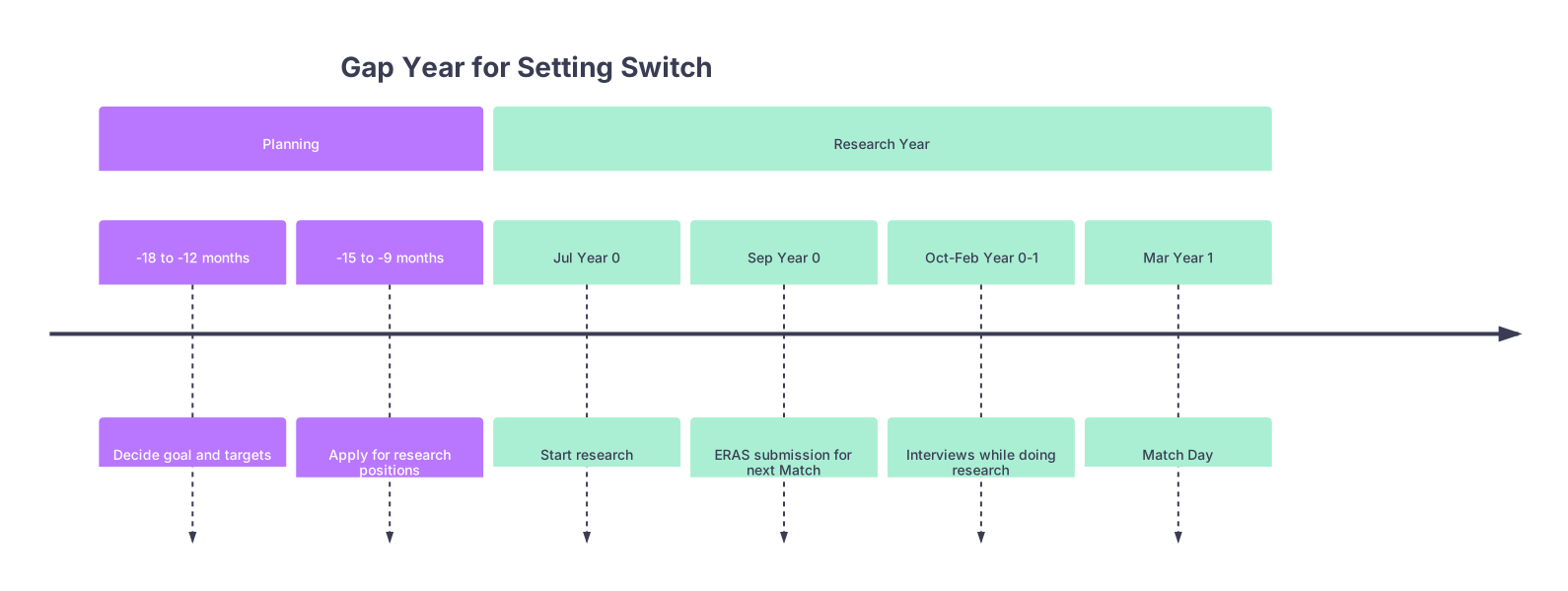
| Period | Event |
|---|---|
| Planning - -18 to -12 months | Decide goal and targets |
| Planning - -15 to -9 months | Apply for research positions |
| Research Year - Jul Year 0 | Start research |
| Research Year - Sep Year 0 | ERAS submission for next Match |
| Research Year - Oct-Feb Year 0-1 | Interviews while doing research |
| Research Year - Mar Year 1 | Match Day |
The key point: if you start a research year in July, you’ll be applying for the very next Match in September—just 2–3 months into the year. That means the main value of the year for that application cycle is:
- The institution name
- The letters of recommendation
- Your stated trajectory (“I’m here in the cardiology imaging lab, building a research foundation for an academic cardiology career”)
Most publications will not be visible yet. Plan accordingly.
Choosing the right research environment for your switch
This is where people screw it up. You can’t pick any random lab.
If you’re going community → academic:
- You need:
- A recognizable academic institution name
- A PI who is active in national societies and writes strong letters
- A niche that aligns with your target academic field
(e.g., heart failure outcomes, transplant, solid tumor trials, etc.)
If you’re going academic → community:
- You need:
- Projects that highlight QI, systems-based practice, cost-effectiveness
- Exposure to clinical operations, workflow improvement, or population health
- Work that can be sold as “I understand how to optimize care in a real-world, resource-constrained setting”
Do not just chase prestige for a community-bound future unless it clearly helps: some community groups care more about “Can you run this ICU at 3am?” than “Did you publish in JAMA?”
9–12 Months Before Research Start: Secure the Position and Align Documentation
At this point you should be actively locking down a formal research role that looks good on ERAS, not just “I’ll help out with some projects.”
Month-by-month
9–12 months before start
- Email targeted faculty:
- Use subject lines like “Prospective research year – IM resident interested in academic cardiology”
- Attach CV tailored to your goal: put clinical strengths in context of the new setting you want
- Ask blunt questions:
- Will I have my own projects?
- How many papers/abstracts do your research fellows usually get?
- Are you comfortable writing a strong letter for fellowship/residency applicants?
6–9 months before start
- Finalize:
- Institutional onboarding
- Funding / visa status if relevant
- Tell your current PD:
- For community → academic: frame it as “I want to build research skills to bring back rigorous evidence-based practice.”
- For academic → community: frame it as “I want formal QI/population health experience that will make me a stronger community clinician.”
You want letters from your current setting that support the narrative of your switch, not hint at misalignment or escape.
3–6 Months Before Start: Build a Pre-Arrival Track Record
At this point you should be building momentum before day one of the gap year.
What this looks like:
- Finish small projects at your current program:
- Case reports, short communications, simple QI projects
- Present locally or regionally if you can
- Secure at least one mentor who will:
- Say, in writing, “This person is serious about [academic X / community-focused Y]”
- Be reachable by your future PI (yes, people actually email quietly and ask “What’s the real story?”)
If you’re aiming for academic fellowship from a community base, you want your future application to show:
- Community program + evidence of academic curiosity
- Then: research year at academic center that confirms this wasn’t random
If you’re aiming for community jobs from an academic base, you want:
- Academic program + evidence you care about practice efficiency, outcomes, or QI
- Then: research/QI year that clearly connects to value-based care, throughput, or system improvement
Month 0–3 of the Research Year: Launch Fast and Loud
This is the most under-appreciated window. At this point you should be:
- In your new institution
- On-boarding fast
- Getting your name on projects within the first 4 weeks
Because ERAS opens in September, and program directors will read your application when you’re barely settled.
Week 1–2
- Meet with your PI:
- Demand (politely) a project list with short-, medium-, and long-term goals.
- Identify 1–2 projects where you can be first or second author.
- Clarify expectations:
- Will you be on rounds? Clinics? Just research?
- What’s the realistic number of abstracts/papers for the year? (I like to hear a plan for 2–3 abstracts and at least 1 serious manuscript.)
Week 3–4
- Start drafting:
- Abstracts from existing data
- IRB proposals if starting something new
- Get your name:
- On the research group email list
- On any recurring meetings where people will see you consistently
Your goal: when PDs or selection committee members at that institution glance at your file, someone in the room says, “Oh yeah, I’ve seen them in meetings. They’re working with Dr. X.”
The ERAS Application During Your Gap Year: How to Frame the Switch
At this point (usually September–October) you’re applying while only a small piece of the research year is visible. The framing matters.
Community → Academic: how your application should read
You want your trajectory to look like:
- “Solid community foundation”
- “Deliberate move into academic environment to gain research and scholarly skills”
- “Clear subspecialty/academic interest with concrete early outputs”
Your ERAS should emphasize:
- Clinical experiences in the community that show:
- Autonomy
- Breadth of pathology
- Real-world patient care
- New research experiences that show:
- Specific academic niche (heart failure, GI motility, health disparities)
- Early outputs (submitted abstracts, manuscripts in preparation)
- Letters from academic names saying: “They belong in an academic trajectory.”
Academic → Community: how your application should read
You want your trajectory to read as:
- “Strong academic training”
- “Intentional focus on applying evidence and QI to real-world practice”
- “Stable, committed to long-term community work”
Emphasize in ERAS:
- Projects focusing on:
- Throughput, readmissions, cost, patient safety, chronic disease management
- Experiences with:
- Community clinics, FQHCs, safety net hospitals, or health systems operations
- Personal statement that sounds like:
- “I enjoy complex systems, but I want my career anchored in a community group where I can implement and sustain improvements.”
During the Research Year: Month-by-Month Priorities
At this point you should run your year like a compact, high-yield project.
| Month | Primary Focus |
|---|---|
| 1–2 | Join projects, define roles, start drafts |
| 3–4 | Submit abstracts, build visibility |
| 5–6 | Push manuscripts, attend/present at meetings |
| 7–9 | Solidify letters, update CV/ERAS, interview prep |
| 10–12 | Close projects, maintain connections, plan next step |
Months 1–2
- Join multiple projects (3–5), but identify:
- 1–2 where you’ll push hard for first/second authorship
- Start weekly check-ins with your PI or senior mentor
- Track everything:
- Abstract titles, roles, deadlines, IRB numbers
- You will forget details later during interviews if you don’t
Months 3–4
At this point you should have something submitted:
- Abstracts to regional/national meetings
- A manuscript in draft, even if rough
If you’re switching to an academic path:
- Aim for national-level meetings in your field:
- ACC, ATS, ASCO, ACG, RSNA, etc.
- Network at these venues (yes, people absolutely remember the resident who asked one good question in a small session).
If you’re switching to community:
- QI-focused meetings, system-improvement conferences, or society sections that care about implementation science will look strong.
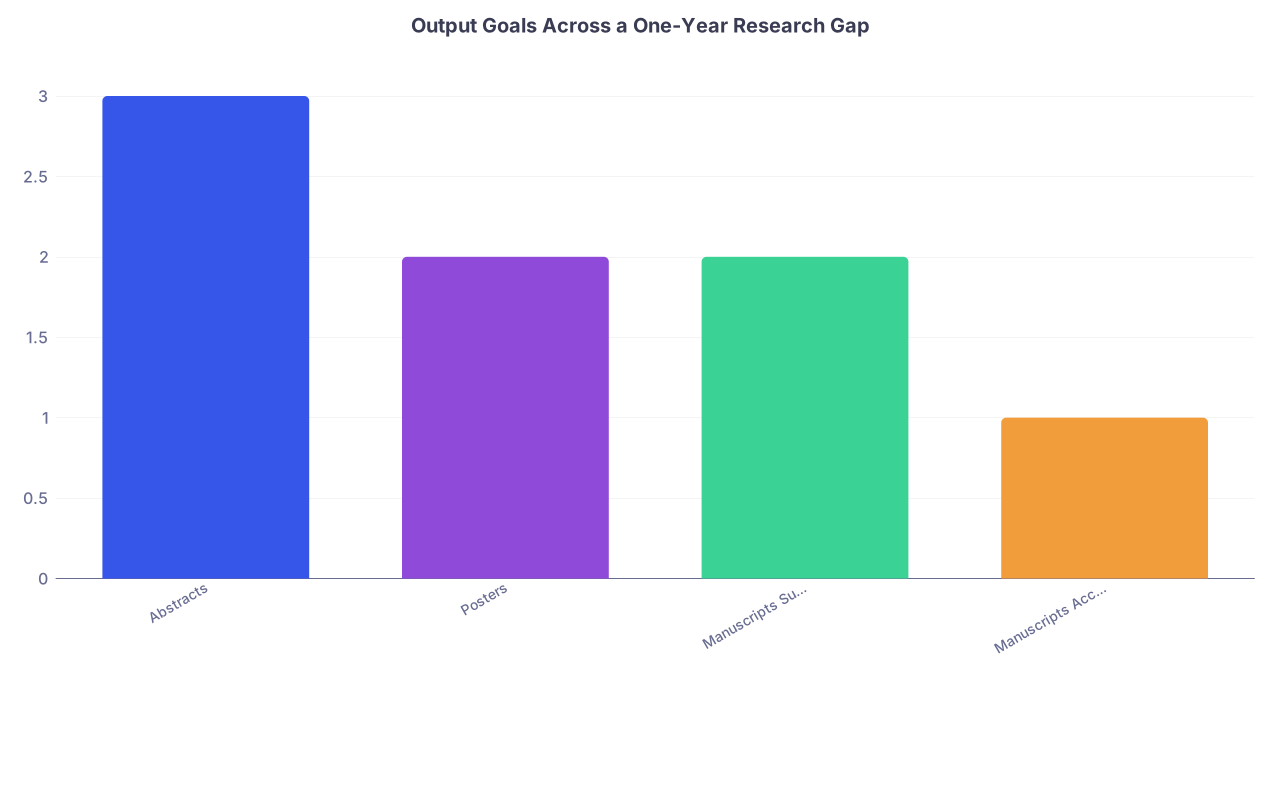
| Category | Value |
|---|---|
| Abstracts | 3 |
| Posters | 2 |
| Manuscripts Submitted | 2 |
| Manuscripts Accepted | 1 |
These numbers aren’t magical, but they’re realistic if you start fast and stay aggressive.
Months 5–6
- Present if your abstracts are accepted
- Push at least one manuscript past the “submitted” stage
- Schedule explicit letter conversations:
- Tell your PI and key faculty:
- Your exact goal (e.g., “GI fellowship at an academic program” or “hospitalist job in high-volume community hospital”)
- The narrative you want their letter to support
- Tell your PI and key faculty:
Do not assume they automatically understand your setting switch. Spell it out.
Months 7–9
At this point you should be deep in interview season.
Your weekly rhythm:
- Mon–Thu:
- Normal research work
- Keep projects moving; interviewers can tell when all productivity stopped in October.
- Fri:
- Interview travel/virtual interviews
- Update your CV and project status document
Your interview answers should be time-consistent:
- Why did you take a gap year?
- Why this research?
- Why this setting (academic vs community) now?
If those three answers don’t line up, you’ll sound aimless. PDs hate aimless.
Months 10–12
At this point you should:
- Close loops on ongoing projects:
- Make sure someone will carry them forward if you leave
- Secure co-authorship agreements in writing (emails count)
- Maintain relationships:
- Thank-you emails to mentors
- Quick updates when things get accepted/published
- Finalize:
- Post-Match plans
- Transition into your new setting (residency, fellowship, or job)
Common Timing Pitfalls (And How to Avoid Them)
At this point, let me be blunt about what I’ve seen go wrong:
Starting the research year too late
- You begin in October.
- ERAS already submitted.
- PDs mostly see a vague “future research position” with zero detail. Almost no value.
Choosing the wrong environment
- Community → academic, but you do research at another small community place with no national footprint.
- Result: your “switch” looks like lateral drift, not an intentional move.
No early products
- You spend 8 months cleaning data and never get your name on an abstract.
- By interview time, you have nothing concrete to talk about.
Mismatched narrative
- Your personal statement screams “hardcore academic,” but your letters hint you’re lukewarm, or vice versa.
- Commit. Pick the setting you’re aiming for and let everything line up behind it.
Quick Comparison: Which Research Year Helps Which Switch?
| Current → Target | Ideal Research Location | Main Focus |
|---|---|---|
| Community → Academic | Large academic center | Subspecialty clinical research, national abstracts |
| Academic → Community | Academic or large system with strong QI | QI, outcomes, cost-effectiveness, workflow |
| Community → Community (competitive job) | Either, with strong mentor | High-yield QI + leadership |
| Academic → Academic (more competitive) | Higher-profile academic center | High-impact publications, big-name letters |

Final Takeaways
- A research gap year only helps you switch between community and academic settings if the timing, environment, and narrative are aligned with your target.
- The most critical window is the first 2–3 months of the research year, because that’s what programs see during ERAS and interviews.
- Design your projects and mentors so your application clearly reads as: “I came from X, I deliberately did Y this year, so I can now thrive in Z setting.” If that story is tight, the switch is absolutely doable.