
July 1: You’ve Submitted ERAS… Now What?
It’s early July. Your ERAS draft is basically done, MS4 schedule locked. You’ve checked the “community vs academic” box in your head a dozen times and still don’t have a real answer.
On paper? You “want good training, good teaching, and a supportive culture.” So does everyone else.
The problem is this: the real differences between community and academic programs do not live on websites or in program overviews. You only see them on the trail. Who actually staffs nights. How attendings speak to nurses. Who does the procedures. Who gets the sickest patients. Who gets fellowship interviews.
From July through September, your job is to build a structured, time-based way to evaluate that—while you’re drowning in rotations, interview prep, and logistics.
Here’s how to do it, step by step.
July: Set Up Your “Community vs Academic” Evaluation System
In July you’re mostly in pre-interview mode. This is when you set the rules of the game.
At this point you should:
- Be crystal clear on your career direction (at least: fellowship vs no fellowship, research vs not)
- Build a standardized scorecard you’ll use for every program
- Identify what you actually care about beyond buzzwords
Week 1 (July 1–7): Decide Who You Are (for Now)
You cannot evaluate programs if you don’t know your own priorities. Academic vs community isn’t just “big name vs smaller hospital.” It’s:
- Research pipeline vs service-heavy clinical work
- Subspecialty “launch pad” vs strong generalist training
- Medical student-heavy vs resident-centric learning
By end of this week, you should have answers—even if provisional—to:
Do I want a fellowship?
- Yes, in a competitive field (GI, cards, heme/onc, ortho, derm, etc.)
- Yes, but less competitive (sleep, geri, nephro, palliative, etc.)
- Maybe, leaning no
- Absolutely not
How much do I care about research?
- Need protected time, mentorship, and publications
- Would like a few projects if they fall in my lap
- Don’t care, just want to be a strong clinician
Lifestyle vs prestige vs pathology – rank them 1–3:
- Lifestyle (schedule, call, geography)
- Prestige / name recognition
- Pathology / acuity / volume
Write this down. Not in your head. On paper or in a note.
This becomes the filter through which you judge “community vs academic.”
Week 2 (July 8–14): Build Your Program Scorecard
Now you set up the tool you’ll use during August–September visits and interviews.
Create a one-page template (Notion, Google Doc, OneNote—whatever you’ll actually open) with the same categories for every program.
Here’s a concrete starting template:
| Category | Weight (1–5) |
|---|---|
| Clinical volume & acuity | 4 |
| Autonomy & procedures | 4 |
| Teaching & didactics | 3 |
| Research & fellowship | 5 |
| Culture & wellness | 4 |
| Location & cost of living | 2 |
Under each category, break out what you’ll actually look for:
Clinical volume & acuity
- Number of admits per call
- ICU exposure
- How many “train wrecks” vs stable patients
Autonomy & procedures
- Who does lines, codes, consults
- How often attendings do the work instead of residents
- ED/ICU trust in residents
Teaching & didactics
- Protected time? Or constantly getting paged out?
- Board pass rates
- Presence of fellows (they can be asset or competition)
Research & fellowship
- How many graduates match into fellowships, and where
- Availability of mentors in your interest area
- Are there ongoing projects residents actually get on?
Culture & wellness
- How residents talk about leadership when leadership is not in the room
- Response to burnout—lip service or concrete changes
- Schedule flexibility (pregnancy, illness, life stuff)
Location & cost of living
- Commute, housing, family proximity
You’ll fill this in as you visit or interview. Same sheet for community and academic programs.
Week 3 (July 15–21): Clarify What “Community” vs “Academic” Actually Means
At this point you should stop using these words vaguely.
Rough breakdown:
Academic program
- University-affiliated, big-name tertiary/quaternary center
- Lots of subspecialty services, often many fellowships
- Research expectations exist or are easy to access
- Often more layers: students, interns, juniors, seniors, fellows, attendings
Community program
- Non-university hospital, often serving a defined region
- Fewer or no fellowships, more generalist-focused
- Residents often do more procedures and carry more responsibility
- May or may not have academic ties (some are “hybrid” with university affiliation)
Then some hybrids:
- Community site with academic affiliation and visiting fellows
- “University community” hospitals—owned by a big name but functioning like community
Your job from August–September is to see where each program really lands, functionally, not just on the website banner.
Week 4 (July 22–31): Start Tracking Your Target List
By end of July:
You should have a working list of programs split into:
- Pure academic
- Pure community
- Hybrid / unclear
For each, quickly note:
- Research-heavy vs clinically heavy
- Known for strong fellowship match vs not
- Known for autonomy vs hand-holding
If you do not know, that’s fine. Leave it blank. That’s exactly what August–September will solve.
August: On Rotations and Early Communication – Start Gathering Real Data
In August you’re still mostly pre-interview, but now you’re seeing programs up close at away rotations and hearing from residents who’ve been through the trail.
At this point you should:
- Use your Sub-I / away rotations as live test cases
- Start asking pointed, reality-based questions
- Decide how open you are to either model
Week 1–2 (Aug 1–14): Use Your Current Rotation as a Case Study
Whether you’re at a community or academic site right now, treat it as a lab.
Every day, ask yourself:
Who is actually running the team?
- Academic: often senior + fellow, attending rounds mid-morning, heavy note burden split between student/intern.
- Community: senior and attending might run the list together, fewer layers; resident might call consultants directly and manage independently.
Who does the procedures and the scut?
- Academic: lines often by ICU/fellow teams; notes pile up on interns; consults done by subspecialty services.
- Community: residents do more lines, taps, splints, reductions; often directly manage ICU patients with attending backup.
How does the hospital feel?
- Academic: more bureaucracy, more committees, more policies. Sometimes more siloed.
- Community: more direct, sometimes rougher around the edges, but quicker to adjust.
Document this using your scorecard format—even if it’s your home program. This gives you a baseline comparison.
Week 3 (Aug 15–21): Prep Your Interview Questions – Targeted by Program Type
Now start tailoring questions you’ll use later on the trail.
For academic programs, ask residents:
- “How easy is it to get on research projects here? How many of your classmates actually publish vs just talk about projects?”
- “How do fellows impact your procedures and autonomy—especially in the ICU and on consult services?”
- “Where have recent grads matched for fellowship? Any trouble areas?”
For community programs, ask:
- “What kind of exposure do you get to rare or complex pathology? Any tertiary center you rotate at?”
- “How hard is it for grads to match into competitive fellowships from here?”
- “Would you say you feel overworked service-wise, or is it a reasonable balance with teaching?”
You’re not just being polite. You’re gathering hard data for your July template.
Week 4 (Aug 22–31): Define Your Default Lean
By the end of August, set a provisional lean. Not permanent. Just a tiebreaker rule.
Example:
- “If two programs are equal on all my metrics, I’ll favor academic because I’m leaning cards fellowship and want research.”
- Or: “If two are equal, I’ll favor community because I care more about autonomy, procedures, and lifestyle in this specific city.”
The reason: once September hits and you start getting interview invites, you’ll need a quick way to decide which offers to accept, decline, or waitlist.
September: On the Trail – How to Evaluate Community vs Academic in Real Time
Now you’re in it. Emails dinging. Invites popping up. Some academic, some community, some mystery hybrids.
At this point you should:
- Use a consistent one-day playbook for every interview
- Watch for red flags that split community vs academic
- Update your scorecard the same day, while it’s still fresh
Before Each Interview: Know Which Lens You’re Using
Night before:
- Review your July priorities (fellowship, research, lifestyle).
- Decide: “I am evaluating this place as a potential best fit, not just another box checked.”
- Look up:
- Presence of fellowships
- Research expectations
- Hospital size and catchment area
Then, briefly set your expectations:
- Academic: “Today I’ll focus on: mentorship, research infrastructure, how residents are respected within a larger machine.”
- Community: “Today I’ll focus on: autonomy, breadth of clinical work, and how they support residents aiming for fellowship if that’s me.”
Interview Day: What to Watch For – Hour by Hour
You’re not just here to impress them. You’re here to collect reality.
1. Morning Presentation / Program Overview
What usually happens:
- PD, APD, or coordinator runs a slide deck about curriculum, conferences, wellness days, etc.
What you should be listening for:
At an academic program:
- Do they show concrete fellowship match data or just say “our grads do well”?
- Do they highlight resident research with real examples?
- Do they mention any resident-led QI or curriculum innovations? (Shows resident voice matters.)
At a community program:
- Do they own that they’re community, or are they insecure about it?
- Do they show where grads end up—especially:
- How many do fellowships
- At what types of institutions
- Do they talk about autonomy and procedures with specifics, not vibes?
If they avoid showing any grad outcomes—big red flag.
2. Resident Room / Breakout Chat
This is where you get the truth, if you ask correctly.
Ask residents differently depending on setting:
At academic programs:
- “On call, do you feel like you actually run the show or mostly execute orders from fellows?”
- “How often do attendings staff things late vs require you to pre-round with full plans?”
- “If you want a non-academic job, does the program support that or is there pressure to go academic?”
At community programs:
- “What’s the sickest stuff you see here vs what gets shipped out?”
- “Do you ever feel like you’re stuck doing service work without learning, or is there a good balance?”
- “For people who applied to cards/crit/gastro recently, how did they do? What support did they get?”
You’re listening for patterns, not one loud intern’s hot take.
3. 1:1 or 2:1 Faculty Interviews
Faculty answers tell you a lot about institutional culture.
Things to ask at academic programs:
- “How do you see the role of residents in balancing research, education, and service?”
- “How are underperforming residents supported? What does remediation look like?”
- “Have there been any recent changes driven by resident feedback?”
You’re looking for whether residents are valued as learners or just labor.
Things to ask at community programs:
- “How has the program changed in the last 5 years?”
- “What made you choose to work and teach here instead of an academic center?”
- “How receptive is administration when residents bring up schedule or workflow problems?”
You’re trying to gauge leadership humility vs defensiveness.
After Each Interview: Same-Day Debrief
Do not wait a week. End of the day, or on the flight/drive home:
Open your scorecard for that program.
Score each category 1–5 with specific notes:
- “Autonomy: 4 – senior said they run all ICU codes; no house staff; fellows only in pulm/crit.”
- “Research: 2 – PD admitted they struggle with infrastructure. Residents do 1 QI project each, few publications.”
Label clearly:
- “Functionally academic”
- “Functionally community”
- “Hybrid with academic name but community feel”
Over time, a pattern will appear. Some “academic” programs will feel like community with a university sticker. Some “community” programs will quietly send 50% of grads to big-name fellowships.
Visual Timeline: July–September Decision Flow
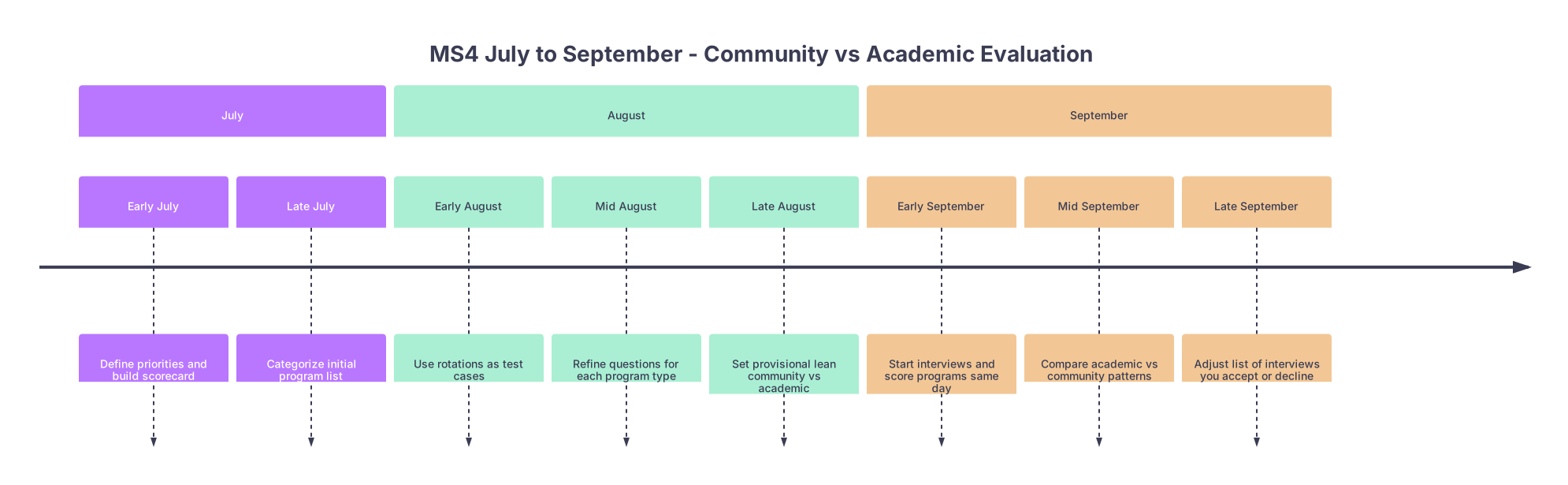
| Period | Event |
|---|---|
| July - Early July | Define priorities and build scorecard |
| July - Late July | Categorize initial program list |
| August - Early August | Use rotations as test cases |
| August - Mid August | Refine questions for each program type |
| August - Late August | Set provisional lean community vs academic |
| September - Early September | Start interviews and score programs same day |
| September - Mid September | Compare academic vs community patterns |
| September - Late September | Adjust list of interviews you accept or decline |
Common Patterns You’ll See (And How to Interpret Them)
You’re going to start noticing trends. Some are predictable. Some are traps.
Pattern 1: Academic Name, Community Training
Example: “University-affiliated hospital” 40 minutes from campus, no fellows, minimal research, strong local reputation.
Often looks like:
- Residents run everything clinically
- Limited research infrastructure
- Fellowship matches decent but not loaded with top-10 institutions
- Strong bread-and-butter training
How to treat it:
- If you want excellent clinical training and maybe a less competitive fellowship, this can be ideal.
- If you want a heavy research career or ultra-competitive fellowship, it’s not enough by itself—you’ll have to hustle harder.
Pattern 2: Community Hospital, Stealth Powerhouse
Example: Large community system that:
- Has a formal relationship with a nearby university for electives
- Sends multiple grads yearly to solid academic fellowships
- Has 1–2 research-oriented attendings adopting residents
How to treat it:
- If you want both quality of life and a shot at fellowship, this can beat mid-tier academic places.
- You have to confirm the “success stories” aren’t just 1 superstar every 5 years.
Pattern 3: Big Academic Center, Miserable Residents
You’ll see this. Name-brand place, lots of fellowships, but residents look fried.
Signs:
- They brag about volume but whisper about support.
- “Wellness” is yoga classes and pizza, not schedule changes.
- Residents describe “surviving, not thriving.”
How to treat it:
- If your top priority is prestige and research and you’re resilient, maybe it’s worth it.
- If you know you burn out easily, or have family responsibilities, do not romanticize this. The name on the badge won’t fix misery.
Pattern 4: Community Program with Low Ceiling
You’ll also see programs where:
- Very few grads do fellowship
- Minimal high-acuity exposure
- Residents sound defensive when you ask about education vs service
How to treat it:
- If you want to be a strong community generalist in that area and like the culture, fine.
- If you’re undecided or leaning subspecialty, this is risky. You’ll make your future harder for no good reason.
Quick Comparison Snapshot: What Often Differentiates Them
| Feature | Academic Program | Community Program |
|---|---|---|
| Research Infrastructure | Strong | Variable |
| Fellowship Match | Often stronger | Depends heavily on program |
| Autonomy | Can be limited by fellows | Often higher |
| Procedures | Sometimes less (fellows do them) | Often more |
| Bureaucracy | Higher | Lower to moderate |
| Lifestyle | Variable, often heavier | Frequently better |
This table is generic. Your job from July–September is to convert this from “usually” to your actual data for each program on your list.
Final Checkpoint: End of September – Where You Should Be
By September 30, you should not be saying “I don’t know if I want community or academic.” You should be saying:
- “Given my goals, I lean X, and here’s the evidence from 5–10 programs I’ve seen.”
- “I’ve seen that my best-fitting programs, regardless of label, share these traits: ____.”
- “I know which offers to prioritize going into October because my scorecard consistently favors these types of environments.”
If you look at your notes and they’re all vibes—“felt nice,” “residents seemed chill”—you didn’t do the work. Go back, call a current resident, and fill in the missing hard data.
Three Things to Remember
- “Community vs academic” is a lazy shortcut. What matters is fellowship support, autonomy, culture, and outcomes, not the logo on the slide deck.
- July–September is when you build and start using a structured scorecard so interview days become data-gathering missions, not just awkward small talk.
- At every stage, ask yourself: “Given the doctor I want to be, does this environment push me there or pull me away?” Then trust the pattern that emerges, not the marketing.