
It is late March of MS3. You just finished a long call day on medicine, your shoes are still damp from a code in the ICU, and you are staring at an email about an “Academic Internal Medicine interest meeting” tomorrow at noon. Next to it in your inbox: a chief from a local community program just invited you to do a sub-I there.
You do not have a fellowship picked. You are not even sure what specialty you want. But everyone keeps asking some version of the same question:
“So… are you more of a community person or an academic person?”
This is the point in the year when that question stops being theoretical. You are moving into decision territory.
Here is how to think about it, week by week and month by month, from MS3 spring through early MS4, so you are not guessing blindly on ERAS.
Late MS3 (March–April): Clarify What “Academic” vs “Community” Actually Means
At this point you should stop using “academic vs community” as vague vibes and turn it into something concrete.
Week 1–2: Define the lanes
Block off one evening and do this deliberately. You need a working definition, not Reddit myths.
| Feature | Academic Program | Community Program |
|---|---|---|
| Primary setting | University/tertiary center | Non-university hospitals |
| Research expectation | Structured, often required | Optional, usually limited |
| Fellows | Many specialties | Few or none in many fields |
| Autonomy early on | Less in PGY-1, more later | More from day one |
| Typical fellowships | Strong pipeline | Variable, can be excellent |
Then, during this 1–2 week span, do three focused tasks:
Reality-check your assumptions
– Ask residents on your current rotation:
“Why did you choose this program over a community one?”
“If you could switch to the opposite style (community ↔ academic), would you?”
Listen for specific trade-offs: autonomy, research, lifestyle, fellowship chances.Name your non-negotiables
Open a blank page and create three columns:- Must have
- Nice to have
- Deal breakers
Populate them with specifics, not fluff. Examples: - Must have: “Training in a safety-net population,” “Decent step-up to subspecialty fellowship,” “Not more than Q4 call as senior.”
- Nice to have: “On-site basic science labs,” “In-house IR 24/7,” “No clinic on post-call days.”
- Deal breakers: “70+ hour average weeks sold as ‘malignant but we are a family’,” “No protected didactics.”
Score yourself on scholar vs clinician identity Be blunt. On a scale of 1–10:
- How much do you enjoy reading primary literature and designing projects?
- How much do you value being the person who runs the list, manages flow, and just gets patients out safely?
A “9” on the first and “3” on the second pushes you toward academic-heavy programs. The reverse leans community. If you are 6–7 on both, you are the swing voter this article is for.
At this point you should not be “picking” a path. You should be creating a language for what you are actually deciding between.
Early April MS3: Use Your Current Rotations as Test Cases
You are likely still on core rotations. This is free data collection.
Week 3–4: Ward life as a microscope
For the next 2 weeks, watch the residents around you like a scientist:
Who staffs your patients?
- Are attendings around all day, or do residents run most things with brief check-ins?
- Are there fellows in the middle, filtering everything?
Where does teaching live?
- Is there a dedicated chalk talk at 11 a.m. every day?
- Or is education mostly “on the fly” between pages?
What does “career” talk sound like on the team?
- Academic program vibes: “We can connect you with the basic science PI in pulmonary,” “Our residents get into GI at X, Y, Z big-name places.”
- Community program vibes: “Our grads practice hospitalist at A, B, C health systems,” “You will run the whole ICU as a PGY-3.”
You are not judging them. You are deciding: Which environment makes you think, “I could do this for 3 years without losing my mind”?
Take 10 minutes each Sunday night and jot bullet points:
- “Loved how PGY-2 ran family meeting himself. More autonomy. Felt community-like.”
- “Rounds took 5 hours with huge academic team, but teaching was excellent. I left understanding hyponatremia cold.”
By the end of April, you should have at least two pages of these notes. They will matter when your memory blurs.
Late April–May: Anchor Your Timeline to ERAS and Away Rotations
This is where timing starts to matter. The question “Am I leaning community or academic?” becomes:
“What do I need to decide before I lock in my MS4 schedule and ERAS strategy?”
By April 30: Know your preliminary lean
I am not saying you must be 100% sure. But by the end of April, you should be able to say one of four sentences:
- “I am clearly leaning academic.”
- “I am clearly leaning community.”
- “I am open to both, but need at least one audition in each to compare.”
- “I have no idea.” (If this is you, you are behind, but not lost. Catch up aggressively.)
Because May–June is when away/sub-I requests and letters start to crystalize.
First half of May: Plan MS4 rotations with your lean in mind
Now you schedule like an adult, not a passenger.
If you are leaning academic
- Aim for:
- 1 sub-I at your home academic program in your likely specialty.
- 1 away rotation at another academic center if your specialty is competitive (derm, ortho, ENT, neurosurgery, plastics, etc.).
- Protect time for:
- Continuing or starting at least one research project that will be ready to present or submit by fall of MS4.
- Aim for:
If you are leaning community
- Prioritize:
- A sub-I at a strong community or community-affiliated program where you might realistically match.
- An additional sub-I or elective at your home institution just to keep one academic letter in your pocket.
- Focus on:
- Getting stellar clinical LORs from people who can say, “This student can function like an intern now.”
- Prioritize:
If you are truly undecided
- Build a comparison plan:
- 1 sub-I in an academic program
- 1 sub-I in a community-heavy site
- 1 “flex” block for either another sub-I or research depending on what you learn
- Build a comparison plan:
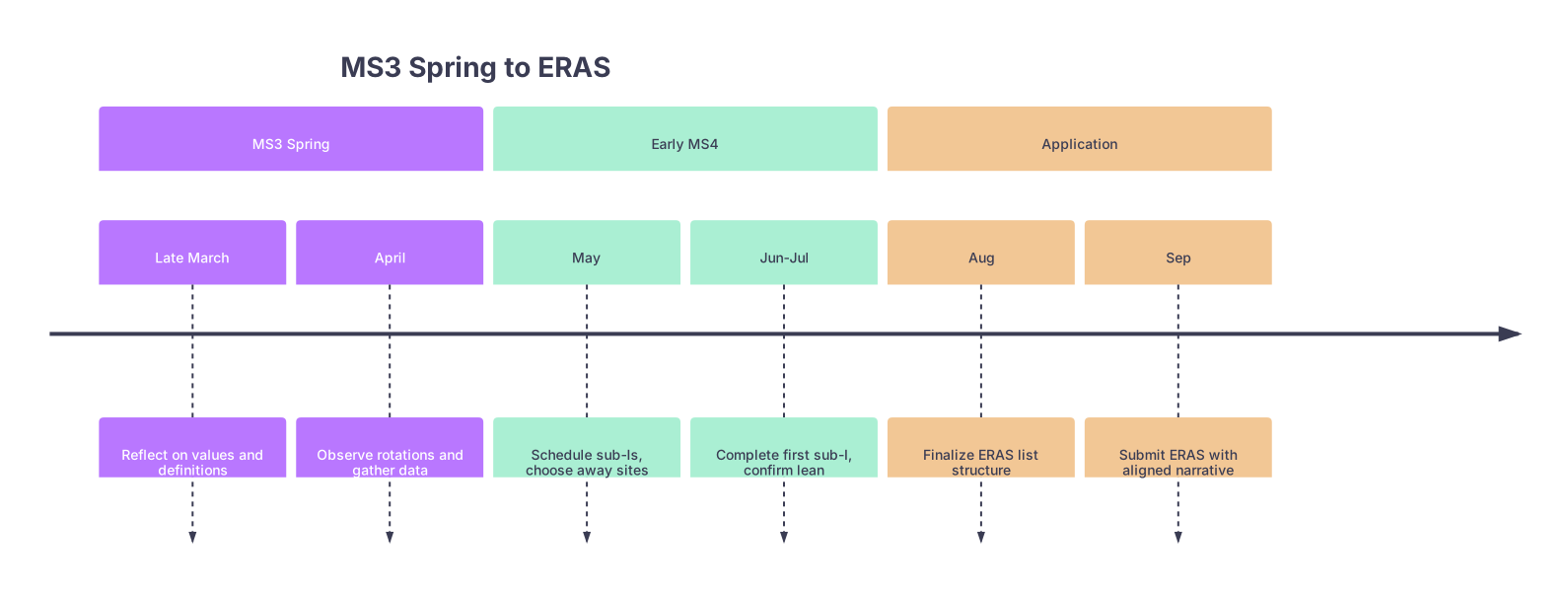
| Period | Event |
|---|---|
| MS3 Spring - Late March | Reflect on values and definitions |
| MS3 Spring - April | Observe rotations and gather data |
| Early MS4 - May | Schedule sub-Is, choose away sites |
| Early MS4 - Jun-Jul | Complete first sub-I, confirm lean |
| Application - Aug | Finalize ERAS list structure |
| Application - Sep | Submit ERAS with aligned narrative |
At this point you should have your MS4 schedule drafted in a way that actually tests your lean, not randomly scatters experiences.
June–July (Early MS4): Use Your First Sub-I as the Tiebreaker
You will learn more about community vs academic in 3 weeks as a sub-I than in 6 months as a student loitering at the back of rounds.
Week 1–2 of your first sub-I: Watch the extremes
Whether you are at an academic flagship or a community workhorse, focus on four domains:
Autonomy
- Are you or the residents:
- Writing most of the notes and orders?
- Calling consults and doing the initial thinking?
- Leading family meetings?
- Academic pattern: “We will discuss with the fellow and attending; the plan may change.”
- Community pattern: “Run it by the attending, then just do it.”
- Are you or the residents:
Pace and volume
- Academic: Fewer patients, more complexity, lots of teaching time, many people per patient.
- Community: More patients per resident, faster discharges, less patience for long chalk talks.
Teaching vs service
- Do attendings stop to explain why or mainly ask what?
- Are conferences robust and protected, or frequently canceled “because we are slammed”?
Career paths of current residents
- Ask seniors directly:
- “Where have recent grads gone?”
- “If someone wants a competitive fellowship from here, what does it realistically take?”
Compare what they say with actual match lists, not just anecdotes.
- Ask seniors directly:
Write a short reflection at the end of week 2:
- 3 things that energized you
- 3 things that drained you
- Would you be proud to train here?
Week 3–4 of that sub-I: Decide your default direction
By the end of your first real sub-I, you should draw a line in the sand, even if you might cross it later:
- “If I had to choose today, I would build my list around academic programs.”
- Or, “If I had to choose today, I would build my list around community programs.”
You are not deleting the other type from your ERAS list. You are picking a center of gravity.
This affects:
- How much you lean into research vs pure clinical excellence in your personal statement.
- Who writes your key letters.
- Which programs you actually email early to express interest.
August: Shape Your ERAS Strategy Around Your Lean
This is when indecision becomes expensive. Your personal statement, experiences section, and program list cannot be written for “everyone.” That reads like mush.
Early August: Tailor your narrative
If you are leaning academic Your application should clearly show:
- Evidence of scholarly interest:
- Posters, abstracts, QI projects, case reports. They do not have to be in NEJM. They do have to exist.
- Engagement with teaching:
- TA roles, peer tutoring, curriculum committees.
- Exposure to complex tertiary care settings:
- Rotations at big university hospitals, ICU time, transplant, etc.
Your statement should make sense if read by a PD at:
- University of Michigan IM
- UCSF Pediatrics
- Duke Neurology
Meaning: you speak the language of curiosity, evidence-based practice, and some appetite for academia.
- Evidence of scholarly interest:
If you are leaning community Your application should emphasize:
- Clinical horsepower:
- Strong clerkship comments, clear narratives of high responsibility, stepping up in busy environments.
- Communication and efficiency:
- Managing high patient volume, smooth handoffs, good feedback from nurses and staff.
- Real-world patient care:
- Safety-net clinics, community rotations, continuity clinics, not just esoteric referrals.
Your statement should be compelling to a PD at:
- Large community IM program in a health system (e.g., community affiliates of Mayo, Cleveland Clinic, HCA programs)
- Regional centers that pride themselves on “producing excellent clinicians, not academic superstars.”
- Clinical horsepower:
If you are going to apply to both You have two options:
- Write one core statement that is neutral but not bland, then adjust a short paragraph for academic-heavy vs community-heavy places (if your specialty/program allows multiple statements).
- Stay honest: “I value X and Y, and I see both academic and community programs that fit this in different ways.” Then demonstrate you have done the homework with specific experiences in each world.
Program List Construction: How Your Lean Changes the Mix
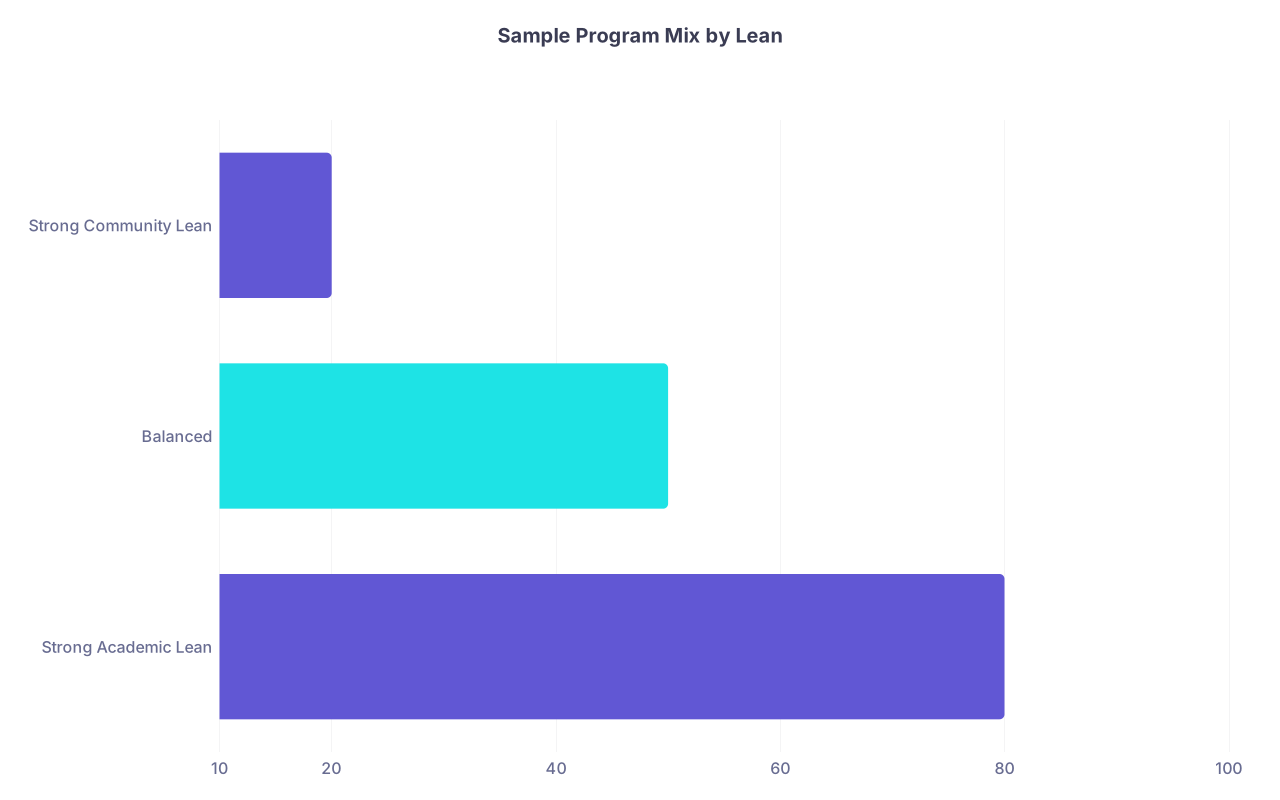
By late August, you are assembling your list. This is where the lean becomes concrete numbers.
| Category | Value |
|---|---|
| Strong Academic Lean | 80 |
| Balanced | 50 |
| Strong Community Lean | 20 |
Interpretation idea (for IM or similar-level competitiveness):
- Strong academic lean: maybe 80% academic, 20% community.
- Balanced: roughly 50/50.
- Strong community lean: 20% academic (safety for fellowship chances, geography, or brand), 80% community.
You adjust based on:
- Step scores / COMLEX
- Class rank
- Specialty competitiveness
- Geography
But the key is: You are doing this on purpose, not haphazardly.
Red Flags and Course Corrections (September–October)
You submitted ERAS. Now what?
Mid-September: Sanity-check your choices
Once you hit submit, ask yourself honestly:
- Do the programs on my list actually match the environment I liked as a sub-I?
- Did I over-apply to brand-name academic places that do not fit my actual goals?
- Did I throw in a few random community programs in cities I do not want, just because I panicked?
If you realize you mismatched your lean badly:
- You can still:
- Send targeted emails to programs that better fit your true direction.
- Add a few additional programs early before interview season ramps.
October–November: Use interviews to refine, not reinvent
At this point, your “lean” should be pretty stable. But interviews surface reality:
On academic interviews:
- Ask: “What percentage of your grads go into fellowship vs general practice?”
- Ask: “How are residents supported if they are not research-inclined?”
On community interviews:
- Ask: “How do you support residents aiming for competitive fellowships?”
- Ask: “What does a typical day look like for an intern on wards? How many patients do they carry?”
If you leave 4–5 community interviews energized and 4–5 academic interviews drained (or vice versa), listen to that. Adjust how you think about your rank list early.
When Do You Have to Decide?
Let me be very direct.
There are three hard checkpoints where indecision actually hurts you:
By late April of MS3
You need at least a provisional lean to plan MS4 rotations properly.By end of your first sub-I (June–July of MS4)
You should know which environment you want as your default.
Not an ironclad decision, but a clear direction.By early August of MS4
You need a committed lean to:- Shape your ERAS narrative
- Prioritize which PDs you reach out to
- Decide the majority mix (academic vs community) on your list
If you are still saying “I have no idea” at any of those checkpoints, something is off. You are not asking the right questions, or you are avoiding the decision.
Final 3-Day Exercise (Any Time in MS3 Spring)
If you are reading this now in MS3 spring, give yourself three days:
Day 1 (evening, 30 minutes)
Write two short paragraphs:
- Paragraph A: Describe your ideal day in residency at an academic center. Be specific: morning report, subspecialty clinic, journal club, complex ICU case on ECMO.
- Paragraph B: Describe your ideal day in a busy community program. Large list, rapid discharges, limited subspecialty backup, strong relationships with hospital staff.
Underline phrases that excite you in each.
Day 2 (midday)
Talk to:
- One resident at a clearly academic program.
- One resident at a clearly community program.
Ask each: “If someone is on the fence, what do they usually misunderstand about your type of program?”
Day 3 (evening, 20 minutes)
Write one sentence:
- “If I had to submit ERAS tomorrow, I would bias my list toward ______ programs because ______.”
You are not married to that conclusion. But now you have a stake in the ground. Your future scheduling, letters, and application choices become about refining that call, not avoiding it.
Key Takeaways
- By the end of MS3 spring, you do not need a final answer, but you do need a clear lean toward community or academic to plan rotations and letters intelligently.
- Your first MS4 sub-I is the real stress test. Use it deliberately to confirm or challenge that lean, then build your ERAS narrative and program list around what you learn.
- The worst outcome is not choosing “wrong.” It is never really choosing at all and submitting a scattered, incoherent application that fits nobody. Pick a direction, then refine.