You are a rising MS4 on your Sub-I. It is 9:20 p.m. The colectomy that was supposed to be “quick” for the chief has now blown past three hours. In between retracting and suctioning, you hear the PGY-3 complaining in the corner: “I have done two colectomies all year. The interns at that community program down the road are doing more lap choles than I am.”
You are trying to build a rank list. One big question in your head: what exactly will I be operating on, and when, if I go community vs academic?
Let me break this down specifically: surgical case mix profiles, by PGY year, comparing a typical community-heavy general surgery program to a large academic tertiary center.
We are going to talk concrete: appendixes, lap choles, hernias, Whipples, vascular bypasses, trauma thoracotomies. Who actually does what, and when.
1. The Core Difference: Volume, Complexity, and Ownership
Strip away the marketing slogans and this is the real tradeoff:
- Community programs: higher early autonomy, more bread‑and‑butter, less exotic complexity.
- Academic programs: higher complexity, more subspecialty, slower progression to primary operator.
Most applicants vaguely know this. What they underestimate is how it plays out year by year.
At the end of training, you need two things:
- Enough total volume to be comfortable.
- Enough variety and complexity to handle what your eventual practice will throw at you.
The real question is not “Which is better, community or academic?” That is lazy thinking. The real question is, “For a resident at each PGY level, what case mix and role in the OR am I realistically getting at each type of program?”
That is what matters for your learning curve.
2. PGY‑1: Who Gets the Appy and the Lap Chole?
PGY‑1 is where the paths start to diverge.
In a community-heavy program, the interns are often thrown into the fire. In many academic programs, they are still on the bench.
| Case Type | Community PGY-1 Role | Academic PGY-1 Role |
|---|---|---|
| Laparoscopic appy | Primary or shared primary | Assistant / camera |
| Lap chole | Primary on easy cases | Camera holder / second assist |
| Small open hernia | Primary with attending | Occasional primary, rare |
| Port placements | Primary | Primary (more uniform) |
| Central lines | Primary on floor/ICU | Shared with ICU/anesthesia |
Community PGY‑1
In many community programs, especially those with only one or two residents per year and few fellows:
- Laparoscopic appendectomy: by mid-year, you might be primary on straightforward appys, skin-to-skin, with the attending scrubbed but hands off unless you get lost.
- Laparoscopic cholecystectomy: initially you are camera + assistant; by the second half of the year, if you show any competence, you start doing parts of simple lap choles (dissection in Calot, clipping, sometimes entire case).
- Hernias: small umbilical and inguinal hernias often go to PGY‑1s early, especially at smaller hospitals where there is no competition for cases.
- Endoscopy: some community programs will let a motivated PGY‑1 scope early, but that is highly variable.
The tradeoff: you will do a lot of “simple” operations. You might do your 30th non-complicated lap appy before you ever see a choledocholithiasis.
Academic PGY‑1
At big academic centers with residents + fellows + advanced practice providers, PGY‑1s are often lower in the pecking order:
- Laparoscopic appy: you might hold the camera, maybe retract a bit, sometimes get to close skin. Occasionally primary if the case is at 2 a.m. and nobody else wants it.
- Lap chole: most of these go to PGY‑2s or 3s as primary operators; PGY‑1 runs the camera.
- Small hernias: you may get some, but often chiefs or PGY‑3s use them as “easy days” to stay sharp as primary surgeon.
- ICU/trauma/wards: a lot of your PGY‑1 academic life is floor and ICU heavy with limited daytime OR time.
The flip side: even when you are not primary, you see more pathology—perforated Crohn’s, complex biliary, post-transplant complications—right from the beginning. You just are not the one driving yet.
3. PGY‑2: Bread‑and‑Butter vs “Still Waiting My Turn”
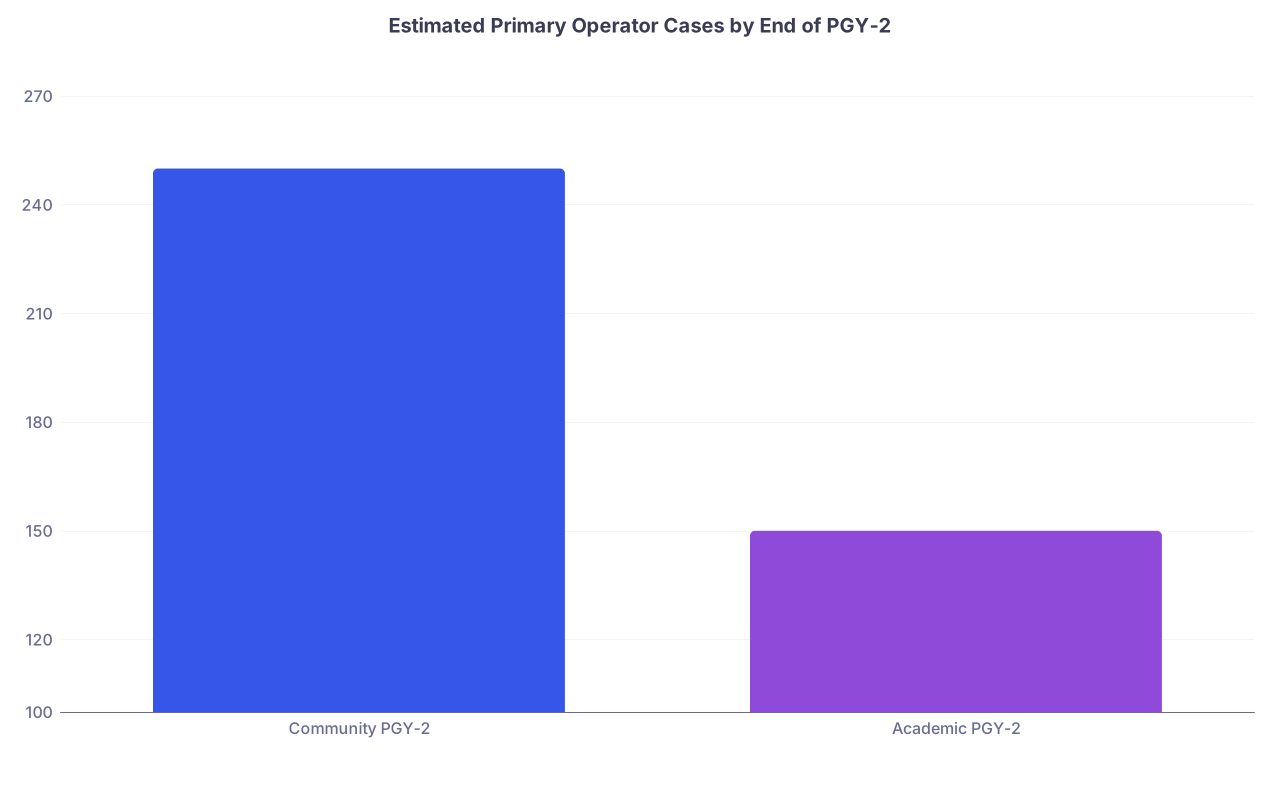
By PGY‑2, the community trainee has often logged a pretty impressive set of straightforward cases. The academic trainee has seen more complexity, but often through glass.
| Category | Value |
|---|---|
| Community PGY-2 | 250 |
| Academic PGY-2 | 150 |
Those numbers are rough but not fantasy. I have seen community PGY‑2s north of 300 logged cases, mostly general surgery bread‑and‑butter. And academic PGY‑2s sitting around 150–200 primary cases but have assisted on hundreds more.
Community PGY‑2: The Early Workhorse
Common PGY‑2 primary case types in a community-centric program:
- Laparoscopic cholecystectomy – including some more difficult gallbladders, though the truly hostile ones may go to seniors.
- Laparoscopic and open appendectomy – virtually all of them.
- Basic open and laparoscopic hernia repairs – inguinal, umbilical, ventral.
- Simple small bowel obstruction lysis of adhesions.
- Basic colorectal (segmental colectomies) shared with seniors but often with you doing port placement, some dissection, and anastomoses.
- Endoscopy – EGD and colonoscopies start to appear as primary.
Your daytime schedule has more OR and endo, fewer floor months. Trauma at community sites tends to be blunt and less complex operative trauma, but you may run the trauma bay sooner due to less competition.
Academic PGY‑2: Graduated Responsibility, Slowly
At an academic program, PGY‑2 is when you start touching the main cases, but the hierarchy is obvious:
- Lap appys and lap choles: now more often primary, but still in competition with PGY‑3s. You do the “routine chole at 10 a.m. on Tuesday,” the PGY‑3 grabs the “BMI 48, acute cholecystitis, prior open surgeries.”
- Hernias: you do more of them, often with chief as teaching assistant or attending scrubbed.
- Basic foregut: occasional Nissen, PEG placements, gastrostomies—but often as assistant rather than full primary.
- Trauma: if there is a dedicated trauma service with fellows, you may run the secondary survey, do diagnostic peritoneal lavages (if anyone still does them), and get pieces of exploratory laparotomies when it is slow or off-hours.
The upside: even as PGY‑2, you probably have seen Whipples, esophagectomies, transplant cases, complex reoperative abdomens. You just have a limited role: exposure, stapling under tight guidance, occasional closure.
4. PGY‑3: The Critical Split in Case Mix and Autonomy
PGY‑3 is where the curve sharply diverges. This is the year where in community programs you really start owning the bread‑and‑butter general surgery. In academic programs, some residents still feel largely “middle management.”
Community PGY‑3: You Are the Default Surgeon for Many Cases
In many community-heavy programs, PGY‑3s are workhorses and often default primary surgeons on:
- Most lap choles, including some more complex acute cholecystitis.
- Many open and laparoscopic inguinal, ventral, and incisional hernias.
- A large fraction of laparoscopic colectomies under attending supervision.
- Exploratory laparotomies for perforation, obstruction, GI bleed (depending on site).
- Many EGDs and colonoscopies as fully independent operator (with attending in the room).
- Basic vascular exposure if the program has vascular integrated into general.
You often run community hospital OR days: 4–5 cases list where you and an attending crank through lap choles, hernias, scopes. Chiefs may be off doing more complex tertiary cases at the main site.
You also may cover unopposed community trauma at night. You may do your first trauma laparotomy as a PGY‑3, skin-to-skin, with the attending mostly guiding but not micromanaging every move.
The downside: complex hepatobiliary, complex colorectal, advanced minimally invasive, and oncologic resections may be less frequent. You may rarely see a Whipple, liver resection, or cytoreductive surgery with HIPEC at all.
Academic PGY‑3: The “Middle” Resident
At many academic programs, PGY‑3 is still a transitional year:
- You now reliably get to be primary on a good number of lap choles, appys, small hernias, and benign foregut.
- On colorectal, HPB, surgical oncology, and transplant services, you are often the assistant or “second surgeon” while the chief or fellow is primary.
- Trauma: if there are trauma fellows, a lot of operative trauma still goes to senior + fellow. You might drive some cases on night float or when things are too busy.
- ICU: you may have heavy critical care rotations where you run ventilators, pressors, and manage complex post-op patients—but that is not logged as operative cases.
You do see high-end operations: Whipples, low anterior resections with coloanal anastomosis, pelvic exenterations, EVAR/TEVAR, open AAA repairs, transplant. But your role is often: help with exposure, staple, close, maybe do individual steps under very tight direction.
This matters. You will graduate comfortable seeing complex stuff. But your first time doing a full Whipple as primary may be in fellowship, not residency.
5. PGY‑4: The Senior Year That Feels Very Different
By PGY‑4, the community resident has usually had independent control over most bread‑and‑butter general surgery. The academic resident is now finally stepping into primary roles on complex operations—but with limited volume.
| Case Category | Community PGY-4 (Primary) | Academic PGY-4 (Primary) |
|---|---|---|
| Lap chole (total) | 150–250 | 80–150 |
| Lap appy (total) | 80–150 | 40–100 |
| Inguinal/ventral hernia | 100–200 | 60–120 |
| Colectomy | 40–80 | 30–70 |
| Whipple/complex HPB | 0–5 (assist mostly) | 5–20 (partial or full primary) |
Numbers are ballpark. Every program will crow about outliers; look at your real case logs when you interview or during sub-I.
Community PGY‑4: Almost a Junior Attending on Bread and Butter
Your PGY‑4 life in a community program might look like:
- Several days a week as “senior resident” running an OR room or even multiple rooms with different attendings.
- Complex lap choles, some biliary tree work, occasional CBD exploration if your attendings still do them.
- More advanced hernias: component separation, recurrent incisional hernias, some mesh removals.
- Colectomies as primary: open and laparoscopic, often doing majority of dissection and anastomosis with attending as teacher rather than driver.
- Endoscopy: large independent volume, polypectomies, bleeding control, PEGs.
You may still have relatively limited high-complexity oncology or HPB volume. The rare big operation that appears at your community site often gets done primarily by the attending with you assisting.
Academic PGY‑4: The Subspecialty Workhorse
Academic PGY‑4s often rotate on niche services:
- Colorectal: multiple low anterior resections, APRs, ileal pouch-anal anastomosis (J-pouch) as significant primary operator, especially in the latter half of the year.
- HPB: portions of Whipples (kocherization, portal dissection, sometimes anastomoses), hemihepatectomies, hilar dissections.
- Surgical oncology: gastrectomies, cytoreductive surgeries, sarcoma resections.
- Thoracic: lobectomies, VATS cases as primary or near-primary.
- Vascular: open bypasses, endovascular interventions, carotid endarterectomies (depending on structure).
There is a catch: you are often sharing this niche-rich environment with fellows. On HPB with a fellowship, that beautiful Whipple you thought you would do? It is often divided: fellow does half, you do pieces, attending finishes. You still learn, but your logbook may show “partial primary” on complex cases rather than many full skin-to-skin experiences.
If the program has no fellows, PGY‑4 and chiefs split most complex subspecialty cases. Those are the places where academic training really shines.
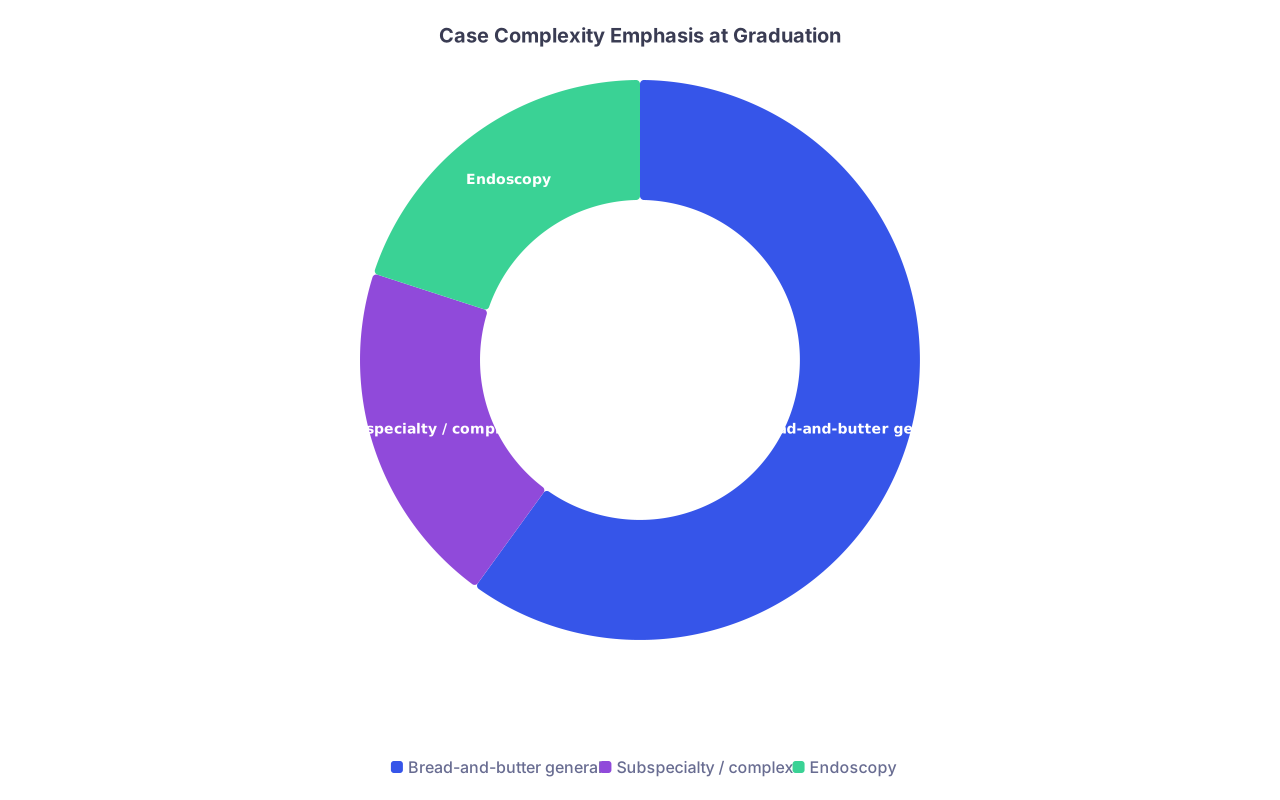
6. PGY‑5 (Chief): Exit Profile – What Surgeon Are You Actually Becoming?
By chief year, the question is not just “How many cases?” It is “What pattern of cases, and at what level of independence?”
| Category | Value |
|---|---|
| Bread-and-butter general | 60 |
| Subspecialty / complex | 20 |
| Endoscopy | 20 |
That doughnut roughly matches a strong community program graduate. A heavy academic oncologic center grad? More like 40 / 40 / 20. Again, trends, not gospel.
Community Chief: High Volume, High Independence, Limited Exotic Work
By the end of a solid community general surgery residency without heavy fellow competition, your chief experience often includes:
- Hundreds of lap choles, appys, and hernias where you are genuinely independent.
- Comfortable running multiple ORs, triaging add-ons, handling routine complications.
- Being the default for emergency general surgery: perforated ulcers, diverticular perfs, SBOs, incarcerated hernias.
- Good endoscopy numbers meeting and usually exceeding ABS requirements.
Where you may be light:
- Complex HPB: very few Whipples, limited liver resections.
- Complex esophageal and foregut (esophagectomy, complex paraesophageal hernias with Collis gastroplasty).
- Major vascular (if separated out to vascular fellowship/service).
- Transplant, advanced oncologic resections, rare pathologies.
Translation: if you want to be a strong bread‑and‑butter community general surgeon right after residency, you are in good shape. If you want HPB oncology, transplant, or high-level MIS/foregut, you will absolutely need fellowship—and you may be behind some academic grads who have been around that pathology more.
Academic Chief: Lower Total Volume, Higher Complexity Slice
Academic chiefs tend to finish with:
- Fewer total cases than many community graduates, but a higher proportion of big operations: complex colorectal, HPB, thoracic, vascular, oncologic.
- Enough endoscopy but sometimes not as many as community programs, depending on how GI and surgery share scope time.
- Less raw “repetition” on basic operations, but a broader repertoire of advanced ones.
The nuance: many academic-trained chiefs still do not feel comfortable jumping straight into solo rural general surgery. They may have done three esophagectomies and ten Whipples as primary, but only 40–60 independent laparoscopic choles without a senior in the room. It is a different comfort set.
They are, however, much better positioned for competitive fellowships and tertiary-care academic practice.
7. Trauma and ICU: Where Program Type Warps Your Experience
You cannot talk about case mix without mentioning trauma and ICU, especially for programs with big trauma centers.
Community Trauma Profile
- Many community programs are Level II or lower trauma centers.
- Operative trauma is relatively rare and mostly blunt: splenectomies, bowel injuries, occasional liver packing.
- A community PGY‑3 or PGY‑4 might be the primary surgeon on a trauma laparotomy because no one else is competing for the case.
- If there is no trauma fellowship, a community chief might have more actual trauma laparotomies as primary than an academic chief at a place with 10 times the trauma volume but 3 fellows.
Academic Trauma Profile
- Level I with massive volume: penetrating trauma, complex vascular injuries, cardiac injuries.
- But: trauma fellow and senior run the show. Juniors assist and retract.
- Operative trauma is concentrated in a smaller number of hands. An academic resident might “see” hundreds of trauma laparotomies but only truly “do” a small fraction as primary.
ICU is similar:
- Community: more early responsibility running a surgical ICU or mixed ICU, often as PGY‑2 or PGY‑3 with attending guidance.
- Academic: often a high-acuity SICU/trauma ICU with complex ECMO, transplant, LVAD, etc., but you might operate under stricter protocols, with less independent decision-making.
8. What This Means for Your Application and Rank List
This is where you stop thinking like a tourist and start thinking like a surgeon.
You need to be honest about:
- What kind of surgeon you want to be five years after residency.
- How much you value early hands-on autonomy vs exposure to rare complex disease.
- Whether you are fellowship-bound and in what field.
Here is the blunt version.
If your ideal future:
- Community general surgery, maybe small town or regional center.
- High-volume lap choles, appys, hernias, scopes, bread-and-butter emergency general surgery.
Then you should strongly consider a robust community-based program or an academic-affiliated program with heavy community rotations and minimal fellow interference. Look for:
- High case numbers in basic general surgery by PGY‑3.
- Limited number of subspecialty fellows stealing cases.
- Chiefs consistently hitting strong endoscopy and bread‑and‑butter numbers.
If your ideal future:
- HPB surgeon at MD Anderson.
- MIS/foregut specialist doing complex paraesophageal hernias and revisional bariatrics.
- Surgical oncologist doing cytoreductive surgery and HIPEC.
- Vascular, CT, or transplant.
Then you lean toward high-complexity academic programs where the residents live in a world of tertiary referrals and subspecialty services. But you must pick the right kind of academic program:
- Some academic programs drown residents in consults and service work but shove nearly all cool cases to fellows.
- Others intentionally protect resident case time, limit fellow numbers, and ensure chiefs get real skin-to-skin exposure on big cases.
You cannot tell the difference from the glossy website. You find out by:
- Asking residents: “By PGY‑3, what percent of lap choles are done by PGY‑3+ vs PGY‑1–2 vs fellows?”
- Asking chiefs: “How many Whipples / esophagectomies / open AAAs did you do skin-to-skin as true primary?”
- Asking mid-levels: “What do your PGY‑2s actually do most days? Floor? ICU? Assisting? Running a room?”
Do not ask the PD vague questions. They will give you vague, optimistic answers. Ask residents for numbers and whether they feel ready for the job they want next.
9. Red Flags in Case Mix (Regardless of Community vs Academic)
A few patterns should make you cautious, no matter the label:
Fellows everywhere, residents nowhere.
If every major subspecialty has robust fellowships, and residents “help a lot” but chiefs cannot quote concrete primary case numbers, be skeptical.Low chief case numbers, padded with assist roles.
If you hear “Our chiefs graduate with 1,000–1,200 cases,” ask what proportion are primary vs assist. I have seen logs with 800 assists and 300 primary cases quietly presented as “1,100 cases.”Weak endoscopy exposure.
For general surgery, having minimal endoscopy is a problem if you plan to work in the community. Ask PGY‑3s and chiefs directly how many independent colonoscopies and EGDs they have done and in which year it ramped up.Overly protected juniors with no early operative time.
A little of that is fine; totally non-operative PGY‑1 and PGY‑2 years are not. By the end of PGY‑2, if you rarely touched a lap chole as primary, that is a problem in my book.Service-to-education imbalance.
Residents who spend most of their day on floor scut, with advanced practice providers getting procedures because they are “more efficient,” are not being trained properly. That can happen at both community and academic centers.
10. How to Read Between the Lines on Interview Day
When programs present “case mix” data, you will usually see total case counts and maybe some ABS category numbers. On paper, things might look similar.
You need to dissect it.
Ask:
“As a PGY‑1, what was your first case as primary?”
Good answer at a community program: “Lap appy in October.” Mediocre answer at a big academic: “Closing skin on an appy in April.”“By the end of PGY‑2, roughly how many lap choles had you done where you really felt like primary?”
You are trying to see if the PGY‑2 is still doing mostly camera work or is actually dissecting Calot’s.“How often do PGY‑3s run their own OR room for a full day list?”
That tells you mid-level autonomy.“On your last Whipple, who was primary: fellow, chief, or attending? Who did the anastomoses?”
You want to know if residents are truly driving or just watching.“If you want to go straight into community general surgery, do your chiefs feel ready?”
Then ask to talk to a recent grad who did exactly that.
The goal: reconstruct the year-by-year operative story, not just hear the highlight reel.
Key Takeaways
Community programs generally give earlier and higher-volume autonomy on bread‑and‑butter cases; academic programs generally give later but richer exposure to complex subspecialty surgery, often diluted by fellows.
The critical differences appear at PGY‑2 and PGY‑3: who is actually primary on lap choles, hernias, and emergent laparotomies, and how much of complex cases you touch vs watch.
Do not trust labels or websites. On interview day, interrogate residents about their real case mix by PGY year, who gets what cases, and how ready recent graduates feel for the exact jobs you want to do.