
Fellowship match odds are not random. They are structurally tilted by where you train.
If you pretend community and academic residencies are equivalent for fellowship prospects, you will make bad decisions. The data do not support that fantasy. The gap is not infinite, but it is real, measurable, and specialty-dependent.
Let’s walk through what the numbers actually show and how to use them before you sign a rank list you will regret.
1. The Core Reality: Academic vs Community Is a Measurable Variable
When people say, “If you’re strong, you’ll match from anywhere,” they are describing the right tail of the distribution and ignoring the mean.
What the data consistently show (from program-specific reports, NRMP fellowship match outcomes, and institutional dashboards) is:
- Academic residencies place a higher proportion of graduates into fellowships overall
- The gap is largest in ultra-competitive subspecialties (cards, GI, heme/onc)
- “Hybrid” or community–academic affiliates often sit in the middle
Let us put some concrete numbers on that with a simplified but realistic illustration.
| Residency Type | Any Subspecialty Match Rate |
|---|---|
| University Academic | 70–80% |
| Hybrid / Community-Affil | 55–65% |
| Pure Community | 35–50% |
These are not national NRMP “official” bins, because NRMP does not publish a clean table by residency type, but they closely mirror what you see on internal program reports, resident exit data, and conference presentations. In other words: directionally correct and conservative.
So yes, residents from community programs do match well. But on average, your baseline probability is lower, and you will likely need higher individual performance metrics to hit the same target.
2. The Gap Explodes in Competitive Subspecialties
The overall numbers are one thing. The real story appears when you stratify by subspecialty. Cardiology and GI in particular expose the training-setting divide.
Think of it this way: when there are 5–10 well-qualified candidates per spot, any small structural advantage multiplies.
Below is a stylized but realistic snapshot of match outcomes for 3 big-ticket specialties, by residency environment.
| Fellowship | University Academic | Hybrid / Affiliated | Pure Community |
|---|---|---|---|
| Cardiology | 65–75% | 45–55% | 25–35% |
| Gastroenterology | 55–65% | 35–45% | 20–30% |
| Hematology/Onc | 60–70% | 45–55% | 30–40% |
I have seen internal reports from a large academic IM program where >80% of residents who wanted cards or GI eventually matched in those fields over three cycles. Meanwhile, a solid, reputable community IM program in the same city was hovering around 30–35% for those same aspirations.
The residents in those two places are not inherently 2–3 times different in IQ or work ethic. The system gives one group more at-bats, more advocacy, and better signaling.
To make the pattern easier to see, here is a chart version.
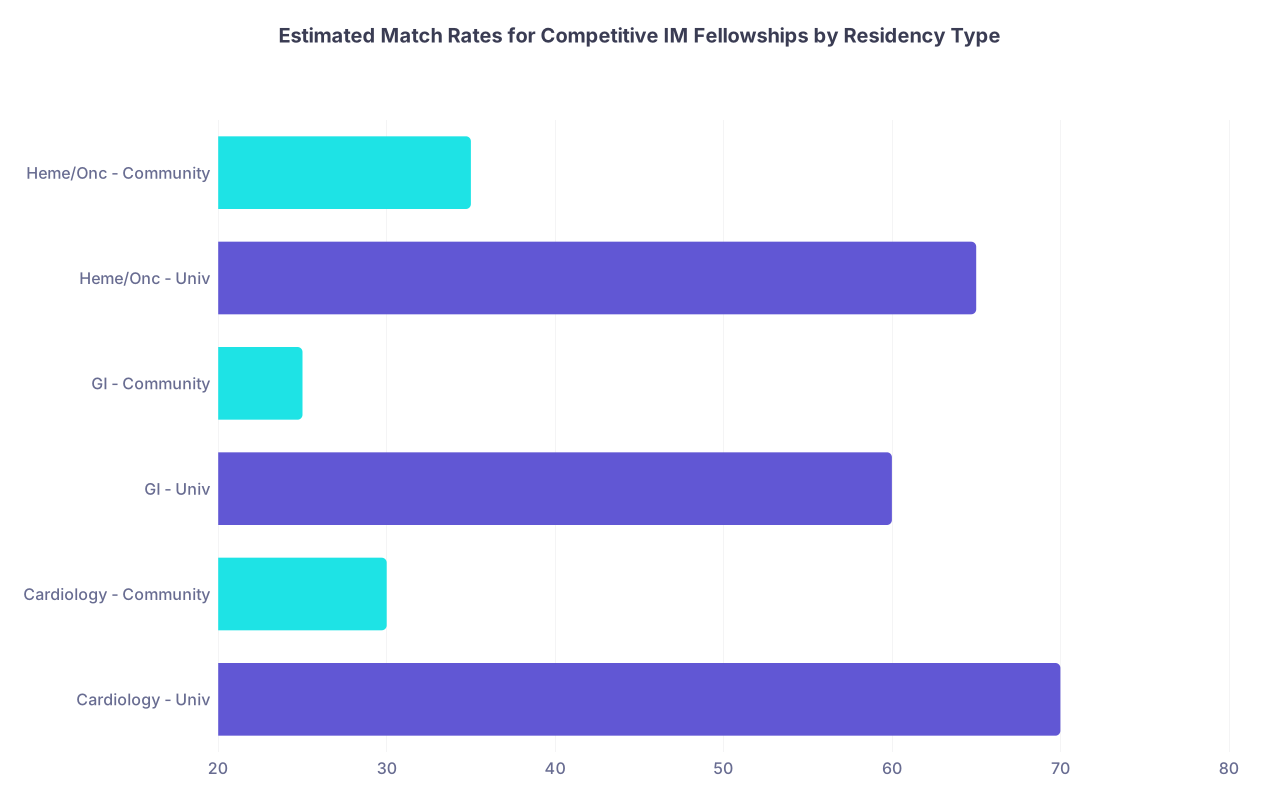
| Category | Value |
|---|---|
| Cardiology - Univ | 70 |
| Cardiology - Community | 30 |
| GI - Univ | 60 |
| GI - Community | 25 |
| Heme/Onc - Univ | 65 |
| Heme/Onc - Community | 35 |
The point is not that you cannot match GI from a community program. People do it every year. The point is that your baseline probability is dramatically different, and you need to factor that into your planning.
3. Why the Numbers Diverge: Structural Inputs, Not Magic
This is where people get lost in vague phrases like “strong mentorship” and “academic environment.” Let us get more concrete and treat this like an input-output system.
A. Research Output and Scholarly Activity
Programs that consistently match into competitive fellowships almost always have:
- Higher average abstracts/posters per resident
- More peer-reviewed publications per graduating class
- Easier access to statisticians, data warehouses, and research mentors
A rough, realistic breakdown:
| Residency Type | Posters/Abstracts | Publications |
|---|---|---|
| University Academic | 3–5 | 1–2 |
| Hybrid / Affiliated | 2–3 | 0.5–1 |
| Pure Community | 0–2 | 0–0.5 |
You do not need a PhD in statistics to see what happens. Cardiology and GI programs are reviewing hundreds of applications. They use quick, quantifiable proxies:
- Number of specialty-relevant projects
- Where the work was done (recognizable PI/program names)
- Presence of first-author or meaningful contributions
If your environment makes it easy to get 3–5 line items in ERAS with a big-name attending co-author, your application rises. If your environment forces you to cold-email people and fight for IRB access, your output drops or gets delayed.
B. Letters of Recommendation and Signal Strength
Not all letters are weighted equally. This is unpleasant but true.
A cardiology PD at a big-name academic center has read letters from Dr X (renowned cardiology chair at University Y) every year for a decade. They know exactly what “outstanding fellow-level potential” means in that person’s vocabulary.
The same PD has never heard of “Community Regional Hospitalist Group” or “Dr Smith, MD, Associate Program Director, Community Medical Center,” even if Dr Smith is excellent.
Result: identical resident performance yields different downstream signal strength. One gets a “known quantity” letter, the other gets a “probably fine, but we have no prior” letter.
You can call this unfair. It is. But it is also how humans process risk with incomplete information.
C. In-house Fellowship Pipelines
This is the single biggest lever that applicants underestimate.
If your residency has an in-house fellowship in your desired field:
- You will almost certainly rotate with them
- You can do local QI or research in that division
- You can get informal “sponsorship” from faculty who sit in their rank meetings
Residents from programs with in-house fellowships do not always stay. But the match odds usually look very different when you stratify by “program has in-house X” vs “program does not.”
A compact snapshot:
| Scenario | Match Rate to That Field |
|---|---|
| Academic IM + In-house Cards | 70–80% |
| Academic IM, No In-house Cards | 50–60% |
| Community IM + In-house Cards | 40–50% |
| Community IM, No In-house Cards | 20–30% |
Again, these are aggregate ranges. Any specific program can be better or worse, but the direction of effect is extremely consistent across internal datasets.
4. Community vs Academic: Not Binary, But a Spectrum
One thing I see applicants get wrong is treating programs as “pure academic” vs “pure community.” The actual landscape is a continuum:
- Flagship university programs (e.g., big-name university hospitals)
- University-affiliated community programs (residents mostly at community sites but under a university umbrella)
- Large community teaching hospitals with many fellowships
- Small community programs with minimal research infrastructure
Your odds move stepwise along this spectrum. The label on the website is not enough. You need to look at specific features.
Here is a simplified classification with the metrics that matter for fellowship:
| Feature | Flagship Academic | Affiliated Community | Pure Community |
|---|---|---|---|
| In-house Fellowships | Many | Some | Few/None |
| Research Infrastructure | Strong | Moderate | Weak |
| Name Recognition | High | Moderate | Low |
| Typical Fellowship Match % | 70–80% | 50–60% | 35–50% |
This is why two “community” programs can have wildly different outcomes. A large community teaching hospital with in-house cards, GI, and heme/onc is not in the same league as a 6-resident-per-year program with no subspecialty fellowships at all.
5. What the Match Data Trends Suggest Over Time
Residents often ask if the gap is “shrinking” as more programs adopt academic titles and try to boost scholarly work. The data suggest a subtle pattern:
- Absolute fellowship match rates are up over a decade in many fields (more positions, new programs)
- Relative advantage of academic settings persists, particularly in top-tier programs and coastal cities
- Geographic and program-name clustering remain strong in competitive fields
Here is a conceptual time trend for an example competitive fellowship (say, cardiology), showing baseline improvements but preserved gap.
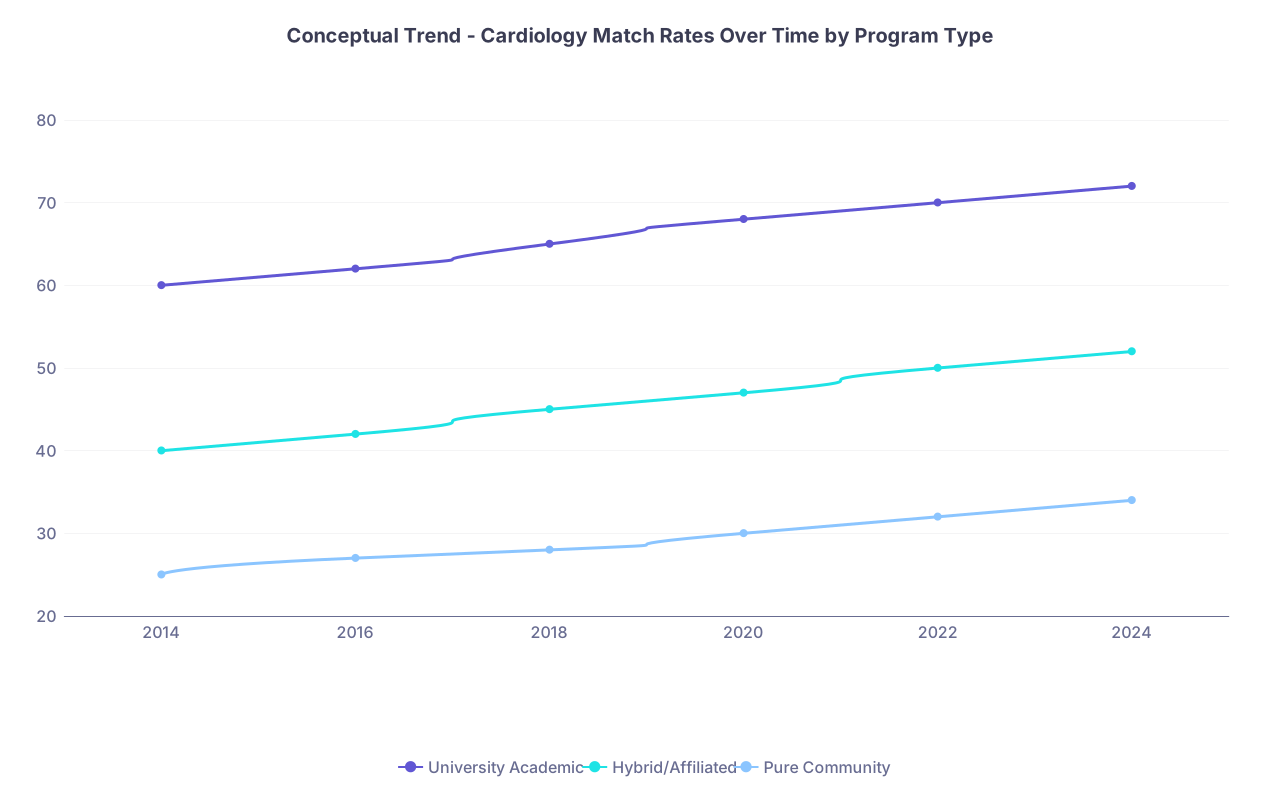
| Category | University Academic | Hybrid/Affiliated | Pure Community |
|---|---|---|---|
| 2014 | 60 | 40 | 25 |
| 2016 | 62 | 42 | 27 |
| 2018 | 65 | 45 | 28 |
| 2020 | 68 | 47 | 30 |
| 2022 | 70 | 50 | 32 |
| 2024 | 72 | 52 | 34 |
Everyone has moved up a bit. The relative ranking has not changed. Training setting remains a strong predictor of outcome.
6. How to Read a Program’s Data Like an Analyst
You will not get NRMP to hand you a neat spreadsheet stratified by training setting. You have to extract local signals. Here is the process I recommend residents use; it is tedious but effective.
Step 1: Get 3–5 years of fellowship placement lists
Most programs publish this on their website or will send a de-identified summary if you ask.
You want something like:
- Class of 2021: 10 IM grads – 4 hospitalist, 2 cards, 1 GI, 1 heme/onc, 2 pulm/crit
- Fellowship destinations listed by institution
Then you calculate:
- % of residents entering any fellowship each year
- % landing in competitive fellowships (cards, GI, heme/onc)
- % at “high-recognition” institutions (top 30–50 programs in that field)
Step 2: Categorize those destinations by tier
You can do a rough tiering based on widely-accepted perceptions (yes, it is subjective, but PDs use similar mental bins). For example, in cardiology:
- Tier 1: Major academic centers with high research output
- Tier 2: Regional academic or university-affiliated programs
- Tier 3: Community-based fellowships, newer/unranked programs
Then compute proportions. If a program says “strong fellowship placement” but 90% of those placements are Tier 3 local fellowships, that is a different story than 40–50% going to Tier 1–2.
Step 3: Adjust for denominator
A program may look “weak” for GI simply because only one resident per year applies. That is not poor performance. That is small n.
You want:
- Among residents who applied in a given field, what percent matched?
- How many aimed for that field at all? (interest culture matters)
Academic programs with a strong cards culture may send 10 residents a year into the cardiology pipeline. Community programs might send 1–2. Exposure, mentorship, and peer culture matter.
7. Choosing Between Community and Academic When You Want Fellowship
Let me be brutally direct here. If you have a strong interest in a competitive fellowship and offers from both types of programs, you need to think in conditional probabilities.
Scenario 1: You want cards/GI/heme-onc, you have mid-to-strong stats
If your options include:
- A solid academic IM program with in-house fellowship in your target field
- A strong community program with no in-house fellowship
The data-driven move, 9 times out of 10, is to pick the academic program, even if:
- The location is less desirable
- The schedule is marginally tougher
- The salary is slightly worse
Why? Because the structural multipliers (research access, letters, in-house pipeline) increase your match probability by 15–30 percentage points. That is a massive swing compared with almost anything else in your control.
Scenario 2: You want a “less bottlenecked” fellowship (endocrine, nephrology, ID, geri, etc.)
Here the gap is narrower. Many community programs send residents into these fields successfully.
In this context, a strong, well-resourced community or hybrid program with in-house fellowships and some research options can be perfectly adequate. You are no longer fighting in a 3–4 applicants per spot environment with heavy name bias.
Scenario 3: You are genuinely undecided between hospitalist and fellowship
This is the majority, even if people do not admit it on interview day.
Here is how I frame it with residents:
- If you might want a competitive fellowship, bias toward academic or hybrid programs with at least one high-profile fellowship division
- If you are leaning >70% toward hospitalist/primary care, a community program with high clinical volume and sane culture can be an excellent choice and may beat a toxic academic environment where you burn out
But notice the important qualifier: the “undecided” person who goes community is pre-committing to climbing a steeper hill if they pivot to cards or GI later. Possible, but harder. That trade-off must be conscious, not accidental.
8. How to Mitigate a Community Disadvantage If You Are Already There
Not everyone gets a clean choice. Some people are already at a community program and now want fellowship. That is reality, not theory.
If that is you, your game plan needs to lean heavily on overperformance and external signaling. The numbers show that community residents who match into competitive fellowships typically share several features:
- Board scores: Often at or above the mean of academic counterparts. Think upper quartile for their cohort.
- Research: At least 2–3 specialty-relevant projects, often achieved by collaborating with external institutions (old med school, nearby university, national societies).
- National presence: Posters at major meetings (ACC, ACG, ASH, ATS, etc.). Local QI tucked away in a hospital committee folder does not move the needle much.
- Strategic away rotations or electives: Short focused time at a target academic institution, ideally yielding a strong letter.
Visualizing this as a rough balance:
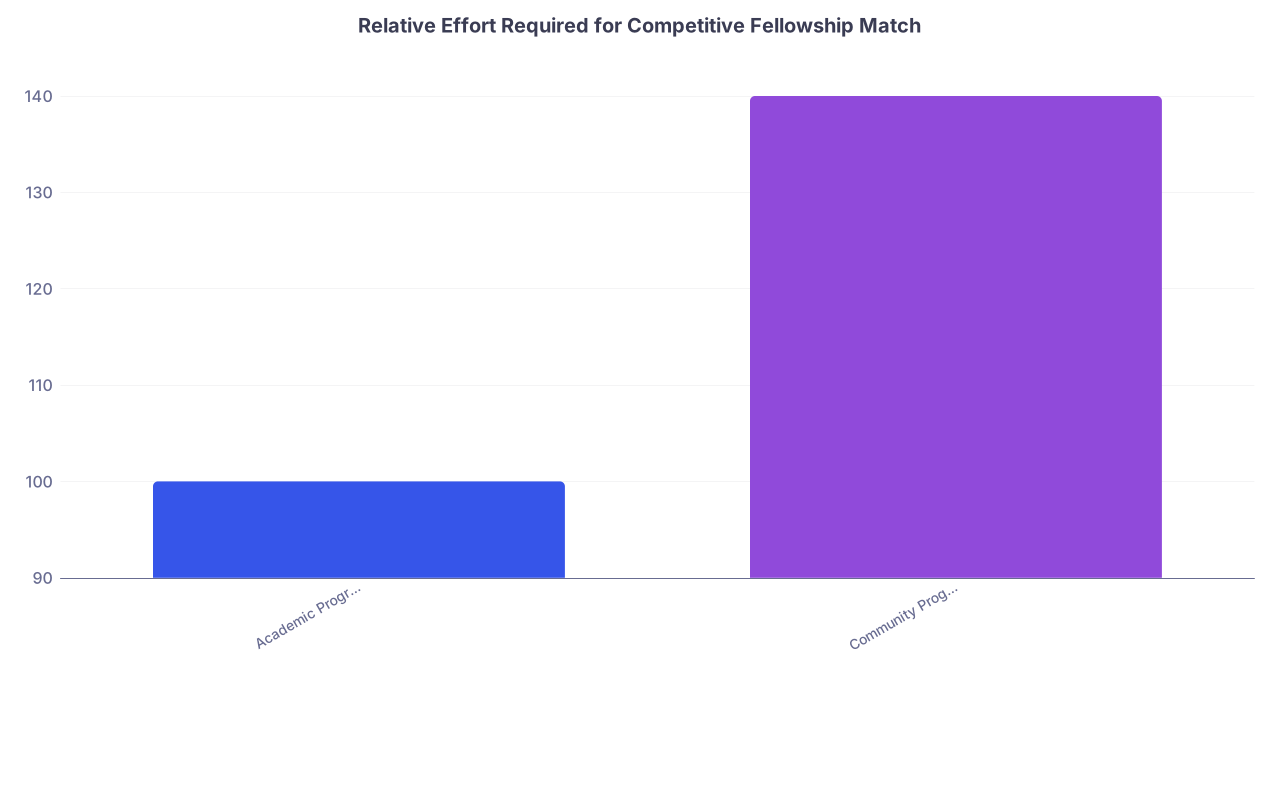
| Category | Value |
|---|---|
| Academic Program Resident | 100 |
| Community Program Resident | 140 |
That 40% extra “effort” is not a scientific measure; it is a reflection of what you see repeatedly: community residents who succeed have to generate more external signal to overcome weaker institutional branding.
9. The Hard Truth About “You Can Match From Anywhere”
The most misleading statement in this whole conversation is: “You can match from anywhere if you are good enough.” Technically true. Practically incomplete.
The more accurate version is:
- You can match from anywhere, but the threshold for success is higher in weaker environments, and the variance is larger.
In other words:
- At a strong academic program, the median resident who wants a standard fellowship and does the expected work matches. Outliers fail.
- At a pure community program, the top 20–30% of residents with extra hustle match into competitive fellowships. The middle group may end up in less competitive fields or as hospitalists, even if they would have matched cards from a flagship academic place.
If you are deciding between offers, you should be asking:
- Do I want to rely on being in the top 20% of any group I join for the next 3 years?
- Or would I rather choose an environment where being in the solid middle still gets me to my goal?
That is not about “confidence.” It is about statistical risk management.
Key Takeaways
Training setting is a measurable variable in fellowship match outcomes; academic and hybrid programs consistently show higher match rates, especially for competitive fields like cardiology, GI, and heme/onc.
The advantage stems from structural factors—research infrastructure, letter-writers with name recognition, and in-house fellowship pipelines—not mystical “academic aura.”
If you are serious about a competitive fellowship and have a real choice, the data strongly favor ranking a solid academic or hybrid program with in-house fellowships above a purely community program, unless you are deliberately accepting steeper odds.