
The resident-to-faculty ratio is the most underrated metric in residency program evaluation—and it quietly explains a lot of what applicants call “mentorship,” “support,” or “feeling like a number.”
If you ignore this number, you are effectively guessing about mentorship quality.
What “Resident-to-Faculty Ratio” Actually Measures
I will define terms clearly, because programs stretch definitions when it suits them.
At its simplest:
Resident-to-faculty ratio = total number of residents ÷ total number of core teaching faculty who directly supervise and evaluate residents.
Not every physician in the hospital counts. The denominator should be:
- Core faculty listed on ACGME program documents
- Regular attendings who provide direct supervision and evaluative input
- Not just per-diem hospitalists who appear twice a year
In practice, you care about three related ratios:
- Program-level ratio – Residents per core faculty across the entire program
- Clinical supervision ratio – Residents per supervising attending on a typical day on a team
- Mentorship load – Residents assigned per faculty advisor / mentor
They are related, but not identical. A program might have a decent global ratio, but daily teams still run with one attending for six residents and two students. Or faculty advising loads might be 20 residents per advisor, which is mentorship theater, not mentorship.
To make the distinctions concrete, look at how these ratios usually shake out by setting.
| Setting Type | Program-Level Ratio (Residents per Core Faculty) | Typical Ward Team Ratio (Residents per Attending) | Advisor Load (Residents per Faculty Advisor) |
|---|---|---|---|
| Large Academic Center | 2.0–3.0 | 3–4 | 12–18 |
| Hybrid Community–Academic | 1.5–2.5 | 2–3 | 8–14 |
| Pure Community (mid-size) | 1.0–1.8 | 1–2 (often 1 resident + 1–2 students) | 4–10 |
| Small Community (new) | 0.7–1.3 | 1 | 3–6 |
Numbers like this are what sit beneath the vague interview comments like “you’ll get a lot of one-on-one time here” versus “you learn from a big team.”
How Ratios Differ: Community vs Academic Reality
1. Large Academic Programs: Scale versus Access
In large academic medical centers, the data pattern is remarkably consistent.
- Internal medicine program with 30–50 residents per year (90–150 total)
- 40–70 core faculty on paper
- So a program-level ratio around 2:1 to 3:1 residents per core faculty
Nice on a brochure. But drill down to the daily work environment and the numbers look different.
On a teaching inpatient team, you often see:
- 1 attending
- 2–3 residents (PGY1–PGY3 mix)
- 1–2 medical students
So the clinical supervision ratio is roughly:
2–4 learners per attending at any given time
That is manageable for clinical teaching. However, academic centers often spread faculty across:
- Research commitments
- Subspecialty clinics
- Administrative roles
So the “core faculty” headcount overstates actual availability. I have seen departments where a third of “core faculty” are 0.5 FTE or less clinically. Functionally, the real ratio during the workday is closer to:
3–4 residents per genuinely available teaching faculty
Then there is advising. Look at a typical big-name academic internal medicine program:
- 120 residents total
- 10–12 designated faculty advisors who actually do longitudinal mentoring
That yields:
10–12 residents per advisor on paper, often 15+ in reality when some advisors are “advisors in name only.”
So what do residents experience?
- You get exposure to many different teaching styles
- You get access to subspecialty mentorship—if you chase it
- You do not get high-frequency, longitudinal one-on-one from the same attending unless you aggressively cultivate it
When residents at these places complain that “nobody really knows me well,” they are describing a ratio problem. Not a personality problem.
2. Community Programs: Fewer People, Denser Contact
Now look at a mid-sized community program:
- 8–12 residents per year (24–36 total)
- 20–30 core faculty (hospitalists, outpatient docs, a few subspecialists)
That gives:
1.0–1.8 residents per faculty at the program level
On inpatient wards:
- 1 attending
- 1–2 residents
- Maybe a student, maybe not
So you end up with a clinical supervision ratio of:
That is radically different from an academic team structure. The attending is not just the final signature. They are in your workflow constantly.
For advising, many community programs run something like:
- 24 residents
- 4–6 truly engaged advisors
So:
4–8 residents per advisor
You can actually know those people. When I have looked at resident survey data from these programs, the “my advisor knows my career goals” rate is often 20–30 percentage points higher than in large university programs.
Residents in these settings often complain about other things—fewer subspecialty research options, for example—but they rarely say “I never see my attendings.”
3. Hybrid Community–Academic: The Middle Band
Hybrid programs (community hospitals affiliated with a university) frequently land in the middle, and the numbers show it.
- 12–20 residents per year (36–60 total)
- 25–40 core faculty between hospitalists and university part-timers
Program-level ratio:
About 1.5–2.5 residents per faculty
Inpatient teams:
- 1 attending
- 2 residents
- 1–2 students
So figure:
2 residents per attending in most blocks
Advising loads:
8–14 residents per advisor, depending on whether subspecialists are counted as advisors
In survey data, hybrids tend to score decently on both “I get one-on-one teaching” and “I have access to subspecialty mentors,” but they rarely lead nationally on either metric. Middle of the distribution by design.
Visualizing Access: Ratios Across Settings
Let’s put these categories side by side in one simple chart.
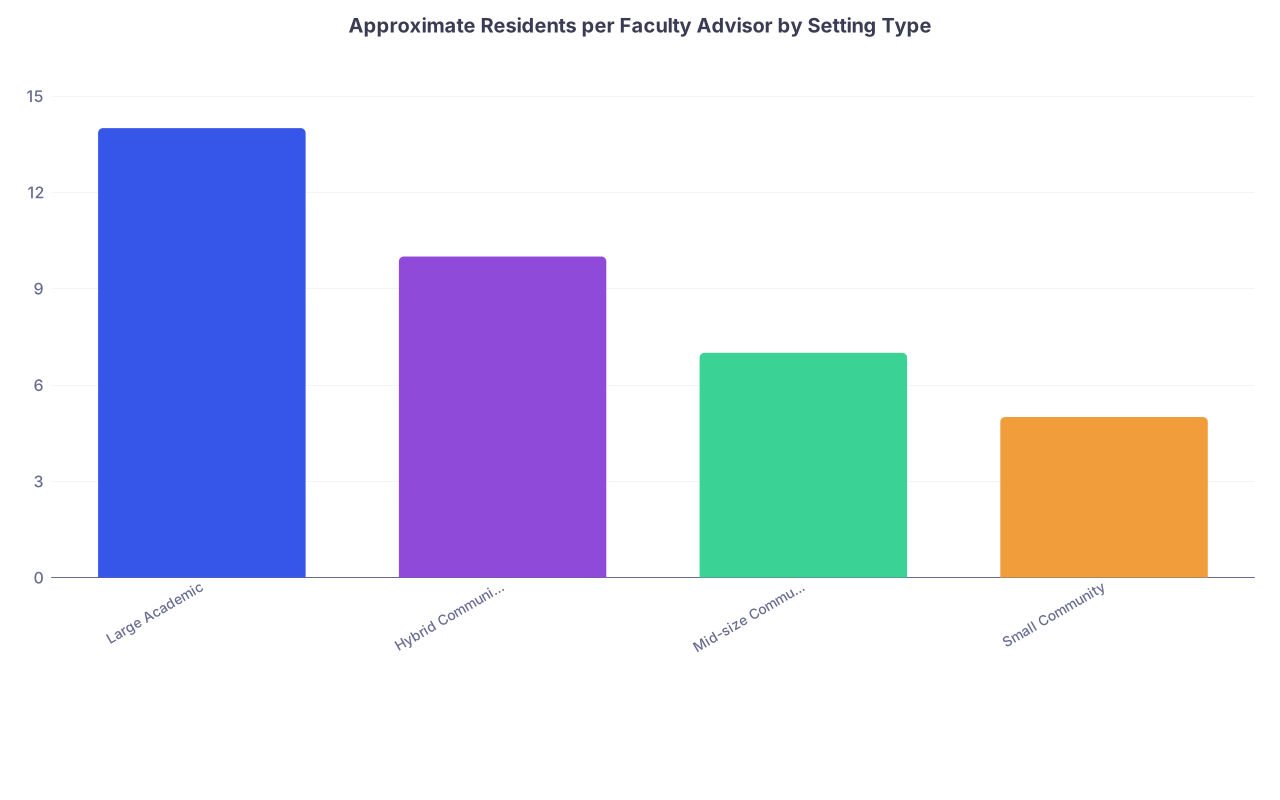
| Category | Value |
|---|---|
| Large Academic | 14 |
| Hybrid Community-Academic | 10 |
| Mid-size Community | 7 |
| Small Community | 5 |
This is where mentorship density lives. Fewer residents per advisor translates very directly into more emails answered, more letters written, more specific career planning.
In high-ratio environments (higher bars), everything becomes optional and student-driven. In low-ratio environments (lower bars), mentorship is hard to avoid.
How Ratios Show Up in Daily Life
Strip away the marketing gloss and look at what you actually live through as a resident.
Teaching Time per Resident per Day
Take a simple model: an attending has capacity for about 90 minutes of real teaching and feedback per day that is not just “sign this” or “this order is wrong.”
Now distribute that:
- Large academic team: 90 minutes / 3 residents → 30 minutes each
- Hybrid team: 90 minutes / 2 residents → 45 minutes each
- Community team with 1 resident: 90 minutes / 1 resident → 90 minutes (you get all of it, unless students are present)
You will not literally sit for 30, 45, or 90 minutes in a row. But over weeks and months, the cumulative exposure is huge.
Extend this to a month-long rotation:
- Large academic: 30 minutes × 20 working days ≈ 10 hours of real attending-focused teaching per resident
- Hybrid: 45 minutes × 20 ≈ 15 hours
- Community: 90 minutes × 20 ≈ 30 hours
The ratio directly multiplies your teaching time.
Feedback Frequency
Residents consistently complain they do not get enough feedback. Very often, the math explains it.
Suppose an attending can realistically give:
- One thorough mid-rotation feedback conversation (20–30 minutes)
- One end-of-rotation summary (15–20 minutes)
for each resident.
- If they have 3 residents on service, that’s 6 conversations per month. Doable but heavy.
- With 1–2 residents, that is 2–4 conversations. Much more likely to happen and be thoughtful.
When you look at ACGME survey data, community-heavy programs almost always outperform large academic ones on “I receive timely and actionable feedback,” despite similar written policies. The actual supervision ratio is doing the work.
Letter of Recommendation Dynamics
Letters are a nice practical test of mentorship density.
Here is what the cycle looks like numerically for a typical attending:
- An attending can reasonably write 15–25 strong, detailed residency or fellowship letters per year before quality drops.
- In a large academic program, that attending might work with 30–50 residents per year, plus medical students. Mentor-to-mentee competition is real.
- In a small or mid-size community program, they might work meaningfully with 10–20 residents per year.
Residents in community programs often secure more detailed, personalized letters from core faculty because:
- The faculty have seen them more days per year.
- There are fewer residents per faculty competing for that attention.
Again, the ratio quietly advantages one setting for certain outcomes—especially if your goal is a strong generalist or hospitalist career, or a moderately competitive fellowship rather than elite academic positions.
Academic Output vs Mentorship: The Trade
Let me be explicit: a low resident-to-faculty ratio is not automatically “better.” It depends what you want.
Look at research output per resident in different settings. A rough pattern:
- Large academic IM programs: median 2–4 publications or abstracts per resident by graduation (often more for fellowship-bound residents)
- Hybrid programs: 1–2
- Mid-size pure community: 0–1, usually case reports or QI
Why? Because the research mentor-to-trainee ratio in academic centers is actually quite favorable within specific niches.
A pulmonary-critical care division with:
- 10 fellows
- 20 research-oriented attendings
has a 0.5 fellow per faculty ratio in that niche group. That is extremely mentorship-dense if you are one of those fellows or residents embedded with that division.
So the practical split is:
- Academic programs:
- Clinical teaching ratios: often less favorable (more residents per attending)
- Research mentorship: often highly favorable within divisions
- Community programs:
- Clinical mentorship and feedback: highly favorable ratios
- Research mentorship: sparse or highly opportunistic
You cannot maximize both simultaneously in most environments. The headcount and funding reality just does not support it.
How to Estimate Ratios From Public Information
Programs rarely hand you the ratio straight. You have to reverse engineer it.
Here is a simple approach during residency applications:
Calculate program-level ratio from websites.
- Count residents: many sites list “X residents per class.” Multiply by years.
- Count faculty: look for “core faculty” or “teaching faculty” list.
- Residents ÷ faculty = rough ratio.
Infer daily team ratio during interviews. Ask:
- “On a typical teaching service, how many residents are on each team?”
- “How many teams is each attending supervising at one time?”
- “How many students are also on the team?”
Then compute: residents per attending.
Probe mentorship load. Ask very specific questions:
- “How many residents is each advisor assigned?”
- “How often do advisors meet with residents in a structured way?”
- “Who actually writes most fellowship letters here—core advisors or subspecialists?”
If you track these across 6–8 interviews, you will see a pattern. The outlier programs—very high or very low ratios—tend to reveal themselves in the numbers quickly.
To make the decision pressure obvious, think in terms of competing priorities.

| Step | Description |
|---|---|
| Step 1 | Applicant Preferences |
| Step 2 | Target low resident to faculty ratio |
| Step 3 | Accept higher ratio for academic depth |
| Step 4 | Prioritize community or hybrid programs |
| Step 5 | Prioritize large academic centers |
| Step 6 | Select hybrid or strong community with academic ties |
| Step 7 | Select best mentorship fit |
| Step 8 | Big name academic with strong research |
| Step 9 | Smaller academic with better ratios |
| Step 10 | Primary Goal |
| Step 11 | Need top tier fellowship? |
| Step 12 | Ok with less one on one? |
That is the actual trade you are making, even if no one spells it out.
Red Flags and Green Flags in Ratios
Once you think in ratios, some patterns become obvious.
Red Flag Patterns
Very large program + tiny faculty roster.
Example: 18 residents per year (54 total), “about 20 faculty.” That is >2.5 residents per faculty, often worse if some faculty are part-time.One attending covering multiple teams.
If an attending is “overseeing two resident teams,” supervision ratio is effectively doubled. Education becomes more about throughput than discussion.Advising panels with >15 residents per advisor.
I have never seen this work well in practice. Residents end up finding unofficial mentors elsewhere, or not at all.
Green Flag Patterns
Program-level ratio <1.5:1 with stable faculty.
This is where residents routinely report “I can always find someone to help” and “a few attendings really know me.”1–2 residents per inpatient attending.
Especially strong environment for interns and early PGY2s building core clinical reasoning.Advising loads under 8 per advisor with defined meeting frequency.
These programs can actually deliver on the “longitudinal mentorship” promise.
To visualize the supervision gap, look at this simple bar chart:
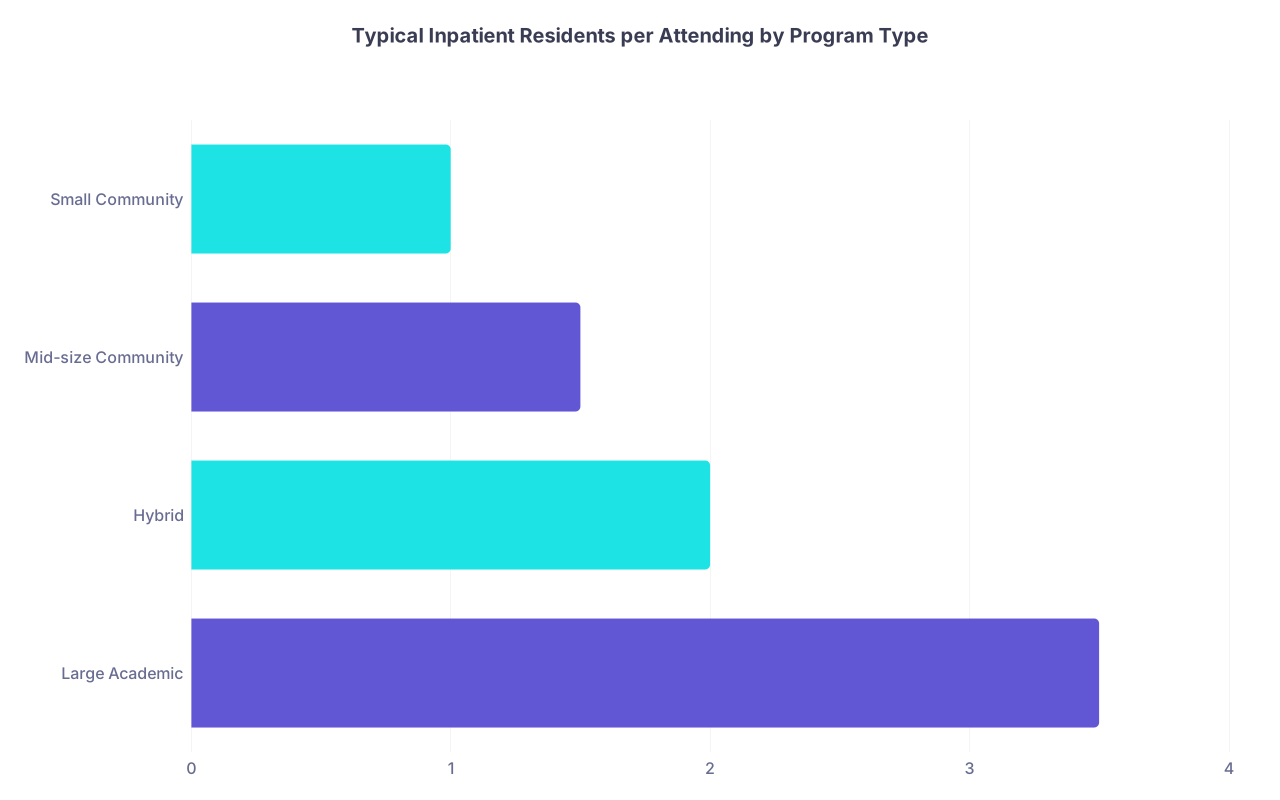
| Category | Value |
|---|---|
| Large Academic | 3.5 |
| Hybrid | 2 |
| Mid-size Community | 1.5 |
| Small Community | 1 |
Each increment on that chart is more or less directly convertible into “less of the attending’s mental bandwidth on my growth.”
How to Match Your Goals to the Ratios
You are not choosing a ratio in isolation. You are choosing what you want out of the next three years.
Use these broad rules of thumb.
If your top priority is:
Becoming a strong, confident clinician with lots of direct feedback
→ Favor programs where:- Program-level ratio is roughly 1.0–1.8
- Inpatient teams run 1–2 residents per attending
- Advisors have at most ~8 residents each
These are often community or hybrid programs.
Securing a highly competitive subspecialty fellowship at a top institution
→ Be willing to accept:- Higher clinical supervision ratios (3–4 residents per attending)
- Advisors with 12–18 residents
In exchange for: - Dense subspecialty faculty in your chosen field
- Formal research infrastructure
These are usually large academic centers or their strong hybrid affiliates.
Keeping options open with balanced clinical and academic exposure
→ Look for the “hybrid middle”:- 1.5–2.5 residents per faculty
- 2 residents per attending on wards
- Real but not overwhelming research flow
No one will hand you a spreadsheet on interview day. But you can more or less reconstruct this with a notebook and three or four honest questions.
The Bottom Line
Three core points, stripped of the marketing:
Resident-to-faculty ratio is a quantifiable proxy for mentorship density. Lower ratios usually mean more one-on-one teaching, more specific feedback, and more personalized letters. Higher ratios generally mean you must be more aggressive and self-directed to get the same level of mentorship.
Community and academic programs sit at different ends of this ratio spectrum. Community-heavy programs usually win on clinical supervision and advisor accessibility. Large academic centers usually win on subspecialty and research mentorship—at the cost of thinner day-to-day clinical attention.
You can and should estimate these ratios from publicly available data and interview conversations. Count residents, count core faculty, ask how many residents are on each team, and ask explicitly about advisor loads. Then pick the environment whose numbers align with your actual goals, not just its name recognition.