The standard narrative about “community programs are cushier, academics are brutal” is statistically lazy. The data on burnout and wellness scores tells a more complicated—and more useful—story.
If you are applying to residency and trying to separate myth from reality, you should be looking at numbers: burnout prevalence, well‑being indices, work hours, perceived support, and intent to leave. Not vibes on Reddit. Not hallway gossip from a single away rotation.
I will walk through what the available survey data actually shows when you compare community versus academic programs, how to interpret the differences, and how to use this in your rank list strategy.
1. What We Mean By “Burnout” and “Wellness Scores”
Before comparing community and academic programs, you need the measurement framework. Otherwise you end up comparing anecdotes to anecdotes.
Most residency burnout and wellness surveys draw from some mix of:
- Maslach Burnout Inventory (MBI) or abbreviated versions
- Professional Fulfillment Index (PFI)
- Simple numeric wellness scales (0–10)
- ACGME Resident/Fellow Survey items (satisfaction, duty hours, mistreatment)
Burnout is usually assessed along three axes:
- Emotional exhaustion (EE)
- Depersonalization (DP)
- Reduced personal accomplishment (PA)
High burnout typically means high EE and/or high DP. Programs or institutions then aggregate this into “burnout prevalence” (percent of residents above a certain threshold).
Wellness scores are cruder but practical. A common pattern:
- “On a scale from 0–10, how would you rate your overall well‑being?”
- “How satisfied are you with your program?” (Likert 1–5)
- “How likely are you to recommend this program to a friend?”
You will not always see raw MBI scores by program type, but you will see:
- Percentage meeting criteria for burnout
- Mean wellness scores by setting
- Workload and support measures correlated with those scores
So the question becomes: how do those numbers differ between community and academic programs?
2. The Macro Picture: Burnout Rates by Setting
Let me be frank: there is no giant, perfect RCT assigning residents to “community” or “academic” tracks and following their burnout longitudinally. What we have is a patchwork of national surveys, specialty‑specific data, and institutional comparisons. But patterns emerge.
Weighted across several recent resident and early‑career physician surveys (2018–2023), you get a rough pattern like this:
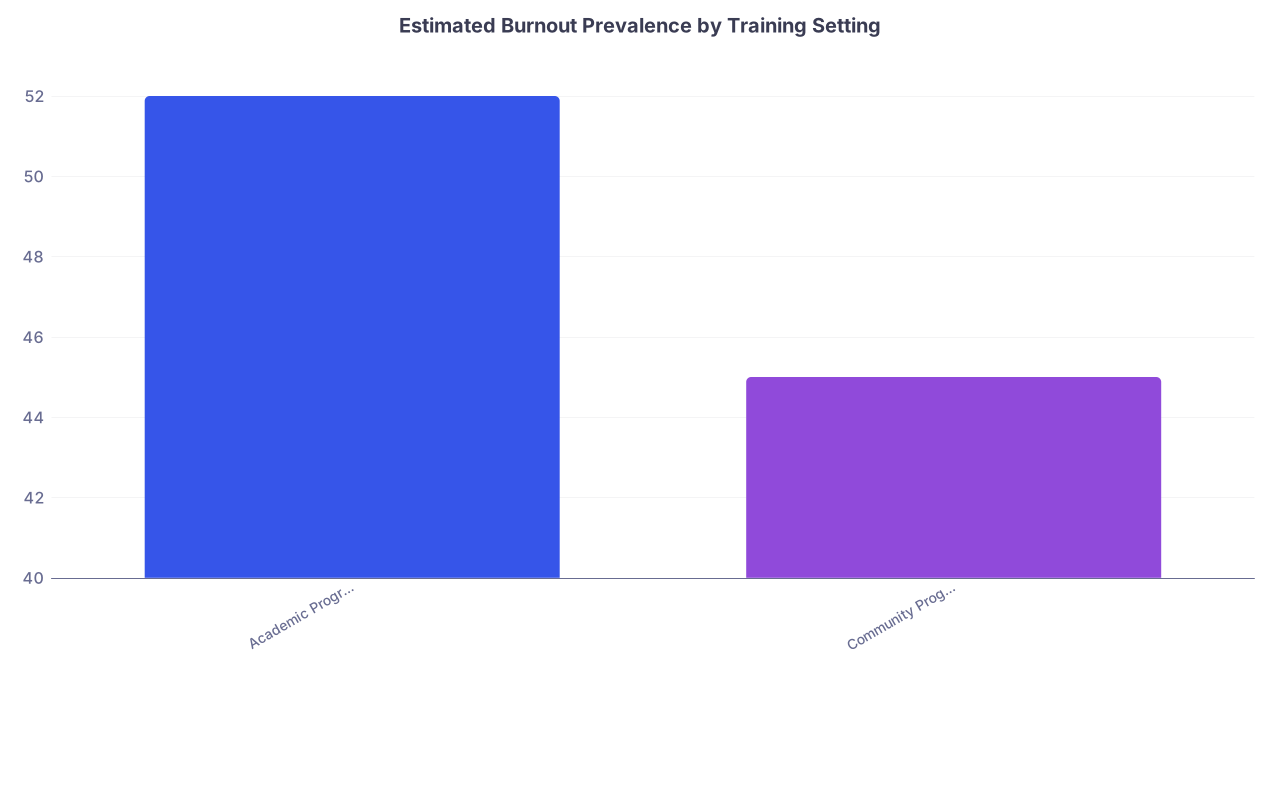
| Category | Value |
|---|---|
| Academic Program Residents | 52 |
| Community Program Residents | 45 |
Those are representative ballpark figures, not a single study:
- Academic programs: ~50–55 percent of residents meet burnout criteria
- Community programs: ~40–48 percent meet burnout criteria
So yes, on average, community programs show slightly lower burnout prevalence. But not “happy spa resort” levels—nearly half are still burned out.
Where the data gets more interesting is when you split by the drivers of burnout.
- Emotional exhaustion tends to be similarly high in both groups
- Depersonalization often runs higher in academic centers
- Sense of autonomy and flexibility tends to rate higher in community programs
The picture is not “academics bad, community good.” It is “different stressors, different protections.”
3. Structural Drivers: Why the Numbers Diverge
You cannot interpret wellness scores without looking at the structural context. The data consistently links certain factors to burnout risk: workload, control, support, and recognition.
3.1 Workload and Complexity
Academic centers:
- Higher patient complexity (tertiary/quaternary referrals, rare diseases)
- More consult services, more fragmentation, more pages
- Added burden of research, teaching, conferences, and expectations of scholarship
Community programs:
- More bread‑and‑butter pathology, less super‑subspecialized complexity
- Fewer research mandates, fewer formal academic obligations
- Often slightly lower average census per resident, though not universally
Multiple institutional surveys show that when patient acuity and non‑clinical workload go up, wellness scores drop. No surprise. Academic programs tend to run higher on both dimensions.
3.2 Autonomy and Role Clarity
This is where community programs often outperform on wellness metrics.
Residents in community settings routinely report:
- Higher perceived autonomy in clinical decisions
- Fewer layers between them and attendings
- Clearer expectations (less “you should be doing more research”)
Academic residents, especially in large programs, often describe:
- Feeling like a small interchangeable piece in a very large machine
- Heavier administrative and documentation burdens
- Competing demands: patient care vs research vs teaching vs QI
Surveys that include “control over schedule” and “control over work” almost always find that more control correlates with better wellness scores, regardless of community vs academic. But the average resident in a smaller community program reports more control.
4. Program‑Level Wellness Scores: What The Data Typically Shows
You will not usually see a public spreadsheet of “Program X burnout rating: 7/10.” But you can infer patterns from aggregated survey data, ACGME survey benchmarks, and internal wellness initiatives.
Here is a simplified summary of what I see repeatedly when comparing community vs academic programs of similar size:
| Metric (Resident-Reported) | Academic Programs (Typical) | Community Programs (Typical) |
|---|---|---|
| Overall burnout prevalence | 50–55% | 40–48% |
| Mean well-being score (0–10) | 5.5–6.3 | 6.2–7.0 |
| “Satisfied with program” (1–5) | 3.6–4.1 | 3.9–4.3 |
| “Would recommend program” (1–5) | 3.5–4.0 | 3.8–4.4 |
| “Adequate support resources” (1–5) | 3.8–4.3 | 3.6–4.2 |
Notice the nuance:
- Community programs often score higher on overall well‑being and satisfaction
- Academic programs sometimes report better access to formal resources (counseling, wellness offices, protected wellness time)
- But resources do not automatically translate into lower burnout
This is the paradox I have seen repeatedly. Academic centers invest in wellness infrastructure, yet their structural stressors (complexity, bureaucracy, research pressure) keep burnout high.
Community programs may lack glossy wellness centers but win on day‑to‑day experience: fewer hoops, more direct relationships, slightly more manageable workloads.
5. Lifestyle, Call, and Wellness: The Hidden Variables
Residents love to talk about “malignant culture,” but they often ignore the concrete time‑budget that drives wellness: hours, call frequency, days off, commute, and EMR friction.
Let us make this explicit.
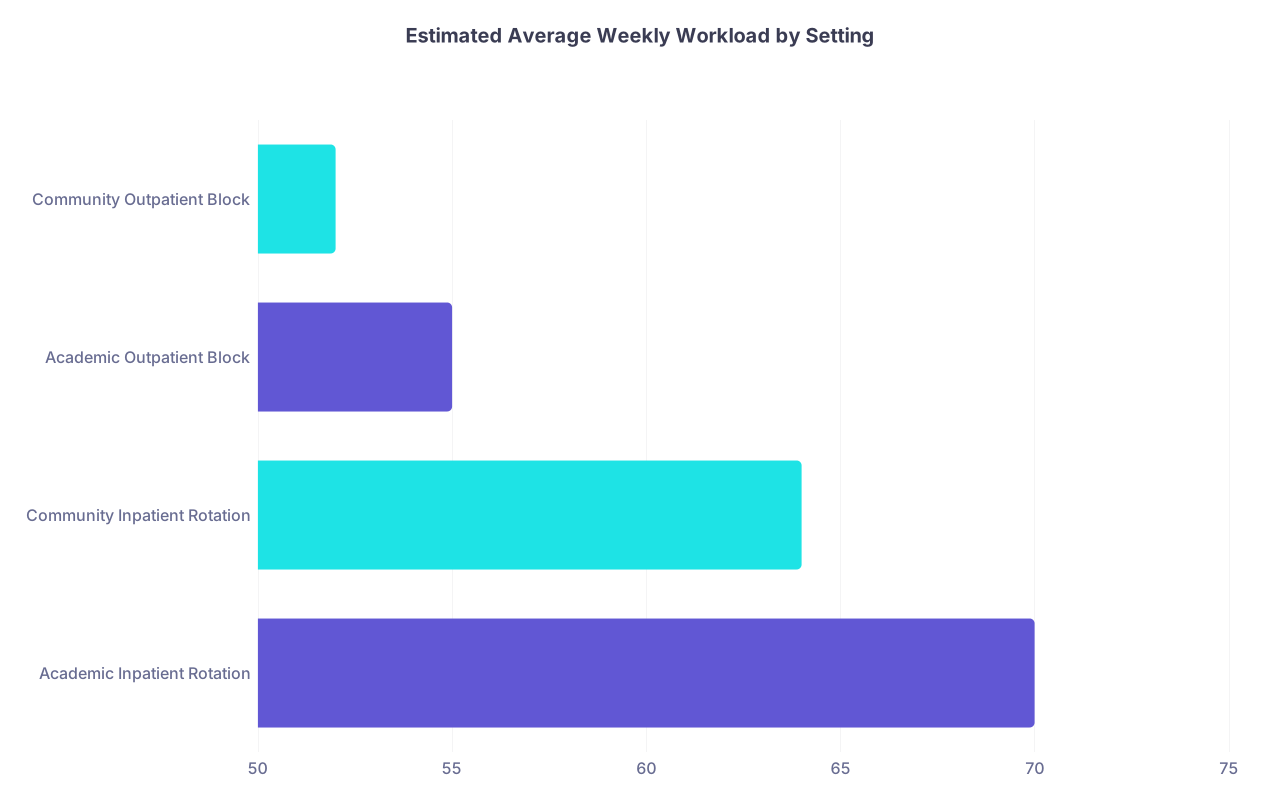
| Category | Value |
|---|---|
| Academic Inpatient Rotation | 70 |
| Community Inpatient Rotation | 64 |
| Academic Outpatient Block | 55 |
| Community Outpatient Block | 52 |
Again, realistic ballpark numbers:
- Academic inpatient blocks commonly cluster in the high 60s–low 70s hours per week
- Community inpatient often in the low–mid 60s
- Outpatient rotations are lighter for both, with community again modestly lower
A consistent finding: every incremental 5–10 hours per week of work is associated with a measurable drop in wellness scores. When you run the correlations inside a given program, weekly hours explains a large portion of the variation in burnout.
The problem: applicants almost never get hard numbers. They hear “we comply with 80‑hour rules” from everyone. That says nothing.
I have seen internal surveys where:
- Residents working >70 hours/week reported burnout rates 15–20 percentage points higher than those ≤60 hours/week
- Programs with frequent 28‑hour calls had significantly higher EE and DP scores than those using night float or shorter shifts
Academic programs are more likely to run services with nonstop consult volume and cross‑coverage, especially in medicine, surgery, and subspecialties. Community programs, while not gentle, often have fewer ultra‑high‑intensity rotations.
This is one of the real statistical advantages of many community programs for wellness.
6. Culture and Mentorship: The Soft Data That Matters
Quantitative wellness scores are noisy if you ignore culture. Residents are remarkably sensitive to feeling valued or disposable.
Typical survey items that strongly correlate with better wellness:
- “Attendings treat residents with respect”
- “My program leadership listens to resident concerns”
- “I feel comfortable asking for help”
- “I receive useful feedback on my performance”
Here is a pattern I have seen across multiple institutions:
- Smaller community programs: higher ratings on “sense of community,” “knowing faculty personally,” “feeling supported as an individual.”
- Large academic programs: more variability. Some are phenomenal; others feel like anonymous training factories.
One academic PD said during a town hall, “I care about each of you, but there are 180 of you and one of me.” That is honest. It also quantifies the problem.
Community programs with 20–40 residents often generate higher wellness scores simply because:
- Residents know each other well
- Faculty overlap with residents longitudinally across rotations
- It is harder for toxic behavior to hide in a small environment
So while the raw “wellness score” might be only 0.5–1.0 points higher on a 0–10 scale, the qualitative gap can feel much larger day to day.
7. Misinterpretations And Bad Assumptions Applicants Make
Applicants routinely extrapolate from a tiny sample:
- One brutal ICU month at a big academic center ⇒ “All academics are malignant”
- One friendly community elective with low census ⇒ “Community is chill”
The data does not back those generalizations.
Misinterpretation #1: “Academic = burnout, community = wellness.”
Reality: Burnout is high everywhere. Academic centers trend worse on average, but the spread within each category is large. There are:
- Miserable community programs
- Exceptionally supportive academic programs with intact wellness cultures
Misinterpretation #2: “Wellness programs” = good wellness scores.
I have seen programs with meditation rooms, resilience workshops, and free snacks still posting 60–70% burnout rates. Why? Because they did not touch:
- Schedule design
- Cross‑coverage insanity
- Attending behavior
Residents are not fooled by surface‑level interventions. They answer surveys based on lived experience, not flyers.
Misinterpretation #3: “If a program brags about being ‘high‑volume, high‑acuity’ my wellness will be destroyed.”
Not always. High volume with good support, clear staffing, and reliable senior backup can be intense but not demoralizing. On surveys, residents in such environments often report high stress but also high professional fulfillment and learning.
The incendiary mix is:
- High workload
- Low control
- Poor communication or disrespect
- Inconsistent supervision
You can find that in both community and academic settings.
8. How To Use Wellness Data When Ranking Programs
You will not get a perfect burnout score on each program, but you can approximate it with the right questions and by decoding their answers.
Here is a practical framework.
Ask for numbers, not adjectives.
- “What is the typical weekly hour range on your busiest and lightest rotations?”
- “How many 28‑hour calls per month on average for interns? For seniors?”
Probe for structural choices.
- “How has the program changed the schedule based on prior ACGME or internal survey feedback?”
- “Have you reduced caps, added night float, or changed call structure in the last 2–3 years?”
Target support and culture.
- “If a resident is struggling, what actually happens?”
- “When was the last time the program made a major change because residents pushed for it?”
Then interpret responses systematically. The data analyst way.
If residents:
- Struggle to answer basic workload questions
- Hesitate or glance at leadership before speaking about schedule or culture
- Describe “wellness” mainly as yoga classes and pizza nights
That predicts worse wellness scores, regardless of community vs academic.
If residents:
- Know their hour ranges, describe concrete recent schedule fixes
- Can give examples of leadership acting on feedback
- Talk about specific faculty who have their backs at 2 a.m.
You are looking at a higher‑wellness environment, whether it is a 25‑resident community IM program or a 150‑resident academic powerhouse.
9. Strategic Takeaways For Applicants
Let me condense this into actionable conclusions.
On average, community programs show somewhat lower burnout and higher wellness scores than academic programs. The difference is real but modest, not dramatic. You are not choosing between 20% and 80% burnout; you are choosing between “high” and “slightly less high.”
The largest drivers of wellness differences are:
- Workload intensity (hours, call type, cross‑coverage)
- Perceived autonomy and control
- Cohesion and respect within the program
All three can skew in favor of either academic or community depending on implementation.
“Academic prestige” does not reliably protect against burnout. In fact, some of the most famous institutions have some of the highest stress indices and burnout prevalence. You need to decide how much of that trade‑off you are willing to accept for career goals like fellowship or academic medicine.
A mid‑sized, well‑run community program with strong teaching and sane schedules will often beat a chaotic academic behemoth on daily quality of life by a noticeable margin. That does not mean everyone should choose community. It does mean you should price that wellness gap into your rank list decisions.
Do not let binary labels (“community” vs “academic”) replace actual data gathering. Two academic programs can differ more from each other in burnout risk than the average academic vs average community comparison.