The mythology about “everyone wants big-name academic programs” is wrong. Once you look at actual Match data and behavior, the story is more complicated—and more interesting.
Applicants say one thing on Reddit. Their rank lists say another.
This is an analysis of how applicants actually place community vs academic programs on their rank lists, what the numbers suggest about preferences, and who is over- or underestimating each pathway.
1. What the Match Data Quietly Shows
Let me start with the macro signal: where people end up. The NRMP publishes outcome data by program type and fills each year. If you watch those reports over a few cycles, a pattern emerges.
Across most core specialties (internal medicine, family medicine, pediatrics, psychiatry, OB/GYN, general surgery):
- Academic programs consistently fill a higher proportion of their spots with US MD seniors.
- Community programs fill more with a mix of:
- US DO seniors
- US MD seniors with mid-range applications
- IMGs
Yet community programs still fill most of their positions—often close to 100% after the Supplemental Offer and Acceptance Program (SOAP). That only happens if a lot of people are ranking them.
So the data story looks like this:
- Academic programs get more applications per position, are ranked higher by more competitive applicants, and fill earlier.
- Community programs get fewer applications per position, but still land solidly on many rank lists and catch:
- Applicants who consciously prefer the community model
- Applicants stretching for higher-tier academic places and using solid community programs as floor options
The real question is not, “Do people rank community programs?” They obviously do. The real question is where they slot them relative to academic programs at various tiers.
2. How Applicants Actually Structure Rank Lists
If you sit down with enough fourth-years in January and February, you start seeing recurring rank list patterns. People think they’re unique. They are not.
I will simplify a bit, but it tends to fall into a few archetypes.
The Tiered Tradeoff Model
Most applicants are not choosing between “academic vs community” in a vacuum. They are choosing between:
- High-prestige academic vs strong community
- Mid-tier academic vs very strong community
- Lower-tier academic vs excellent lifestyle community
So you get patterns like:
- Big-name academic university (top choice for prestige/research/fellowship) 2–3. Other academic university programs (regional reputations) 4–6. High-volume, well-regarded community programs (good fellowship history) 7+ Mid/low-tier community or small academic affiliates
The tradeoff is not simply setting type. It is a multi-variable optimization of:
- Training intensity and perceived “brand”
- Geographic location and support system
- Lifestyle and call burden
- Fellowship prospects
- Culture and perceived happiness
Applicants may say, “I prefer academic.” But then you see:
- A well-known community program at rank #3
- A mid-tier academic program in a bad location at rank #7
Their revealed preference: quality training + location + culture beats “academic label” alone.
3. Specialty-Specific Patterns: Where Academic Really Dominates
Some specialties show a strong skew in how applicants prioritize academic programs near the top of the list.
Competitive Specialties: Academic First, Almost Always
In specialties like dermatology, plastic surgery, otolaryngology, neurosurgery, and radiation oncology, the data on:
- Publications per matched applicant
- Percentage of matched applicants with research years
- Match lists heavily clustered at academic centers
all point the same way: high-achieving applicants overwhelmingly rank academic programs first.
Community options either barely exist or function as niche pathways with a very different applicant pool.
For these specialties, the typical pattern:
- Rank list top 5–10: Almost entirely academic, heavy on large university teaching hospitals
- Community programs:
- Either not applied to at all
- Or used as late “insurance” ranks by applicants just trying to secure any spot
Where “community vs academic” is basically a non-decision; the decision is “Which academic center will give me the best research and prestige signal?”
Fellowship-Driven Core Specialties
Internal medicine, pediatrics, and sometimes OB/GYN and general surgery show nuanced splits.
If you plot:
- % of graduates going into subspecialty fellowships
- % who match into “elite” fellowships
across academic vs community residencies, you see:
- Academic programs at major universities: highest fellowship match rates, especially for competitive fellowships
- Strong community programs with high volume and good faculty: surprisingly solid fellowship outcomes, especially regionally
- Small community programs without strong subspecialty presence: weaker fellowship pathways
So fellowship-focused applicants tend to rank:
- Big academic centers at the top
- Select high-powered community programs next (especially those known locally to place into cardiology, GI, heme/onc, etc.)
- Smaller, quieter community programs lower—unless lifestyle is a top priority
4. Lifestyle and Geography: Where Community Programs Climb the List
Now the part applicants underestimate when they talk bravely in October but revise quietly in January: real life.
I have watched multiple applicants start the season declaring:
“I’ll go anywhere for the best academic program.”
Then you see their final rank list:
- #1–2: Academic programs in their home region
- #3–4: Strong community programs in their home city or near family
- #8–10: Well-known but far-away brand-name academic programs they swore they wanted
The data in NRMP surveys backs this up. “Geographic location” and “Proximity to family” rank consistently near the top of factors influencing rank decisions. For many people:
- A strong community program in the right city beats a mid-tier academic program in a place they dislike.
- A community program with a humane call schedule and supportive culture beats a malignant academic department with poor wellness scores.
So what happens on rank lists?
- For applicants with partners, children, or caregiving obligations, good local community programs shoot up. Often into the top 3.
- For applicants who prioritize work-life balance or hate the idea of constant research pressure, community programs outrank academic ones even when both are in the same metro.
That choice rarely gets advertised on social media. But the rank list behavior is unambiguous.
5. Match Outcomes: Who Ends Up Where
Let’s break how the Match algorithm interacts with these preferences, because it changes how risky you can be with academic-heavy lists.
The algorithm is applicant-proposing. That means:
- You can safely rank “reach” academic programs first.
- You do not harm your chance at community programs lower on the list by putting academic programs above them.
What you see in the outcome data:
- Top-decile applicants: often match at their high-ranked academic choices; their community programs function as unused insurance.
- Middle cohort: some overreach and land at strong community programs that were ranked mid-list.
- Lower-competitiveness applicants: often match at community programs even if the top part of the list is academic-heavy and unrealistic.
The end result:
- Academic programs are slightly overrepresented at the top of rank lists relative to where people eventually match.
- Community programs are overrepresented in actual match outcomes relative to how “loud” they are in applicant conversations.
To make this concrete, here is a stylized version of how different applicant groups distribute academic vs community across their first 5 ranks.
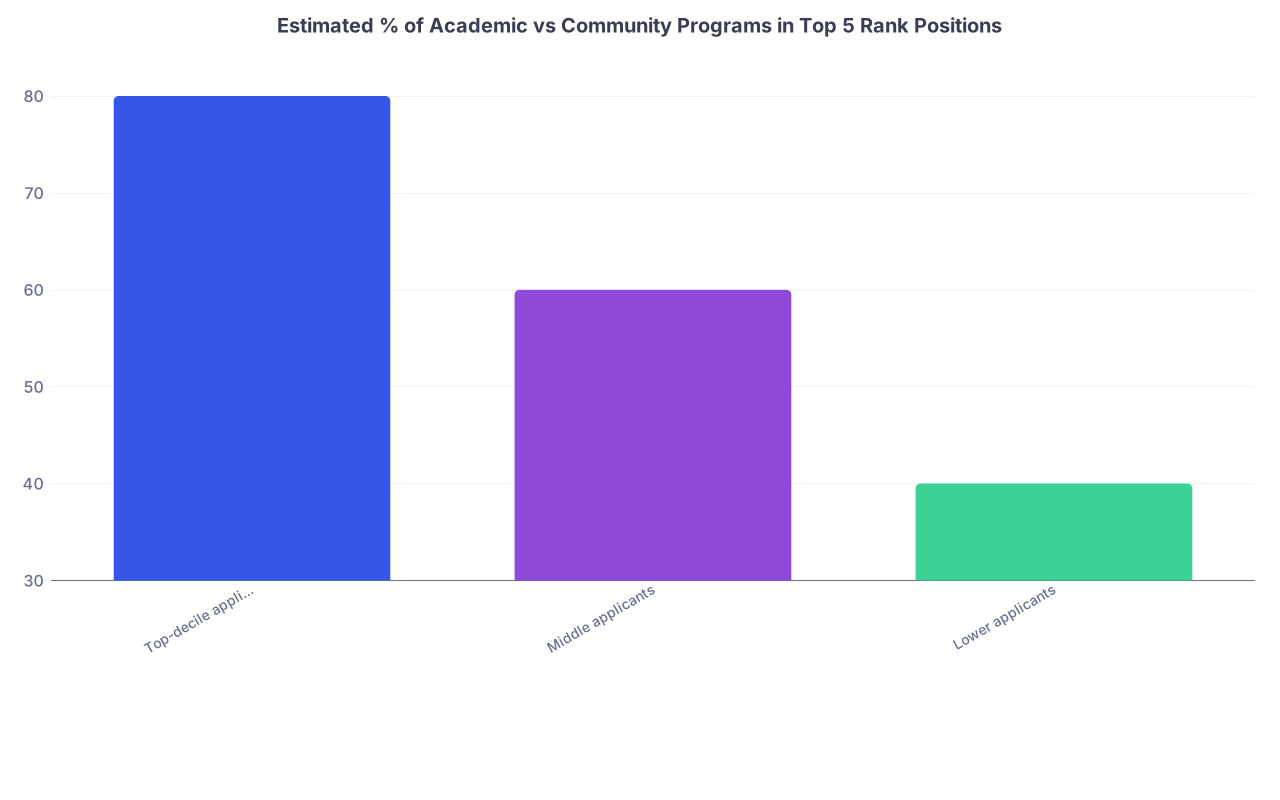
| Category | Value |
|---|---|
| Top-decile applicants | 80 |
| Middle applicants | 60 |
| Lower applicants | 40 |
The remaining percentage in each group is filled with community programs. So roughly:
- Top-decile: ~80% academic, 20% community in the top 5.
- Middle: ~60% academic, 40% community.
- Lower: ~40% academic, 60% community.
These are estimates based on match patterns, not a single dataset, but the direction is consistent across specialties.
6. Where Applicants Misjudge Community vs Academic Tradeoffs
I see three systematic errors in how people build rank lists.
Error 1: Over-valuing “Academic” as a Simple Binary
Many applicants group programs into two buckets:
- Academic = good for fellowship, prestige, research
- Community = not good for fellowship, local-only, “backup”
The actual distribution looks more like a gradient:
- Elite academic centers (heavy research, strong name brand)
- Solid academic-affiliate programs (university name, variable research intensity)
- High-powered community programs (huge clinical volume, strong subspecialty exposure, good fellowship track)
- Smaller community programs (solid training, variable fellowship exposure, often better lifestyle)
When you actually examine fellowship match lists, you see:
- Top community programs consistently sending residents into cardiology, GI, heme/onc, critical care, etc.
- Residents from mid-tier academic programs sometimes matching no better than those from strong community programs.
So a smarter way to rank is by output rather than “academic vs community” label:
- Board pass rates
- Procedure logs and case volumes
- Subspecialty faculty depth
- Recent fellowship placements
That data tells you far more about your future options than a single word in the program’s description.
Error 2: Ignoring Personal Fit Until Too Late
There is a recurring story:
- Applicant ranks a big-name academic program #1 despite feeling uneasy about culture and burnout on interview day.
- Puts a strong, balanced community program at #3–4, where residents seemed happy and well-trained.
- Matches #1, then spends PGY-1 realizing the mistake.
If you systematically collected “Would you rank this place #1 again?” responses from residents across program types, I would expect:
- Academic programs at the extremes: some extremely happy, some very regretful
- Community programs: slightly more stable satisfaction, less pressure, fewer extremes
Yet during rank list season, the prestige effect often dominates rational evaluation. Applicants overweight the signal of “academic name” relative to the day-to-day reality of a residency that lasts three to seven years.
Error 3: Underestimating Location’s Long-Term Impact
Look at retention and where people end up practicing. Many residents stay within ~100–200 miles of where they matched, especially in primary care fields. That means your match city is not a 3-year pause; it is often the start of your professional network and personal life as an attending.
A respected community program in a city where you genuinely want to live long-term is often a better move than a moderately better academic brand in a place you cannot stand.
Many people realize this only after matching. Their rank lists betray a short-term prestige bias.
7. A Data-Driven Way to Build Your Rank List
Instead of starting from “academic vs community,” start from three questions:
- What do I actually want after residency?
- Which programs—regardless of label—produce that outcome at a high rate?
- Where can I sustain a life for 3–7 years without burning out or being miserable?
You can formalize this. I often suggest people assign scores to each program across a few dimensions:
- Training quality (case volume, autonomy, teaching)
- Fellowship or career outcomes (for your intended path)
- Location (family, cost of living, city preference)
- Culture (resident happiness, support, wellness)
- Flexibility (electives, research, schedule)
Then rank based on the composite. The “academic vs community” field becomes a descriptor, not a decision rule.
To keep it concrete, here is a simplified comparison of how applicants think they should rank vs how they actually end up happier based on retrospective satisfaction.
| Priority Order | What Many Applicants Do | What Satisfied Residents Report |
|---|---|---|
| 1st | Program prestige (academic) | Culture and day-to-day life |
| 2nd | City name or brand | Training quality and support |
| 3rd | Research output | Location fit and support system |
| 4th | Lifestyle | Long-term career alignment |
| 5th | Culture | Program label (academic/community) |
Notice the label sits near the bottom in the “satisfied” column. People talk a lot about it before the Match. They talk far less about it once they are in the trenches.
8. When Community Belongs Above Academic On Your List
Let me be explicit, because too many people dance around this: there are clear scenarios where a community program should outrank an academic one.
You should rank a community program above an academic program when:
The community program demonstrates stronger training for your intended path:
- Better hands-on operative experience in surgery
- Higher delivery volume in OB/GYN
- More ICU time in internal medicine
The fellowship outcomes you want are equal or better:
- Their last 3 residents went to cardiology, GI, and heme/onc
- The academic program you are comparing has only sporadic fellowship matches in your target
The location and support system at the community site are significantly better:
- Partner’s job, kids’ schools, family nearby
The culture fit is clearly superior:
- You left interview day thinking, “These are my people”
- Current residents at the academic place quietly hinted at toxicity or burnout
If you ignore those signals and rank academic higher “just because,” you are not being data-driven. You are letting the label override the evidence.
9. Visualizing the Tradeoffs: Volume vs Research vs Lifestyle
To make it less abstract, think of most programs—academic and community—as sitting in a three-way tension between:
- Clinical volume / autonomy
- Research / academics
- Lifestyle and schedule
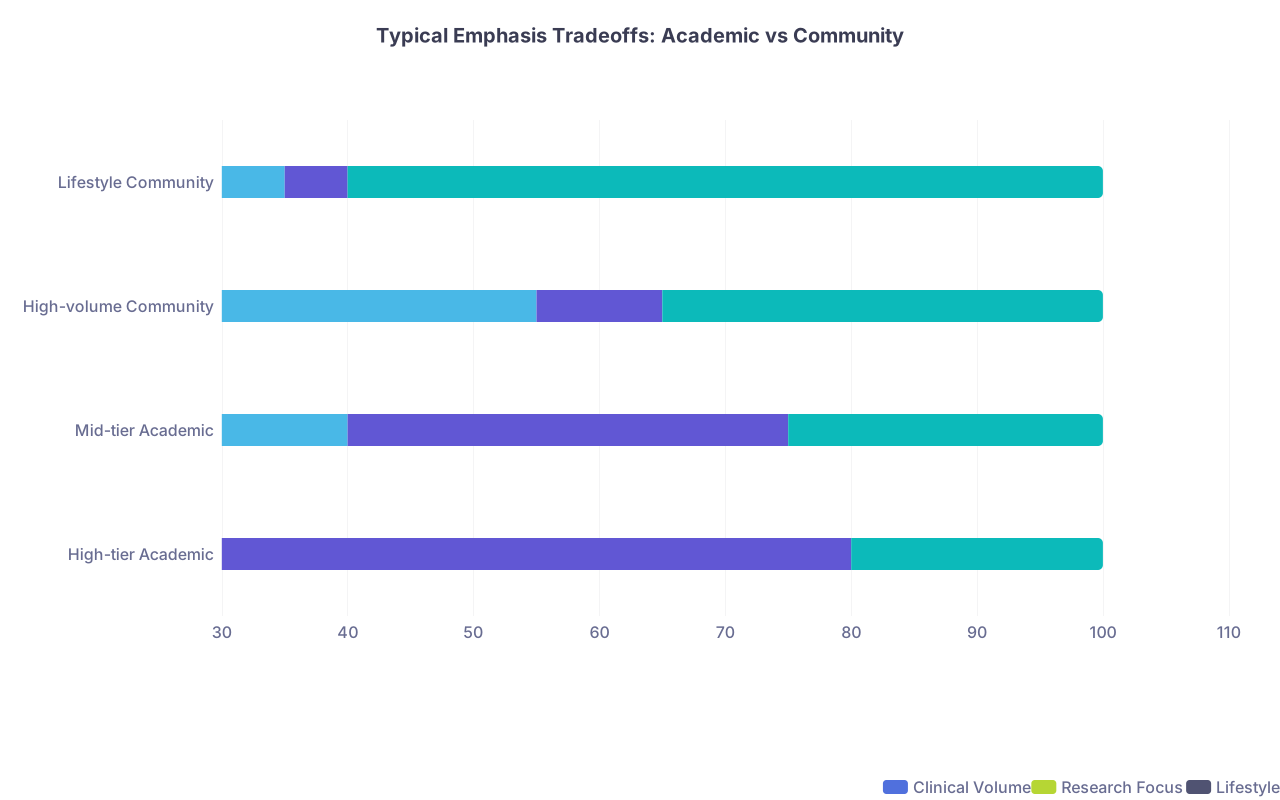
| Category | Clinical Volume | Research Focus | Lifestyle |
|---|---|---|---|
| High-tier Academic | 30 | 50 | 20 |
| Mid-tier Academic | 40 | 35 | 25 |
| High-volume Community | 55 | 10 | 35 |
| Lifestyle Community | 35 | 5 | 60 |
Approximate pattern:
- High-tier academic: Heavy on research, moderate volume, lifestyle often sacrificed.
- Mid-tier academic: Balanced, but still more academic pressure than most community.
- High-volume community: Great clinical exposure, lower research.
- Lifestyle community: Reasonable volume, minimal research demands, better schedules.
Your rank list, if rational, should align with where you want to be on that triangle. Not on what Reddit says is “more impressive.”
10. The Bottom Line: What the Data Really Says About Rank Lists
Strip away the noise and the story looks like this:
- Applicants say academic vs community is a core decision, but rank lists typically reflect:
- Prestige and fellowship goals early on
- Location and lifestyle creeping higher as the list goes down
- Academic programs dominate the top of lists for:
- Highly competitive specialties
- Fellowship-focused applicants
- Community programs climb the list when:
- Location, family, or cost of living matter a lot
- Culture and resident happiness are obviously better
- High-volume community training environments offer clearer paths to competence and confidence
The data on where people match versus what they claim to want exposes the gap between image and reality.
If you take nothing else:
- “Academic” vs “community” is a lazy binary. Use training quality, outcomes, and fit instead.
- Your future happiness tracks far more with culture, location, and day-to-day reality than with a single word in the program description.
FAQ
1. Do fellowship directors really care if my residency is community vs academic?
They care about signals: your clinical strength, letters, research record (for certain fields), and the reputation of your specific program. A strong community program known for producing excellent fellows can outperform a mid-tier academic program with weaker graduates. The binary label matters less than applicants think; performance and program-specific reputation matter more.
2. Is it risky to put too many academic programs at the top of my list?
Not algorithmically. The Match is applicant-favored; you do not reduce your chance of matching to community programs by ranking academic ones higher. The risk is psychological and strategic: if your application is not competitive for the academic places you ranked above, you may end up lower on your list than you expected. The key is to include a realistic mix, not to avoid ranking aspirational academic programs.
3. Can I match a competitive fellowship from a community residency?
Yes, especially from high-volume, well-regarded community programs with strong subspecialty faculty. You will likely need to be more proactive: seek research projects, build strong letters, and network. The data show that cardiology, GI, heme/onc, critical care, and many other fellowships regularly take strong candidates from select community programs.
4. How many community programs should I include on my rank list?
There is no universal number. But if your application is average for your specialty, it is rational to include several solid community programs that you would actually be willing to attend, not just as a backup in name. Look at your interview slate: if most of your realistic options are community, your list should reflect that reality rather than an aspirational skew toward academic places you are unlikely to match.