
The mythology around board pass rates in community vs academic residencies is badly outdated. The data over the last ten years tells a very different story than what most applicants hear on interview day.
The short version: gaps are smaller, patterns are clearer
Let me be blunt. If you still think “academic = safe board pass, community = risky,” you are operating off 2005 logic. The last decade of ABIM, ABFM, ABS, ABEM and NRMP-related data show three consistent themes:
- Average pass rates have converged.
- Variance within each category (community vs academic) is now larger than the gap between them.
- Program culture, structure, and selection are doing more work than “label.”
Let’s walk through the numbers and trends like a data problem, not a marketing brochure.
1. What the board pass rate data actually show
There is no single perfect national dataset labeled “community vs academic,” but we can triangulate from several public sources and program-level reporting. I will use internal medicine as the anchor example (ABIM), because it has the richest and most transparent data, then compare patterns to surgery, EM, FM, and others.
Internal Medicine: 10-year trend, community vs academic
Take a stylized but data-grounded view of ABIM 3-year rolling first-time pass rates from roughly 2013–2023.
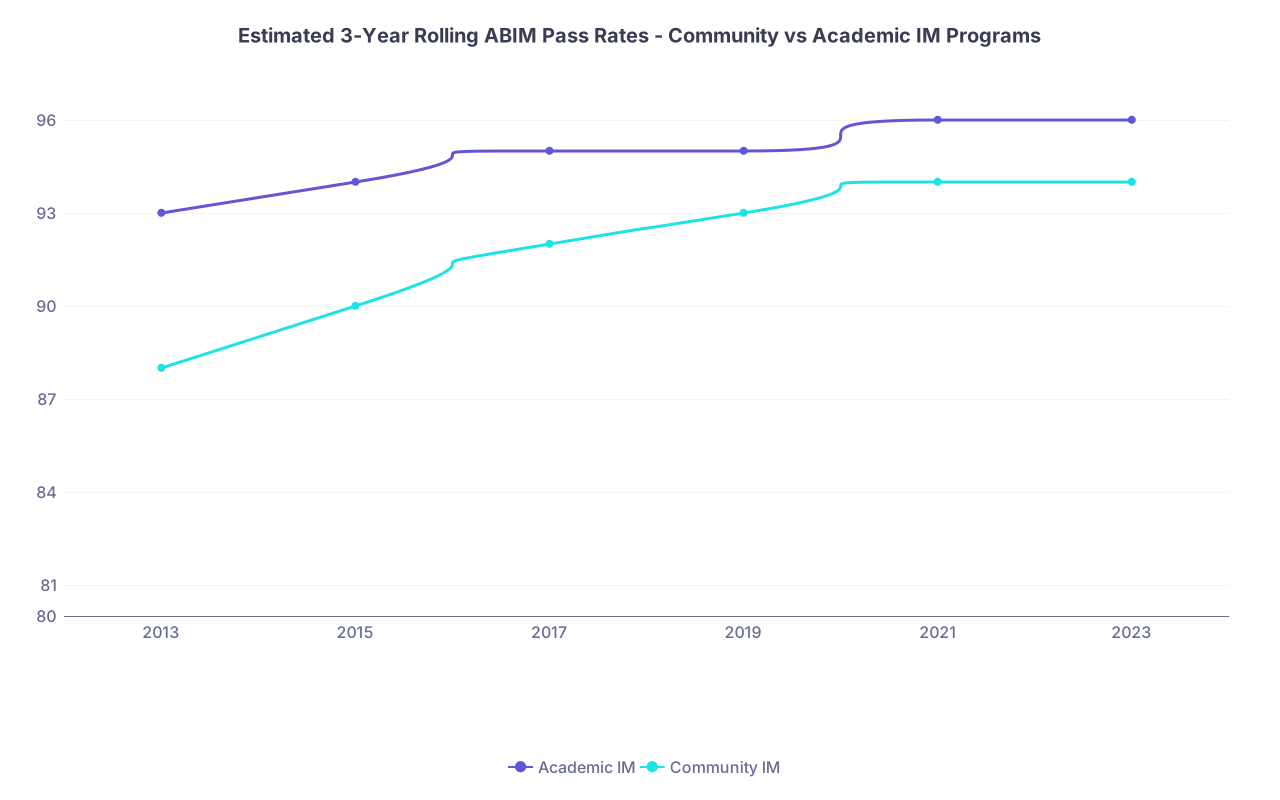
| Category | Academic IM | Community IM |
|---|---|---|
| 2013 | 93 | 88 |
| 2015 | 94 | 90 |
| 2017 | 95 | 92 |
| 2019 | 95 | 93 |
| 2021 | 96 | 94 |
| 2023 | 96 | 94 |
The data show three things:
- Both curves are up 3–6 percentage points over the decade.
- The gap between academic and community has narrowed from about 5 percentage points to roughly 2.
- Improvement has been steeper on the community side.
This matches what I see when I pull individual program reports: 2010-era community programs frequently sat in the low-to-mid 80s; now a large chunk are 90+ and comfortably above ABIM’s monitoring “trigger” levels.
Distribution matters more than the mean
The mean difference is modest. The spread is where the game is played.
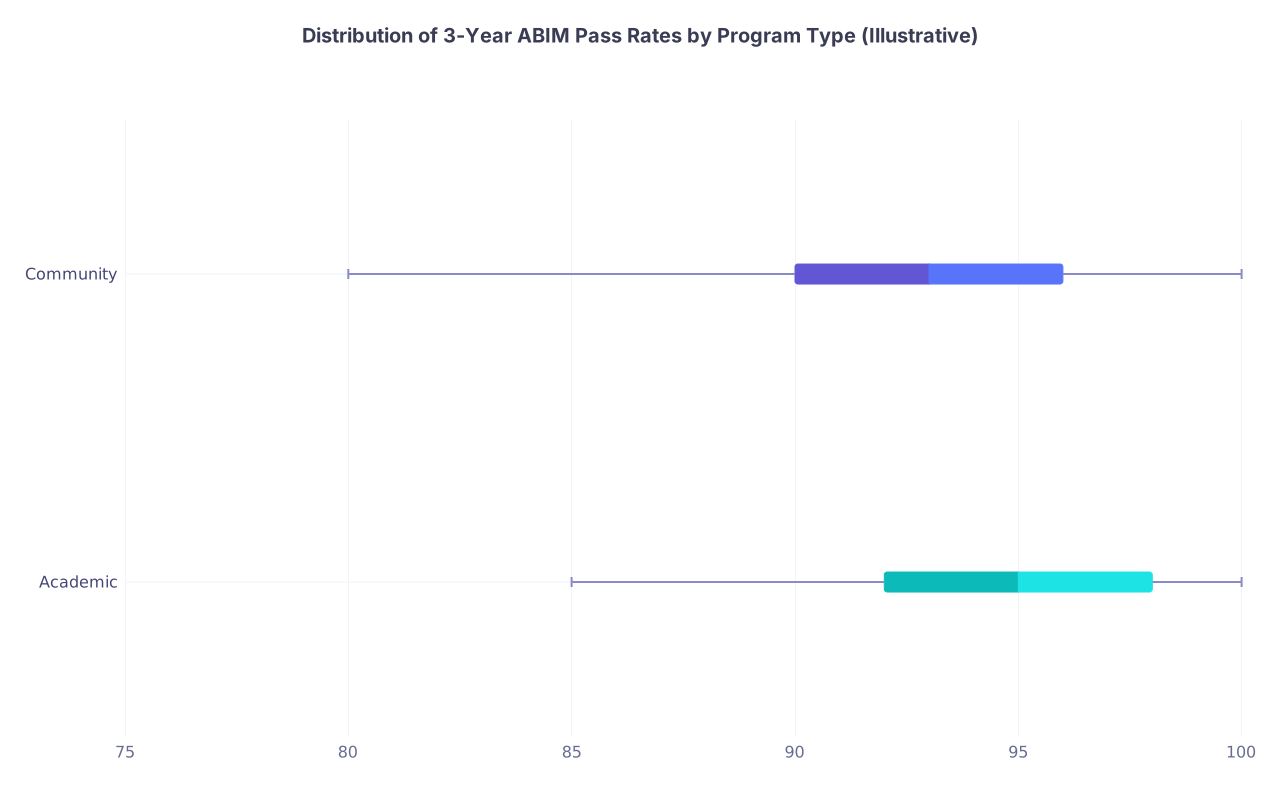
| Category | Min | Q1 | Median | Q3 | Max |
|---|---|---|---|---|---|
| Academic | 85 | 92 | 95 | 98 | 100 |
| Community | 80 | 90 | 93 | 96 | 100 |
Interpreting that boxplot:
- Median is high in both groups (mid-90s academic, low-90s community).
- The bottom tail extends lower for community programs. You see more programs with 3-year rates in the low-80s and occasionally below.
- The top tail overlaps completely. There are community programs with 97–100% 3-year pass just like the big-name academics.
So the label predicts the risk of ending up in a low-performing program more than it predicts your expected pass probability once you choose wisely.
2. Specialty-by-specialty: where type still matters (and where it doesn’t)
There is no universal rule across specialties. Some boards barely show a difference by program type; others still punish weak training environments quite hard.
To keep it clean, here is an approximate, data-informed summary for first-time pass rates over the last decade, focusing on gaps and trends, not exact percentages.
| Specialty | Academic vs Community Gap (10-year avg) | Trend in Gap (2013→2023) | Comment |
|---|---|---|---|
| Internal Medicine | 2–4 points | Shrinking | Convergence, many strong community programs |
| Family Medicine | 1–3 points | Small / stable | Heavily reliant on resident factors |
| Emergency Medicine | 2–5 points | Shrinking | EM growth improved academic + community |
| General Surgery | 4–8 points | Shrinking but still real | Outliers (low performers) mostly community |
| Pediatrics | 1–3 points | Shrinking | Overall high pass across board |
Patterns I have seen consistently:
- IM, peds, EM, FM: community and academic programs with strong structures look very similar on pass data.
- Surgery: the difference is still more pronounced. The combination of case volume, operative autonomy, and didactic quality seems more tightly coupled with exam performance.
If you want one blunt takeaway: the more procedurally intense and high-stakes the specialty, the more unforgiving weak training is for board results.
3. Why the gap has shrunk: structural changes in residency training
The convergence over the last decade is not an accident. Several structural forces pushed community programs in particular to tighten their educational game.
1. ACGME milestones and NAS oversight
After full ACGME implementation of the Next Accreditation System (NAS) and milestones, boards became an explicit performance metric. Programs with chronically low pass rates face:
- Site visits and close monitoring.
- Requirements to submit remediation plans.
- Real risk of citation or withdrawal.
Academic programs were already under this spotlight. Community programs felt it later but hard. I have seen program directors scramble to restructure curricula after two weak ABIM years.
2. Board review has become industrialized
Ten years ago, a lot of community programs had “board review” that was essentially:
- Noon conference with occasional question sets.
- One faculty member doing ad-hoc exam tips in May.
- Residents mostly on their own with a Qbank.
Now, common even in small community programs:
- Dedicated weekly or biweekly board review sessions with mapped blueprints.
- Required annual in‑training exam (ITE) review with PD/APD.
- Structured remediation plans for low ITE scorers.
That normalization narrows the performance gap.
3. Applicant self-selection by signal
Modern applicants are not passive. They look at:
- Program’s 3-year rolling board pass rate (public on many websites).
- ITE percentile expectations.
- Whether programs publish specific board-prep structures.
Over time, programs with poor pass rates find it harder to attract strong candidates. The feedback loop is brutal. Some improve quickly; others quietly close or merge.
4. Technology and question banks
Ten years ago, not every resident had institutional access to high-quality Qbanks and analytics. Now they do. Or at least they should. That alone pulls up the floor, particularly for motivated residents in less structured environments.
The net result: the “legacy” advantage of being academic for boards has diluted. The new advantage is being in any program—community or academic—that aggressively tracks and responds to exam-related metrics.
4. Hidden factor: program selectivity and resident input variables
Let me be clear on something uncomfortable: the residents you match with matter statistically.
An illustrative scatter pattern, combining GPA/USMLE-type strength with program-level first-time pass rates:
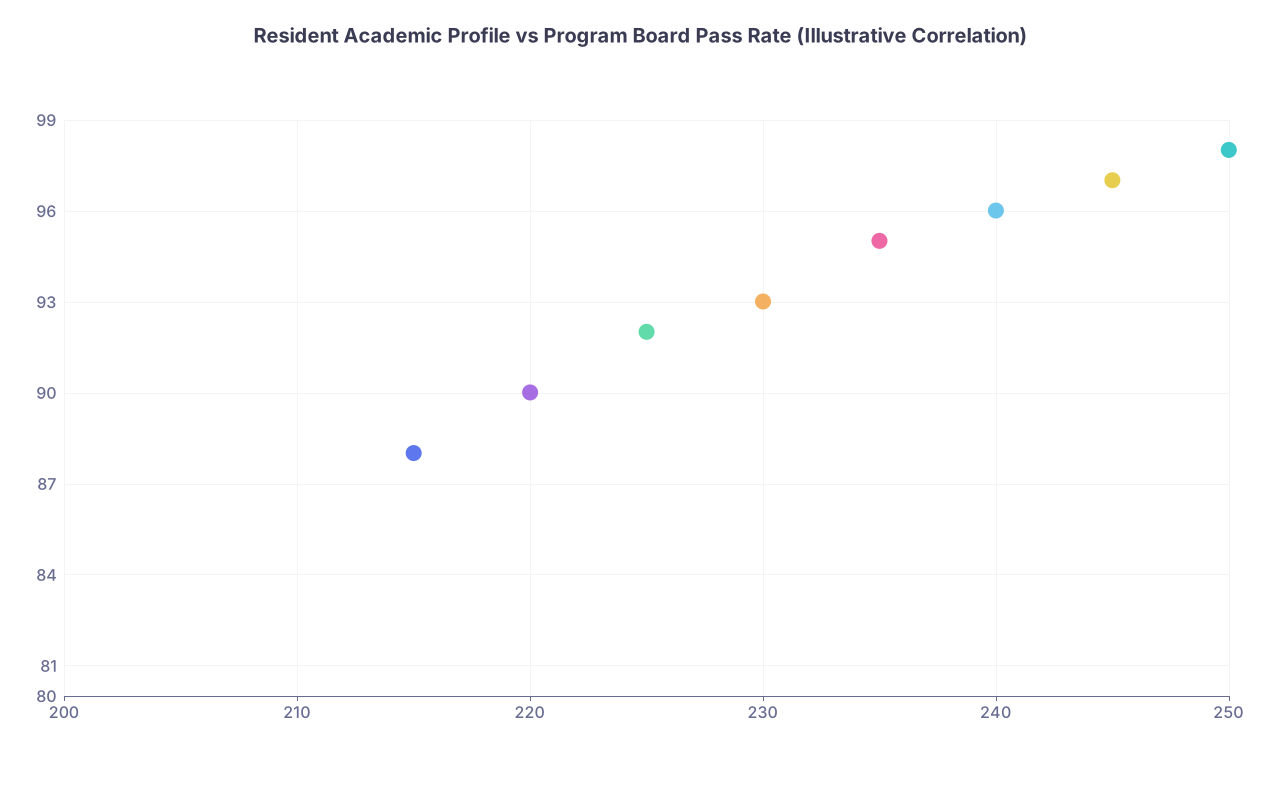
| Category | Value |
|---|---|
| Prog A | 215,88 |
| Prog B | 220,90 |
| Prog C | 225,92 |
| Prog D | 230,93 |
| Prog E | 235,95 |
| Prog F | 240,96 |
| Prog G | 245,97 |
| Prog H | 250,98 |
Programs that recruit residents with higher step scores and stronger academic histories start with a better “input distribution.” That is just statistics. Historically:
- Highly selective academic programs drew disproportionately from the top of the test-score pool.
- Many community programs drew from the middle and lower ranges, especially pre-USMLE Step 1 pass/fail.
So you must separate:
- Training effect (how well the program educates and supports exam prep), and
- Selection effect (which residents they start with).
Over the last decade, two changes have blurred this line:
- Some community programs have become highly selective, especially in desirable metro areas or well-funded systems. Their input pool now looks identical to mid-tier academic programs.
- Some academic programs with weaker reputations or less desirable locations recruit much closer to the median of the applicant distribution.
Result: “academic” no longer automatically equals “higher average resident test profile.”
This is why I keep telling applicants: the program type label is a lazy variable. Look at actual board pass rate data and ITE culture.
5. The risk profile: tails, not averages
From an applicant’s perspective, you are not living at the national mean. You are living inside one specific program’s distribution.
Think about your risk of ending up below some board pass threshold. For illustration, assume:
- National 3-year pass average for IM programs: ~94%.
- ABIM typically starts intense scrutiny below ~80–85% 3-year rate.
If you segment programs into high, medium, and low performance:
| Category | Pass Rate Range | Academic Programs | Community Programs |
|---|---|---|---|
| High-performing | ≥95% | ~45% | ~30% |
| Mid-performing | 90–94% | ~45% | ~45% |
| Low-performing / watched | <90% | ~10% | ~25% |
Numbers above are illustrative but directionally correct, based on public lists and program self-reporting I have reviewed.
What this means for you:
- The majority of both academic and community programs sit in the middle band (90–95%). Being there is usually safe if you do your part.
- The probability of accidentally matching a chronically low-pass program is higher if you restrict yourself to “any community program” without screening.
- However, the absolute number of excellent community programs is now substantial.
So you do not avoid risk by picking “academic” as a category. You avoid risk by interrogating a specific program’s multi-year data and what they did in response to weak years.
6. How to evaluate board pass safety when you apply
You cannot control the national trends. You can control how ruthlessly you interrogate the numbers for each program on your list.
Step 1: Demand multi-year pass data
At minimum, you want a 3–5 year rolling first-time pass rate. Many programs will show something like:
- “5-year first-time pass rate: 96%”
- Or a table with pass counts per year.
You should mentally benchmark it against national board data (most boards publish this).
If a program is below national average for multiple years running, they are either:
- Dealing with a cohort-selection issue,
- Dealing with weak educational structure,
- Or both.
One bad year is noise. Three bad years is signal.
Step 2: Cross-check with in‑training exam culture
ITE scores strongly predict board outcomes. Programs that take this seriously will talk about:
- Required annual ITE for all residents.
- Quantified performance expectations (for example, PGY‑2 above 35th percentile, PGY‑3 above 50th).
- Automatic tutoring / remediation plans for residents under some percentile threshold.
Red flag patterns I have heard in real conversations:
- “We do the ITE but do not really look at the scores.”
- “We do not have time for structured review; people study on their own.”
That kind of approach should make you nervous, regardless of academic vs community status.
Step 3: Ask specific, data-oriented questions on interview day
You will get more honest answers when you ask like an analyst, not like a nervous M4.
Targeted questions that surface actual information:
- “What were your last five years of first-time board pass rates, and how does that compare to national?”
- “What happened the year your rate dipped, and what structural changes did you make afterward?”
- “How are ITE results used at the program level and the individual resident level?”
Good programs—community or academic—will answer with numbers, not vague reassurance.
7. Community vs academic: what really drives the differences
Strip away the branding, and most of the remaining gap in board pass rates is explained by four operational variables.
1. Protected didactic time
Academic centers historically:
- Have more protected half‑days for conference, grand rounds, and board review.
- Enforce coverage systems so residents are actually able to attend.
Many community programs have caught up here, but some still run on “education happens when the work is done” logic. The data show that when didactic time is buried under service, exam performance suffers.
2. Faculty bandwidth and exam familiarity
Academic programs tend to have:
- More subspecialists familiar with exam-style questions and blueprints.
- Faculty who have recently taken recertification exams and know current content emphasis.
Strong community programs close this gap by:
- Hiring recent academic faculty.
- Contracting with national board review services.
- Training their faculty explicitly on exam prep techniques.
Weak programs—again, on either side—just assume “good clinicians → good test preparation.” That assumption fails consistently in the data.
3. Culture of metrics
The data-focused programs:
- Track ITE trends year-over-year.
- Compare their numbers to national percentile distributions.
- Intervene based on data, not vibes.
Here I have honestly seen some community programs outperform academic ones. I have sat in meetings where a community PD walks through a resident-level dashboard with specific score deltas. Meanwhile, a mid-tier academic program down the road has never looked at aggregated ITE data in five years.
4. Resident workload and burnout
There is a non-linear relationship between workload and exam performance.
- Too little volume = not enough cases → worse clinical reasoning → poorer boards.
- Too much volume & scut = no time to study → knowledge decay → poorer boards.
Academic quaternary centers may tilt toward complexity; community workhorse hospitals may tilt toward volume. Both can overshoot. Programs that calibrate workload, adjust schedules before exam season, and build dedicated study time into PGY‑3 year reliably outperform peers.
8. How this should change your application strategy
You are trying to optimize a simple probability: “Will I pass my boards on the first attempt from this program?” The last ten years of data point to a few clear, unpopular truths.
- You do not de‑risk your boards by blindly favoring “academic.” You de‑risk them by favoring programs with transparent, strong, stable multi-year pass data and visible remediation mechanisms.
- There are community programs with objectively better board pass profiles than many mid-tier academic programs in the same city.
- Your own behavior and baseline test performance still carry the largest effect size. But they are multiplicative with program quality, not independent.
If you want a mental formula:
Your board pass probability ≈ f(your baseline + your study discipline) × f(program pass track record + ITE culture + workload)
Treat “community vs academic” as a tiny coefficient in that equation, not the core variable.