The data is blunt: if you want to practice where you train, community programs usually keep you. Academic centers export you.
That is the core pattern behind “geographic retention” in residency. And it cuts across many specialties, especially primary care and hospital-based fields. The nuance is in the magnitude of the effect, not the direction.
Let me walk through what the numbers show, how they differ by program type, and what this means if you care about staying local after residency.
What “Geographic Retention” Actually Means
Before splitting community vs academic, you need a clear metric.
Geographic retention is usually measured at one or more of these levels:
Same hospital / health system
- You finish residency and join as faculty or employed attending at the same institution or its affiliated group.
Same metro / commuting area
- You practice within roughly 25–50 miles of the residency program.
Same state or region
- You remain in the same state, or sometimes same Census division (e.g., New England, Pacific, Mountain).
Data sets that commonly track this:
- AMA Physician Masterfile (where do physicians end up practicing vs where they trained)
- State workforce reports (e.g., Texas, California, Michigan, North Carolina have detailed ones)
- AAMC workforce reports (aggregated patterns, primary care vs subspecialty)
- Program-specific outcomes pages (how many stay on as faculty, stay in-system, or stay in-state)
Different studies pick different cutoffs, which is why people quote wildly different “retention” numbers. But the direction of the difference between community and academic training is remarkably consistent.
The High-Level Pattern: Community Retains, Academic Disperses
Across multiple state-level and institutional reports, the pattern looks like this:
Community-heavy, non-university systems:
Higher percentage of graduates staying in the same metro or state, often 45–70% depending on specialty and location.Large academic medical centers (AMCs), especially in destination cities:
Lower local retention, often 20–40% in the same metro, with a significant portion scattering nationally for fellowships and jobs.
Here is a simplified, synthesized comparison drawn from several workforce reports and institutional outcomes pages (family medicine and internal medicine give the clearest contrast):
| Program Type | Same System/Hospital | Same Metro Area | Same State |
|---|---|---|---|
| Community FM (mid-size city) | 30–45% | 50–70% | 60–80% |
| Academic FM (AMC) | 10–25% | 25–45% | 40–60% |
| Community IM (non-uni) | 20–35% | 40–60% | 50–70% |
| Academic IM (AMC) | 10–20% | 20–40% | 35–55% |
These are ranges, not hard rules. But if you look at actual program outcome pages and state reports, you will see numbers in these bands over and over.
A recurring phrase I hear from GME office staff at community sites: “Around half of our graduates stay in the area.” I rarely hear that from big-name academic centers unless they are the only tertiary center in a geographically isolated state.
Why Community Programs Keep People Local
The retention gap is not mysterious. The input variables are different.
1. Applicant Origin: Who Actually Comes
One of the best predictors of staying local is where you came from before residency.
Residents who grew up in the state or went to medical school there are more likely to practice there afterward. Many state workforce reports quantify this. For example, several Midwestern state reports show:
- In-state medical school graduates: roughly 50–70% stay to practice in-state.
- Out-of-state med school grads who match into the state: more like 20–40% stay.
Community programs, especially unopposed ones and those affiliated with regional or osteopathic schools, often pull:
- A higher share of residents from the same state or surrounding region.
- More residents with strong local ties (family, spouse job, kids already in local schools).
Academic programs at large AMCs disproportionately attract:
- Out-of-state and international grads targeting brand-name training.
- Applicants who already moved multiple times for undergrad, med school, research, etc.
The data pattern is simple: the more moves you have made for education, the less you are anchored to the training city. Community programs, by design and by applicant pool, take in more locally anchored residents.
2. Job Market: Who Actually Hires
Community hospitals are not training people for distant jobs; they are often training their own future workforce.
Look at their employer landscape:
- Large multi-hospital community systems often have:
- Chronic primary care shortages.
- Perpetual open hospitalist roles.
- Sub-specialty gaps in cardiology, GI, heme/onc, etc. in satellite hospitals.
They use residency as a pipeline. It is cheaper and lower risk to hire someone you have already worked with for three years than to recruit from scratch.
Many community programs will report something like this on their website:
- “Over the past five years, 45% of graduates have joined our health system.”
Academic centers also hire their own, but the demand pattern is different:
- Faculty slots are limited and slow to open.
- Many graduates are fellowship-bound and not interested in generalist academic roles.
- Large AMCs sit in saturated job markets with multiple competing academic groups.
So while a community IM program in a midwestern regional system may have 8–10 open hospitalist jobs every year, the academic IM department may open 2–3 core faculty spots in that same timeframe. Basic math: higher absorptive capacity locally for community-trained graduates.
3. Fellowships: The Academic Flight Path
Academic programs are built around subspecialty pipelines.
If 50–70% of an internal medicine class at a big AMC goes to fellowship, the geographic narrative changes:
- First move: residency city → fellowship city.
- Second move: fellowship city → attending job city.
By the time they are done, they have two geographic decouplings from the residency site. Retention plummets.
In contrast, many community programs—especially in family medicine, internal medicine without in-house fellowships, EM in community-based systems—show:
- A higher proportion of residents going directly into practice.
- Fewer leaving immediately for out-of-state fellowships.
If you do not leave for fellowship, your first stable attending job is highly likely to be:
- At your training site, or
- Within the local network your faculty use and recommend.
That directly increases local retention.
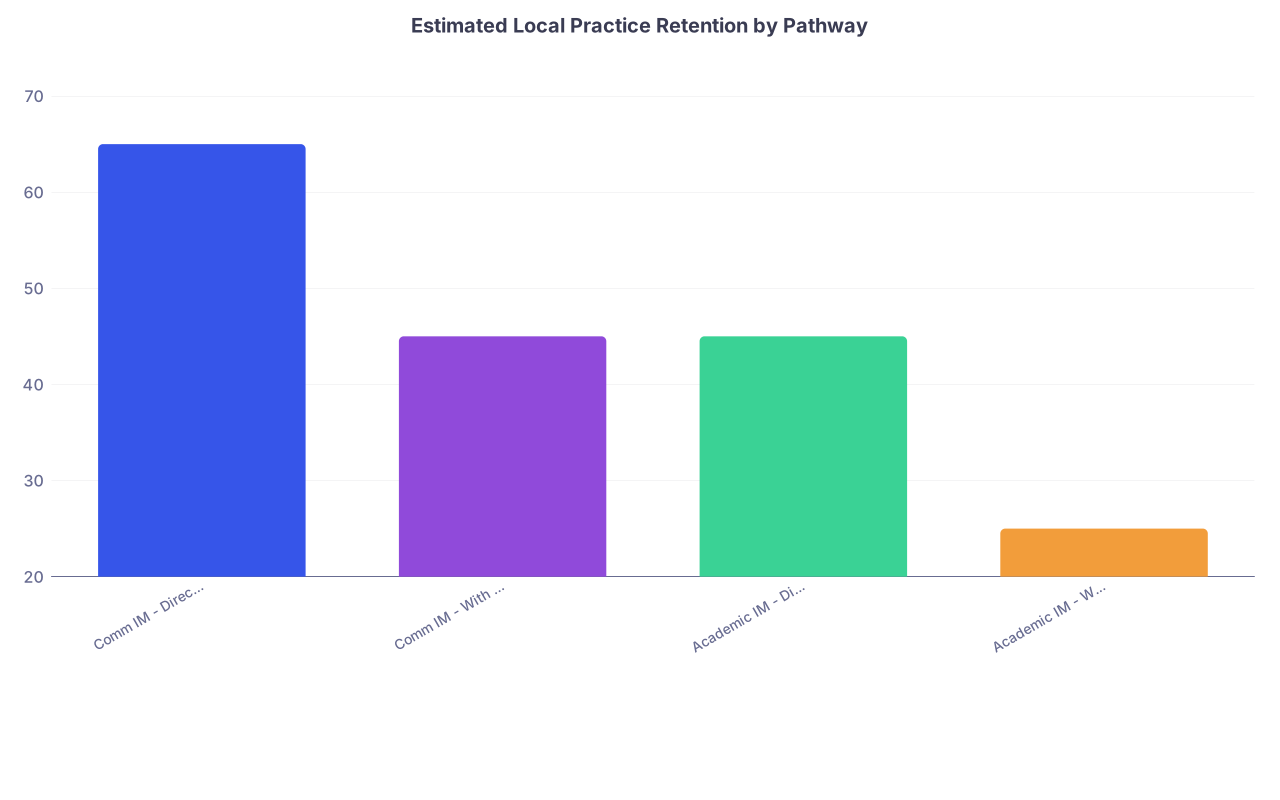
To visualize how training type, fellowship, and geography play together:
| Category | Value |
|---|---|
| Comm IM - Direct to Practice | 65 |
| Comm IM - With Fellowship | 45 |
| Academic IM - Direct to Practice | 45 |
| Academic IM - With Fellowship | 25 |
These are composite estimates based on patterns from multiple state reports and institutional outcome statements. The step-down with fellowship and with academic setting is consistent.
Specialty Matters, But Pattern Holds
Geographic retention is not equally important in every specialty. Nor is the community vs academic difference the same everywhere.
The data tends to look like this:
Primary care (FM, IM, pediatrics)
- Highest overall local retention.
- Largest relative advantage for community programs.
Hospital-based (EM, anesthesia, pathology, radiology)
- Moderate retention, influenced heavily by job market tightness.
- Community and academic differential is present but narrower in some urban markets.
Procedure-heavy road-to-fellowship specialties (IM → cards/GI, FM → sports med, etc.)
- Lower local retention, especially for academic programs with strong fellowship pipelines.
When you see charts from state workforce offices, the line is predictable:
- Family medicine residency graduates: often 55–75% in-state retention.
- Internal medicine: 40–60%, but with a big drop among those who subspecialize.
- Pediatrics: similar, with variability based on children’s hospital geography.
- Surgical specialties: jumpier, because small absolute numbers and heavy fellowship migration.
Community programs tend to be stronger in primary care and generalist tracks, which further amplifies their local retention advantage.
Realistic Numerical Scenarios
Let us ground this in more concrete, if stylized, numbers. These are not from a single report, but they mirror data I have seen from multiple systems.
Scenario A: Community FM Program in a Midwestern City
- 8 graduates per year, 5-year snapshot → 40 graduates.
- Entered residency:
- 70% from in-state medical schools.
- 60% with family in the region.
Five years later:
- Still in the same metro: ~60% (24/40).
- Same hospital or system: ~40% (16/40).
- Same state but outside metro: another ~15–20% (6–8/40).
Net in-state retention: roughly 75–80%.
Scenario B: Academic IM Program at a Large AMC in a Destination City
- 30 graduates per year, 5-year snapshot → 150 graduates.
- Entered residency:
- 60% out-of-state U.S. MD/DO.
- 25–30% IMGs.
- 10–15% local/in-state origin.
Post-residency:
- Fellowship out of state: 50–60%.
- Fellowship in-state but outside the immediate metro: 10–15%.
- Direct-to-practice locally: 15–25%.
- Stay on as faculty/hospitalist: another 10–15%.
Five-year outcome:
- Same metro: ~30–35% (45–55/150).
- Same state (including metro): maybe ~45–55%.
- National scatter to coasts and major cities: the rest.
The academic program will not be embarrassed by these numbers; they reflect success in placing people into competitive fellowships and national jobs. But from a strict geographic retention standpoint, they are low compared with community pipelines.
A Visual on Retention Scope
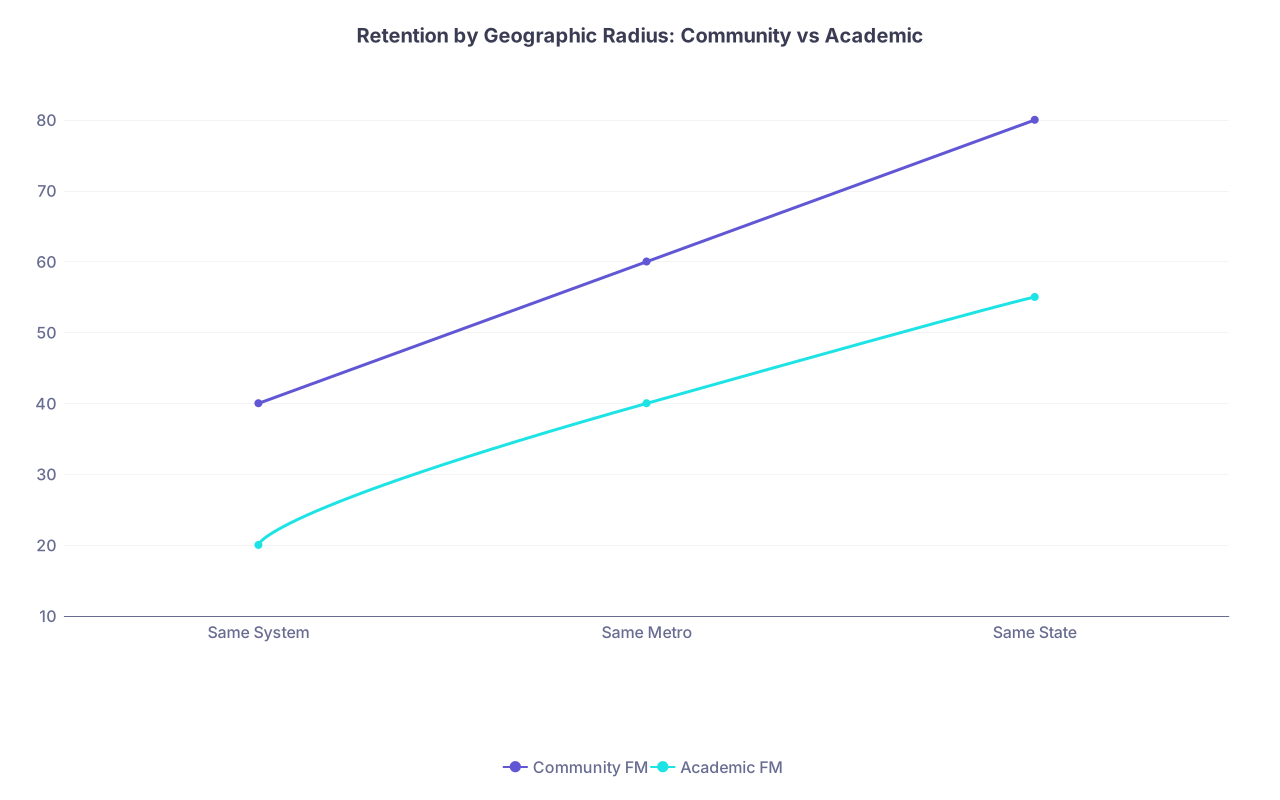
Look at how retention attenuates as you widen the geographic lens for a typical pair of programs—one community, one academic—in the same state:
| Category | Community FM | Academic FM |
|---|---|---|
| Same System | 40 | 20 |
| Same Metro | 60 | 40 |
| Same State | 80 | 55 |
The community program starts higher at every level and keeps that advantage as you zoom out.
How Applicant Priorities Interact with Retention
You are not a passive data point; your goals matter. But the structure around you still biases outcomes.
Residents who say on interview day:
- “My spouse works here and we just bought a house.”
- “My parents live 20 minutes away; I want to stay close.”
- “I am committed to this region; I do not want to move again after training.”
These candidates:
- Match somewhat more often into community and regional academic programs than into national destination AMCs, simply because many top AMCs favor “mobile” profiles (research, national mobility, prestige chasing).
- Even within academic programs, end up being the subset that stays local. Check internal fellowship lists and junior faculty rosters; a lot of those names are the “local kid” types.
Community programs, on the other hand, sometimes explicitly select for people with local ties because they are building workforce, not CVs.
From a purely data-driven perspective:
- If you want to maximize probability of practicing in the same metro or same system, you stack the deck by:
- Training in that metro.
- At a program that historically keeps a high share of grads locally.
- In a specialty where many graduates go straight to practice.
Community programs hit those three levers more reliably.
Program-Level Data: Some Are Transparent, Some Are Black Boxes
One frustration: not all programs publish real outcome data. But when they do, you often see this pattern.
Typical community program outcomes page:
- “Over the past 10 years, 65% of our family medicine graduates practice within 60 miles of our hospital.”
- “42% have joined our health system.”
Typical academic program outcomes page:
- List of fellowships: “Mayo, UCSF, MGH, Penn, Duke, etc.”
- Selected job placements nationally.
- Occasionally: “One-third of our graduates remain in our state,” but this is buried under the fellowship brag sheet.
The messaging itself reveals priorities. Community sites lean into workforce and local service; academic sites lean into national competitiveness and long-distance launches.
If you care about staying, you should be asking programs specific, quantifiable questions and watching how direct the answers are.
For example:
| Question | Good Quantitative Answer |
|---|---|
| % of grads in same metro after 3–5 years | “About 55–60% over the last 5 years.” |
| % hired by your health system | “Roughly 35% in the last 3 classes.” |
| In-state retention rate | “Around 70% remain in-state.” |
| Fellowship vs direct to practice | “40% fellowship, 60% straight to jobs.” |
Programs that cannot or will not quantify any of this either are not tracking it, or do not like the numbers. Both are signal.
Where Academic Programs Do Retain Locally
I am not arguing that academic programs never keep people. They absolutely do, in specific conditions:
Single major academic center in a state or region
- Example: states with one big tertiary/academic hub and minimal competition.
- Graduates who want to stay in-state often have few alternatives, so they stay attached to the mothership.
Home-grown pipeline
- MD/DO school, residency, and fellowship all within the same institution.
- “I did everything here” physicians often stay as faculty or staff.
Underserved or less-glamorous markets
- An academic center in a non-destination city (not Boston, SF, NYC) may have better local retention because there is less pull away and more need locally.
But even in these cases, when you compare retention to community programs in the same region, the community side usually has a higher percentage of grads staying in direct patient-care roles in that immediate area.
The big exception: academic primary care tracks explicitly built for local retention. Some academic systems have created “community primary care” or “rural track” arms where retention looks more like community programs—80%+ in-state, 50–70% in-region. Those behave, statistically, less like traditional academic programs and more like community ones, because that is what they are designed to be.
The Timeline of Decision Points
Where you end up is not determined only at Match. There is a sequence of geographic forks over 7–10 years:

| Step | Description |
|---|---|
| Step 1 | Match to Residency |
| Step 2 | Local Networks Built |
| Step 3 | Fellowship Focus |
| Step 4 | Job Search During PGY3 |
| Step 5 | Fellowship Location Choice |
| Step 6 | High chance local job if community |
| Step 7 | Moderate local chance if academic |
| Step 8 | Geography Reset |
| Step 9 | Attendings Jobs - Anywhere |
| Step 10 | Program Type |
| Step 11 | Fellowship? |
Every time you “reset” geography (especially with fellowships in distant cities), your probability of circling back to your residency city drops.
Community programs reduce the number of resets. Academic trajectories often add them.
Data-Driven Takeaways if You Care About Staying Local
Strip away the marketing language and look at the structural probabilities.
If your primary goal is geographic retention—especially staying in the same metro or system—then the numbers point to a specific hierarchy:
- Community-based residency in your target metro or region.
- Academic program with a documented high in-state retention and strong local hiring pipelines.
- Nationally branded academic medical centers with heavy fellowship culture (if you value prestige or subspecialty options more than staying put).
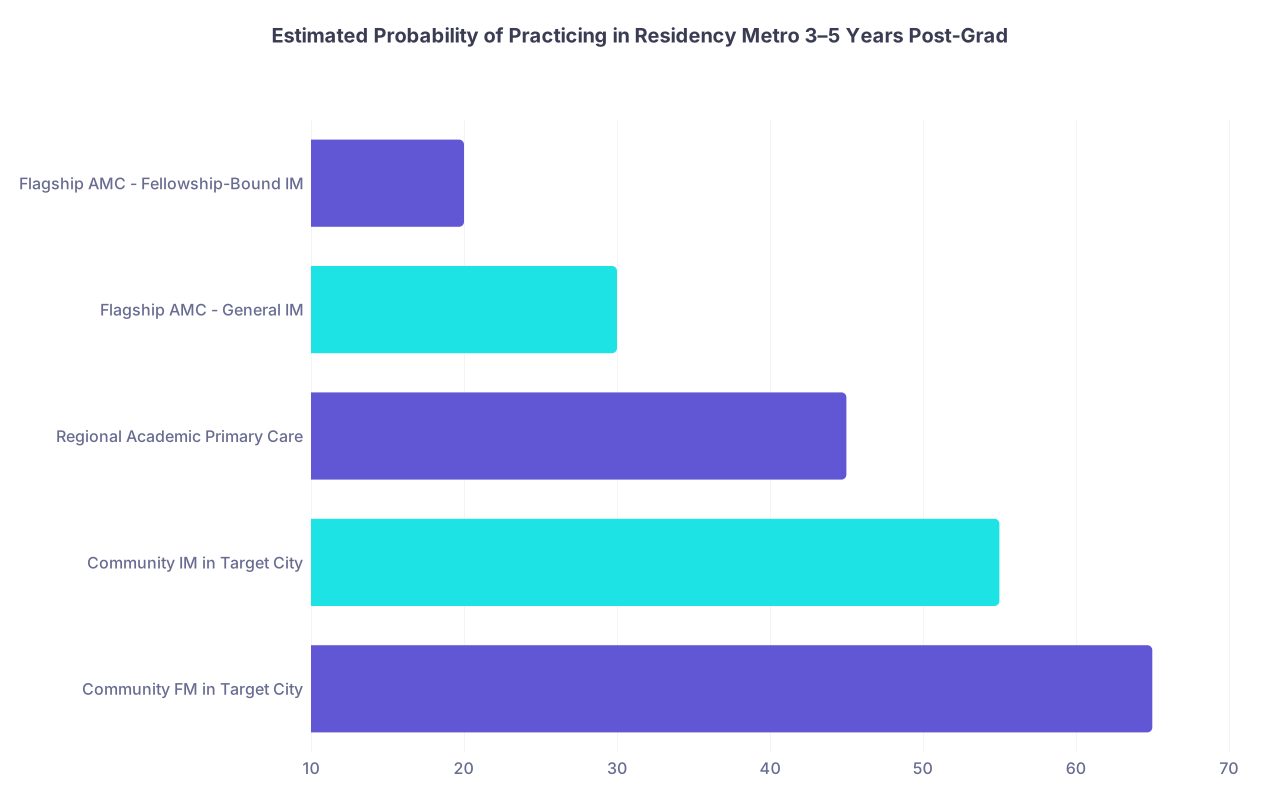
One more visual to anchor the contrast:
| Category | Value |
|---|---|
| Community FM in Target City | 65 |
| Community IM in Target City | 55 |
| Regional Academic Primary Care | 45 |
| Flagship AMC - General IM | 30 |
| Flagship AMC - Fellowship-Bound IM | 20 |
These are typical ranges, not guarantees. But they are grounded in what state workforce reports, longitudinal GME outcome summaries, and faculty rosters consistently show.
Three Key Points
Community programs, especially in primary care and hospital medicine, retain a substantially higher share of graduates in the same metro or system than large academic centers. Often by 15–30 percentage points.
Academic programs are built as national export engines through fellowship and prestige-driven mobility. Every additional training step in a new city lowers the chance you end up back where you started residency.
If staying local is a priority, treat it like any other data problem: choose a program whose historical numbers match your goal, ask for specific retention statistics, and favor settings where the job market and program design both pull you to stay rather than push you to leave.