
It’s late. You’re back from your third interview this week, badge still hanging from your neck. Your email has another invite from a big-name university program… and another from a community program that everyone says has great lifestyle. You open your draft rank list and just stare.
On one side: prestige, reputation, fellowship opportunities, “doors open.”
On the other side: humane call schedules, affordable city, people who look actually happy.
You’re asking the right question: how much should you weigh prestige vs lifestyle when choosing between community and academic residencies?
Here’s the answer you’re looking for.
First, be brutally clear on what you actually want after residency
You can’t answer “prestige vs lifestyle” without knowing what you need residency to do for you.
Let’s sort you into buckets. Rough, but helpful.

| Step | Description |
|---|---|
| Step 1 | Start - What do you want later? |
| Step 2 | Prestige matters more |
| Step 3 | Lifestyle can take priority |
| Step 4 | Lean slightly to stronger brand |
| Step 5 | Worried about matching competitive fellowship? |
| Step 6 | Want academic or research career? |
| Step 7 | Value lifestyle and location more? |
If any of these are true, prestige (and therefore academic programs, usually) gets extra weight:
- You’re targeting a very competitive fellowship: derm, ortho, plastics, IR, GI, cards, heme/onc at top centers
- You want a research-heavy or academic career: K awards, R01s, major trials, “Professor of…”
- You care about national reputation, leadership roles, policy work, or big-name institutions on your CV
If these are you, prestige is not everything — but it’s not optional either.
If instead this sounds like you:
- You want to be a solid, well-trained clinician, probably in community practice
- You care a lot about being near family, partner job, or a specific city
- Your top priorities are not burning out and actually liking your day-to-day life
Then lifestyle can legitimately outweigh prestige, especially if the community program is strong and well-regarded in your region.
The trick is knowing how hard to lean each way.
What “prestige” actually buys you (and when it doesn’t)
People talk about prestige like it’s magic. It isn’t. It does very specific things.
Here’s what a strong academic name tends to give you:
Easier access to competitive fellowships
Fellowship directors know the big academic programs. They know the letter writers. When they see “MGH IM” or “UCSF EM” or “Mayo Anesthesia,” they have a mental model of the training. That shortcut helps you.Built-in research pipeline
You get:- Mentors who publish a lot
- Existing projects you can plug into
- Institutional support staff (biostats, IRB, clinical trial offices)
If you want 10+ pubs by graduation, academics makes it easier.
National-network effect
Graduates + faculty spread across the country. They chair departments, run programs, sit on boards. That network opens doors for jobs and leadership roles later.Brand value on your CV
People pretend they’re above it. They’re not. A well-known name in the education/training section buys you the benefit of the doubt.
But here’s where prestige is overrated:
For straightforward community practice jobs in many markets, especially if:
- You trained in the same region
- Your PD is well-known locally
- Your program has a good rep with local groups
For specialties that are not insanely competitive for fellowship, or where solid clinical skills and good letters matter more than brand.
If you’re miserable. Burned-out, depressed residents do not magically get great letters or crush interviews just because the logo on their coat is shiny.
What “lifestyle” actually means in residency (and what’s fake lifestyle)
People say “good lifestyle program” like it’s some mystical vibe. Let’s translate.
Lifestyle in residency usually comes down to:
Work hours and call schedule
Not “are they ACGME compliant?” (everyone will tell you yes).
Real questions:- Do people routinely leave on time or stay 1–2 hours late charting?
- How often do people “voluntarily” stay post-call because the list is insane?
- Are golden weekends real or mythical?
Culture of support vs abuse
Do seniors and attendings:- Teach and pitch in?
- Or dump and disappear?
What happens when someone is struggling — coaching or quiet exile?
Location and cost of living
Big one. A “decent” salary stretches very differently in NYC vs Midwest suburb.
Commute time, housing, partner job options, access to childcare. That’s lifestyle.Operational sanity
EMR efficiency, ancillary support, staffing levels.
Places with chronic understaffing and endless scut feel terrible, even if “hours” aren’t extreme on paper.
Not all “lifestyle” claims are real.
Red flags when programs brag about lifestyle:
- “We’re chill, everyone is like family” — but nobody shows real schedule samples.
- Heavy reliance on moonlighting to make income tolerable.
- Residents seem weirdly upbeat but evasive when you ask specific questions.
If you think lifestyle is a top priority, you need to verify it ruthlessly.
Community vs Academic: where prestige and lifestyle really differ
Let’s compare what typically differs — and what doesn’t.
| Factor | Academic Program | Community Program |
|---|---|---|
| Fellowship competitiveness | Strong edge, especially at top centers | Variable, strong regionally if known well |
| Research opportunities | Abundant, often expected | Limited but possible with initiative |
| Call/intensity | Often heavier, tertiary/quaternary | Often lighter, more manageable |
| Autonomy early on | Sometimes slower, more layers | Often faster, more “just do it” |
| Brand recognition | National | Mostly regional or local |
Stereotypes exist for a reason, but I’ve seen enough programs to say this plainly:
- Some academic programs have surprisingly good lifestyle.
- Some community programs are absolute grind-fests with no backup.
So don’t rank based only on the word “community” or “university” in the name. Rank based on the specific way that program lives out prestige and lifestyle.
How much weight should prestige get vs lifestyle? A simple rule of thumb
Here’s a framework I use with students when we’re staring at rank lists.
Imagine you have 100 “priority points” to allocate between three buckets:
- Prestige / career capital
- Lifestyle / wellness
- Location / personal life
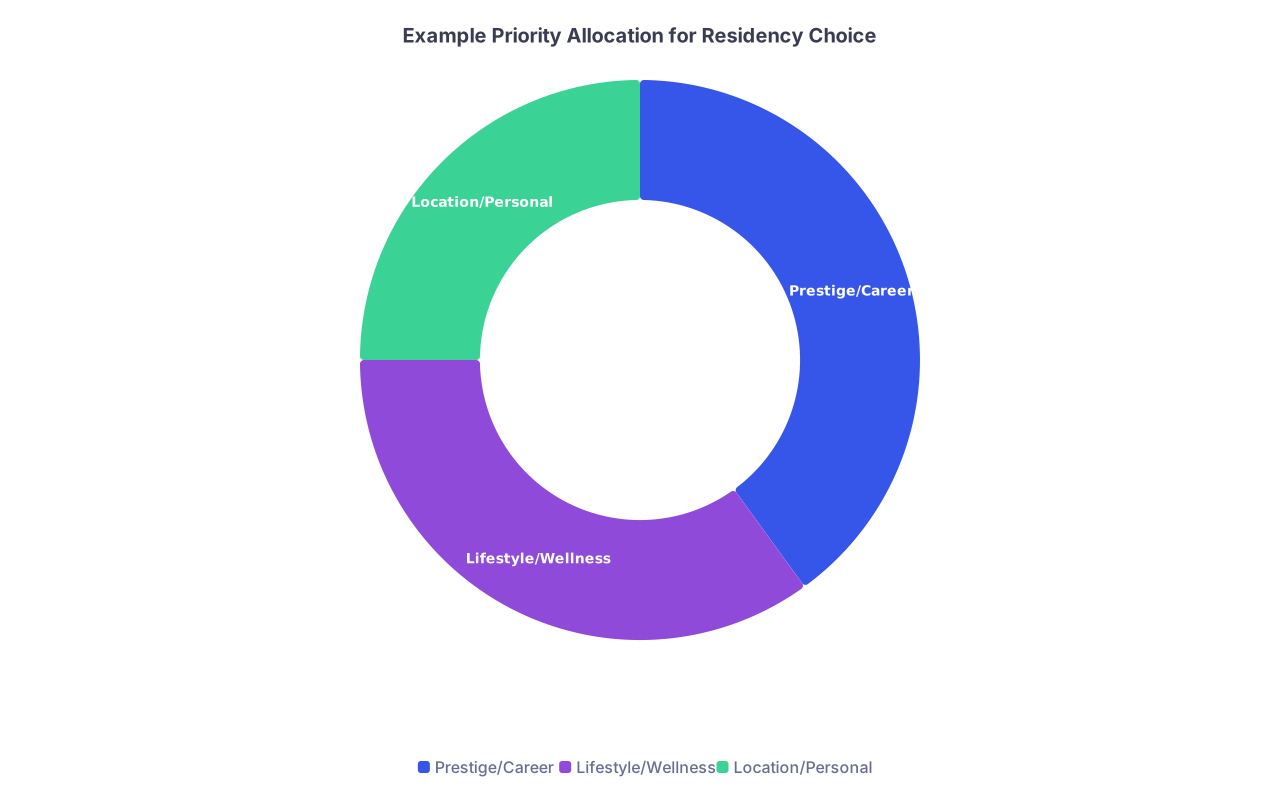
| Category | Value |
|---|---|
| Prestige/Career | 40 |
| Lifestyle/Wellness | 35 |
| Location/Personal | 25 |
Now, based on your goals:
If you want competitive fellowship or academic career
- Prestige / career: 45–60
- Lifestyle / wellness: 20–30
- Location / personal: 15–25
You don’t ignore lifestyle, but if you pick a cushy program that can’t get you the letters or cases you need, you’ll regret it later.
If you want solid community practice, minimal research
- Prestige / career: 25–35
- Lifestyle / wellness: 35–45
- Location / personal: 20–30
You still want competent training and a respectable program, but you don’t sacrifice 3–7 years of your life to chase a brand you don’t really need.
If you’re truly undecided
Default to:
- Prestige / career: ~40
- Lifestyle / wellness: ~35
- Location / personal: ~25
Then tweak based on any strong pull (family, specific city, niche interest).
You don’t have to do the math perfectly. The point is to force yourself to admit what actually matters to you — not what impresses your classmates.
When choosing a less-prestigious program is absolutely the right move
Let me be clear: picking the “less shiny” program is often the smarter choice.
It’s a good idea to favor lifestyle (and/or location) over prestige when:
- You have concrete mental health concerns or a history of burnout
- You have major life obligations: kids, sick family, single-income household
- You’re not aiming for a hyper-competitive fellowship and are fine with community practice
- The community program:
- Has alumni doing exactly what you want to do
- Places people in solid jobs/fellowships in your target region
- Genuinely has happier residents and sustainable schedules
A very specific example I’ve seen play out:
Candidate A: Chooses mid-tier university IM program with heavy Q4 call, mandatory research year, in a brutal cost-of-living city. They wanted outpatient community cards in their hometown eventually. They finish exhausted, do a non-competitive fellowship mainly for lifestyle, and end up back home anyway. The “prestige” barely changed their trajectory.
Candidate B: Chooses strong regional community IM program known locally, fantastic teaching, lighter but solid workload, reasonable COL. They get great clinical skills, strong letters, and match a good cardiology fellowship in the same region, then join a high-paying community group… with less emotional scarring.
Prestige helps most when it aligns with your long-term goals. If it doesn’t, it’s just pain with a logo.
When you should suck it up and choose the more intense, more “prestige-heavy” place
There are times when you intentionally trade lifestyle for career capital.
You should lean harder into prestige (usually academic) when:
You already know you want:
- Derm, ortho, ENT, urology, plastics, IR, radiation oncology
- Highly competitive fellowships (GI/cards/onc at top 20 hospitals)
You’re genuinely excited by research and want it to be a core part of your identity
You see yourself in:
- Academic leadership
- National committees, guideline writing, big trials
- Medical education leadership at big-name institutions
You handled med school intensity well and have good personal support structures
In these cases, the grind is buying you something specific and powerful. You’re trading some PGY sanity for long-term optionality.
Just don’t romanticize it. Hard is fine. Toxic is not. There’s a line.
How to compare specific programs: a targeted checklist
Don’t overcomplicate this. For each program on your list, answer:
Where do their grads go?
Look at the last 3–5 years:- Fellowship placement: which specialties, which institutions?
- Job placement: where, what kind of practice?
What do senior residents say privately?
Not on the tour. In the corners:- “If you had to rank again, would you choose this place?”
- “If I came here, what’s the thing I’d be most annoyed by in 6 months?”
- “How often are you actually out on time? What’s your true average weekly hour load?”
What does a “hard month” look like?
You can handle hard. But know the ceiling.- Call frequency?
- Typical patient caps?
- Nights structure? Backup when it gets crazy?
How is the worst resident treated?
The struggler, the one with family issues, the one who failed a board.
That tells you more about culture than any “we’re a family” speech.If you stripped away the name, which day-to-day would you rather live?
Imagine no one else ever sees your program name. Just you living there for 3–7 years.
Which one would you choose?
That last question usually cuts through the BS faster than anything.
A quick example: two hypothetical programs
You’re choosing between:
Program A: University IM, big name, city with brutal rent, Q4 call on wards, tons of research, 70–80 hour weeks at times, great GI/cards/onc fellowship matches.
Program B: Community IM, strong regional rep, suburban city with affordable living, solid 55–60 hour weeks, good teaching, fewer fellowships but some grads match GI/cards locally every year.
If you:
- Want top-10 GI or cards anywhere in the country → Program A probably wins, if you can survive it.
- Want to be a community hospitalist or outpatient doc in that region → Program B is likely the smarter and happier choice.
- Want cards but are fine with regional programs near that community hospital → B may still be enough, especially if you can be near the top of the class, publish a bit, and get strong letters.
In reality, people overvalue Program A’s name when they’re not actually planning to use its full power.
Quick sanity checks before you finalize your rank list
As you stare at that list:
- If two programs are close, rank the one where you think you’ll be a better version of yourself — not just more impressed with your badge.
- Ask: “If I have a kid / sick parent / health issue during residency, where would I rather be?”
- Ask: “If I don’t match my dream fellowship, will I still feel okay about what this program gave me?”
And one more uncomfortably honest question:
If you took away what your classmates, attendings, or social media would think — which program are you secretly hoping you match at?
That’s usually your real #1.

Key takeaways
- Prestige matters most when you’re chasing competitive fellowships or academic careers. Then it deserves real weight — but you still shouldn’t ignore toxic culture or absurd workload.
- Lifestyle isn’t “soft.” Burnout wrecks careers. For many people planning community practice, a strong, sane community program beats a big-name grind.
- Don’t rank labels. Rank the actual lived experience and outcomes: where grads go, how residents are treated, and who you’ll realistically be on the other side of training.
FAQ (exactly 5 questions)
1. If I want a competitive fellowship, is a community program a bad idea?
Not automatically. Some community programs have fantastic fellowship placement, especially into regional fellowships they’re connected to. But if you want top-tier, nationally competitive fellowships (e.g., GI at major academic centers), an academic program with a strong reputation and research output usually gives you a clearer path. Look at actual fellowship match lists from each program, not just assumptions.
2. How do I know if a “prestigious” program is actually toxic?
Use residents, not the brochure. Ask seniors:
- “What makes people leave this program?”
- “Has anyone quit in the last few years?”
- “What’s the reaction when someone says they’re overwhelmed?”
If you get vague answers, forced smiles, or hear phrases like “sink or swim,” “that’s just how it is here,” or “it’s a badge of honor to survive,” that’s code for: this place may be rough.
3. Will a community program hurt my chances for an academic career later?
It can make it harder, but not impossible. You’ll have to be more self-directed: seek research projects, present at conferences, get involved with societies, and maybe do an academic-leaning fellowship. Plenty of academic hospitalists and subspecialists started in community programs. But if you already know you want a research-heavy faculty role at a big-name institution, starting in an academic residency makes life easier.
4. What if my top lifestyle program is in a city my partner hates?
Then it’s not actually a top lifestyle program for you. Lifestyle includes your real life — partner, kids, support system. A “great” schedule in a city where your partner is miserable or jobless becomes a bad lifestyle package fast. Factor in their situation as a core part of your decision, not an afterthought.
5. Should I rank based on where I felt most “at home” on interview day?
That feeling is useful but not enough by itself. Interview days are artificial and heavily curated. Use your gut feeling as a tiebreaker between programs that are roughly similar on objective factors: outcomes, workload, culture, location. If your “at home” program is also clearly worse on training quality or outcomes, be careful. Warm vibes won’t compensate for major deficits in opportunities you actually care about.