
The loudest people talking about community vs academic pay usually have no data and a lot of vibes. Most residents are making career decisions off rumors and cherry‑picked anecdotes. That is a terrible way to carry six figures of debt into the rest of your life.
Let’s rip this apart properly.
You’ve heard some version of this:
- “Community pays way more, academics is a pay cut.”
- “You’ll never pay off loans if you stay in academics.”
- “If you care about money, you can’t do academic medicine.”
- “Fellowship is lost income you’ll never get back.”
Most of that is either half‑true, outdated, or flat wrong when you actually run the numbers.
This isn’t a feel‑good “follow your passion” piece. This is: what does the compensation and debt picture actually look like, and how should that affect how you think about community vs academic programs when you’re applying and ranking?
Myth #1: “Community Always Pays More Than Academic”
No, it doesn’t. Not “always.” Not even consistently once you adjust for specialty, geography, and incentive structure.
Here’s the problem: residents talk in absolutes based on three stories they heard in the workroom.
Your co‑resident says: “My friend did cards at Big State U, got a job at Community General for $550k. My other buddy stayed on as faculty for $260k. So academics is trash.”
That sounds convincing. But it’s a garbage sample.
Let me show you how messy this actually is.
| Specialty (Generalist) | Community Base ($) | Academic Base ($) | Who *Often* Pays More? |
|---|---|---|---|
| Internal Med (outpt) | 230k–280k | 200k–260k | Community |
| General Pediatrics | 200k–240k | 180k–230k | Community |
| General Surgery | 350k–450k | 325k–400k | Community |
| EM (democratic group) | 250k–350k | 220k–300k | Community |
| Hospitalist | 250k–300k | 220k–280k | Community |
Yes, community tends to pay more on base salary, especially for primary care, EM, and hospitalist gigs. But even here, the spread can overlap, and a lot of people forget the rest of the package: RVU bonuses, call pay, administrative stipends, retention bonuses, loan repayment, retirement match, etc.
I’ve seen “academic” jobs at big hybrid systems that beat “community” jobs across town because:
- They’re RVU‑heavy and the volume is nuts.
- They’re in a less desirable location.
- They throw serious money at recruitment (sign‑on, relocation, loan help).
And I’ve seen community jobs underpay because the residents don’t know the market and never negotiate.
Here’s where residents get fooled: they compare base salary only. The people actually making money are looking at total compensation over time.
Myth #2: “If You Care About Loans, You Can’t Do Academics”
This one is confidently wrong for a big chunk of people, especially if you’re eyeing Public Service Loan Forgiveness (PSLF).
Public service = 501(c)(3) or government employer. Most academic centers qualify. A lot of large community hospitals qualify too, by the way, so stop pretending PSLF is an “academic only” thing.
But here’s the twist: if you’re serious about PSLF, academic might actually be the stronger move for debt, not weaker.
Why?
Because PSLF is about qualifying payments, not how big your paycheck is. You need 120 qualifying monthly payments under an income‑driven plan while working full‑time for a qualifying employer. That’s 10 years.
Residency + fellowship + early attending years at a qualifying hospital can get you all the way there.
Let me show you why the “academics means you’ll never pay off debt” crowd is stuck in 1998.
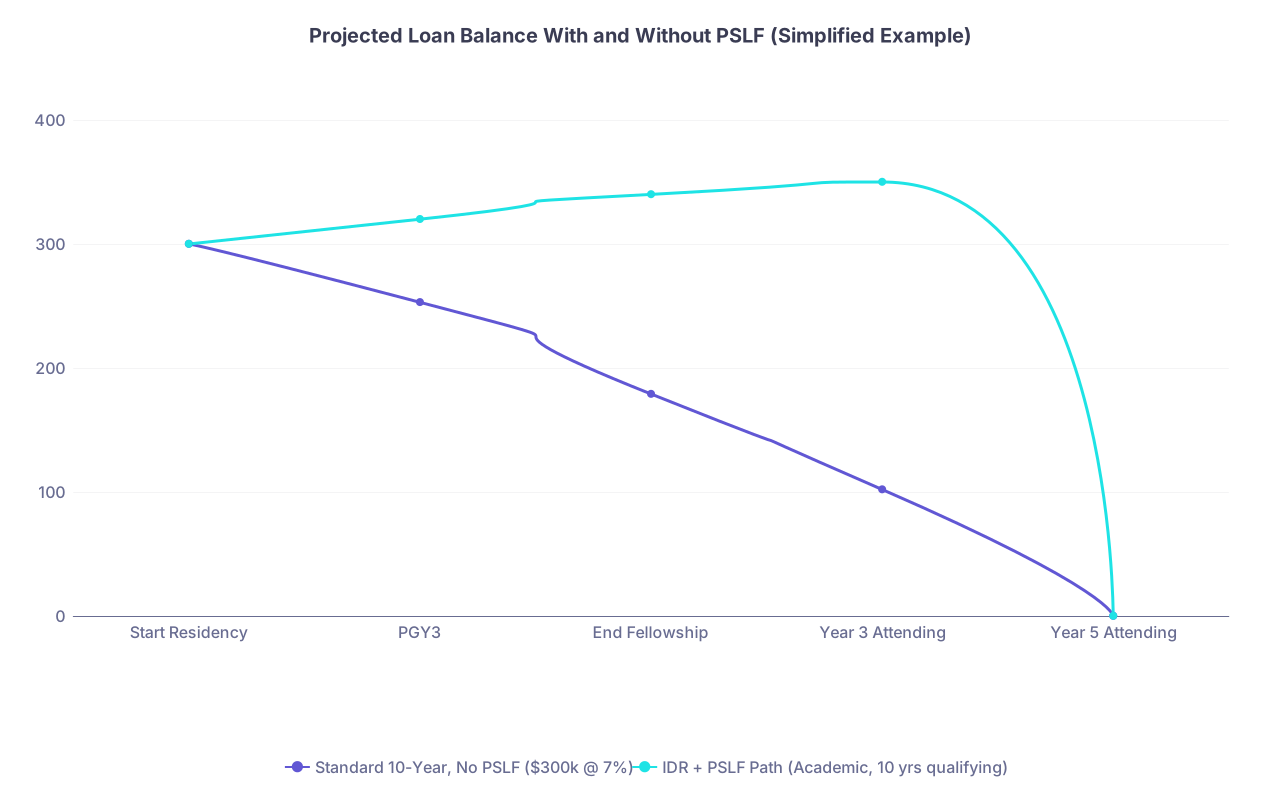
| Category | Standard 10-Year, No PSLF ($300k @ 7%) | IDR + PSLF Path (Academic, 10 yrs qualifying) |
|---|---|---|
| Start Residency | 300 | 300 |
| PGY3 | 253 | 320 |
| End Fellowship | 179 | 340 |
| Year 3 Attending | 102 | 350 |
| Year 5 Attending | 0 | 0 |
Crude numbers, but the point stands:
- Non‑PSLF path: you grind out big payments, probably in higher‑paying community or private practice, kill the loan yourself.
- PSLF path: your balance might balloon on paper during training, but after 120 qualifying payments, the rest is forgiven tax‑free.
Here’s the nasty little secret attending physicians don’t always tell you: plenty of them could have qualified for PSLF but accidentally blew it by taking private jobs too early or consolidating loans wrong.
If you’re starting with $300k+ in federal debt and you’re at or heading to a nonprofit system, writing off PSLF automatically because “I wanna be paid” is not just emotional. It’s financially illiterate.
Myth #3: “Where I Match for Residency Locks Me into Community or Academics Forever”
No. Your first job is flexible. Your career is even more flexible.
I’ve watched:
- Residents from community IM programs match GI, cards, heme/onc at big academics, then do either academic or community practice.
- Academic EM grads join democratic community groups and never look back.
- Community EM grads go back for fellowship, then land academic jobs.
Your training environment and your eventual practice setting correlate, but they’re not handcuffed.
What does matter: what a program normalizes.
Here’s what I actually look at when I’m trying to predict someone’s options coming out of a program:
| Program Type | Common First Jobs | Academic Door Still Open? |
|---|---|---|
| Big-name academic | Fellowships, academic jobs, mixed | Yes, easily |
| Mid-tier academic | Mixed: community + some academic | Yes, with hustle |
| Strong community | Mostly community, some fellowships | Yes, but not automatic |
| Small community only | Local community jobs | Harder, but possible |
So when you’re making a Match list, stop thinking “community vs academic” as a salary decision. Think:
- What percentage of grads land the kind of career I might want?
- How strong is their fellowship match if I change my mind later?
- Do they have relationships with big academic centers if I decide I want that life?
If you want maximum flexibility, strong academic or “hybrid” community‑academic systems are usually your safest bet. But that’s about career optionality, not just raw pay.
Myth #4: “Fellowship Is Always a Financial Loss Compared to Going Straight into Community Practice”
This is one of those zombie ideas that keeps walking around because people do lazy math.
The usual argument:
- “Three years as a hospitalist at 260k = $780k.”
- “Three years of cards fellowship at 75k = $225k.”
- “So you ‘lost’ over half a million. You’ll never make that back.”
This ignores:
- Lifetime earning differences between generalist and subspecialist.
- Where you end up—community vs academic.
- How long you actually plan to work.
Let’s oversimplify on purpose to make the point.
Say:
- You finish IM residency at 30.
- Option A: community hospitalist at 260k.
- Option B: 3-year cards fellowship (earning 75k), then community cards attending at 550k.
- Both retire at 65.
Approximate lifetime pretax earnings:
- Hospitalist: 35 years × 260k = $9.1 million.
- Cards: 3 years at 75k (225k) + 32 years at 550k (17.6 million) ≈ $17.8 million.
Even if those exact numbers shift, you get the idea. Fellowship isn’t a “loss”; it’s an investment. You give up income early to move to a different earnings curve.
Now plug academics into that.
Say cards academic pays 350k instead of 550k (yes, I know reality is more nuanced, but go with it):
- 3 years at 75k (225k) + 32 years at 350k (11.2 million) ≈ $11.4 million.
That still beats the straight‑to‑hospitalist path in this toy scenario.
So is fellowship a financial net negative? Only if:
- You pick a subspecialty that doesn’t increase earning power much over your generalist option, or
- You choose low‑pay academic roles in notoriously low‑pay specialties and work fewer years, or
- You do fellowship for purely prestige reasons and then choose low‑RVU, low‑pay jobs.
The real myth is simpler: “Fellowship automatically screws you financially if you don’t go to community right away.”
Reality: it depends. Specialty, location, practice type, and your time horizon matter more than the word “academic.”
Myth #5: “Academic Docs Are Poor; Community Docs Are Rich”
I’ve seen academic attendings quietly make more than their community friends because they:
- Keep a side consulting/research gig.
- Take on leadership roles with stipends.
- Moonlight strategically.
- Live in a lower‑COL city but get paid on a “regional” scale.
And I’ve seen community attendings making “big” salaries but:
- Carrying lifestyle creep.
- Paying private practice overhead.
- Getting crushed by taxes due to poor planning.
- Not using 401k/403b/457b to the full extent.
Compensation is not just the number on the contract. It’s how you use it and what else comes with it.
Here’s a stripped‑down example.
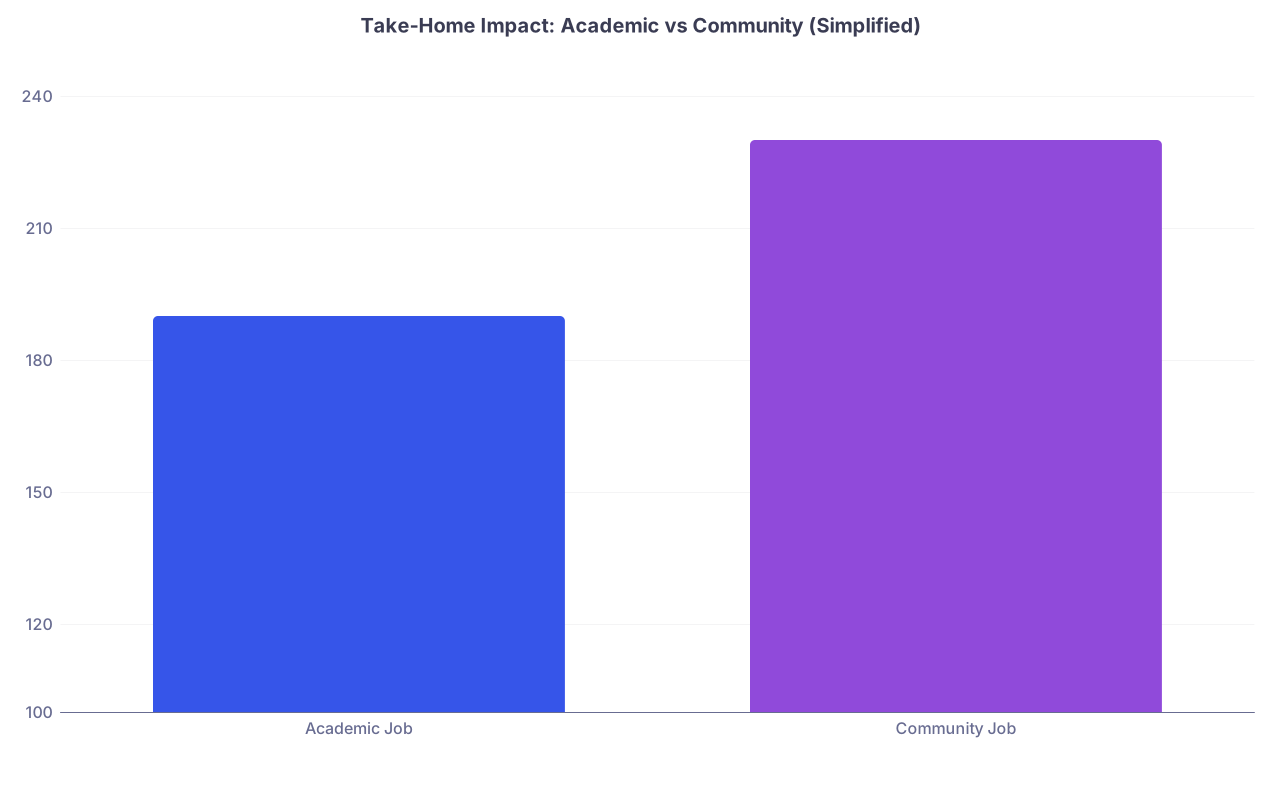
| Category | Value |
|---|---|
| Academic Job | 190 |
| Community Job | 230 |
Let’s say:
- Academic: 260k base, excellent benefits, strong 403b + 457b match, plus PSLF forgiveness down the line.
- Community: 300k base, decent 401k match, no PSLF, for‑profit system.
After:
- Taxes
- Retirement contributions
- Loan strategy
Your effective “useful money” difference might be far smaller than the sticker difference suggests. In some PSLF scenarios, the academic doc comes out ahead despite lower nominal pay.
Is that always true? No. But the narrative that “academic = broke, community = rich” is lazy.
Myth #6: “For Debt, Only Starting Salary Matters”
Your first attending contract feels enormous coming off a 70k PGY3. That’s why a lot of residents get fixated on that first number and completely ignore trajectory.
You should be asking:
- What’s the ramp? Do people go from 260k to 400k in 3–5 years as they build RVUs?
- What’s the partnership track (if private)? What do partners actually take home?
- Is there realistic promotion and administrative ladder in the academic job?
- How stable is the group/system? (EM residents, you know this pain.)
Let me lay this out visually.
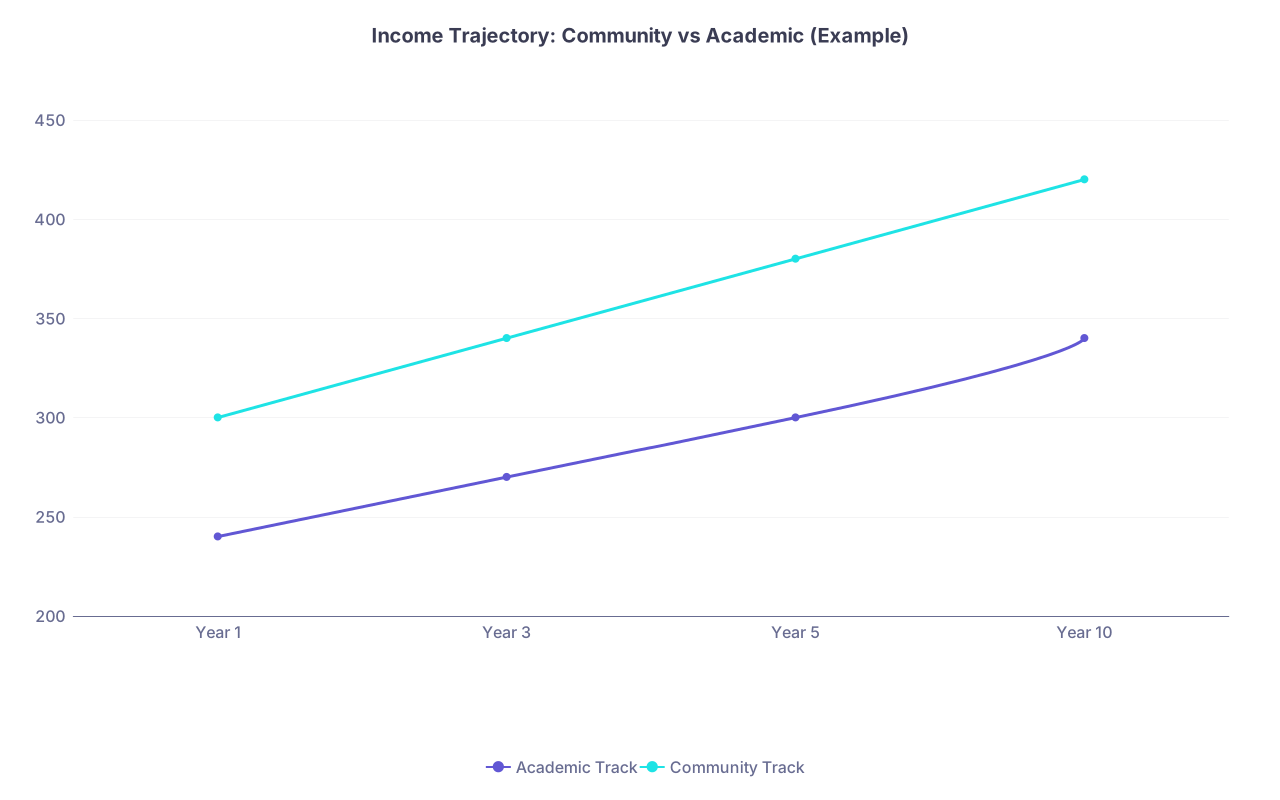
| Category | Academic Track | Community Track |
|---|---|---|
| Year 1 | 240 | 300 |
| Year 3 | 270 | 340 |
| Year 5 | 300 | 380 |
| Year 10 | 340 | 420 |
Community starts higher and usually stays higher. But if PSLF wipes out $300k of loans tax‑free and you avoid lifestyle explosion, an academic doc can build net worth surprisingly fast.
The smart question is not: “Who has the bigger salary?”
It’s: “Given my debt, loan type, risk tolerance, and life goals, which path gives me the best net worth after 10–15 years?”
Most residents never do that math. They just chase whichever starting offer looks bigger in the group chat.
What This Means for Your Match List (Right Now)
You’re not signing your life away when you choose community vs academic residency. But you are planting seeds.
Here’s how to think about it like an adult, not like someone arguing in an online forum.
Stop treating salary myths as program selection criteria.
Choosing a weaker training environment because “they say community pays more” is backward. First decide: do I want better training, better mentorship, better fellowship chances, or a specific region? Then, within that, compare programs.Look at where alumni actually end up.
Ask programs:- How many grads go to community vs academic jobs?
- What are starting salaries like for recent grads? (Some PDs will be surprisingly honest.)
- Any grads using PSLF who are willing to talk?
Know your loan reality before you rank.
- Federal vs private?
- PSLF-eligible or not?
- How many years will training consume (res + fellowship)?
If your loans are mostly private, PSLF becomes irrelevant, and raw salary weighs more. If they’re federal and big, PSLF and nonprofit work should be on your radar.
Evaluate moonlighting and side‑gig options during residency.
Some community programs have insanely good moonlighting pipelines—residents finish with $50–100k less debt. Some academics do too. Others block it entirely. That difference can matter more than the community/academic label.Think in 10‑year blocks, not 1‑year snapshots.
The dumbest financial mistake residents make is optimizing for PGY1–3 comfort, not Years 5–15 post‑residency. Apply that same principle to “community vs academic” thinking: where could each path put you a decade after graduation?
The Real Takeaway
Community vs academic is not a clean “good money vs bad money” dichotomy. That’s a story people tell because it’s simple and emotionally satisfying.
Reality:
- Community usually wins on base pay, especially early.
- Academics can win on PSLF, stability, and career flexibility.
- Fellowship can be a smart financial move—or not—depending on specialty and where you practice afterward.
- Residency program type influences options, but it does not imprison you.
If you’re building a rank list or thinking about your future practice, stop asking, “Which pays more, community or academic?” and start asking, “Given my debt, goals, and tolerance for tradeoffs, which combination of training and first jobs gives me the best long‑term position?”
Years from now, you won’t remember the exact salary numbers you argued about with co‑residents; you’ll remember whether you understood your own situation well enough to ignore the noise and choose deliberately.