Is Teaching Quality Higher in Academic Programs? What Trainees Report
The belief that “academic programs have better teaching” is lazy thinking. It is repeated on Reddit, in advising offices, and on interview trails—with almost zero nuance and not much data. The truth: academic vs community tells you almost nothing about whether you’ll actually be taught well.
You are not choosing between “real teaching” (academic) and “service work” (community). You are choosing between specific micro‑environments with wildly variable cultures, expectations, and people. Those happen to be embedded in academic or community structures.
Let’s pull apart the myth and look at what trainees actually report and what the limited data shows.
What Residents Actually Say About Teaching: The Data vs The Hype
Surveys of residents and fellows over the last decade paint a very unsexy picture: teaching quality is highly variable within both academic and community programs, and “academic” as a label does not guarantee better bedside teaching, feedback, or supervision.
A few key patterns from multi‑program surveys and ACGME data analyses:
Residents consistently rate:
- Quality of clinical supervision
- Feedback frequency and usefulness
- Attendings’ accessibility much higher in programs with a strong “education culture,” regardless of academic vs community status.
Academic affiliation modestly predicts:
- More formal didactics
- More subspecialty conferences and grand rounds
- More exposure to research and scholarly activity
It does not reliably predict:
- Better 1:1 teaching on rounds
- More deliberate feedback
- More protected time from scut so you can actually learn
So yes, academic centers tend to have more lectures and conferences. But that is not the same as better teaching.
Here is what trainees often assume vs what data and resident reports actually support:
| Belief about Academic Programs | What Trainees Actually Report |
|---|---|
| More lectures = better teaching | Lecture volume ≠ teaching quality |
| Academics care more about education | Some do; many care more about RVUs and research |
| Community = service work, no teaching | Some community programs have extremely strong teaching |
| Academic = more feedback and mentorship | Feedback culture is program-specific, not setting-tied |
| Community = weaker exam/boards prep | Many community programs match or exceed board pass rates |
Residents repeatedly report something like: “The teaching here is great because the attendings actually like teaching and have time, not because the building says ‘university’ on the front.”
What “Teaching Quality” Actually Means (And What Programs Pretend It Means)
Let’s stop using “teaching” as a vague compliment. When you ask residents to define good teaching, they don’t say “lots of PowerPoints” or “weekly grand rounds.” They talk about very specific behaviors:
- Attendings explaining their thought process in real time.
- Being allowed to make decisions with backup, not just take orders.
- Getting specific, timely feedback (“your presentations are too long; try this structure tomorrow”).
- Not being buried in tasks so deep they can’t process what’s happening.
This is where the academic vs community myth really falls apart. Academic centers tend to score high on formal didactics and number of conferences. But those are the easiest, laziest things to measure. Real teaching is about how the work is structured and how people interact during normal clinical days.
To make this concrete, here’s how residents often describe it:
- Academic PGY‑2: “We have conference basically every day, but half the time I’m charting during it. On wards, some attendings are great; others just run through a list and sign notes at 4 pm.”
- Community PGY‑3: “We don’t have fancy subspecialty conferences, but my attendings actually stand at the whiteboard and walk through cases. They know my strengths and push me.”
Who has “better teaching” here? It depends which metric you care about: number of slides, or quality of real-time coaching.
Where Academic Programs Actually Do Better (And Where They Don’t)
Let me be fair. Academic programs do have structural advantages that can support education—if they choose to use them.
Clear strengths of many academic programs
Subspecialty exposure and depth
You’ll usually see more rare disease, have more subspecialists, and more niche conferences. For someone headed to cardiology, GI, heme/onc, etc., that can be a real educational boost.Formal curriculum and volume of didactics
The schedule tends to be more filled with:- Morning reports
- Noon conference
- M&M
- Grand rounds
- Subspecialty teaching sessions
Scholarly infrastructure
Easier access to:- Research mentors
- IRB support
- QI project frameworks
- People who know how to turn an idea into a poster/paper
And yes, all of that can translate into better “teaching” for a certain type of trainee, especially if you’re academically minded or fellowship‑bound.
But notice what’s missing: none of this guarantees that the attending on night float will give you good feedback on your cross‑cover decisions.
Where academic programs often fall short
This is the part that gets glossed over on interview day.
Service pressure and RVUs
Many academic attendings are under intense pressure to bill. Residents in those settings often say:- “Rounds feel rushed; there’s no time to stop and teach.”
- “Attending disappears to clinic; we’re basically self‑run with a senior.”
More complex patients + more consults + heavy throughput pressure often means less time for deliberate teaching.
Hierarchy and diffusion of responsibility
Big academic centers can have:- Multiple learners per team (students, sub‑Is, interns, residents, fellows).
- Less direct attending-resident interaction because the fellow is in the middle.
Translation: you might learn a ton from a good fellow, or you might watch them do everything at lightning speed while you hold the pager.
Teaching not tied to advancement
Promotions committees care heavily about research output. Educational excellence is often lip service unless you’re formally in a “clinician‑educator” track. Residents notice. The best teachers may be doing it out of personal interest, not institutional support.
Where Community Programs Quietly Win on Teaching
This is the part students underestimate, badly.
Strong community programs often have structural advantages that are very pro‑education, even if they lack the shiny “university” label.
1. Attendings whose main job is clinical medicine
At many community sites:
- Attendings are primarily clinicians.
- They don’t have a lab to run.
- They’re not chasing R01s or tenure.
Some of them genuinely like teaching and see residents as future colleagues. They’ve also practiced independently for years and have a very grounded sense of what you actually need to know.
When that aligns with a culture that values education, you get focused, practical teaching with fewer distractions.
2. Less crowding by learners
Community hospitals rarely have the same density of:
- Multiple subspecialty fellows
- Several layers of students on each team
That creates room for residents to:
- Do more procedures themselves
- Interact more directly with attendings
- Own decisions (with backup) instead of watching from the sidelines
Trainees often report: “I got way more hands‑on experience and direct feedback here than my friends at Big Famous U.”
3. Stronger emphasis on autonomy and bread‑and‑butter medicine
If you ask attendings at a solid community program what they’re proud of, they’ll often say some version of: “Our grads are ready to practice on day one.”
That usually means:
- Intense focus on bread‑and‑butter cases
- Practical reasoning
- Systems work (discharge planning, outpatient follow‑up, communicating with consultants)
All of which is real teaching, even if it’s not packaged as “advanced translational oncology updates.”
What Trainees Report: Patterns Across Settings
There are a few consistent themes when you look at trainee comments across specialties and regions.
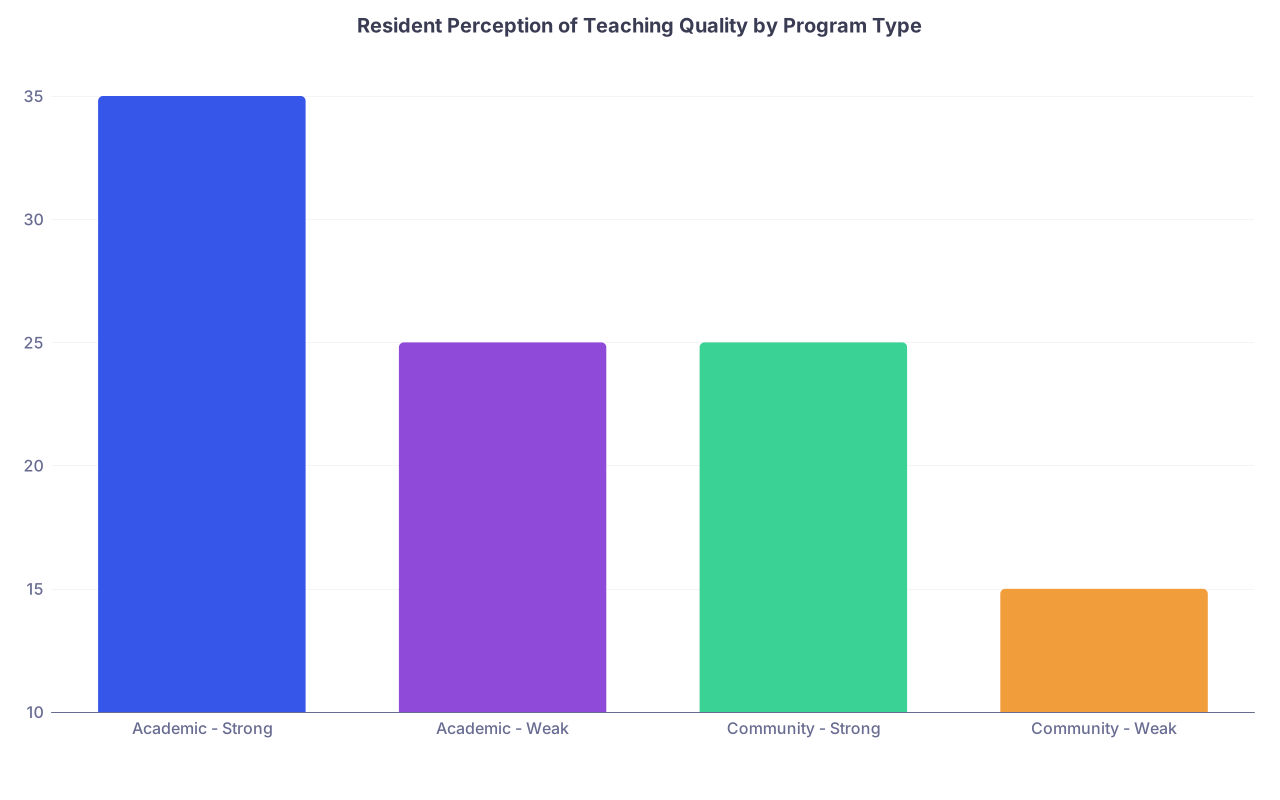
| Category | Value |
|---|---|
| Academic - Strong | 35 |
| Academic - Weak | 25 |
| Community - Strong | 25 |
| Community - Weak | 15 |
Think of the landscape roughly like this:
- Roughly a third of academic programs are actually excellent for teaching at the bedside and in conference.
- Another quarter have strong formal curriculum but mixed or weak day‑to‑day teaching.
- A solid chunk of community programs are excellent teaching environments, especially for autonomy and feedback.
- And yes, there are community programs that treat residents purely as cheap labor with minimal teaching.
The split is not “academic good / community bad.” It’s “programs with an education culture / programs where education is secondary,” and those live on both sides.
How to Actually Judge Teaching Quality When You’re Applying
Let me be blunt: relying on “academic vs community” as a shortcut is lazy and will screw up your rank list. You have better tools.
Here’s what correlates much more strongly with real teaching quality, according to resident reports and common sense:
How residents talk, when faculty are not in the room
On interview dinners or second looks, ask:- “Who are your best teachers and why?”
- “How often do you get direct feedback on your performance?”
- “Do attendings know your strengths/weaknesses?”
Watch for vague answers vs specific names and stories.
Schedule and structure of the work
Do residents say they:- Consistently attend conference without getting paged out?
- Get some protected time for reading or board prep?
- Have systems that reduce pointless scut (transport, phlebotomy, clerical overload)?
If residents are drowning in tasks, teaching suffers. Always.
Evidence that teaching is valued and measured
Look for:- Formal teaching evaluations that actually impact attending reviews
- Teaching awards that residents care about
- Faculty with titles like “Associate Program Director for Education” who are actually present on the wards
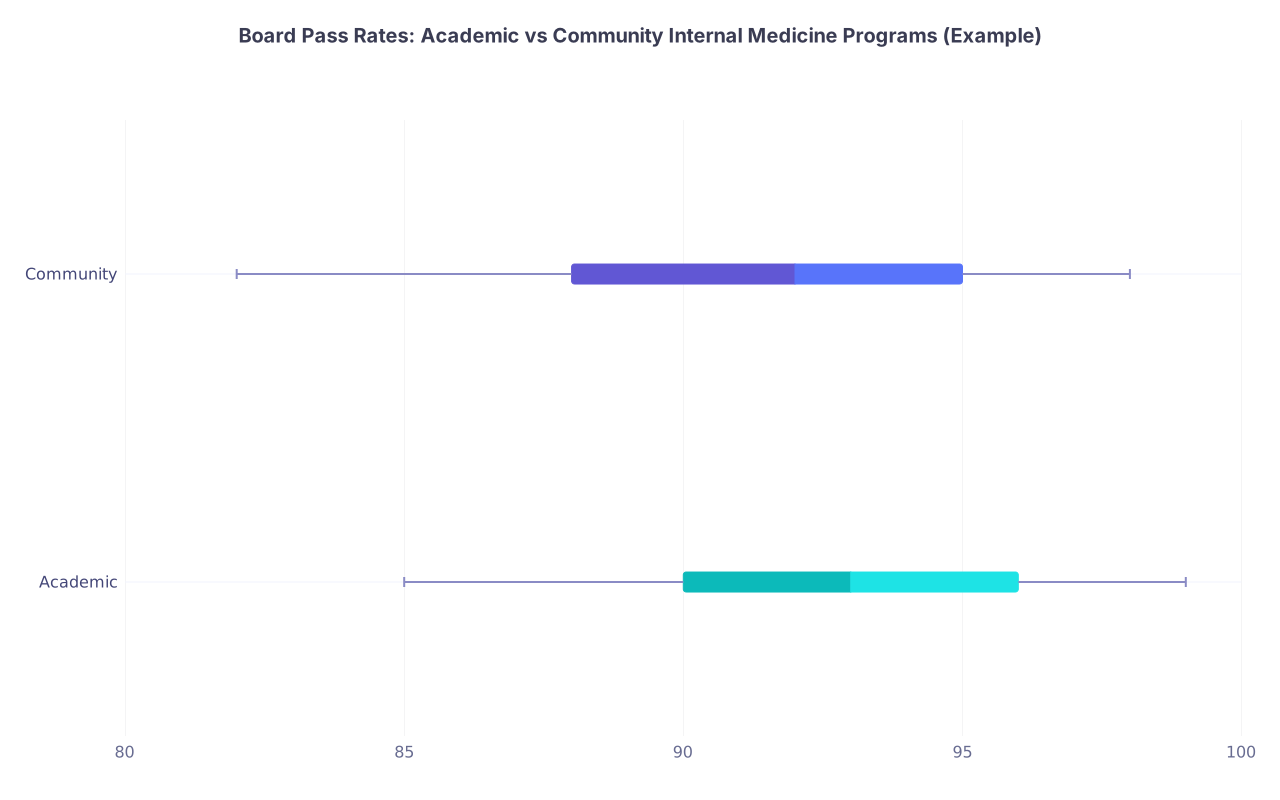
Board pass rates and in‑training exam support
These are not perfect, but they tell you something about how seriously the program takes education.
| Category | Min | Q1 | Median | Q3 | Max |
|---|---|---|---|---|---|
| Academic | 85 | 90 | 93 | 96 | 99 |
| Community | 82 | 88 | 92 | 95 | 98 |
Notice: distributions overlap heavily. That’s the point.
When Academic vs Community Does Matter For You
There are scenarios where the setting legitimately affects your experience.
Choose academic if:
You’re strongly leaning toward a competitive fellowship and want:
- Research output
- Letters from big names
- Niche subspecialty exposure
You prefer a highly structured curriculum:
- Lots of required conferences
- Well‑developed academic half days
- More formal teaching on rare and complex conditions
Choose community if:
You want to be a strong, independent generalist:
- Hospitalist
- Outpatient internist
- Community EM, FM, or surgical practice
You value:
- Autonomy
- Procedural volume
- Direct attending mentorship
But don’t confuse these career/logistical considerations with a guarantee of “better teaching.” They’re adjacent, not identical.
A More Honest Mental Model for Applicants
Replace the lazy binary with this three‑step question:
Does this program, academic or community, consistently protect learning time, or are residents always choosing between patient care and conference?
Do the attendings and senior residents actually enjoy teaching, and is that visible in how residents talk about them?
Is there a track record of graduates who look like what you want to become—well‑trained clinicians, confident decision‑makers, maybe researchers—who still speak highly of the place?
If the answer is yes to those, I don’t care what’s on the building. That’s a strong teaching environment.
To make it even simpler on interview trail:

| Step | Description |
|---|---|
| Step 1 | On Interview Day |
| Step 2 | Red flag |
| Step 3 | Teaching likely generic |
| Step 4 | Service heavy, teaching at risk |
| Step 5 | High chance of strong teaching |
| Step 6 | Residents seem engaged? |
| Step 7 | Specific stories about good teachers? |
| Step 8 | Protected time for learning? |
That’s a more accurate compass than “academic vs community” will ever be.
The Bottom Line
Teaching is not inherently better in academic programs. Here’s what actually matters:
- “Academic” predicts more structure and subspecialty exposure, not guaranteed better bedside teaching or feedback.
- Education culture, protected time, and committed teachers drive teaching quality—and those exist in both academic and community programs.
- If you judge programs by label instead of by how residents talk about daily teaching, you’re optimizing for branding, not learning.