Interview scarcity is usually not bad luck. It is bad system design.
Educational disclaimer: This article is for general educational purposes only and is not legal, financial, tax, malpractice, or professional advising advice. Match strategy, application decisions, and any concerns about liability, institutional policy, or professional risk should be discussed with your dean's office, specialty advisors, program leadership, or other qualified professionals.
I have seen applicants with excellent scores get fewer interviews than classmates with weaker numbers because they built a sloppy list, overestimated "dream" programs, or treated ERAS like a personality test instead of a probability problem. The data shows that scarcity is often self-inflicted: poor normalization of your application signals, weak tier definitions, bad timing, and too little Tier 2 breadth.
ERAS tiering fixes that. Not perfectly. But materially. It turns a vague process into a decision model: inputs → estimated interview probability → application action. That is how adults should approach a high-stakes market.
This article gives you 7 practical tiering steps grounded in measurable selection signals: Step 2 CK performance, clerkship grades, research output, away rotations, specialty-specific letters, timing, and program behavior. The goal is not to make you feel better. The goal is to improve expected interview yield and reduce the odds that you are staring at your inbox in October wondering what went wrong.
1) Start With Your Evidence: Convert Every Signal Into Comparable Metrics
Most applicants make the same first mistake: they compare apples, scalpels, and compliments. A Step 2 score, a surgery honors, a case report, and a "strong" letter are not naturally comparable. If you do not normalize them, your tiering is just vibes dressed up as strategy.
The data shows you need a common scale. I recommend a 0-5 rubric across six domains:
- Step 2 CK: percentile-based
- Clerkship performance: ordinal conversion from honors/high pass/pass
- Research productivity: weighted output, not raw count
- LOR strength: categorical-to-numeric
- Specialty fit/experiences: sub-Is, continuity, longitudinal involvement
- Professionalism/leadership: meaningful roles, not checkbox fluff
A simple example rubric:
- 5 = top-decile or clearly exceptional
- 4 = above average and competitive
- 3 = solid/within target range
- 2 = below target but viable
- 1 = weak signal
- 0 = absent or concerning
For research, raw publication counts are lazy analysis. One first-author original article in the target specialty should outscore three poster abstracts in unrelated fields. Weight matters. I use a structure like:
- First-author original paper: 3 points
- Co-author original paper: 2 points
- National poster/podium: 1.5 points
- Local poster/case report: 0.5-1 point
Then convert the total into a 0-5 score relative to the specialty norm.
For letters, "my chair likes me" is not a metric. Convert letter quality into categories based on directness, credibility, and specificity. More on that in Step 3.
Once everything sits on the same scale, tiering becomes possible. Before that, you are just romanticizing your application.
2) Map Program Selection Behavior by Specialty: Use Tiering Anchors, Not Vibes
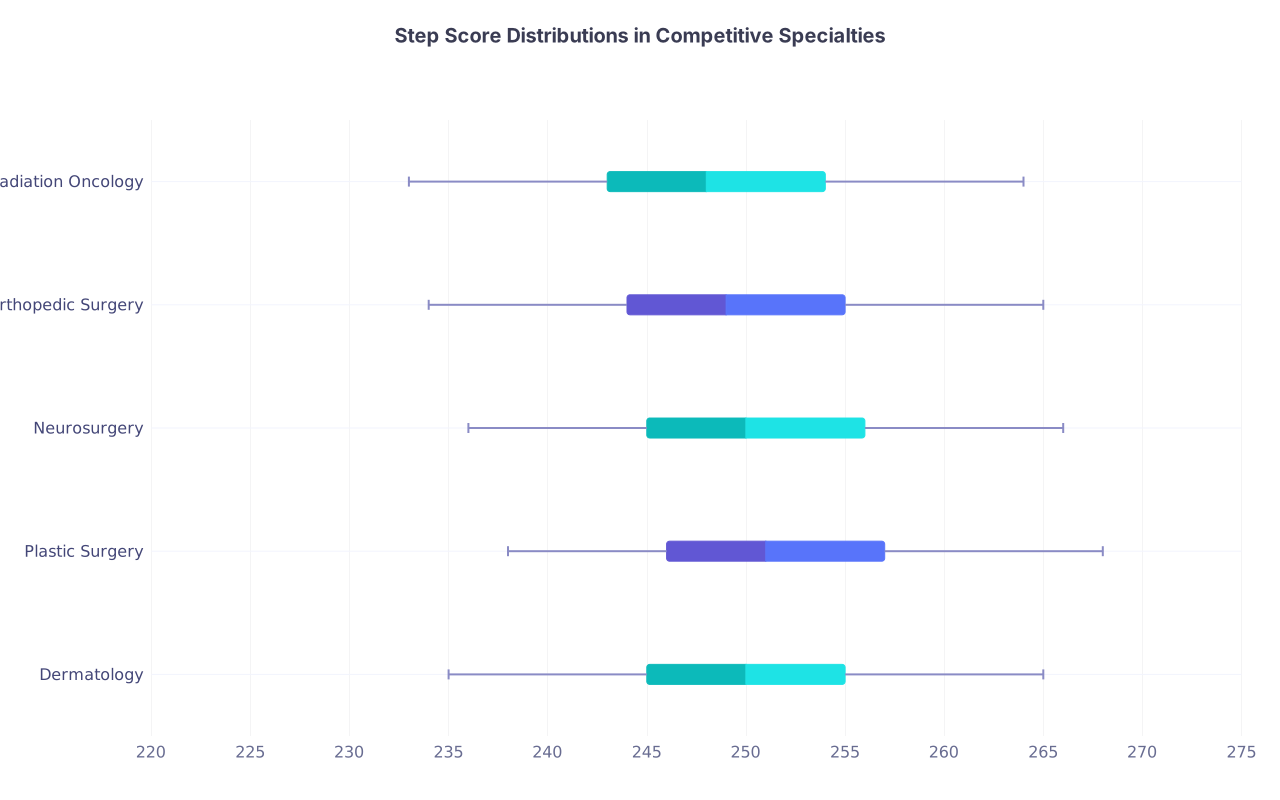
A universal tiering system across all specialties is dumb. The data shows selection behavior differs sharply by field.
A research-heavy academic dermatology list does not behave like community internal medicine. Orthopedics interprets away rotations differently than psychiatry. ENT may care deeply about home-program credibility and niche letters. Family medicine often weights fit, geography, and service record differently than score-maximizing fields. If you ignore this, your tier definitions will be wrong from the start.
You need specialty-specific anchors. Three anchor groups matter most:
Typical score band
- Not the published fantasy range from the highest-profile programs alone.
- The majority range across your actual target program set.
Research expectation
- Minimal, moderate, or intense.
- Quantity and quality both matter, depending on specialty.
Letter pattern
- Does the specialty reward continuity letters from long-term mentors?
- Or does it heavily value sub-I/away-rotation letters from known faculty?
A practical tiering framework looks like this:
- Tier 1 programs: your normalized profile meets or exceeds the majority anchor range
- Tier 2 programs: your profile overlaps meaningfully but is not dominant
- Tier 3 programs: you are below anchor range unless a specific compensating factor exists
Compensators are real. A student with a middling Step 2 but a superb away rotation letter in orthopedics may move from Tier 3 to Tier 2. A student with strong scores but thin specialty commitment may drop in programs that care about demonstrated fit. I have watched this happen repeatedly. Programs do not reward generic excellence equally. They reward the kind of excellence they trust.
So do the boring work. Build a spreadsheet. Columns should include:
- Program type: academic, hybrid, community
- Geography
- Step 2 signal band if known or inferred
- Research intensity
- Home-region preference
- Visa friendliness if relevant
- Importance of away rotations
- Number of current residents from similar backgrounds
That is not overkill. That is basic market segmentation. A similar logic applies when you compare community versus university-heavy lists across specialties.

3) Score the Letters as the Highest-Variance Predictor (and Tier Accordingly)
If applicants are wrong about one variable most often, it is letters.
The data shows letters are high-variance and high-impact. Small wording differences matter. "Outstanding student, performed at intern level, among the best in recent years, I would recruit without hesitation" is not the same as "pleasant, hardworking, completed all expected tasks." Yet applicants routinely treat both as "strong."
That is fantasy.
Build a Letter Strength Index using three components:
- Credibility: faculty rank, specialty relevance, institutional reputation, whether the writer truly knows you
- Endorsement intensity: explicit advocacy versus generic praise
- Recency/direct observation: recent clinical work and firsthand assessment beat old shadowing nostalgia
You can score each domain 0-3 or 0-4, then sum to a 0-10 index. Example:
- Credibility: 4
- Endorsement intensity: 4
- Recency/direct observation: 2
- Total: 10/10
Here is the brutal truth: one elite letter in your target specialty can move you up a tier. Not always, but often enough that ignoring it is malpractice-level planning. Especially for borderline applicants. A student sitting around the 45th percentile in Step 2 with a glowing sub-I letter from a respected faculty member is a different statistical object than a student with the same score and three bland letters.
But letters cannot erase major deficits. They can offset moderate weakness. They do not resurrect a fundamentally misaligned application.
Read the subtext carefully. If your best possible letter writer is lukewarm, that is data. Do not submit it just because the person is famous.
4) Use ERAS Timing Mathematics: Do Not Wait for Perfect; Schedule for Response Windows
Perfectionism kills applications.
The data shows earlier submission improves exposure to programs reviewing complete files in their first pass. If your application is "almost ready" but waiting on one non-essential cosmetic tweak, submit. Programs do not award points for your internal sense of completeness. They review what is available when they review.
Think in timing gates:
Gate 1: baseline submission
- Personal statement done
- Core letters assigned
- Scores released
- Transcript/MSPE pipeline confirmed
Gate 2: early update window
- New specialty letter
- Away rotation evaluation
- Accepted publication
- Strong new grade
Gate 3: mid-cycle correction
- Additional outreach where appropriate
- Reassessment of list breadth
- Backup expansion if interview velocity is poor
For tiering, this matters a lot:
- Tier 1: submit early and clean
- Tier 2 with likely updates: submit now, improve later
- Tier 3: be selective unless a pending update materially changes your profile
I have seen applicants hold back entire applications waiting for a publication acceptance that, statistically, changed almost nothing. Meanwhile, they missed the first review wave. That is bad math.
5) Build a Program List Like an Optimization Problem (Maximize Expected Interviews)
This is the core equation:
Expected interviews ≈ Σ P(interview | you, program)
That is how your list should be built. Not by prestige cravings. Not by Reddit folklore. Expected value.
A useful allocation model is a 3-tier quantity rule. Exact numbers depend on specialty and competitiveness, but the principle is consistent:
- Too many Tier 1 programs = beautiful spreadsheet, empty calendar
- Too many Tier 3 programs = wasted money, poor fit, low utility
- Strong Tier 2 breadth = where interview yield often lives
For many applicants, the balanced strategy wins because Tier 2 programs provide the best combination of realistic probability and acceptable fit. The data repeatedly points there.
You also need constraints. Real ones:
- Total application cap
- Geography and signaling logic
- Visa/ECFMG filters
- Couples match or dual-apply complexity
- Interview scheduling limits
- Program overlap in the same region and season
An example with 100 applications:
- 25 Tier 1 at 24% expected yield = 6 interviews
- 50 Tier 2 at 16% expected yield = 8 interviews
- 25 Tier 3 at 8% expected yield = 2 interviews
- Expected total = 16 interviews
Now compare that with an aggressive prestige-heavy build:
- 50 Tier 1 at 24% = 12
- 30 Tier 2 at 16% = 4.8
- 20 Tier 3 at 5% = 1
- Expected total ≈ 18, but variance is much higher and the model is fragile if your Tier 1 assumptions are inflated.
That is the point. Expected value is not the only metric. Variance matters. Risk-adjusted yield matters more than ego.
6) Stress-Test Your Tiers With Failure Modes: The "Interview-Scarcity" Checklist
Before you submit, run a quantitative quality check. Every year, I see the same scarcity drivers:
- Overestimating competitiveness
- Underweighting letter quality
- Applying too narrowly in Tier 2
- Failing to submit updates on time
- Confusing "I like this specialty" with demonstrated specialty fit
- Geographic rigidity that quietly shrinks the real program pool
Your tier distribution should match your actual competitiveness band. A high-achiever should not apply only to Tier 1s. That is arrogance masquerading as confidence. A middle-band applicant who underbuilds Tier 2 breadth is making a more common mistake: they choose too many reaches and too many low-yield long shots, with a hollow middle.
Use a quick checklist:
- Do my letters explicitly support the specialty story?
- Does my experience profile match the programs I marked Tier 1?
- Is my Tier 2 group large enough to generate stable yield?
- Am I relying on one update that probably will not change odds much?
- Have I filtered out programs where visa, geography, or mission mismatch make the real probability near zero?
If the answers are bad, change the list. Not your mindset. The list.

7) Convert Tiers Into Actions: Finalizing ERAS Submissions and Ranking Strategy
Tiering is not finished when you click submit. It should shape how you interpret interviews and build your rank list.
Here is the clean mapping:
- Tier 1: high-confidence targets; if the interview confirms fit, these become strong rank positions
- Tier 2: realistic core programs; often the backbone of a safe and satisfying rank list
- Tier 3: exploratory options; rank selectively based on actual interview performance and fit
Track interviews by tier. If your actual interview yield differs sharply from model predictions, update the model. That is how analysts work. If Tier 1 conversion is low but Tier 2 conversion is strong, stop emotionally overvaluing prestige interviews and focus on where mutual interest is real.
Post-interview, use structured notes with scored categories:
- Program fit
- Resident culture
- Training confidence
- Geographic practicality
- Gut reaction, yes, but bounded by data
Emotional ranking drift is real. After a charismatic dinner or one flattering conversation, applicants reshuffle lists irrationally. I have watched excellent candidates talk themselves into bad rank choices because one interview "felt special." Feelings matter. Unstructured feelings wreck decisions.
ERAS tiering works because it forces honesty. Normalize the signals. Anchor them to specialty behavior. Respect letter variance. Submit on time. Build the list for expected yield, not vanity. Then stress-test the whole thing before it is too late to fix.
That is the summary the data supports.
Interview scarcity is often not a verdict on your worth. It is a consequence of bad forecasting and worse allocation. Fix the process, and the odds improve. Not magically. Quantifiably.