The last 90 days before ERAS make or break your shot at a competitive specialty. Not your Step score. Not your third-year evals. This stretch right here.
I’ve watched strong applicants coast through this window and quietly slide down rank lists. I’ve also seen “borderline” candidates use these exact 3 months to claw their way into derm, ENT, ortho, plastics, neurosurgery. The difference is always the same: who treated the final 90 days as strategic execution vs “just finishing rotations.”
Here’s your specialty-specific, time-stamped game plan.
Big Picture: Your 90-Day Countdown Framework
First, anchor the calendar. I’ll assume:
- Day 0 = ERAS submission opening (mid-September most cycles)
- We’re starting at Day -90 (around mid-June)
You’ll move through three distinct phases:
- Days -90 to -61 (Month 1): Positioning & Proof
- Lock letters, targeted rotations, research output.
- Days -60 to -31 (Month 2): Application Architecture
- Personal statement, experiences, program list calibration.
- Days -30 to 0 (Month 3): Polish & Last-Minute Leverage
- Final tweaks, targeted emails, evidence that you’re ready now.
To keep this concrete, I’ll walk you through:
- A core, universal timeline
- Then competitive-specialty specific tasks layered on top (derm, ortho, ENT, plastics, neurosurg, ophtho, rad onc, urology, EM, etc.)
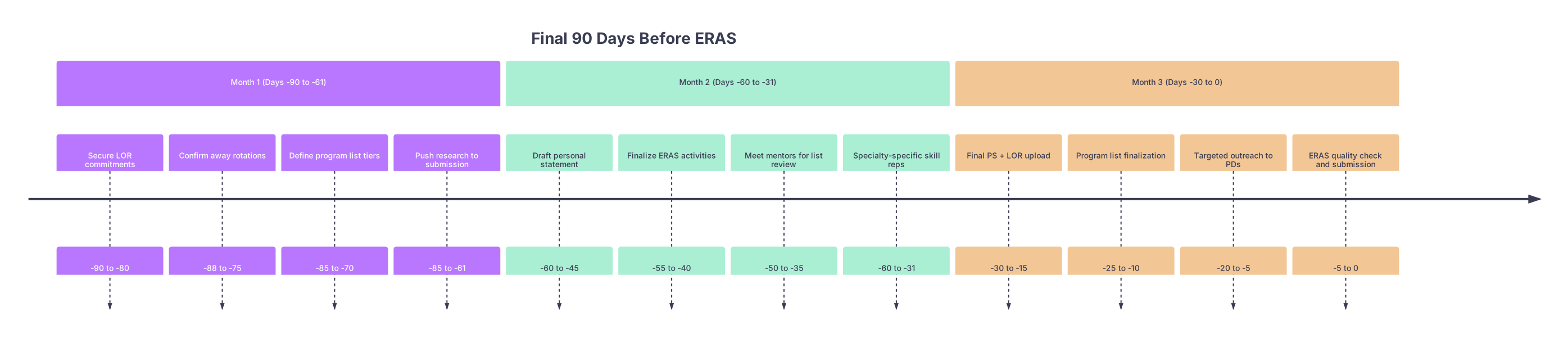
| Period | Event |
|---|---|
| Month 1 (Days -90 to -61) - Secure LOR commitments | -90 to -80 |
| Month 1 (Days -90 to -61) - Confirm away rotations | -88 to -75 |
| Month 1 (Days -90 to -61) - Define program list tiers | -85 to -70 |
| Month 1 (Days -90 to -61) - Push research to submission | -85 to -61 |
| Month 2 (Days -60 to -31) - Draft personal statement | -60 to -45 |
| Month 2 (Days -60 to -31) - Finalize ERAS activities | -55 to -40 |
| Month 2 (Days -60 to -31) - Meet mentors for list review | -50 to -35 |
| Month 2 (Days -60 to -31) - Specialty-specific skill reps | -60 to -31 |
| Month 3 (Days -30 to 0) - Final PS + LOR upload | -30 to -15 |
| Month 3 (Days -30 to 0) - Program list finalization | -25 to -10 |
| Month 3 (Days -30 to 0) - Targeted outreach to PDs | -20 to -5 |
| Month 3 (Days -30 to 0) - ERAS quality check and submission | -5 to 0 |
Month 1 (Days -90 to -61): Lock Your Competitive Edge
At this point you should stop “exploring” and start positioning. The competitive specialties do not reward indecision.
Core tasks for everyone:
- Nail down who is writing your letters
- Confirm or adjust away rotations
- Force your research to show up as tangible output
Universal Month-1 Checklist (All Competitive Specialties)
By Day -80 you should:
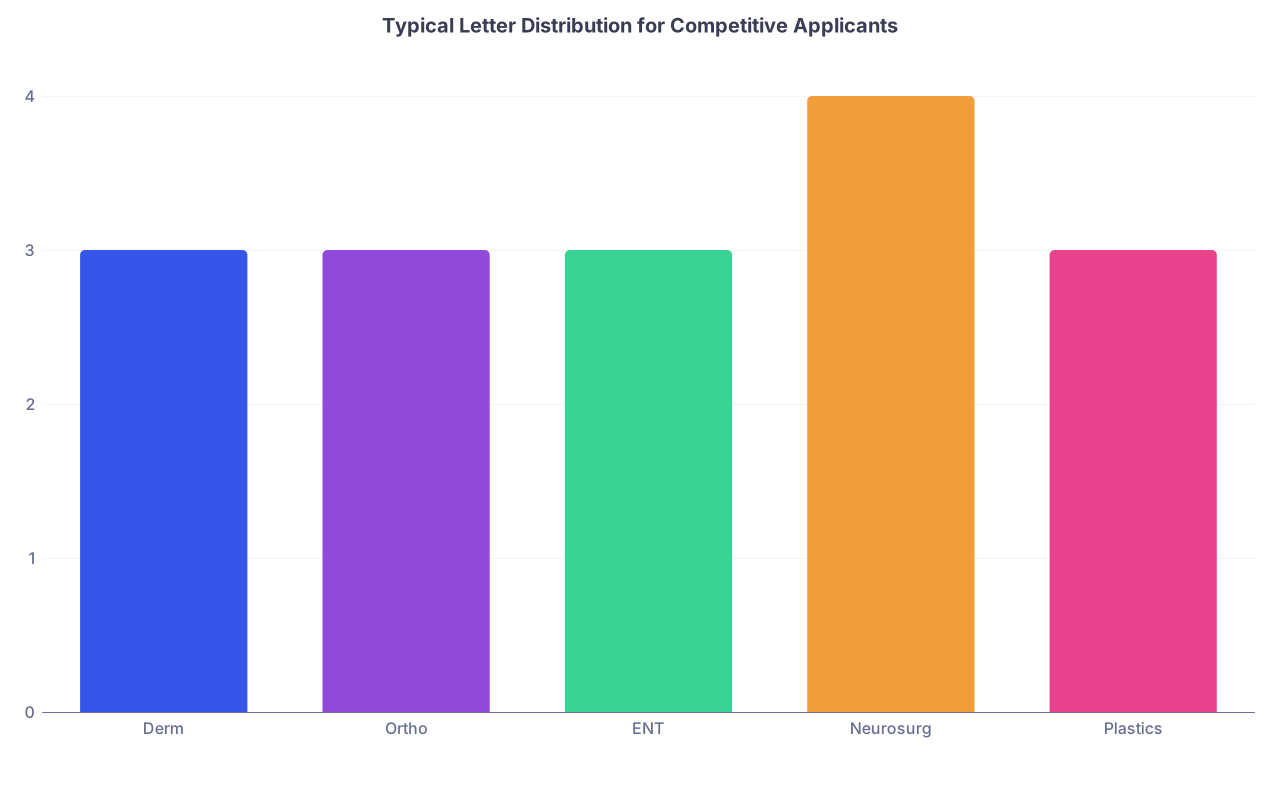
- Have 3–4 committed letter writers (2+ from the specialty if possible)
- Know which home and away rotations will be on your CV at submission
- Have 1–2 projects you can realistically get to “submitted” or at least “manuscript in preparation” by Day 0
By Day -70 you should:
- Sketch an initial program list (reach / target / safety)
- Identify any red flags (exam failure, LOA, late specialty switch) and plan your explanation
Now, overlay specialty specifics.
Dermatology (Hyper-stat, research-heavy)
By Day -90 to -75:
- Confirm at least one derm letter:
- Ask directly: “Would you be comfortable writing a strong letter for a dermatology application?”
- Push every derm project toward:
- Abstract submission (AAD, SID, local derm meetings)
- Manuscript submission (yes, “submitted” still beats “data collection”)
By Day -70:
- Be sure you can honestly list:
- ≥3 derm-related experiences (research, clinic, dermatopathology, community skin screenings)
- Evidence of sustained interest (not “decided last month”)
At this point you should also:
- Decide if you need a transitional or prelim backup plan if your board scores are soft for derm (e.g., IM prelim plus derm reapplicant strategy).
Orthopedic Surgery
By Day -85:
- Secure 2 ortho attendings for letters:
- Ideally one from your home program and one from an away/sub-I
- Confirm at least one orthopedic sub-I between now and early September. If you haven’t booked, this is late, but you must get one high-intensity month with solid face time.
By Day -70:
- Jot concrete case numbers and skills:
- Approx number of cases scrubbed, specific procedures or reductions you’ve assisted with
- Where you’ve shown initiative (late cases, weekend coverage)
You’ll use these as receipts in your ERAS descriptions.
ENT / Otolaryngology & Plastic Surgery
These both punish weak letters and nonexistent research.
By Day -80:
- Identify a single primary champion:
- ENT: division chief or research mentor who actually knows you
- Plastics: program director, integrated plastics faculty, or big-name research mentor
- Lock at least one specialty-specific research project to list.
By Day -65:
- Make sure you’ve:
- Scrubbed enough cases to speak credibly about why this specialty (not just “cool surgeries”)
- Collected specific patient stories (you’ll need one for your personal statement)
Neurosurgery
Neurosurgery is about commitment and grit on paper.
By Day -85:
- Secure:
- 2 neurosurgery letters (one can be from a research mentor if clinically focused)
- Confirmation of 7–8 week equivalent of neurosurgery exposure (home + away/sub-I)
By Day -70:
- Push all neuro-related projects:
- Aim for at least one first-author or clearly defined major contribution
- Audit your CV for:
- Leadership in something hard (lab, student run clinic, NSIG, whatever—just not passive)
Ophthalmology & Urology (early deadlines but same principle)
Even though their match/application systems can differ (SF Match, AUA), the 90-day ERAS window still matters for signal alignment.
By Day -80:
- Confirm:
- You understand their separate application timelines
- Your ERAS content doesn’t contradict or downplay your interest in them
By Day -65:
- Have:
- At least 2 specialty letters
- One strong, specific clinical experience per specialty ready to narrate
| Category | Value |
|---|---|
| Derm | 3 |
| Ortho | 3 |
| ENT | 3 |
| Neurosurg | 4 |
| Plastics | 3 |
Month 2 (Days -60 to -31): Build the Application Skeleton
By this point you should stop collecting more random experiences and start organizing what you already have into a coherent story.
Core Month-2 goals:
- Personal statement drafted and specialty-aligned
- ERAS activities written in impact-first language
- Program list vetted by someone who’s actually matched in your field
Week 9–8 (Days -60 to -46): Personal Statement & Storyline
By Day -60 you should:
- Decide on your single, primary specialty narrative
- Decide clearly on:
- Will you dual apply? If yes, to what and how will you keep both stories honest?
Then:
- Draft 1 of your personal statement:
- One tightly focused clinical vignette (not your entire life story)
- 1–2 paragraphs showing sustained engagement with the specialty
- A short closing that points to what you bring to residency (work style, team fit, resilience)
Specialty nuance:
- Derm: Include concrete derm experiences (clinic, dermpath, research) and at least one line showing you understand chronic disease + psychosocial impact, not just “visual pattern recognition.”
- Ortho / Neurosurg / Plastics: Do not write “I like working with my hands” and stop there. Overused. Include examples of long hours, physically demanding work, and team dynamics in the OR.
- ENT / Ophtho: Show an understanding of function + quality of life (hearing, vision, airway, speech). That separates you from the “cool gadgets” crowd.
- EM (yes, also very competitive in good markets): Show comfort with uncertainty, volume, and cross-discipline coordination, not just adrenaline.
By Day -50:
- Get one in-specialty mentor to read your draft.
- Accept that they’ll probably say: “Cut this paragraph” or “This sounds generic.” Fix it.
Week 7–6 (Days -45 to -31): ERAS Activities & Program List
At this point you should build out every ERAS slot aggressively.
Activities section:
- 10 core entries with clear outcome language:
- “Coordinated,” “developed,” “implemented,” “led,” “analyzed” > “helped” or “observed”
- For research: give status (submitted, accepted, published) and your role (data collection vs analysis vs first author)
Competitive-specialty twist:
- Your top 3 entries must scream your specialty:
- Derm: derm clinics, derm research, dermatopathology, skin cancer screenings
- Ortho: sports med clinic, fracture clinic, ortho research, ortho sub-I
- ENT/Plastics: head & neck clinic, reconstruction cases, facial trauma call
- Neurosurg: neuro ICU, neurosurgery research, spine clinic
- Rad Onc: tumor boards, oncology research, physics or dosimetry exposure
Program list building:
By Day -40 you should have a draft that looks something like:
| Specialty | Reach Programs | Target Programs | Safety/Backup |
|---|---|---|---|
| Derm | 8–10 | 15–20 | 5–8 IM prelim |
| Ortho | 10–15 | 20–25 | 5–10 gen surg |
| ENT | 8–12 | 15–20 | 5–10 prelim |
| Neurosurg | 5–8 | 10–15 | 5–10 IM/TY |
| Plastics | 5–8 | 10–15 | 5–10 gen surg |
Numbers will flex with your Step/COMLEX, school name, and research depth. But the point stands: you need a tiered list, not a fantasy list.
By Day -35:
- Run your program list by:
- A recent applicant in your specialty
- A faculty advisor who actually knows current match realities, not just prestige.

Month 3 (Days -30 to 0): Polish, Proof, and Push
Now you’re out of “I’ll fix that later” runway. Last month is about refining, confirming, and executing small strategic moves.
Week 4 (Days -30 to -24): Letters & Final Content
By Day -30 you should:
- Confirm all LORs are requested in ERAS, with writers given a hard deadline (Day -15 in your email).
- Re-read your personal statement out loud. Anywhere you stumble, rewrite.
Specialty-driven tasks:
If you’re on a sub-I / away right now (classic for ortho, ENT, derm, neurosurg, plastics):
- Ask explicitly for feedback from attendings:
“If I perform at this level by the end of the month, would you feel comfortable writing me a strong recommendation?” - Then actually adjust based on what they say. Show up earlier. Stay later. Volunteer for scut you haven’t been doing.
- Ask explicitly for feedback from attendings:
Derm / Rad Onc / Ophtho:
- Push to have:
- Updated PubMed or abstract status for each active project
- At least one attending ready to mention your research productivity in your LOR
- Push to have:
Week 3 (Days -23 to -17): Targeted Program Strategy
By Day -23:
- Finalize your geographic priorities:
- Where do you have real ties? Family, prior training, undergrad, long-term partner.
Use this to:
- Slightly boost programs in your priority regions on your list
- Prepare a 1–2 sentence explanation of ties you can re-use if emailing PDs or mentioning region in your statement or supplemental essays
Competitive specialty nuance:
- Neurosurg / Plastics / ENT / Ortho:
- Identify 5–10 absolute top-choice programs.
- For each, know:
- Recent resident med school backgrounds
- How many residents they take per year
- Any faculty your mentors know
By Day -20:
- Ask mentors:
- “Would you feel comfortable sending a short email of support to [Program X, Y, Z] when I apply?”
- Do not demand. But you should know who is willing to advocate, and where.
Week 2 (Days -16 to -10): Quality Control & Subtle Outreach
At this point you should be in cleanup and precision mode.
By Day -15:
- Verify:
- All LORs received in ERAS (or writers have confirmed imminent upload)
- No typos in your:
- Name, AAMC ID
- Publications (author order, journal names, dates)
- Work and activities descriptions
Silent application killers are stupid errors.
Program-side moves:
- If you have a late-breaking update (accepted abstract, new paper, award):
- Prepare a concise 3–4 line update email template.
- Plan to send only to:
- Programs with a genuine connection
- Places your mentor specifically recommends
Don’t spam every PD in the country. It reads as desperate.
Week 1 & Final Days (Days -9 to 0): Submission & Buffer
By Day -9 to -5:
- Your ERAS should be essentially complete. Use these days for:
- One last pass from a trusted friend for grammar and clarity
- One mentor glance to ensure your specialty fit comes through
By Day -3:
- Lock it. No huge last-minute edits. Every year I see someone break a previously good personal statement with a 2 a.m. “improvement.”
On Submission Day (Day 0):
- Submit early in the day.
- Screenshot confirmation.
- Then stop refreshing your email every five minutes. You’ll get your feedback when interview invites start.
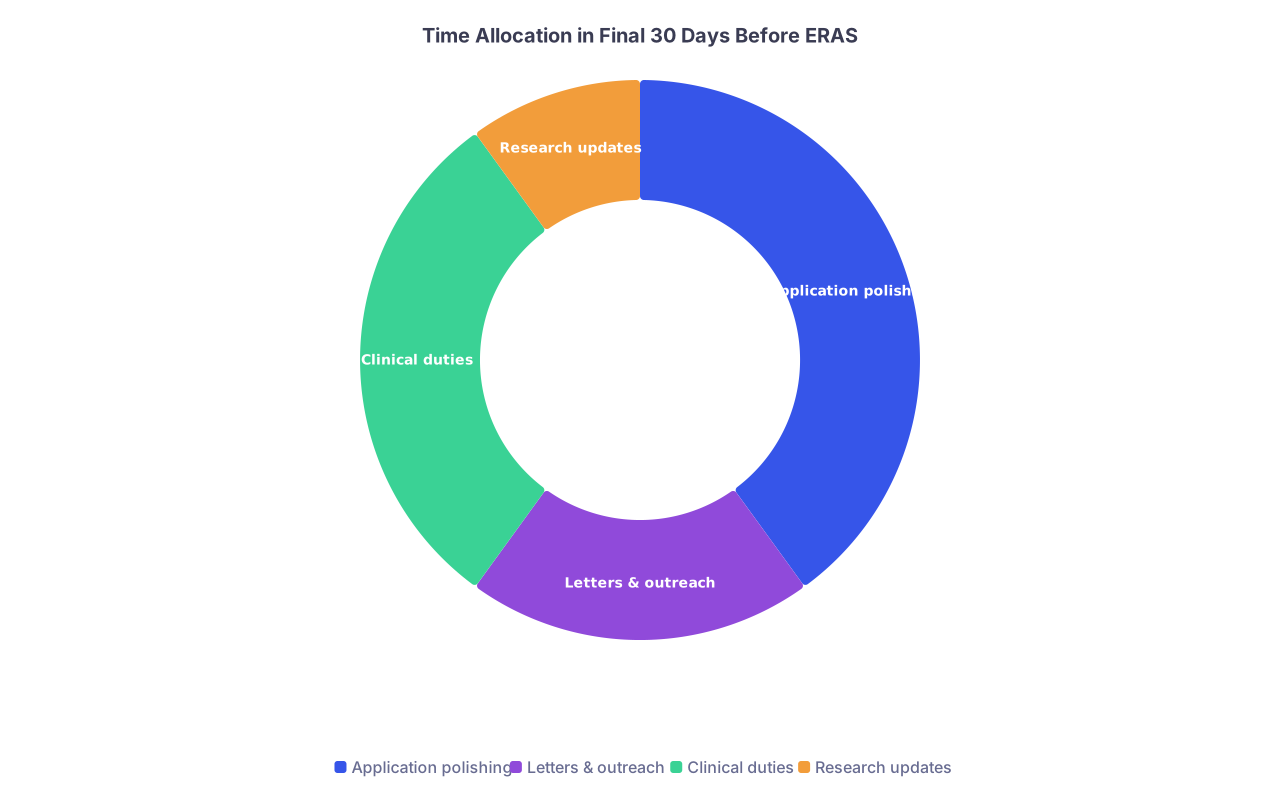
| Category | Value |
|---|---|
| Application polishing | 40 |
| Letters & outreach | 20 |
| Clinical duties | 30 |
| Research updates | 10 |
Specialty-Specific Micro-Tasks by Week (Quick Reference)
This is where you tighten the screws. Think “checklist you tape above your desk.”
Dermatology – Final 6 Weeks
- Week -6 to -4:
- Confirm 2 derm letters + 1 strong medicine/surgery letter
- Ensure every derm experience has a concrete outcome in ERAS:
- “Co-authored 2 case reports, 1 poster accepted to SID”
- Week -3 to -1:
- Ask derm mentor:
- “Are there specific programs where you’d recommend I apply more broadly or more conservatively based on my profile?”
- Be ready with a 1-sentence explanation for any Step gap or red flag. No rambling.
- Ask derm mentor:
Orthopedic Surgery – Final 6 Weeks
- Week -6 to -4:
- During sub-I: be the one who:
- Volunteers for weekend rounding
- Knows every post-op’s plan without being asked
- Collect feedback:
“Anything I can do differently these last 2 weeks to make sure I’m functioning at an intern level?”
- During sub-I: be the one who:
- Week -3 to -1:
- Quantify in your ERAS:
- Approx number of cases you’ve scrubbed
- Any call responsibility and what you actually did
- Quantify in your ERAS:
ENT / Plastics – Final 6 Weeks
- Week -6 to -4:
- Get a clean, succinct narrative of why ENT/Plastics specifically, not just “I like surgery.”
- Make sure at least:
- One ENT/plastics mentor can comment on technical aptitude
- One can comment on work ethic/team fit
- Week -3 to -1:
- If you have aesthetic vs reconstructive interest, articulate it with:
- A clinical example, not Instagram.
- If you have aesthetic vs reconstructive interest, articulate it with:
Neurosurgery – Final 6 Weeks
- Week -6 to -4:
- Confirm your personal statement doesn’t sound like a neurosurgery cliché:
- Avoid purely “brain is fascinating” + singular family tragedy stories unless you have a unique angle.
- Emphasize:
- Longitudinal commitment
- Endurance (busy rotations, research, call)
- Confirm your personal statement doesn’t sound like a neurosurgery cliché:
- Week -3 to -1:
- Have your neurosurgery mentor:
- Review your program list for realism
- Flag where they can personally advocate
- Have your neurosurgery mentor:

Common Last-90-Days Mistakes (Do Not Repeat These)
I’ve seen these tank otherwise competitive files:
Drifting on away rotations.
You are being informally evaluated as “would I want this person at 2 a.m.?” every day. Treat it like a month-long interview.Generic ERAS entries.
“Shadowing” and “helped with research” mean nothing. Action + outcome or delete it.Over-focusing on one fantasy program.
Don’t build your entire final 90 days around a single dream institution. Distribute your effort.Avoiding mentor feedback because it stings.
The most competitive applicants I know actively sought harsh edits in this window.

| Step | Description |
|---|---|
| Step 1 | Start Final 30 Days |
| Step 2 | Email writers with firm deadline |
| Step 3 | Peer and mentor review |
| Step 4 | Meet specialty mentor |
| Step 5 | Freeze major edits |
| Step 6 | Submit ERAS |
| Step 7 | Letters uploaded? |
| Step 8 | PS and activities proofed? |
| Step 9 | Program list vetted? |
If you remember nothing else from this:
- The final 90 days are about execution, not exploration. Choose your specialty and build every move around proving you belong there.
- Competitive fields reward specific receipts: specialty letters, concrete experiences, and research with outcomes—get all three visible in ERAS before you click submit.
- Do not go into ERAS “hoping it works out.” Go in with a deliberate, mentor-vetted program list and a file that reads like it was built for your specialty on purpose, not by accident.