The biggest mistake students make in competitive specialties isn’t their Step score. It’s that they start building faculty relationships a year too late.
You do not “network” into derm, ortho, plastics, ENT, neurosurgery, or rad onc in a single sub‑I. You cultivate a small set of people who:
- Know you well
- Trust your work ethic
- Are willing to put their name on the line for you
That takes time. And you do not have as much time as you think.
Below is a concrete, time‑stamped roadmap: preclinical through ERAS submission and Match. At each point I’ll tell you exactly what you should be doing, who you should be talking to, and what a realistic “relationship milestone” looks like.
Big-Picture Timeline: When Relationships Actually Form
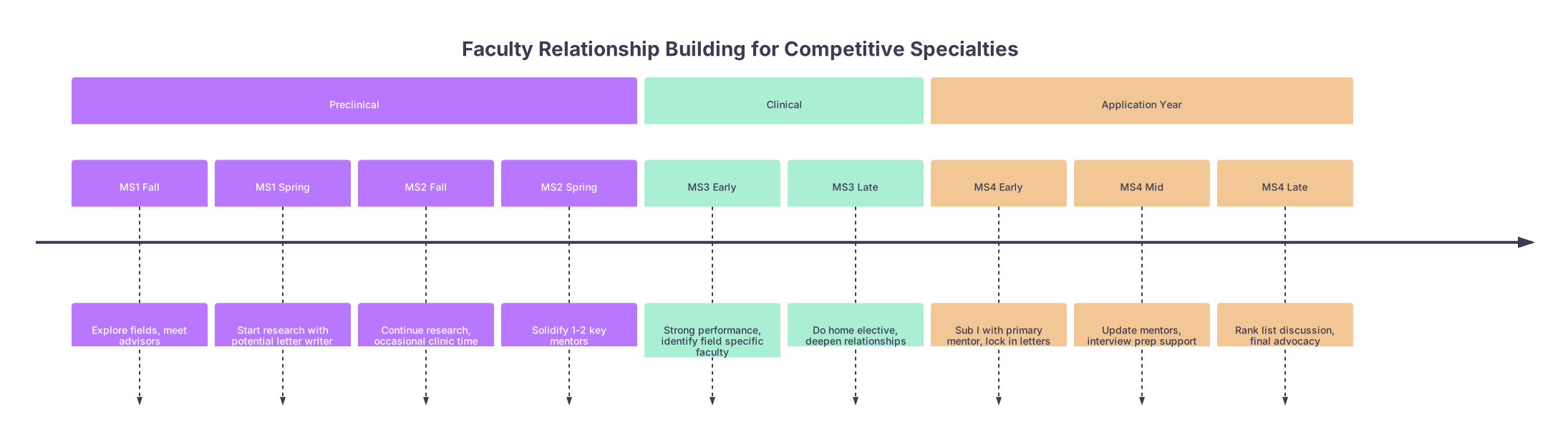
| Period | Event |
|---|---|
| Preclinical - MS1 Fall | Explore fields, meet advisors |
| Preclinical - MS1 Spring | Start research with potential letter writer |
| Preclinical - MS2 Fall | Continue research, occasional clinic time |
| Preclinical - MS2 Spring | Solidify 1-2 key mentors |
| Clinical - MS3 Early | Strong performance, identify field specific faculty |
| Clinical - MS3 Late | Do home elective, deepen relationships |
| Application Year - MS4 Early | Sub I with primary mentor, lock in letters |
| Application Year - MS4 Mid | Update mentors, interview prep support |
| Application Year - MS4 Late | Rank list discussion, final advocacy |
That’s the realistic cadence. If you’re trying to cram all of this into MS4, you’re already behind.
MS1: Quiet Setup (Exploration + Early Visibility)
At this point you should not be asking for letters. You’re laying foundation and getting your name in the right rooms.
MS1 Fall (Months 1–4)
Your goals:
- Get eyes on you from departmental leadership (lightly).
- Start exploring fields that might be competitive for you.
Concrete moves:
Identify the department and the power structure.
For derm, ortho, ENT, plastics, neurosurg, etc., figure out:- Department chair
- Residency program director
- Vice chair for education
- A few “known” resident mentors or chiefs
Meet a generic career advisor early.
By October, you should have had at least one brief meeting with:- Your school’s dean of students / career advisor, or
- The specialty advisor if your school assigns one early
Script is simple:
- “I’m MS1, interested in [field] among others, want to set myself up correctly from the beginning. Who are the people in this department students should get to know over the next 1–2 years?”
Show your face once at a department event.
By the end of fall:- Attend one grand rounds or resident conference in that field.
- Introduce yourself briefly to one faculty member:
- “I’m an MS1, considering [field], just wanted to start learning what the field looks like here.”
No ask. No awkward pitch. Just name recognition step one.
MS1 Spring (Months 5–10)
At this point you should have started something longitudinal with at least one faculty member in a potentially competitive field.
Target: 1 research mentor who could eventually know you well.
Steps:
Approach for research between January–March.
Ideal email:- Brief: 5–6 sentences max
- Includes:
- Who you are
- Why their work interests you (1 specific paper or project)
- Your time availability (realistic)
- Clear ask: “Is there a project I could help with over the next 12 months?”
Prioritize mentors with staying power.
You want:- Core faculty, not someone who just arrived last month
- People consistently publishing
- Preferably involved in the residency program or med student education
If that means taking a project that’s less “sexy” but with a PD or APD, that’s usually the right trade.
By end of MS1:
You should have:- Met your research mentor at least twice in person
- Started doing actual work (chart review, data cleaning, etc.)
- Earned a small amount of trust by responding to emails quickly and hitting deadlines
Relationship milestone: they know your name without looking it up. Low bar, but crucial.
MS2: Turning Contact into Mentorship
MS2 is where students either quietly become “known quantities” or vanish until MS4. You want the first option.
MS2 Summer / Early Fall (Months 11–16)
At this point you should be:
- Embedded in at least one ongoing project
- Starting to see faculty repeatedly enough that roles and expectations are clear
Key moves:
Ask for some clinical exposure with your research mentor.
Not a whole rotation. Just:- 1–2 half days in clinic
- 1 OR day if relevant (ortho, ENT, plastics, neurosurg)
Purpose: they see how you act around patients and staff. This matters later when they write “I’ve worked with them clinically…”
Move from task-doer to owner on at least one piece of a project.
You should be able to say by end of fall:- “I’m first author on a case series / retrospective study” or
- “I handled data extraction and initial analysis on X project”
Faculty respect ownership, not just “I helped.”
Check in intentionally.
Every 6–8 weeks:- Send a short update email or schedule a 15–20 minute check-in:
- Progress on project
- Upcoming milestones (abstract, manuscript, conference)
- Your evolving interest in the field
- Send a short update email or schedule a 15–20 minute check-in:
Relationship milestone by December of MS2:
Your mentor could introduce you at grand rounds as “one of our med students who’s been working on X project and is interested in [field].”

MS2 Late Fall – Spring (Months 17–24)
At this point you should be converting this into a genuine mentor–mentee relationship, not just “my PI.”
Moves:
Have one explicit mentorship conversation.
Around January–February:- Sit down with your main faculty contact
- Say directly:
- “I’m leaning strongly toward [field]. I’d be grateful if you’d be willing to advise me on how to be a strong applicant here.”
If they’re lukewarm or vague, that’s a data point. You may need a different primary mentor.
Ask for strategic introductions.
Your mentor can help you meet:- Program director or assistant PD
- A faculty member known for teaching or student mentorship
- A senior resident who is trusted
You’re not asking for favors yet. You’re building a small web of people who know you.
End of MS2 checklist:
You should have:- 1 primary faculty mentor in your specialty
- 1–2 secondary faculty you’ve met at least twice
- Started or submitted at least one poster/abstract/manuscript with your main mentor
Relationship milestone: your primary mentor now thinks of you as “one of my students going into [field].”
MS3: Clinical Year – This Is Where Most People Blow It
MS3 is not just “do well on rotations.” In competitive fields, it’s “prove to specific faculty that you are a resident they’d want.”
MS3 Early (First 4–6 Months)
At this point you should be:
- Building your clinical reputation
- Quietly signaling to faculty that you’re serious about their field
Steps:
Crush the core clerkships FIRST.
Faculty in competitive fields will ask: “How are they clinically?”
That’s code for: “Are they solid on medicine/surgery/OB/peds?”Stay on your specialty’s radar even if you’re not on their service.
Every 2–3 months:- Quick email to primary mentor:
- Brief update on rotations
- One clinical situation you learned from that touches their field
- Confirm you’re still planning to pursue their specialty
- Quick email to primary mentor:
Do at least 1 generic meeting with the PD by mid-MS3 (if possible).
This is not a letter ask. This is:- 15 minutes
- “I’m an MS3 here, planning on [field], wanted to introduce myself and ask what strong applicants look like from this institution.”
You’re signaling early. People remember who came in early vs who showed up in April of MS4 with a panic face.
MS3 Late (Final 4–6 Months)
This is where home electives and selectives matter.
At this point you should:
- Be arranging your first dedicated time on that service
- Have a game plan for who you want to work closely with
Timeline:
- 6–9 months before ERAS submission: aim to be on your home service (late MS3 or very early MS4 depending on your school).
On your home elective:
Target 2–3 faculty as potential letter writers.
During the month, focus your energy on:- Your research mentor (if they’re clinically active and on the service)
- A teaching-focused faculty member known for strong letters
- One “name” in the department if you can get real facetime
Perform like an intern, not a tourist.
You want comments like:- “They functioned at the level of a sub‑I by the end of the month.”
- “Residents trusted them with independent tasks.”
Ask for quick mid-rotation feedback.
Week 2:- “I’m really interested in [field] and want to be sure I’m on track. Is there anything I can change this week to be more helpful to the team?”
Then do it. That way, when you ask for a letter later, they remember that you responded to feedback.
Relationship milestone by the end of MS3:
You have 2–3 faculty who have seen you clinically and think of you as an obvious future [fill in specialty] resident.
Early MS4: Sub‑I, Letters, and Explicit Support
This is the money phase. You are now converting long‑term relationship equity into letters and departmental advocacy.
MS4 Early (6–8 Months Before ERAS Deadline)
At this point you should be on:
- A sub‑internship or acting internship in your specialty at your home program
- Possibly already planning one away rotation
Priority: lock down 3–4 strong letters from people who actually know you.
Ideal faculty mix in competitive specialties:
| Role | Count | Priority Level |
|---|---|---|
| Program Director | 1 | High |
| Department Mentor | 1 | High |
| Clinical Faculty | 1 | Medium |
| Research Mentor | 1 | Medium |
Steps, week by week on your sub‑I:
Week 1–2:
- Show up early, stay late, volunteer for scut and non‑glamorous tasks
- Identify who you’re clicking with clinically
Week 3:
- Brief check-in with primary mentor:
- “I’m on the sub‑I; I’d be honored if, assuming things continue to go well, you’d consider writing a letter for my residency application.”
- Ask similarly of 1 other faculty if the relationship is strong enough
- Brief check-in with primary mentor:
Week 4 (or at rotation end):
- Formal letter request in person first, then by email
Content to give them:
- Updated CV
- USMLE scores
- Brief paragraph: your career goals and what you hope their letter can highlight (clinical performance, work ethic, research, etc.)
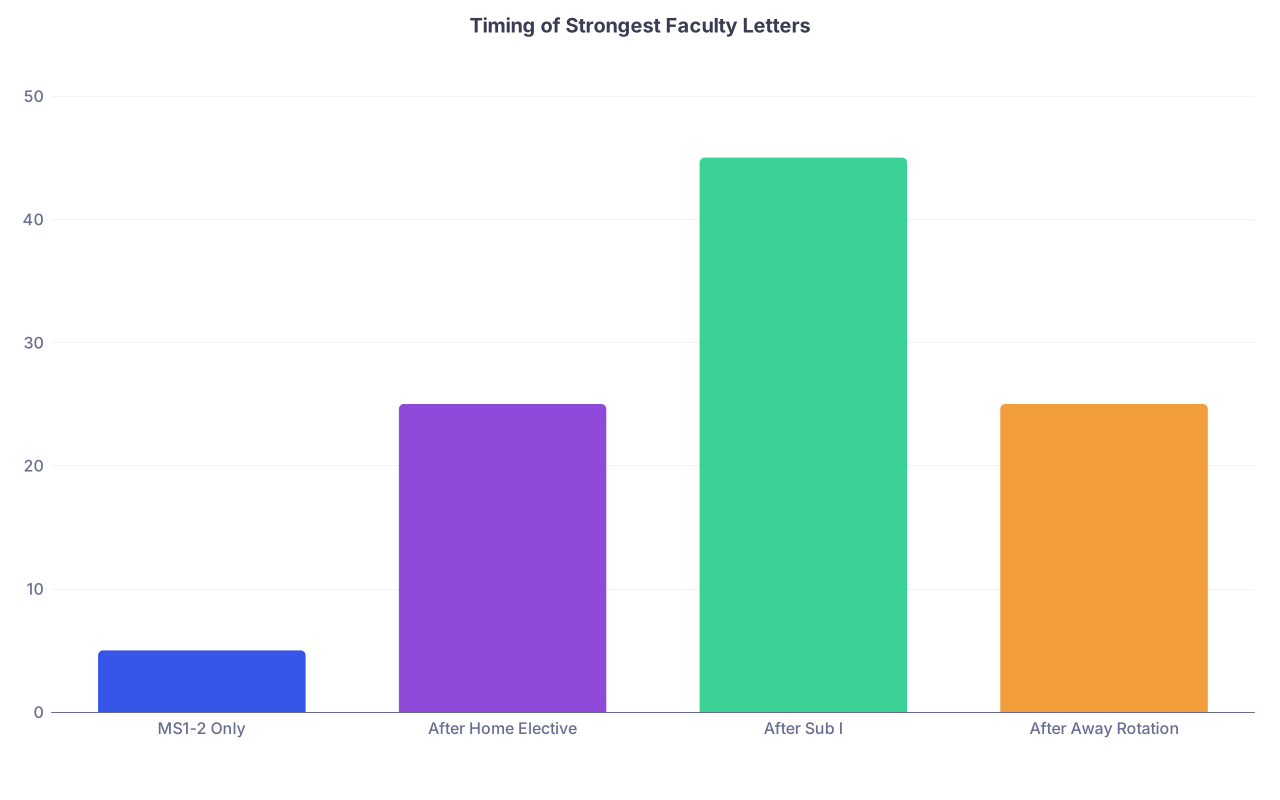
| Category | Value |
|---|---|
| MS1-2 Only | 5 |
| After Home Elective | 25 |
| After Sub I | 45 |
| After Away Rotation | 25 |
MS4 Mid (ERAS Season – September to December)
At this point you should be:
- Done with letter requests
- Maintaining and using your relationships for strategy
Here’s how:
Send a pre-ERAS update to key faculty (late August).
Short email to each core mentor/letter writer:- Final Step scores
- Total number of programs you’re applying to
- Any new publications/abstracts
- Thank them again for their support
Tasteful advocacy ask.
With primary mentor or PD:- “If you feel comfortable, I’d appreciate any advocacy you might be willing to do with programs where you have close contacts, especially [top 3–5 programs].”
They know what that means. You don’t need to micromanage it.
During interview season (Oct–Jan):
Every 4–6 weeks:- Send concise update: number of interviews, any standouts, any concerns
- Ask for advice before you make big decisions (like canceling interviews or planning a second wave of apps)
Relationship milestone by mid-MS4:
Your key mentor feels invested in your match outcome and is actively tracking your progress.
Late MS4: Rank List and Last-Minute Advocacy
People pretend the process ends with interviews. It doesn’t. Faculty advocacy and rank list strategy can move the needle, especially in competitive specialties.
January – February (After Most Interviews)
At this point you should:
- Have a clear idea of your rank list shape
- Be ready for one more round of targeted faculty help
Steps:
Schedule a 20–30 minute meeting with your primary mentor and/or PD.
Agenda:- Walk through your tentative rank list
- Ask directly:
- “Are there programs where you think I’d be especially well‑matched, based on how they know me?”
- “Any red flags about how I’m ranking things?”
If there’s a true top choice, you can ask for explicit support.
Careful here. Do not be needy or manipulative. But:- “I’ll be ranking [Program X] first. If you have any close colleagues there and feel comfortable reaching out, I’d really appreciate it.”
Final updates.
After you certify your list:- Brief, grateful email to all faculty sponsors
- Thank them, share that your list is certified, and that you’ll let them know on Match Day
Special Cases: What If You’re Late?
You might be thinking: “I’m MS3 already and just decided on ortho.” Fine. Then your timeline compresses, but the principles don’t change.
Condensed plan:
Immediately:
- Identify 1–2 key faculty and ask for research or clinic time
- Be honest: “I’m coming to this a bit later; I want to work hard to show you I’m serious.”
Next 3–6 months:
- Do a home elective as soon as you can
- Overperform and get mid‑rotation feedback
- Ask for letters right after
Parallel:
- Meet PD once
- Ask your new mentor:
- “Given my late switch, what would you recommend to strengthen my application in the next 6–9 months?”
You will have fewer long‑term relationships, but you can still have intense, high‑quality ones. That’s what matters.
How Many Faculty Relationships Do You Actually Need?
Not 20. Not zero.
For most competitive fields, aim for:
- 1 primary mentor (knows you for 1–3 years, research + advising + some clinic)
- 2–3 strong clinical faculty (have seen you on service, at least a month of work)
- 1 research-focused mentor (if not the same as primary)
And then a halo of others:
- PD + chair: know who you are, may have met you 1–3 times
- Residents: can vouch informally for your work ethic and how you are to work with
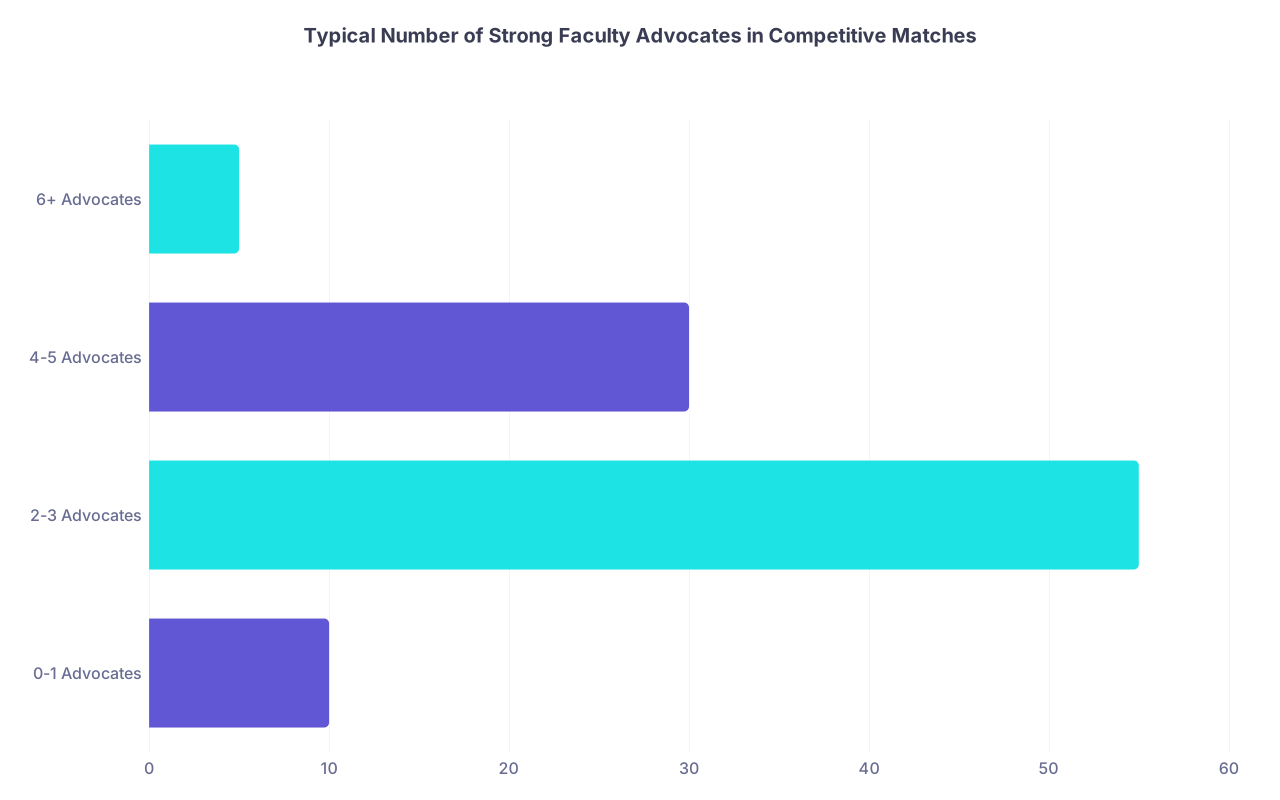
| Category | Value |
|---|---|
| 0-1 Advocates | 10 |
| 2-3 Advocates | 55 |
| 4-5 Advocates | 30 |
| 6+ Advocates | 5 |
Final Checklist by Phase
To make this painfully concrete, here’s what you should have by the end of each phase:
End of MS1
- 1 research relationship started in a competitive field
- Your name known by at least 1 faculty beyond your PI
End of MS2
- 1 primary mentor who sees you as “my student going into [field]”
- 1–2 secondary faculty who’ve met you a few times
End of MS3
- 2–3 faculty who’ve seen you clinically and respect your performance
- At least informal awareness from PD or education leadership
ERAS submission (early MS4)
- 3–4 strong letters from people who genuinely know your work
- One primary mentor prepared to advocate behind the scenes
If You Remember Nothing Else
- Strong letters and real advocacy in competitive specialties are built over 12–24 months, not four weeks on a sub‑I.
- You need a small core of faculty who truly know you, not superficial contacts with an entire department.
- At each stage—MS1, MS2, MS3, early MS4—you should be asking, “Who actually knows my work right now, and what is the next concrete step to deepen that?”
Follow that question month by month, and the relationships you need for a competitive match will be in place before you’re desperate for them.