
It is August. VSLO is open, ERAS is staring at you, and your spreadsheet of programs has more red flags than green.
Your stats look… fine. Not terrible. Not amazing.
- Step 2: 244
- Class rank: middle third
- No home ENT program
- One ENT case report half-finished, one poster in a different specialty
- Two generic “surgical” letters, nothing from a big ENT name
And you are looking at otolaryngology match numbers thinking, “Do I even have a shot?”
You do. But not like this.
ENT is brutally competitive. Mid-tier applications match all the time, but they do not match by playing the same game as the 270/first‑author‑in‑Nature crowd. They win by being intentional, targeted, and disciplined.
I am going to walk you through how to turn a mid‑tier ENT application into something that makes programs pause and say, “We should at least interview this one.”
This is not about magic. It is about a plan.
Step 1: Get Honest About Your Starting Point
You cannot fix what you have not clearly defined. Take one hour, no phone, and write down where you stand.
Break it into five buckets:
- Scores & Transcript
- Clinical Performance
- Research
- Letters of Recommendation
- Connections & Exposure to ENT
| Area | Strong (Y/N) | Notes / Numbers |
|---|---|---|
| Step 2 CK | e.g., 244 | |
| Preclinical performance | e.g., Pass/High Pass | |
| Core clerkships | e.g., mostly High Pass | |
| ENT research | e.g., 1 poster, 0 pubs | |
| Other research | e.g., 2 pubs in IM | |
| ENT letters | e.g., 0 ENT letters | |
| Home ENT program | e.g., No |
Then classify yourself, bluntly:
Academic strength:
- 250+ Step 2, mostly Honors/HP in cores → you are fine academically
- 235–249, mostly HP/Pass → mid‑tier
- <235, multiple low grades → uphill but not impossible
Research profile:
- 3+ ENT pubs/posters/abstracts → solid
- 1–2, especially not ENT → weak
- 0 → you need a plan yesterday
ENT ties:
- Home program, away rotation lined up, 2+ ENT faculty who know you → strong
- No home program, but a nearby one where you have shadowed → moderate
- Nothing → you are anonymous in the field
This is not to depress you. This tells you where you must overperform to offset the rest.
General rule:
- Below‑average stats → you need above‑average networking, letters, and “story.”
- No home program → you need killer away rotations and visible ENT research.
You cannot be average everywhere and match ENT. You need at least 2–3 clear strengths.
Step 2: Choose a Coherent ENT Narrative
Mid‑tier applicants lose ground because their files feel scattered: random research, generic personal statement, no clear reason they chose ENT besides “I liked surgery and continuity of care.”
You need a coherent story that threads through every part of your application.
Pick a lane. Examples that work:
- “Head and neck oncologic care and underserved populations”
- “Hearing, communication, and quality of life / pediatrics”
- “Airway, breathing, and complex critical care in ENT”
- “Global surgery with ENT focus”
- “Technology and innovation in otology / rhinology”
You are not marrying this subspecialty. Programs know you will probably change your mind. But a focused theme makes you memorable, and lets you align:
- Research projects
- Personal statement
- Away rotation choices
- Volunteer work
- Talking points in interviews
If your record is currently random, you retrofit:
- That general surgery QI project? Frame it as “perioperative quality and outcomes” that made you appreciate complex ENT surgeries.
- That pediatrics volunteering? Tie it to pediatric airway or hearing issues.
- That engineering background? Connect it to devices, implants, navigation, imaging.
You are creating a through‑line, not rewriting your life.
Step 3: Fix What Can Still Be Fixed (Timeline‑Driven)
Different phases = different levers. Where you are in the calendar dictates what is realistic.
If You Are 12–18 Months Before Applying
You have options. Use them.
Scores / Academics
- Step 2 is king now. If you have not taken it:
- Treat it like your single biggest lever.
- 245 vs 230 can literally move you from “auto‑screen out” to “we should look.”
- Aim for:
- Dedicated time protected from heavy rotations.
- 2–3 NBME practice exams minimum, tracked and reviewed.
- Step 2 is king now. If you have not taken it:
ENT Research Ramp‑Up
You need visible ENT work on paper.
Concrete actions:
- Email 5–10 ENT faculty within driving distance, including nearby programs, with a tight message:
- 3–4 sentence intro (school, year, interest in ENT).
- 1–2 sentence summary of prior research experience.
- Clear ask: “Do you have any retrospective projects, case series, or chart reviews where an extra pair of hands would help with data collection and basic stats?”
- Accept “small” projects:
- Case reports, chart reviews, database work have gotten many mid‑tier applicants over the line.
- You want stuff that will be submitted before ERAS opens, not a basic science project that takes 3 years.
- Clinical Performance
You cannot fix old grades. You can crush what is in front of you.
Non‑negotiables:
- Surgery, medicine, and any ENT elective = treat them like auditions.
- Show up early, carry the list, know your patients cold.
- Be the student residents ask to have back.
Programs read between the lines in your MSPE comments. Comments like “outstanding work ethic,” “functioned at the level of an intern,” and “eager learner” matter more for you than for the 260+ crowd.
If You Are 6–9 Months Before ERAS
Now you prioritize ruthlessly.
You are not building a complete empire. You are trying to polish 3–4 sharp points:
- Get 1–2 ENT abstracts/posters submitted or accepted.
- Secure at least 1 ENT letter from someone who will describe you in detail.
- Plan away rotations that are realistic for your profile (more on that soon).
- Draft a personal statement that fits your ENT narrative.
At this stage:
- Do not start brand‑new long‑shot basic science projects.
- Focus on short horizon wins: case reports, database projects, chart reviews, literature reviews.
If You Are Inside 3 Months of ERAS
You are in damage‑control and highlight‑mode.
- You will not transform your CV in 8 weeks.
- You can absolutely:
- Tighten your story.
- Make your letters and experiences spin the best possible version of you.
- Expand your program list strategically.
Your priorities:
- Lock in letters.
- Finish whatever ENT project is closest to done (even a submitted abstract > nothing).
- Refine your ERAS descriptions so they scream reliability, work ethic, and ENT commitment.
Step 4: Use Research Strategically, Not Just as Window Dressing
You are not competing with the MD/PhD with 20 ENT publications head‑to‑head. You are trying to convince PDs you understand ENT, can contribute academically, and have the discipline to finish projects.
Focus on three things:
- Speed to Product
- Visibility in ENT
- Fit with Your Narrative
Good targets for mid‑tier applicants:
- Retrospective chart reviews (e.g., outcomes after tonsillectomy, readmissions after sinus surgery).
- Case series (unusual tumors, complex airway cases).
- Case reports with a short literature review.
- Quality improvement in perioperative ENT care.
- Database projects (NSQIP, etc.) with ENT attendings.
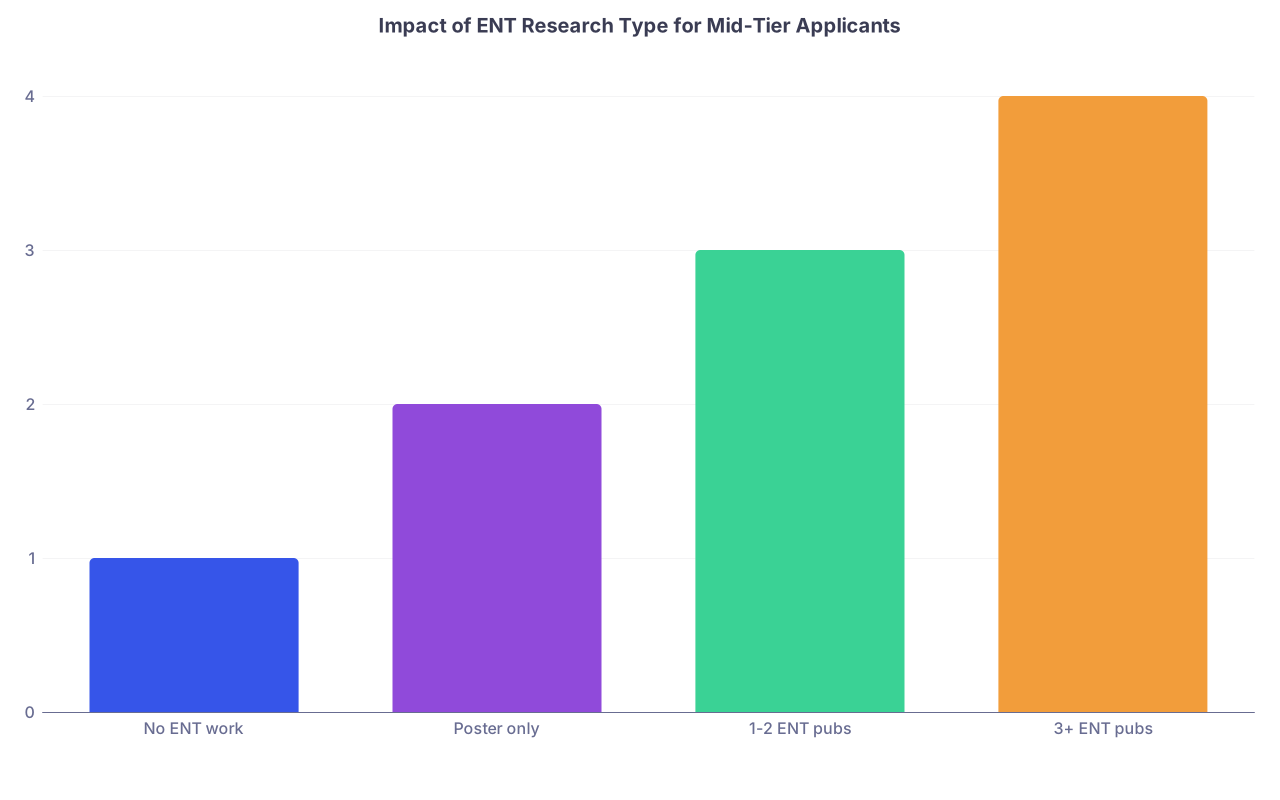
| Category | Value |
|---|---|
| No ENT work | 1 |
| Poster only | 2 |
| 1-2 ENT pubs | 3 |
| 3+ ENT pubs | 4 |
Interpretation: more ENT‑specific work = more “real” in the eyes of ENT programs. You are moving from “tourist” to “member of the tribe.”
Execution protocol:
- Meet with your ENT mentor early. Ask:
- “Which project is most likely to result in a submitted abstract or manuscript before September?”
- “Where can I take ownership: data collection, first draft, figure creation?”
- Push deadlines.
- Set internal deadlines earlier than conference/journal deadlines.
- Weekly 30‑minute check‑ins with your mentor or resident to keep momentum.
Accept that some projects will never see daylight. Drop those early. Protect your time for the ones that can become real entries on your CV this cycle.
Step 5: Build Letters That Actually Move the Needle
Mid‑tier applicants live and die by letters. A generic “hard‑working, pleasant to be around” letter from a random surgeon is worthless for you. You need specific, narrative‑rich letters from ENT faculty.
Target letters:
- 2 letters from ENT (at least one from a program director, chair, or widely known faculty if possible).
- 1 letter from a non‑ENT clinical faculty who can vouch for work ethic, teamwork, and clinical acumen.
- 1 optional fourth letter you can swap in (research mentor, another ENT).
How to earn a strong ENT letter:
On rotation:
- Be useful. Carry the list, help preround, check labs, handwrite postop instructions if allowed.
- Ask for feedback in week 1–2:
“I am really interested in ENT. What is one thing I can do differently this week to function closer to an intern level?” - Present at least once:
- Short 5–10 minute talk on a relevant ENT topic. Do not read slides. Know it.
When asking for the letter:
- Ask directly:
“Do you feel you can write me a strong letter for ENT residency applications?”
If they hesitate, thank them and move on. - Provide:
- Updated CV.
- Short paragraph about why ENT (your narrative).
- Bullet list of cases/encounters where you worked closely with them.
This helps them write something specific like:
“On week two, I watched them stay two hours after sign‑out to help a family understand the airway plan for their child. They functioned at the level of an intern.”
That is gold for a mid‑tier candidate.
Step 6: Away Rotations – Turn Them into Live Auditions
If you do not have a home ENT program, aways are your lifeline. If you do have one, your home rotation is essentially your first away.
Goals of an away rotation:
- Earn a strong letter.
- Get visible advocates in the specialty.
- Show you are someone residents want on their team.
Pick aways realistically:
- Big‑name, ultra‑competitive academic programs rarely rescue a mid‑tier applicant unless you crush the month.
- Balanced strategy:
- One “reach” program if you have a particular regional or personal tie.
- One or two mid‑tier or community‑heavy academic programs known to take outside rotators seriously.
- If possible, a program in your home state/region for geographic alignment.

On the rotation, follow this protocol:
Week 1: Learn the system
- Show up earlier than the earliest resident.
- Learn:
- Where to find postoperative imaging, how dictations work, who to call for consults.
- Do not overstep. Ask before you offer plans.
Week 2: Increase your footprint
- Start pre‑rounding independently.
- Volunteer for consults with the junior resident.
- Ask to scrub every case you reasonably can.
Week 3: Act like a sub‑intern
- Write full notes if allowed.
- Call consults (with supervision).
- Start anticipating next‑day OR needs.
Week 4: Solidify advocates
- Identify 1–2 faculty who know you well.
- Tell them directly:
“I have really enjoyed this month and would be honored to train here. I would appreciate any feedback and would be very grateful for a strong letter if you feel you can write one.”
Residents’ opinions matter more than you think. Be the rotator they actually like:
- Carry your weight.
- Take call without complaining.
- Do not disappear when things slow down. Ask what you can help with.
Step 7: Build a Smart Program List (Not Just a Long One)
Spray‑and‑pray fails in ENT. A bloated list of 90 programs that will never touch your file is a waste of money and energy.
Think like this:
- You want a balanced list of:
- Academic programs.
- Hybrid/community programs.
- Programs that historically take:
- DOs
- IMGs
- Applicants from schools without ENT programs
Gather data:
- Program websites (resident bios: where did they come from, stats you can infer).
- Your school’s match list in ENT (where do people like you end up).
- Ask ENT residents and fellows which programs are:
- “Black box” (hard to predict).
- “Numbers‑heavy” (probably not for you if your Step 2 is weak).
- “More holistic” or DO/IMG‑friendly.
| Program Type | Approx. Count |
|---|---|
| Reach academic | 10–15 |
| Mid-tier academic | 20–25 |
| Hybrid/community | 10–20 |
| Strong geographic ties | 5–10 |
Do not under‑apply. For mid‑tier ENT, I generally tell students:
- 40–60 programs is common.
- Closer to 60+ if:
- No home program.
- Step 2 below national ENT average.
- Weak research.
Step 8: Make ERAS Work Harder For You
You cannot change your scores in ERAS. You can absolutely change how everything else reads.
Experiences Section
Stop listing activities like a catalog. Each entry should answer:
“How did this make me a better future ENT resident or team member?”
Bad:
“Volunteer at free clinic. Saw patients, took histories, presented to attending.”
Better:
“Coordinated ENT and primary care follow‑up for uninsured patients with chronic sinus disease and hearing loss, identifying local resources for low‑cost audiology and imaging.”
You are signaling:
- ENT interest.
- Systems‑based thinking.
- Responsibility.
Personal Statement
Do not make it a literature review of ENT. They know what ENT is.
Your job:
- Open with a concrete story that shows you as a participant, not an observer:
- A trach change in the ICU where you realized the stakes of airway.
- Following one head and neck cancer patient from clinic to OR to postop.
- Tie it to:
- Your strengths: reliability, curiosity, technical interest, communication.
- Your narrative theme (oncology, airway, communication, etc.).
- End with:
- What you are looking for in a program.
- The kind of resident and colleague you intend to be.
One page. Clean. No fluff.
Step 9: Networking Without Being Annoying
You are not going to “network” your way into a spot you have no business getting. But you can absolutely:
- Make sure your application is remembered, not just scanned.
- Turn away rotations, conferences, and research into actual relationships.
Tactics that work:
Conferences (e.g., COSM, AAO-HNS)
- If you have a poster:
- Stand by it.
- Introduce yourself using a 15‑second pitch: “Third‑year from X, interested in ENT with particular interest in Y. Working with Dr. Z on this project.”
- After a good interaction:
- Send a 3‑line follow‑up email within 48 hours.
“Dr. Smith, thank you for stopping by my poster on X. I appreciated your question about Y. I am applying ENT this cycle and enjoyed hearing about your program at W.”
- Send a 3‑line follow‑up email within 48 hours.
- If you have a poster:
Your ENT research mentor
- Ask them explicitly:
- “Would you be comfortable emailing colleagues at a few programs where I am applying to briefly recommend me?”
- Many will do this for students they believe in. Those quiet emails matter.
- Ask them explicitly:
Geographic connections
- If you have ties to an area, mention them in your ERAS geographic preferences and in emails only when you have a genuine connection:
- “Grew up in the region.”
- “Partner is in residency there.”
- “Family support system nearby.”
- If you have ties to an area, mention them in your ERAS geographic preferences and in emails only when you have a genuine connection:
What you do not do:
- Mass email PDs with your CV and a plea for an interview.
- Ask for “feedback” on your application from strangers in late October.
Step 10: Handle Weak Spots Head‑On
You are mid‑tier for a reason. Do not pretend your weaknesses are invisible. Most of the time, the damage comes from how you handle them, not the weakness itself.
Common issues and how to manage them:
Low Step 2 (e.g., <235)
- Do not make excuses in your personal statement.
- If there was a real, short‑term crisis (illness, family event), you can:
- Ask your dean to include a brief explanatory note in the MSPE.
- Counterbalance with:
- Strong clinical comments.
- Stellar ENT letters emphasizing judgment and work ethic.
- Evidence of improvement in later shelf scores or in‑service exams (if you have them).
Little or No ENT Research
- Acknowledge the late pivot if true:
- “I came to ENT later than some, after serious consideration of X. Once I realized the field aligned best with my interests, I pursued Y and Z to build experience.”
- Then show:
- Intensity of your recent ENT involvement.
- Transferable skills from prior research (statistics, database management, QI).
No Home Program
- Use aways to prove you can thrive in an ENT culture.
- Leverage:
- Any local ENT private practice you shadowed.
- Regional ENT groups who know you and can send informal signals on your behalf.
Step 11: Interviewing as a Mid-Tier ENT Candidate
If you get the interview, the playing field narrows. You will be sitting next to 260+ applicants. You can absolutely outperform them in person.
Your goals:
- Be likable, clear, and grounded.
- Communicate your narrative plainly.
- Leave them thinking, “This person will work hard and get along with our residents.”
Preparation protocol:
Know your file cold.
- Every research line: what the project asked, what you did, limitations.
- Every experience: one story that represents it.
Have 3–4 clear talking points you want them to remember:
- “Late but intense commitment to ENT, evidenced by X, Y, Z.”
- “Strong team player with proven reliability on heavy surgery rotations.”
- “Specific interest in [theme] with work on [project].”
Common ENT questions you must own:
- Why ENT, not general surgery/anesthesia/neurosurgery?
- Tell me about a time you made a mistake.
- Tell me about a difficult patient or teammate.
- How do you handle long, stressful days?

| Step | Description |
|---|---|
| Step 1 | Review Application |
| Step 2 | Identify 3 Key Themes |
| Step 3 | Prepare 5 Stories |
| Step 4 | Research Programs |
| Step 5 | Mock Interview |
| Step 6 | Refine Answers |
Your “why ENT” answer must not sound like a brochure. Name actual patients, concrete moments, and specific aspects of the field (airway, endoscopy, oncologic recon, hearing, etc.).
Step 12: Have a Plan B That Is Not Panic
ENT is competitive. Even with a strong strategy, some mid‑tier applicants will not match. You are not a failure if that happens. You are someone who needs a structured second attempt.
Reasonable Plan B options:
- ENT‑adjacent prelim surgery year where:
- You will work with ENT service.
- You will have time and support for more ENT research.
- Research year in ENT at a program that:
- Has a track record of taking their research fellows into residency.
- Different specialty you genuinely also like (radiology, anesthesia, IM, etc.), if your primary goal is to be in that specialty rather than ENT at any cost.
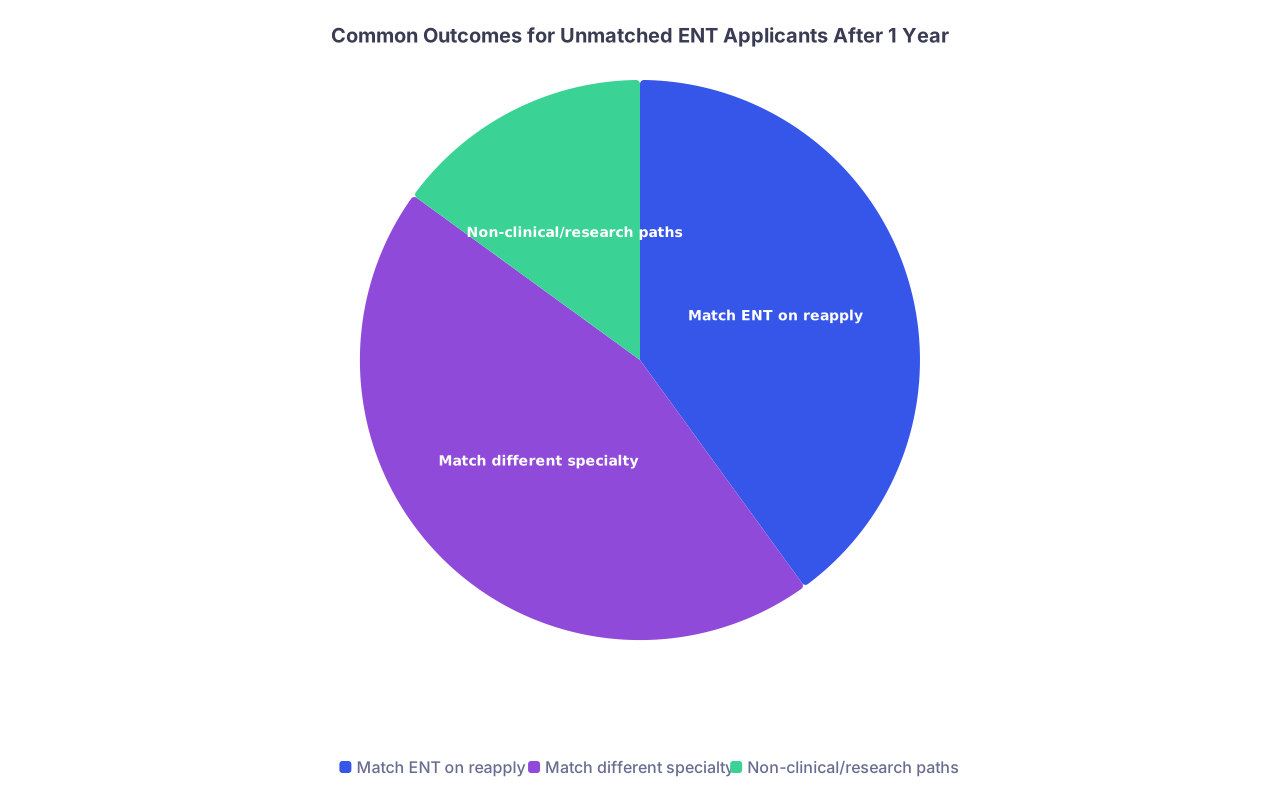
| Category | Value |
|---|---|
| Match ENT on reapply | 40 |
| Match different specialty | 45 |
| Non-clinical/research paths | 15 |
The worst thing you can do is go into denial and apply again with the same application. If you reapply:
- You must show:
- New ENT research.
- Stronger letters.
- Additional clinical experience.
- Your story changes from “mid‑tier” to “persistent, clearly committed, now better prepared.”
The Core Moves That Actually Change Your Odds
Strip away the noise and the tricks and you are left with this:
Sharpen 2–3 pillars of your application to above‑average:
Typically ENT letters, away rotation performance, and ENT‑focused research or narrative.Make your interest in ENT feel real and specific, not generic.
Programs hate tourists. They respect late but serious converts.Play a smart, realistic game.
Pick aways and programs where a mid‑tier applicant with a clear story, strong letters, and visible effort can actually stand out.
You are not trying to become a different person. You are making your best version impossible to ignore.