The way people talk about “Step cutoffs” in ultra-competitive specialties is mostly wrong.
Not a little off. Fundamentally distorted. You hear hard numbers tossed around like commandments—“Derm won’t look at you under 245,” “You need 260+ for ortho,” “Plastics has a 250 cutoff everywhere.” That’s not how programs actually behave, and it’s definitely not what the data shows.
Let’s strip this down to what’s real, what’s myth, and how you should actually think about scores if you’re gunning for derm, ortho, plastics, neurosurgery, ENT, or similarly brutal fields.
The Big Lie: “Every Program Has a Hard Step Cutoff”
There are three separate myths here that get mashed into one bad piece of advice:
- Every program uses a rigid, explicit Step cutoff
- That cutoff is the same for all applicants
- Being below that cutoff = automatic rejection
All three are wrong.
Here’s what actually happens in most ultra-competitive programs:
- They’re flooded with applications, often 600–1000+ for 3–8 spots.
- They’re using filters—but they’re not just “Step score below X = trash.”
- They have ranges, preferences, and exceptions. They bend their own rules constantly for the right candidate.
You almost never see a real, public, program-wide statement like “We will not consider any applicant with Step 2 CK below 245.” What you see instead (in faculty and coordinator meetings, where the real decisions get made) sounds more like:
- “Let’s filter under 230 unless they’re from our school or have strong research.”
- “Flag any <240 for discussion, but don’t auto-nuke.”
- “Screen 220–235 only if they rotate with us or have strong letters.”
That’s not a rigid cutoff. That’s triage.
The cutoff myth survives because it’s simple, easy to repeat, and sounds authoritative. But it doesn’t match what PDs actually do when you put a real human in front of them with great letters, strong research, or direct experience at their hospital.
What the Data Really Shows (Not Reddit Lore)
Let’s look at numbers instead of hallway gossip.
I’ll summarize trends from NRMP’s Charting Outcomes and Program Director surveys, focusing on ultra-competitive fields like dermatology, orthopedic surgery, plastic surgery, neurosurgery, and otolaryngology (ENT).
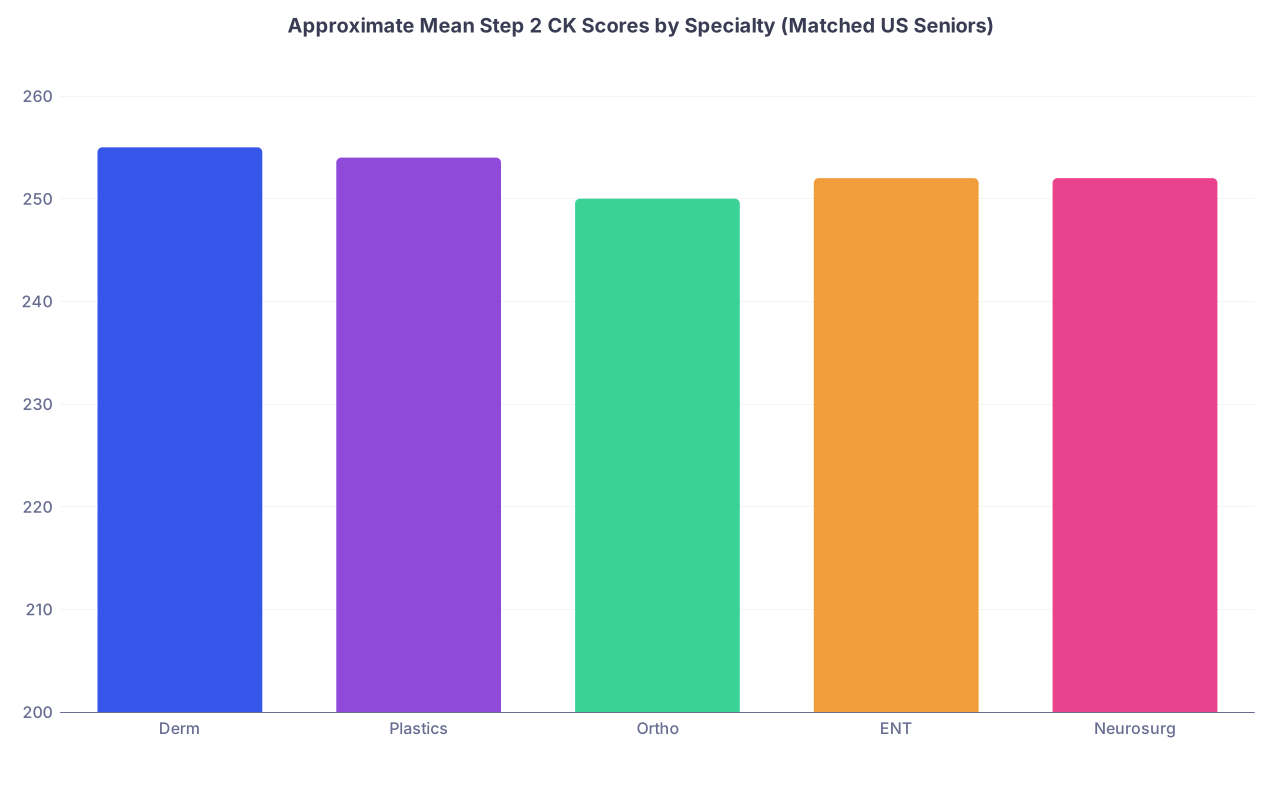
| Category | Value |
|---|---|
| Derm | 255 |
| Plastics | 254 |
| Ortho | 250 |
| ENT | 252 |
| Neurosurg | 252 |
What those numbers don’t mean:
- They do not mean “You must have 252+ to even be considered for ENT.”
- They do not mean “Below 250 = no chance at ortho.”
- They do not mean “Programs have a 250 hard cutoff.”
What they do mean:
- The average matched applicant is high scoring. Obviously.
- The distribution is skewed upward because lower scores are underrepresented among matched candidates.
- Scores are a sorting tool, not the entire decision.
Now match that with Program Director survey data. When PDs are asked what they use to screen, yes, Step 2 CK (now that Step 1 is pass/fail) is near the top. But it’s one piece among:
- Class ranking / AOA
- Clerkship grades (especially related to the specialty)
- Letters of recommendation (especially from known faculty)
- Audition / away rotations
- Research output and fit with the program
If score alone determined everything, you wouldn’t see:
- People with 260+ failing to match derm/ortho/plastics every year
- People with 230s matching those same fields out of strong home programs
And you see that. Regularly.
How Programs Actually Use Score Filters
Let me pull back the curtain on what “cutoff” usually means in practice.
Imagine a competitive ortho program with 700 applications for 5 positions. They can seriously review maybe 150–200, and interview 60–80.
Here’s a common pattern I’ve seen and heard discussed:
Initial Screen by Numbers
They’ll set a soft lower bound on Step 2—maybe 235–240. Not law, but a starting point.- Applicants above this: automatically in the “review this file” pool
- Applicants below this: not automatically dead, but need a reason to get looked at
Exceptions Get Flagged
Below the “preferred range” still gets review if:- You’re from their home school
- You rotated there and impressed people
- You have serious research, especially with someone they know
- A trusted faculty member emails the PD about you by name
Upper-end Scores Help, But Only So Much
A 260+ might push you from “maybe” to “probably interview.”
But a 260 with weak letters and mediocre clinical comments still gets passed over for a 245 with outstanding letters and clear fit.Once You’re Above the Threshold, Scores Stop Helping As Much
Programs will say stuff like, “Above 245 we do not differentiate much.”
Translation: 245 vs 260 matters way less than students think; 245 vs 215 matters a lot.
So, yes, if you’re sitting at 220 trying to break into plastics with no home program, no research, and no away rotations, that “soft” cutoff starts feeling very hard.
That’s not a myth. That’s you being mismatched to the field’s actual competitiveness.
But the idea that a single number—240, 250, whatever—is universal, immovable, and applied identically to everyone? Fiction.
Specialty by Specialty: What “Cutoffs” Look Like in Real Life
Let’s ground this by specialty. Numbers are approximate and for US MD seniors; IMGs and DOs are in a different, harsher universe for many of these.
| Specialty | Typical Step 2 CK Zone for Matched US Seniors | How Programs Really Treat Scores |
|---|---|---|
| Dermatology | High 250s | Below ~240 is tough unless home/research superstar |
| Plastics | Mid–high 250s | <240 usually needs strong connections/home support |
| Ortho | Around 250 | 230s can match with strong letters/home program |
| ENT | Low–mid 250s | 230s possible with big research or strong ties |
| Neurosurg | Low–mid 250s | Lower scores offset by major research or home backing |
Read that carefully.
You’ll notice:
- There’s no universal “cutoff” listed.
- The “tough” or “possible” comments revolve around context: home program strength, research, letters, rotations.
Derm is a great example. PDs will quietly say things like, “We rarely seriously review under 240 unless they’re from our place or have big-name derm publications.” That’s a pattern, not a posted rule. And yes, if you’re sitting at 225 with no derm research, you are fighting gravity.
But then I’ve seen 230s match derm at their home program because they were known, trusted, and clearly dedicated to the field for years.
Step 1 Pass/Fail: The New Distortion
Step 1 going pass/fail didn’t eliminate cutoffs. It just moved the pressure.
Now it looks more like:
- Step 2 CK = main numerical filter
- Preclinical metrics, school ranking, and subjective stuff quietly matter more
- Research and away rotations became even more important in ultra-competitive fields
So if you’re clinging to old “240 Step 1 cutoff” myths, you’re outdated. Programs absolutely shifted to:
- “We really want 250+ Step 2 CK if possible.”
- “Below 235–240, we’ll only look if they’re known to us or very strong elsewhere.”
Is that fair? No. But it’s not the same as, “We will not consider any applicant below X.” They still break their own patterns for certain applicants constantly.
The Hidden Cutoffs No One Talks About
The obsession with Step cutoffs distracts from the real, ruthless filters that are even harder to fix.
Here are the actual cutoffs that quietly shape ultra-competitive matches:
No home program in the specialty
This is a massive disadvantage in derm, plastics, neurosurg. You lose:- Built-in mentors
- Automatic letter writers in the field
- The “we know this person” advantage when scores are borderline
Weak or generic letters
A 260 with bland, template letters loses to a 245 with, “This is one of the best students I’ve worked with in 10 years.”No meaningful research in research-heavy fields
Derm or plastics with zero publications or abstracts? You’re relying almost entirely on scores and charisma. That’s not a good bet.No away rotations or poor performance on them
In ortho, ENT, neurosurg, plastics—audition rotations are basically extended interviews. Blow those, and your score doesn’t save you.
Most applicants will blame “cutoffs” because it’s easier than facing those structural disadvantages.
The Most Dangerous Myth: “A High Score Guarantees Safety”
I’ve seen 260+ Step 2 applicants fail to match derm and ortho. Repeatedly.
When you dig into what actually happened:
- Applied only to “top” programs, too few in number
- Weak or late letters
- Came off poorly on aways (or did none)
- No consistent track record in the specialty—jumped in last minute
- No one advocating for them in PD-to-PD calls
Scores get you in the door to be judged. They do not substitute for:
- People willing to pick up the phone and say, “Take this person”
- A file that shows sustained commitment and alignment with the field
- Being someone residents actually want to work with at 2 a.m.
Programs are not selecting test-takers; they are selecting colleagues.
A 260+ with red flags or zero support is less attractive than a 245 with a powerful network behind them and rock-solid performance on away rotations.
How You Should Actually Think About Your Score
Here’s the part no one wants to say out loud:
Your Step 2 CK is not a magical key. It’s a sorting number. That’s all.
Use this framework instead of obsessing over fake cutoffs:
Below ~230
- For derm/plastics/neurosurg/ENT/ortho, you’re swimming upstream. Hard.
- Not impossible—but you need heavy compensating strengths: home program, big research, jaw-dropping letters, or a Plan B specialty you’d actually be okay with.
~230–245
- This is the “borderland” for ultra-competitive fields.
- Doors open if: you have a strong home program, strong in-specialty support, serious research, and excellent clinical performance.
- You cannot be generic and match here.
~245–255
- You clear most informal filters.
- Now the question becomes: are you actually compelling on paper and in person?
- Mediocre everything-else can still sink you.
>255
- You’ll almost always make the first-pass screen.
- However, you’re rising or falling on letters, interviews, away rotations, and whether the program believes you’re a good fit.
Stop thinking “Score = destiny.” Start thinking “Score = which rooms I’m allowed to enter; everything else determines what happens once I’m in.”
Practical Takeaways If You’re Below the Rumored “Cutoff”
If you’re aiming high and your score is “disappointing,” here’s the blunt truth:
- You do not need to abandon the specialty automatically.
- You do need to adjust strategy, not just hope.
That means:
- Maximizing your home program if you have one—live in that department.
- Stacking away rotations at places that actually interview and rank visiting students (not all do).
- Getting letters from people whose names PDs recognize, not just the nicest attending you worked with.
- Expanding your application list a lot beyond just “dream” places.
- Having a credible parallel plan (e.g., prelim surgery + reapply, or radiology vs derm, etc.) depending on your risk tolerance.
And stop asking, “Is 243 enough for ortho?” Ask a more adult question: “Given my 243 and my specific school, research, letters, and rotations, what range of programs makes sense—and what is my actual risk profile?”
That’s how program directors think about you. Not as a number, but as a package they have to justify choosing over a pile of other strong applicants.
The Bottom Line
You’ve heard a lot of mythology. Here’s the reality in three points:
- Ultra-competitive specialties do not run on rigid, universal Step cutoffs; they run on soft thresholds plus exceptions for known, trusted, or exceptional candidates.
- Once you’re in a reasonable score range, scores rapidly stop being the main decision driver—letters, aways, research, and fit take over.
- Blaming “cutoffs” is often a way to ignore more uncomfortable truths: lack of a home program, weak advocacy, limited research, or poor strategy—those sink more applicants than a 5–10 point deficit ever will.