
27% of residents who matched into the most competitive specialties did not start medical school planning to apply to that field.
So no, the “you must know by M1 or you’re doomed” line you hear in the lounge is not actually backed by data. It’s backed by anxiety and survivor bias.
Let’s talk about switching late into a competitive specialty—derm, ortho, plastics, neurosurgery, ENT, IR, optho, you know the culprits. People will tell you it’s impossible if you “decide too late.”
They’re wrong. But it is structurally harder. And the difference between “hopeless” and “hard” comes down to three boring, unsexy variables: time, receipts, and risk tolerance.
What the Data Actually Shows About “Late” Decisions
First, some grounding.
NRMP and AAMC data aren’t built to track “late switchers” perfectly, but we have clues:
- A decent chunk of applicants in competitive fields did a prior residency, a research year, or had a prior application cycle.
- Transitional and preliminary programs are packed with people pivoting.
- Program directors routinely rank “commitment to specialty” high, but they don’t say “must have dreamed of this since age 6.”
The more useful numbers are these:
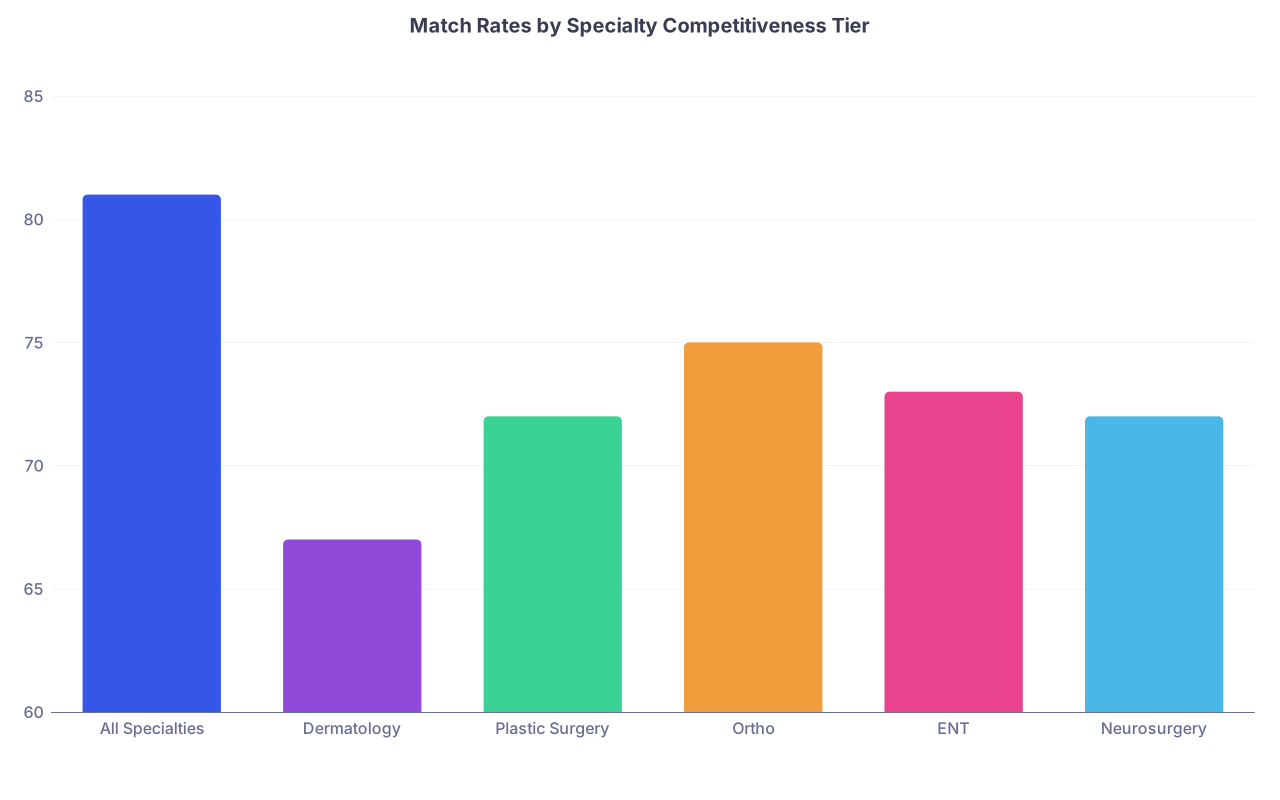
| Category | Value |
|---|---|
| All Specialties | 81 |
| Dermatology | 67 |
| Plastic Surgery | 72 |
| Ortho | 75 |
| ENT | 73 |
| Neurosurgery | 72 |
Those match rates (rounded from recent NRMP data) already include people who:
- Switched specialties late
- Took research years
- Did preliminary years or re-applied
Meaning: late switchers are already in those “success” numbers. The system isn’t only rewarding the linear story.
The real problem is this: late in a competitive specialty means you’re behind on the specific arms race that field cares about—home rotation, letters, targeted research, audition rotations, and signals. That’s the part nobody sugarcoats.
Hopeless? No.
More expensive and logistically ugly? Yes.
The Big Myth: “If You Don’t Decide by Third Year, Forget It”
I’ve heard attendings tell students, straight-faced: “You can’t match derm/ortho if you don’t know by early third year.” That’s just false. What they mean is: “It’s much easier if you know by then.”
Let’s separate the specialties into buckets, because “competitive” isn’t one thing.
| Category | Examples | Late Switch Feasibility* |
|---|---|---|
| Ultra-competitive lifestyle | Derm, plastics, optho | Hard–Very hard |
| Procedural surgical | Ortho, ENT, neurosurg | Hard but common with prelims/research |
| Competitive cognitive/procedural | GI/heme-onc (fellowships), IR | Often via internal routes |
| Moderately competitive | EM (varies), anesthesia, some IM subs | Very feasible |
*Feasible = “can be done with smart planning,” not “walk in casually and it’ll work.”
Where late switching gets ugly is where the culture expects:
- Multiple home/institution-specific letters from “names”
- Early specialty-specific research (case reports aren’t enough)
- Visiting rotations at key programs
- Step scores comfortably above the field’s average
But those expectations don’t say when you had to decide. They say what you must have accumulated by application time.
So the real question isn’t: “Did you decide by M2?”
It’s: “Can you compress 2–3 years of specialty signaling into 12–18 months without setting your life on fire?”
What “Late” Actually Costs You
Let me be specific about what “late” usually means.
1. Less Time for Specialty-Specific Receipts
Programs don’t trust last-minute whims. They trust evidence:
- Letters from people in the specialty who know you
- Research or scholarly work clearly aligned with the field
- Rotations where you’ve already shown you can function at an intern level
- A coherent story about why you belong there, not just “I liked my rotation”
If you wake up at the end of M3 and decide on ENT:
- Peak timelines for away rotations may have passed
- Faculty may have limited bandwidth to throw you into projects
- Your schedule might be filled with electives not useful for ENT
Can you fix that? Yes, but expect:
- Rearranging your schedule, often leaning on admin and student affairs
- A research year or dedicated time off for productivity
- Possibly a transitional or preliminary year as a bridge
You’re not dead. You’re just not doing it in the “clean 4-year” fairytale timeline.
2. Fewer Built-In Advocates
Early deciders collect mentors slowly. Multiple attendings who’ve seen them on rotations. Residents who will vouch for them. Somebody who leans over to the PD and says, “This one’s for real.”
Late deciders often have:
- One enthusiastic attending and a couple of generic letters
- No long-track record in the field
- Faculty who like them but don’t know them deeply
That gap is fixable, but it requires you to do something most late switchers resist at first: be extremely direct.
You can’t just hint you’re interested in plastics. You need to say:
“I decided on plastics after this rotation. I know I’m late. I’m willing to do a research year or a prelim year if needed. Could you be honest about my competitiveness and help me build the best path forward?”
If that conversation scares you, that’s exactly why most people never have it—and why their late switch really does crash.
3. More Reliance on “Bridge” Paths
This is where the data quietly proves the myth wrong.
There are three common bridges for late switchers into competitive specialties:
- Dedicated research year (often between M3–M4 or post-graduation)
- Preliminary surgical or transitional year
- Internal transfer after starting a different residency
That last one is rarer but very real—PGY-1 in general surgery moving to urology, or IM resident shifting to IR once they’ve proven themselves.
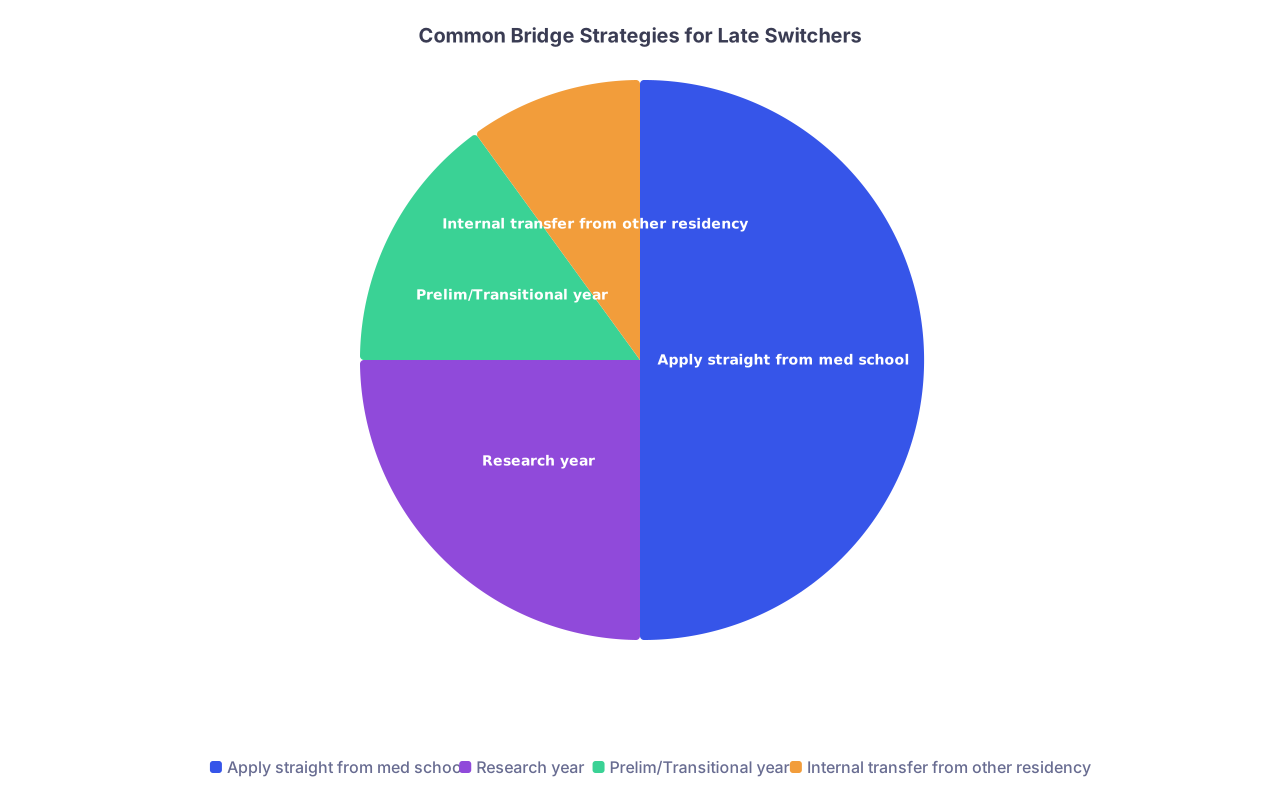
| Category | Value |
|---|---|
| Apply straight from med school | 50 |
| Research year | 25 |
| Prelim/Transitional year | 15 |
| Internal transfer from other residency | 10 |
Are these percentages precise? No—nobody publishes a neat breakdown just for switchers. But this distribution matches what program directors and coordinators will tell you informally.
The point is: half of late-switch success stories are not a smooth M4 → PGY-1 jump. They’re jagged, improvised, and involve swallowing your pride while you do a year that’s more proving ground than dream job.
Specialty by Specialty: Who Actually Allows Late Switchers In?
Let me rank the late-switch difficulty honestly, from “most structurally unforgiving” to “more flexible if you hustle.”
Brutal for Late Switchers
Dermatology – Tiny field, heavy research expectation, deep network emphasis. Late switches need:
- Strong Step 2 (since Step 1 is pass/fail now)
- A real research year in derm, ideally where derm faculty know you cold
- Home or strong away rotation letters
Switching without at least one “extra” year? Very rare.
Ophthalmology – Separate match, early timeline, heavy reliance on letters from ophtho faculty. If you decide late M3 with no ophtho research or letters, you’re almost certainly looking at:
- Research year
- Possibly a prelim year
before a credible shot.
Plastic Surgery (integrated) – Hyper-competitive and brand-conscious. Late switch from gen surg to independent plastics later is more common than “I decided on plastics in March of M3 and matched integrated that fall.”
Hard but Common with Bridges
Orthopedic Surgery – Late switchers absolutely exist. But they usually:
- Do a research year with an ortho department
- Milk away rotations hard
- May use a surgical prelim as a stepping stone
ENT, Neurosurgery – High bar for letters and research. Same pattern: research year + very intentional away rotations. These fields care a lot about “known quantities,” but they also love hungry, late-blooming workhorses who’ve clearly outworked their timeline deficit.
More Open to Late Realization (Relatively)
Anesthesiology, Radiology, EM (depending on year), some surgical subs – Still competitive in good programs, but much more forgiving if you decide in mid/late third year and:
- Grab a couple of high-quality elective rotations in the field
- Get at least 1–2 strong, specific letters
- Show some alignment (research or QI is nice but not always mandatory)
These are the fields where “late but serious” truly can mean “apply once and match.”
Concrete Scenario: What a Viable Late Switch Actually Looks Like
Let me walk through a realistic case. This is basically a composite of several students I’ve watched:
- M1–M2: Aiming for IM, interested in cardiology. Solid but not insane Step 2 (say 247). No specialty-specific research.
- Early M3: Does ortho rotation “just to try it,” loves the OR, feels like they finally fit.
- Late M3: Realizes they want ortho, freaks out, hears “too late” from classmates.
Here’s what the actually workable path looked like:

| Step | Description |
|---|---|
| Step 1 | Decide on Ortho late M3 |
| Step 2 | Meet Ortho PD and mentors |
| Step 3 | Plan dedicated research year |
| Step 4 | Ortho research + clinic exposure |
| Step 5 | 2 away rotations early M4 |
| Step 6 | Strong letters from 3 ortho faculty |
| Step 7 | Apply broadly to Ortho |
| Step 8 | Match Ortho PGY 1 |
Key details most people skip:
- They delayed graduation by a year for ortho research. That felt like failure at the time. It wasn’t. It was the price of entry.
- They accepted that “non-linear” path > “forcing IM then being miserable.”
- They got hyper-intentional: showed up to fracture conference, did call, wrote case reports fast, asked for tangible roles.
Would they have matched ortho without the research year? With no early ortho letters and minimal time for aways? Extremely unlikely.
Was it hopeless when they decided late M3? No. It was just expensive—in time, in ego, and in administrative hassle.
How to Know If Your Late Switch Is Realistic vs Fantasy
You want something actionable, not vibes. Here’s the blunt checklist I use when people ask me if their late switch to a competitive field is “worth trying.”
Ask yourself:
Scores & transcript:
Are your Step 2 and clinical grades at least within shouting distance of that field’s typical ranges? You do not have to be 90th percentile, but you can’t be miles below the average and expect miracles.Institutional support:
Do you have:- A home department in that specialty?
- At least one faculty member willing to say, “Let’s see what we can do”?
If your home institution doesn’t even have that specialty, your path is possible but steeper. You’ll be living on away rotations and external research.
Time flexibility:
Are you willing to:- Take a research year?
- Push graduation back?
- Do a prelim year if needed?
If your answer is “I want derm but I refuse to add even six months,” then yes—for you, it might be hopeless.
Work capacity under uncertainty:
Can you grind for 12–24 months (research, call shifts, aways, networking) without a guaranteed outcome? Some people can; some cannot. This is essentially a personality and circumstances test.
If you tick “yes” on 3–4 of those, late switching into a competitive specialty is hard, but reasonable. If you only tick 1–2, I’d call it low probability unless you drastically change something.
The Hidden Upside of Being a Late Switcher
I’ll give you one encouraging truth nobody advertises: late switchers often bring better stories and clearer motivation.
Program directors are tired of the “I wanted to be a surgeon since age 4, when I dissected a frog” essay. They’re not tired of:
- “I thought I was going into pediatrics until I saw X on this rotation and realized I was wrong.”
- “I was late but then I rearranged my entire schedule, took an extra year, and did Y to prove it.”
Grown adults are allowed to change their mind when new data arrives. That’s actually a healthy trait in a doctor.
Late switchers who do well tend to:
- Have seen another side of medicine and consciously walked away from it
- Handle uncertainty better, because they’ve already lived through it
- Be more grateful and less entitled once they land where they want
Residents who never questioned their path can burn out just as hard as those who chase something late and fail. There’s no risk-free route here.
So: Hopeless or Just Hard?
Three core points and I’m done:
- Late switching into a competitive specialty is rarely hopeless, but almost never clean. It usually costs you a year (research or prelim) and a lot of logistical pain.
- Your odds depend less on when you decided and more on how quickly you can stack specialty-specific receipts—letters, research, rotations, and realistic mentorship.
- If you’re willing to accept a non-linear path, your ceiling is much higher than the doom-talk suggests. If you demand a straight line in exactly 4 years with no detours, then yes—many of the top specialties are effectively closed if you start late.
You’re not choosing between “easy and guaranteed” vs “impossible.” You’re choosing between “comfortable and misaligned” vs “uncomfortable and uncertain, but aligned with what you actually want.”
That’s the real decision. Not the one people dramatize in the student lounge.