
Away rotations in competitive specialties are not “auditions.” They’re live-fire personality and politics tests disguised as electives.
Everyone tells you “just work hard, be nice, read at night.” That’s baseline. That’s table stakes. What actually makes or breaks you on a neurosurgery, ortho, derm, plastics, ENT, or ortho-onc away is a set of unwritten rules that faculty will never put in an official handbook—but they absolutely use to rank you.
Let me walk you through how this really plays out behind closed doors.
What Programs Are Really Doing With Away Rotators
Here’s the first truth: the primary purpose of away rotations in hyper-competitive fields is screening, not teaching.
I’ve sat in the resident workroom and watched this conversation more times than I can count:
“We’ve got three rotators next month. Anyone know them?”
“One’s from [mid-tier school], letters say ‘hard-working’, so…normal. One’s from [big-name school], supposedly a gunner. And one is [home student-style awesomeness], so probably strong.”
“Cool. We’ll see who we actually want to work with at 2 a.m.”
That last sentence is the whole game.
Programs use aways to answer a few very blunt questions:
- Would we trust this person alone with a sick patient at 2 a.m.?
- Will this person make our lives easier or harder?
- Can they function in our culture, not just be “smart” on paper?
- Are we willing to spend 5+ years with this person in tight quarters?
Study habits, board scores, research—they’re baked into your file before you ever show up. On an away, faculty and residents are reading something very different: how you behave in a real ecosystem under stress.
Now, the uncomfortable part: not all specialties use aways the same way.
| Specialty | Typical # of Aways | Weight in Rank List | Main Purpose |
|---|---|---|---|
| Neurosurgery | 2–3 | Very High | Culture fit, work ethic, reliability |
| Orthopedic Surgery | 2–3 | Very High | Workhorse assessment, team fit |
| Dermatology | 1–2 | Moderate–High | Personality fit, research potential |
| Plastic Surgery (Integrated) | 2–3 | Very High | Talent, coachability, social fit |
| ENT (Otolaryngology) | 2 | High | Operative behavior, humility, fit |
Programs will never publicly say, “We need to see you on an away or we won’t rank you highly.” But in many hyper-competitive fields, that’s exactly what’s happening.
The Unspoken Scoring System: How You’re Actually Evaluated
Nobody hands you a rubric. But informal scoring is real and surprisingly consistent.
Here’s how it tends to break down behind the scenes.
1. Residents’ Off-the-Record Votes
Residents have more power than you think. They are the ones program leadership trusts to answer the real questions: Is this person normal? Safe? A headache?
A real Monday-morning debrief I heard after a month with three rotators:
Chief: “Alright, who did we like?”
PGY-3: “Student A is a machine, never complained, never disappeared. Student B is smart but exhausting. Student C…honestly I forgot they were here some days.”
PD (later): “Okay, A is rankable, B maybe if we need research, C is a soft no.”
Residents care about three things:
- Do you make their job easier? Anticipating, not asking every 5 minutes.
- Do you have common sense? Know when to speak and when to shut up.
- Are you going to explode or shut down when things get nasty at 3 a.m.?
If the residents do not like you, you are done. I have seen PDs quietly pull someone off the rank list based on a single strong resident veto.
2. The “Pain-in-the-Ass” Index
There’s a mental scale everyone is running on you, whether they admit it or not:
- +2: Extra-mile, pleasant, quietly competent, low-maintenance
- +1: Solid, teachable, normal human being
- 0: Invisible but harmless
- -1: Mildly annoying, needy, overly intense
- -2: Toxic, arrogant, dangerous, or socially off
Your Step scores don’t matter if you end at -2. In competitive specialties, most applicants look good on paper. Programs use aways to weed out -1 and -2.
3. Your “Story” in the Conference Room
End of the month, your name comes up. What actually gets said?
It’s not: “Their manuscript in JAMA Dermatology was impressive.” It’s:
“Remember, this is the one who stayed until 10 p.m. every day and never complained,”
or
“This is the one who argued with the scrub tech,”
or
“This is the one who disappeared after cases and never checked on post-ops.”
Faculty remember narratives, not bullet points on your CV. On an away, you’re building a story about yourself, whether you know it or not.
Day-to-Day Reality: What Away Rotations Actually Look Like
Let’s get concrete. Here’s what typically happens in a month-long away in a surgical or procedure-heavy competitive specialty.
The First 3 Days: You’re Being Classified
Everyone’s sorting you into a bucket by Day 3:
- “Gun and normal”
- “Gun and psychotic”
- “Quiet but solid”
- “Lost”
- “Totally forgettable”
You think you’re “settling in.” They think they’re already seeing your default operating system once the initial nervousness wears off.
You will not get credit for “warming up” in week 3. First impressions are sticky.
Week 1–2: Reliability and Endurance Test
This is the part nobody says out loud.
Faculty will “accidentally” leave you out of something and see what you do. Residents will give you a mildly thankless task and see if you still show up cheerful the next morning.
Examples I’ve seen:
- A rotator told to “check labs and update us” at 5 a.m.—intern intentionally doesn’t follow up. Did the student text at 5:30 with a concise summary, or disappear and blame Epic later?
- A late add-on case at 5:45 p.m. Everyone tired. Does the student say, “I can stay for this one if you want,” or mysteriously “have dinner plans”?
- Radiology rounds at 6:15 a.m. in a dark basement room. Student clearly exhausted. Do they still lean in, or do they yawn in the attending’s face?
No one will tell you that these were tests. They absolutely were.
Week 3–4: Would We Actually Rank You?
By mid-rotation, the conversation shifts.
Residents start asking: “So, are we trying to get them here?”
Attendings start asking the residents: “If this person matched here, would you be happy?”
This is when your earlier behavior—especially how you handled fatigue and boredom—comes back.
Your performance here influences:
- Whether you get a strong, detailed, politics-savvy letter
- How aggressively the PD will push you on the rank list
- Whether residents will quietly push for or against you when the file is reviewed
The Games Students Play (and How They Backfire)
Let me talk about the stuff students think is brilliant but programs see through immediately.
Over-Gunning and Brown-Nosing
Every program has had that one rotator who:
- Flowers attendings with constant questions in front of others
- Laughs way too hard at every attending joke
- Talks non-stop about their research, “back at my institution…”
Faculty might tolerate it. Residents hate it. And they talk.
I watched one extremely smart rotator at a top-10 ortho program destroy his chances by constantly trying to “shine” in front of the chair. On the evaluation: “Very bright but not a team player. Self-promotional. Would not want to work with.” He was off the rank list within 5 minutes.
Playing the “I’m Too Good for Scut” Card
Refusing to:
- Transport a patient
- Grab supplies
- Help with dressing changes
- Take a manual BP when the machine fails
…because you think you’re “there to learn during surgery,” brands you instantly.
Here’s the quiet rule: in competitive fields, the workhorse gets the spot, not the self-appointed “future academic star” who won’t get their hands dirty.
Trying to Be Everyone’s Best Friend
There’s a particular type of away student who tries to become socially embedded with every resident by day 2. Group chats. Social media. Drinks every night.
It reads as insecurity and lack of boundaries. You need to be likable. You do not need to be ubiquitous.
The residents are exhausted. They want help, not a mascot.
What Actually Works: Behavior That Moves You Up the Rank List
Now the part you actually care about. The behaviors I’ve watched turn “just another rotator” into “we should really try to get this person.”
1. Reliable, Low-Drama Show-Up Power
You don’t need to be brilliant. You need to be there.
The students programs fight over:
- Show up consistently early without making a show of it
- Accept feedback once, adjust, and don’t argue
- Don’t apologize 20 times a day—fix the issue and move on
- Don’t create new work by forgetting simple tasks
The strong student is the one the intern doesn’t have to chase.
2. Calm Under Mild Humiliation
You will get pimped. You will get things wrong. A scrub nurse will snap at you. A fellow might be unnecessarily sharp at midnight.
Faculty and residents are watching your micro-reactions:
- Do you shut down?
- Do you get defensive?
- Do you blame someone else?
- Do you come back the next day having read, with zero visible resentment?
If you absorb a bad moment, recover, and quietly come back sharper, that’s gold.
3. Knowing When to Get Out of the Way
In the OR: read the room.
There are times to ask questions. There are times to shut up and suction.
If the attending is sweating, the blood pressure is dropping, the resident is tense, and anesthesia is talking fast—this is not “learning time.” You don’t need to narrate the anatomy. Your job is to calmly assist and not make it worse.
Outside the OR: when a resident is crushed trying to finish notes at 10 p.m., they probably don’t want to hear your life story. Offer help. If it’s refused, say “Alright, I’ll be in early tomorrow—anything you want me to read?” and leave.
4. Quiet Competence on Simple Tasks
Nobody expects you to place pedicle screws. They do expect you to:
- Know basic post-op orders for common cases by week 2
- Present concisely without wandering narratives
- Write a legible note that doesn’t need a rewrite from scratch
- Recognize sick vs stable without panicking
The bar isn’t perfection. The bar is “I don’t have to redo everything this person touches.”
Letters, Signals, and How Aways Feed the Match Machine
Let’s connect this to the real prize: your match outcome.
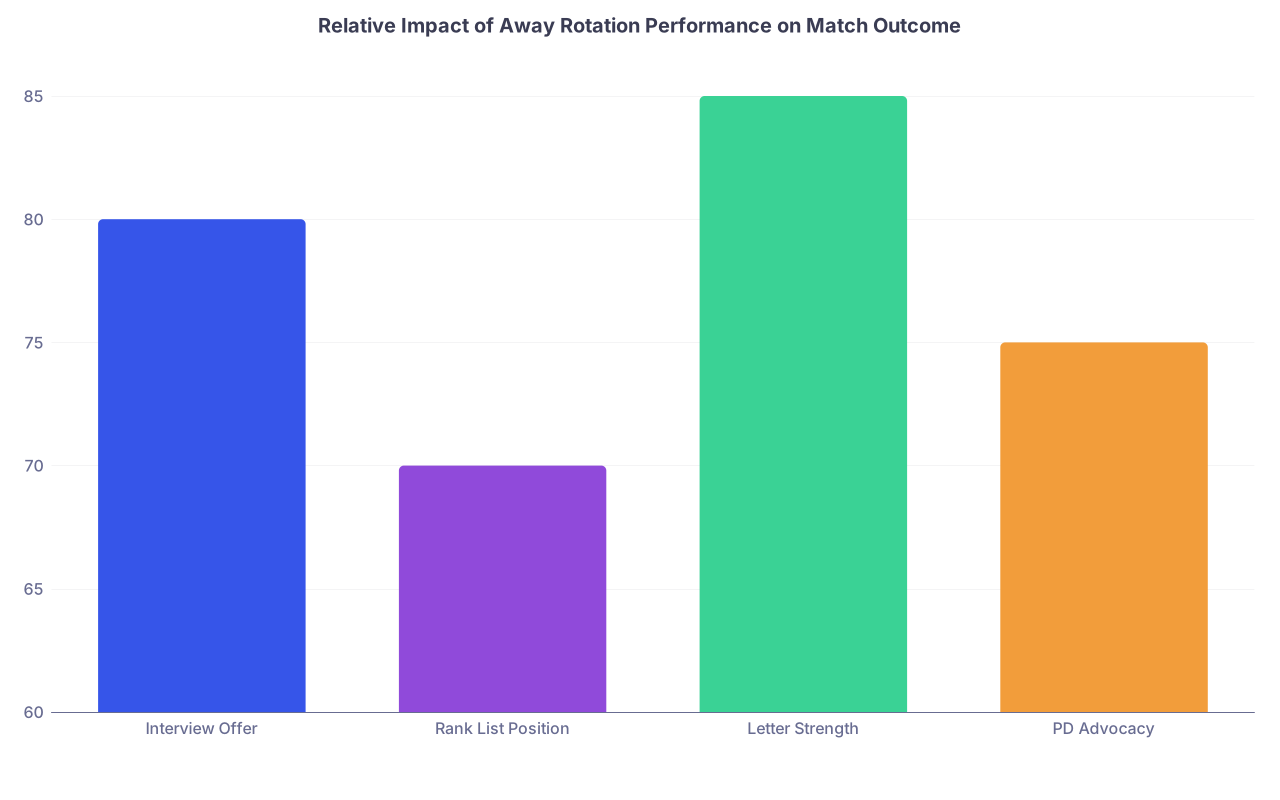
| Category | Value |
|---|---|
| Interview Offer | 80 |
| Rank List Position | 70 |
| Letter Strength | 85 |
| PD Advocacy | 75 |
Those numbers aren’t exact, but they reflect what PDs will tell you privately: in hyper-competitive specialties, aways disproportionately shape your path.
1. The Letter of Recommendation
Here’s what differentiates a real strong letter from a lukewarm one:
- Specificity: “He pre-rounded on our entire spine service for 2 weeks and we trusted his notes” vs “She was a pleasure to work with.”
- Advocacy: “I would be very pleased to have her in our program” vs “She will be an excellent resident somewhere.”
- Signal-reading: PDs know the code phrases. “Top 10%” vs “above average” matters a lot.
Your behavior on the away directly feeds these sentences. There’s no way to fake it. Attendings will subconsciously remember if they saw you on rounds, in the OR, and helping residents—or disappearing after cases.
2. Direct PD-to-PD Communication
In neurosurgery, plastics, ortho, ENT, derm—this happens all the time:
PD A: “Hey, you had this applicant on a sub-I, what’d you think?”
PD B: “Good worker, socially normal, we liked them.”
or
PD B: “Smart, but some red flags. We didn’t rank them high.”
That’s your career being decided in a 30-second phone call based on one month of behavior.
You will never hear about these calls. They still happen.
3. Internal vs External Candidates
Programs almost always give a tilt to:
- Their own home students
- Strong away rotators they know
- Random strong paper applicants they only know on screen
If you crush an away, you can jump tiers. If you bomb an away, you can fall below even weaker-on-paper applicants who didn’t have a chance to show their flaws.
This is why some PDs actually prefer you do not rotate with them if your baseline interpersonal skills are questionable—they’d rather not have evidence they can’t ignore.
Specialty-Specific Nuances You Won’t Hear on Reddit
Not all aways are created equal. A few patterns from the back rooms:
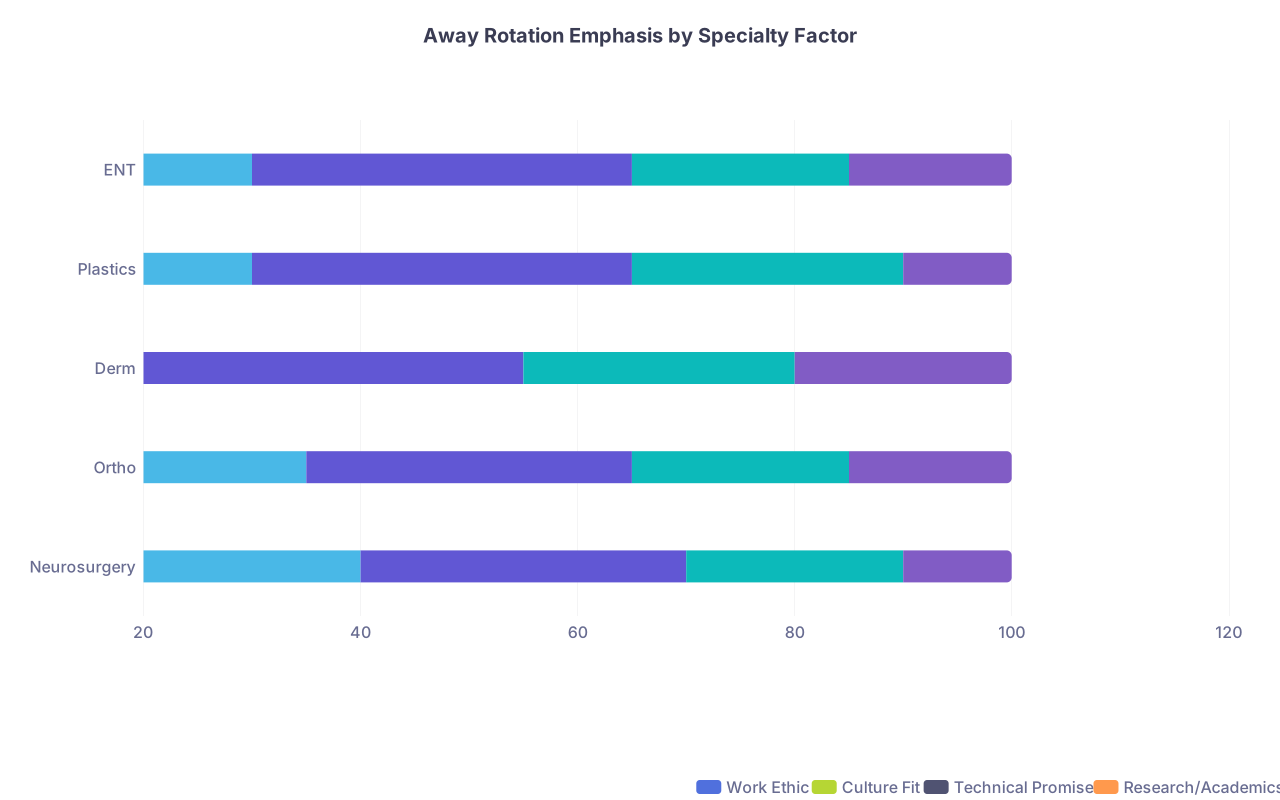
| Category | Work Ethic | Culture Fit | Technical Promise | Research/Academics |
|---|---|---|---|---|
| Neurosurgery | 40 | 30 | 20 | 10 |
| Ortho | 35 | 30 | 20 | 15 |
| Derm | 20 | 35 | 25 | 20 |
| Plastics | 30 | 35 | 25 | 10 |
| ENT | 30 | 35 | 20 | 15 |
Neurosurgery
They’re looking for psychological durability above all else. Long cases, long hours, high stakes.
You’re being evaluated on:
- Your ability to stay engaged during 8–12 hour cases without complaining
- Whether you can handle constant reading and difficult pimping without breaking
- Your mental stamina on q3–q4 call with real neurosurgical emergencies
I’ve watched neurosurgery PDs essentially say, “We can teach them everything else, I just need to know they won’t collapse in 6 months.”
Orthopedic Surgery
The stereotype exists for a reason: they want workhorses who are also socially competent.
Key away signals:
- Do you hustle in the OR without being chaotic?
- Can you banter and take sarcasm without getting wounded?
- Are you physically able to handle standing all day and hustling all night?
If an ortho resident calls you “soft” or “fragile,” your chances nosedive.
Dermatology
Less OR hustle, more social calibration.
On derm aways, what matters:
- Are you weirdly intense for no reason? That’s a red flag.
- Do you play nicely with clinic staff and MA’s, or are you arrogant?
- Can you show intellectual interest without being a pathology robot?
Derm is brutally competitive, but the vibe is more: we have our pick of smart, research-heavy applicants—who would we actually want around in clinic?
Plastic Surgery (Integrated)
Probably the most brutal combination: they want talent, drive, and social grace.
On a plastics away:
- You must be coachable: able to take minute technical feedback without ego
- You cannot be theatrically obsessed with cosmetics while being useless on trauma
- You need to show you understand this is a lifestyle commitment, not an Instagram fantasy
One plastics PD I know calls away rotations “5-year compatibility tests.”
ENT
They watch very closely how you behave in the OR and clinic:
- Are you meticulous with details—airway, anatomy, postop care?
- Do you show up early for cases and know the steps by week 2?
- Are you humble enough to accept that you don’t know neck anatomy yet, but you’re trying?
They’re balancing surgical rigor with personality because ENT is a small world.
Strategic Mistakes: Number and Timing of Aways
Let’s talk strategy, since this is where a lot of students sabotage themselves.
Doing Too Many Aways
Three is usually the upper limit for competitive surgical fields. Four or more and:
- You burn out and start making small social mistakes
- Your performance degrades just when you need to peak
- Letters start sounding repetitive (“hard working” x4 instead of one glowing, detailed letter)
Programs don’t reward you for a masochistic away schedule. They reward quality and consistency.
Poor Timing
Worst move: doing your dream program away as your first rotation ever in that specialty.
You show up:
- Clumsy in the OR
- Clueless on basic workflows
- Slow on notes and pre-rounding
Then spend the rest of the season better, but the program you care about most only saw Version 1.0.
Ideal: one “warm-up” sub-I or home rotation first. Then shoot for your dream away.
Visual Reality Check: What Your Month Actually Feels Like

| Stage | Activity | Score |
|---|---|---|
| Week 1 | Orientation and panic | 3 |
| Week 1 | Trying to impress everyone | 4 |
| Week 2 | Fatigue setting in | 2 |
| Week 2 | Finding a rhythm | 3 |
| Week 3 | Quiet competence | 4 |
| Week 3 | Subtle evaluations happening | 5 |
| Week 4 | Burnout risk | 2 |
| Week 4 | Final impressions formed | 5 |
You feel like you’re just trying to survive. They feel like they’re studying a long-term investment.
FAQ (Exactly 4 Questions)
1. Do I have to do an away rotation to match a hyper-competitive specialty?
In some fields, practically yes. Neurosurgery, ortho, plastics, ENT—aways are quasi-mandatory for a serious shot at strong programs unless you’re a home superstar at a powerhouse department. Derm is a bit more variable, but even there, a well-chosen away can separate you from the large pile of “research-heavy but unknown” applicants. Programs want to see you in action somewhere. If not with them, then with people they trust who can vouch for you.
2. How do I recover if I sense an away is going badly?
You don’t fix this with one “big gesture.” You fix it with 5–7 straight days of being boringly solid. Stop trying to be brilliant; aim for quietly reliable. Ask one trusted resident for blunt feedback: “Is there anything I’m doing that’s hurting me?” Then actually adjust. The worst thing you can do is overcompensate with desperate, inauthentic behavior—loud questions, forced enthusiasm, obviously staged staying-late theatrics. Consistent, low-drama improvement is the only salvage strategy.
3. Should I tell a program on my away that they’re my ‘#1 choice’?
Only if you mean it, and only late in the rotation, to the right person. Telling everyone “you’re my top choice” gets around; programs talk. That will absolutely hurt you. If a PD or chair explicitly asks, be honest but strategic: “You’re very high on my list, and this experience has confirmed that.” If this truly is your #1 and you’re sure, a direct, respectful statement to the PD in the last week can help—but only if your performance already backs it up.
4. What’s the single biggest silent killer of away rotation success?
Subtle negativity. Not open meltdowns—those are rare. It’s the eye rolls when you think no one is looking, the sigh when a late add-on case appears, the offhand complaint about hours to a “friendly” resident. That gets reported upward. I’ve watched multiple otherwise strong rotators get quietly tanked on the rank list because “they complained a lot” or “seemed unhappy here.” In hyper-competitive fields, programs are terrified of recruiting someone who will be a morale problem. They will take a slightly less impressive CV with better vibes every time.
Key points, no fluff: Away rotations in competitive specialties are screening tools for personality and reliability, not just extra OR time. Residents’ opinions and your “pain-in-the-ass index” quietly decide your fate more than your Step score. And the students who win are not the loudest gunners—they’re the ones who make everyone else’s job easier for 4 straight weeks.