The myth that program directors carefully read every line of your CV is false. In competitive specialties, your CV gets 10–15 seconds to prove you belong in the “interview” pile. That’s it.
I’ve watched PDs do this in real time. They don’t “review” your CV. They scan it like a radiologist scans a trauma CT: first for anything obviously disqualifying, then for anything obviously outstanding. Everything else is blur.
Let me walk you through what competitive specialty PDs actually see in those 15 seconds—and what makes them quietly say, “Yes, interview,” before they ever meet you.
How PDs Actually Look at Your CV (Not How They Pretend To)
Here’s the part people outside the room never see.
In ortho, derm, plastics, ENT, urology, neurosurg, rad onc, IR, competitive EM—whatever flavor of pain you’ve chosen—the PD isn’t sitting alone lovingly reviewing your ERAS PDF. They’re usually going through stacks (digital or printed) with an associate PD or senior resident, rapid-fire.
The workflow is almost always some version of this:
- Filter by Step 2 / class rank / sometimes home school or region.
- Open your CV / ERAS experiences.
- 10–15 second scan for “signal.”
- Hard yes, hard no, or “maybe if we need filler.”
They’re not starting with your volunteer work. They’re scanning for pattern recognition: Is this a classic strong candidate, a liability, or a waste of a precious interview slot?
Here’s the brutal truth: in those first seconds, they aren’t deciding whether you’ll be a good doctor. They’re deciding whether inviting you is safe.
The 15‑Second Scan: What Their Eyes Go To First
There’s a very predictable eye path when a competitive PD opens your application. I’ve seen versions of this in multiple programs.

| Step | Description |
|---|---|
| Step 1 | Open Application |
| Step 2 | School and Exams |
| Step 3 | Research and Pubs |
| Step 4 | Home/Signal Rotations |
| Step 5 | Red Flags or Gaps |
| Step 6 | Interview Pile |
| Step 7 | Decline or Low Priority |
| Step 8 | Interview? |
Let’s break down where the eyes actually land.
1. School + Objective Metrics (2–3 seconds)
They glance at:
- Medical school name and region
- Step 2 score (and whether Step 1 was pass on first attempt)
- Any obvious class rank / AOA / Gold Humanism flags
Does this sound shallow? It is. But remember, they have 800 applications for 6 spots. When you’re drowning in volume, shortcuts win.
Here’s how they really think:
- Top‑tier US med school + strong Step 2: “Safe on paper. Keep looking for signal.”
- Mid‑tier but well-known clinical school + strong letters/school rep: “Could be solid. Needs a hook.”
- Caribbean / lower tier + mid scores: “Needs something exceptional to offset risk.”
They won’t say this at your applicant dinner. They say it in the PD meeting.
2. Research Signal (3–5 seconds)
In competitive specialties, your research section is the second place their eyes jump.
They look for:
- Number of publications / abstracts / posters
- Whether any are in the specialty or at least adjacent
- Whether your name is first or second author anywhere
- Whether any journals or conferences ring a bell
They’re not reading your paper titles in full. They’re scanning for recognizable patterns: “multiple derm papers,” “plenty of ortho abstracts,” “single case report in specialty and the rest unrelated.”
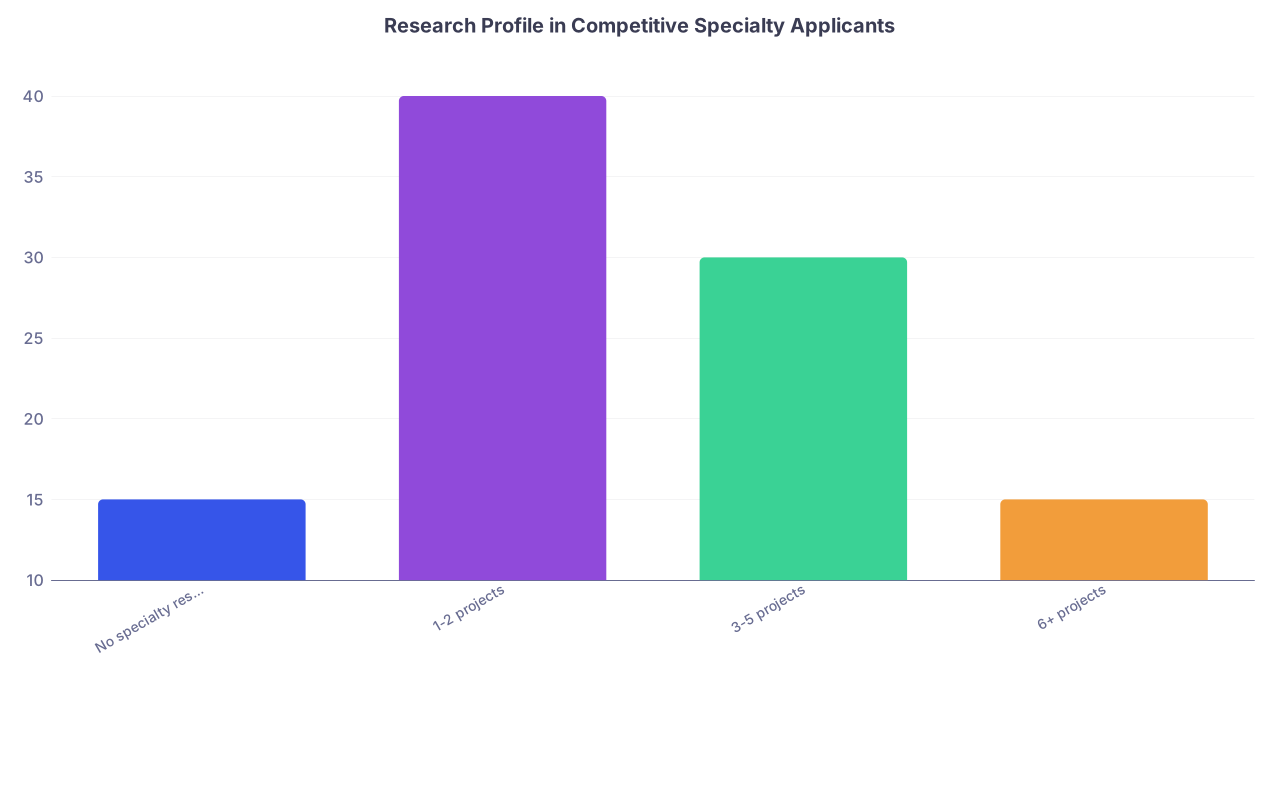
| Category | Value |
|---|---|
| No specialty research | 15 |
| 1-2 projects | 40 |
| 3-5 projects | 30 |
| 6+ projects | 15 |
I’ve watched a derm PD stop on one line: “First-author JAMA Derm, 2023.” He didn’t even care what it was about yet. The signal alone changed the tone: “Okay, who is this?”
By contrast, a row of “poster, local student research day, internal med topic” doesn’t move the needle in ortho or neurosurg. They’re thinking: “Nice, but not specialty-committed. Next.”
3. Home Program & Away Rotations (3–4 seconds)
This part matters far more than students realize.
They look for:
- Do you have a home program in their specialty?
- Did you rotate with them or with big‑name programs in their field?
- Is there clear specialty exposure over time, not just one random elective?
For competitive fields, away rotations = currency. It’s how PDs gauge whether you’ve been “vetted” by another serious shop.
I’ve literally heard:
“Rotated at UCSF and Mayo? Okay, someone else has stress-tested this person clinically.”
versus
“No home program, no aways, no sub‑I in the specialty? Risk. Where did they learn what this specialty actually is?”
4. Leadership, Teaching, And “Trajectory” (2–3 seconds)
This is quick but decisive. They glance at:
- Any long-term leadership roles (over 1+ years, not 2 months)
- Teaching or mentorship roles
- Pattern of responsibility: chief this, founder that, committee roles
They’re asking: “Does this person step up, or do they just collect lines on a CV?” One OR nurse once told an attending reviewing apps: “Give me the one who was actually responsible for something, not the one with 19 one‑off clubs.”
Traction beats clutter almost every time.
5. Red Flags, Gaps, And Weirdness (2–3 seconds)
Finally, their eyes graze for:
- Leaves of absence
- Extended time in med school
- Failed exams
- Massive career pivots with no explanation
- Obvious mismatch between CV and personal statement story
If something looks strange and there’s no narrative to reconcile it, you drop a tier instantly.
What Competitive PDs Actually Respect On Your CV
There’s a quiet hierarchy of what matters. Not what the brochure says. What actually shifts you into “we should invite this person.”
| Signal Type | Weight in Competitive Fields |
|---|---|
| Specialty-focused research | Very High |
| Away rotations at strong programs | Very High |
| Strong Step 2 + clean record | High |
| Longitudinal leadership | Moderate to High |
| Generic volunteering | Low |
Let me translate that into real behavior.
Specialty-Focused Research
If you’re applying derm and your CV shows:
- 1 first‑author derm paper
- 2 derm posters (even at smaller conferences)
- 1 ongoing derm QI project
You look like someone who has been in the room, knows the language, and won’t be shell‑shocked on day one. PDs know research isn’t everything—but it’s a very visible signal of immersion.
On the other hand, 7 publications in nephrology when you’re applying ortho? It reads as “late pivot” unless your story is airtight.
Away Rotations at Programs That Matter
Competitive PDs definitely notice where you rotated. Not all aways are equal.
Strong signals:
- You rotated at their own program
- You rotated at known heavy‑hitting programs in the specialty
- Your rotation list shows increasing responsibility in that field over MS3 and MS4
They assume: if you’ve survived a sub‑I at a strong place and the world didn’t burn down, you can handle at least their workload.
Weak signals:
- Single elective late MS4 in the specialty, no sub‑I
- Random away at a tiny community site no one knows
- CV suggests decision to apply came very late and was opportunistic
Leadership With Actual Teeth
The CV line “President, Surgery Interest Group” is basically wallpaper now. Everyone has some version.
What stands out:
- You built something that didn’t exist and it persisted after you
- You managed a real team or multi‑site project
- You ran something for more than a year and achieved a nontrivial outcome (new curriculum, published work, funded initiative)
PDs talk about “trajectory” a lot. They’re not looking for finished products; they’re looking for someone whose graph clearly points up.
The Mistakes That Kill You In Under 15 Seconds
Now for the part most advisors sugarcoat. There are patterns that make PDs close the file mentally almost immediately.
1. The “Everything and Nothing” CV
This is the classic one:
- 18 short-term volunteer experiences
- 9 clubs, all held for 3–6 months
- 1 or 2 random research projects totally unrelated to your chosen specialty
- No clear spine tying it all together
PDs see this as noise. It reads like someone who chased checkboxes for four years. In a pile of 800, you disappear.
You want your CV to tell a coherent story, not show off how many “activities” you can list.
2. Sloppy Formatting and Obviously Inflated Titles
Yes, they notice.
- Inconsistent dates or overlapping roles that don’t make sense
- Titles like “Chief Executive Director and Project Founder” for something that’s clearly a 3‑student effort
- Overblown descriptions for menial tasks (“Oversaw strategic operational planning for interdepartmental communication” = you sent group emails)
PTSD is real from years of reading embellished CVs. Attending reviewers develop very good BS detectors. Once they suspect you’re overselling, the rest of your application is colored by mistrust.
3. No Specialty Commitment Until the Last Second
Apply to neurosurg, show:
- 0 neurosurg rotations
- 0 neurosurg research
- 0 neurosurg interest-group involvement
- One “Neurosurgery elective, MS4, 4 weeks”
What PDs say in the room: “Backup applicant. They’ll leave if they get what they really want.”
Competitive fields assume you’ve been walking toward them for a while. A last-minute pivot can be salvaged, but only with a crisp, honest story and some rapid, high-yield work (research, letters, rotators who will vouch for you).
4. Hidden or Minimally Explained Gaps
This is worse than having a gap at all.
- Extra year? “Scholarly year” with nothing concrete to show.
- LOA? Zero context.
- Repeated course or exam? Buried and unaddressed.
PDs fill in silence with the worst version. They have seen the whole spectrum—burnout, professionalism issues, legal problems, mental health spirals. If you do not control that narrative, it controls you.
How To Shape Your CV So It Survives the 15‑Second Scan
You cannot rewrite your past, but you can architect how it’s presented. And that’s where most students fail—they dump data instead of curating signal.
Build a Clear Thematic Spine
The strongest CVs have a through-line. Examples:
- “Musculoskeletal injury and performance” for ortho/PM&R
- “Imaging and procedural decision-making” for radiology/IR
- “Chronic disease and aesthetics/quality of life” for derm
- “Complex oncologic care” for rad onc or surg onc
Then experiences cluster around that:
- Research
- Longitudinal volunteering
- Leadership
- Electives and aways
When a PD does their 15‑second scan, they should be able to answer: “What is this person about?” If they can’t, you’re generic.
Front-Load Your Strongest Signals
On ERAS, you don’t have full control over layout, but you can control which experiences are “most meaningful,” how they’re described, and how titles are ordered.
Practical moves:
- Pick 2–3 experiences that scream specialty-fit and list them as most meaningful.
- Use your limited characters to highlight outcomes, not just tasks.
- Put specialty‑aligned research and leadership higher in the lists where description order is flexible.
PDs skim from the top down. Don’t bury your best card on page three.
Write Descriptions Like Someone Who Has Done Real Work
Stop writing fluffy, CV‑speak nonsense. PDs ignore it.
Bad:
“Collaborated with multidisciplinary team to support patient-centered care initiatives.”
Better:
“Built a 6‑resident QI project that cut ED boarding times for ortho admits by 20% over 6 months.”
Best:
“Led 5‑resident QI team; designed new fracture admission pathway that reduced average ED stay from 11.2 to 8.9 hours across 74 patients.”
Numbers. Scale. Time. Outcomes. That’s how serious people describe real work.
What Happens In The Room When They Like Your CV
I want you to hear what actually gets said when your CV hits right. These are real phrases I’ve heard sitting in PD offices.
- “Okay, this one’s been living in the lab. Strong ortho research, we can work with that.”
- “Home program loved them, did aways at two big names, and both wrote strong letters. Safe.”
- “Nontraditional, but look at this leadership trajectory. This is the one running the service in three years.”
- “Step isn’t killer, but I trust this school. And they’ve clearly been all‑in on ENT since M2.”
Notice what’s not said: “Wow, they volunteered three times at a food bank.”
It isn’t cynicism. It’s triage. They’re trying to predict who will:
- Show up prepared on day 1
- Handle workload and stress
- Represent the program in research and on the interview trail
- Not implode or quit
Your CV is a compressed probability estimate. In 15 seconds, they’re trying to decide if inviting you improves or worsens their odds.
If You’re Late To The Game Or “Behind”
There’s a group nobody talks to honestly: the M3/M4 who wakes up late and goes, “I think I want derm/ortho/ENT…” with a very generic CV.
You’re not dead. But you don’t have time for fluff.
Here’s how PDs evaluate “late pivot” candidates who still get interviews:
- They moved aggressively once they decided.
- They locked in at least one real sub‑I / away in the field.
- They picked one or two high‑yield, tightly focused projects and followed through.
- They didn’t pretend they always wanted this—they told a logical, humble story.
I’ve seen late pivots match very well because their last 6–9 months were extremely intentional and their CV, while not packed, had dense signal.
If you’ve only got a short runway, you architect for depth, not breadth.
FAQs
1. If my school doesn’t have a home program in my specialty, am I automatically at a disadvantage?
You’re behind, but not doomed. PDs absolutely do prefer applicants who’ve been “raised” in a home program—that built-in evaluation pipeline is comfortable for them. Without that, you must replace it with:
- Two or more strong away rotations where attendings actually know you
- A mentor in the specialty who will go to bat for you
- Clear evidence you understand the specialty’s day-to-day realities
When they see “no home program,” their next question is, “Who has actually seen this person in our environment?” Your CV needs to answer that quickly.
2. How many publications do I really need for competitive specialties?
There’s no magic number, but I’ve watched how PDs react:
- Zero specialty research: big handicap, unless you’re otherwise exceptional and well‑known clinically.
- One or two specialty‑adjacent projects: acceptable if the rest of the application is strong.
- Three to five meaningful projects (some submitted, some presented, maybe one published): that’s where PDs start saying, “Okay, they’re serious.”
Ten weak case reports in junk journals don’t impress anyone. Three solid projects with real mentor backing can.
3. Do PDs care about non-medical achievements (music, athletics, business)?
Yes, but only if they’re real and not just ornament. A CV line that says “National-level violinist” or “Former Division I athlete” or “Founded profitable startup acquired by local company” absolutely catches eyes—because it speaks to discipline, performance under pressure, and a life outside the bubble.
The mistake is when students bloat minor hobbies into “achievements.” Serious non-medical accomplishments help; half-baked side projects dressed up as “entrepreneurship” don’t. If it would make an attending raise an eyebrow and ask you about it excitedly, include it. If not, keep it lean.
Key takeaways:
Competitive PDs give your CV 10–15 seconds, scanning for specialty-specific signal, not generic busyness. Coherence, depth, and real responsibility beat long lists of shallow activities. If you want that “yes” pile, build and present a CV that tells a clear, specialty-committed story in the first glance.