
What if the strongest part of your residency application—the letters of recommendation you are counting on—are actually the thing quietly knocking you out of consideration for competitive specialties?
Let me be blunt. For derm, ortho, plastics, ENT, neurosurgery, urology, ophthalmology, rad onc, even competitive IM or anesthesia programs: a mediocre or mismanaged letter of recommendation (LOR) can hurt you more than a 5–10 point drop in your Step 2. I have watched applicants with solid scores and research get buried because of weak, vague, or poorly chosen letters.
You think letters are “just a formality”? That belief alone is the first mistake.
Mistake #1: Choosing the Wrong Letter Writers
The most common, quiet career-killer: picking the wrong people to speak for you.
The “Famous But Doesn’t Know You” Trap
You chase the big name. Department chair. Nationally known specialist. Published everywhere.
But here is what programs actually see:
“I had the pleasure of briefly working with [Name] on our service. They were punctual, worked hard, and showed an interest in the field.”
That is not a strong letter. That is a generic attendance certificate.
A “famous” letter writer who barely knows you is worse than a mid-level faculty who supervised you closely and can write concrete, detailed commentary.
Red flag language that screams “I don’t really know this applicant”:
- “I worked with [Name] for a short time…”
- “Seems interested in…”
- “I anticipate they will be successful…”
- “I have no reservations in recommending…”
Those phrases are letter-equivalents of shrugging.
The “They Like Me But Their Word Carries Little Weight” Problem
The opposite mistake: choosing someone who knows you well but whose opinion is low-impact in that specialty.
Examples:
- A family medicine attending writing your anchor letter for neurosurgery.
- A preclinical anatomy professor as your “main” letter for radiology.
- A community physician unrelated to the specialty you are applying into.
They may write glowing praise, but selection committees in competitive specialties weigh:
- Same-specialty letters highest
- Academic faculty above community-only faculty
- Seniority and reputation within that specialty
So a stellar letter from a beloved but unrelated preclinical professor does not replace a strong letter from a respected subspecialist in your field.
What You Should Do Instead (Non-negotiable)
Aim for:
- At least 2 letters from faculty in the specialty you are applying to
- At least 1 from someone who has a known or respected name in that field and actually worked with you closely
- Optional: 1 from another specialty that strongly reinforces clinical excellence, work ethic, or a major research mentor
And when you ask, do not say, “Can you write me a letter?”
Say: “Can you write me a strong letter of recommendation for [specialty]?”
If they hesitate, look uncomfortable, or say anything like “I can write you a letter,” without the word “strong” or “enthusiastic,” back out. That is them warning you.
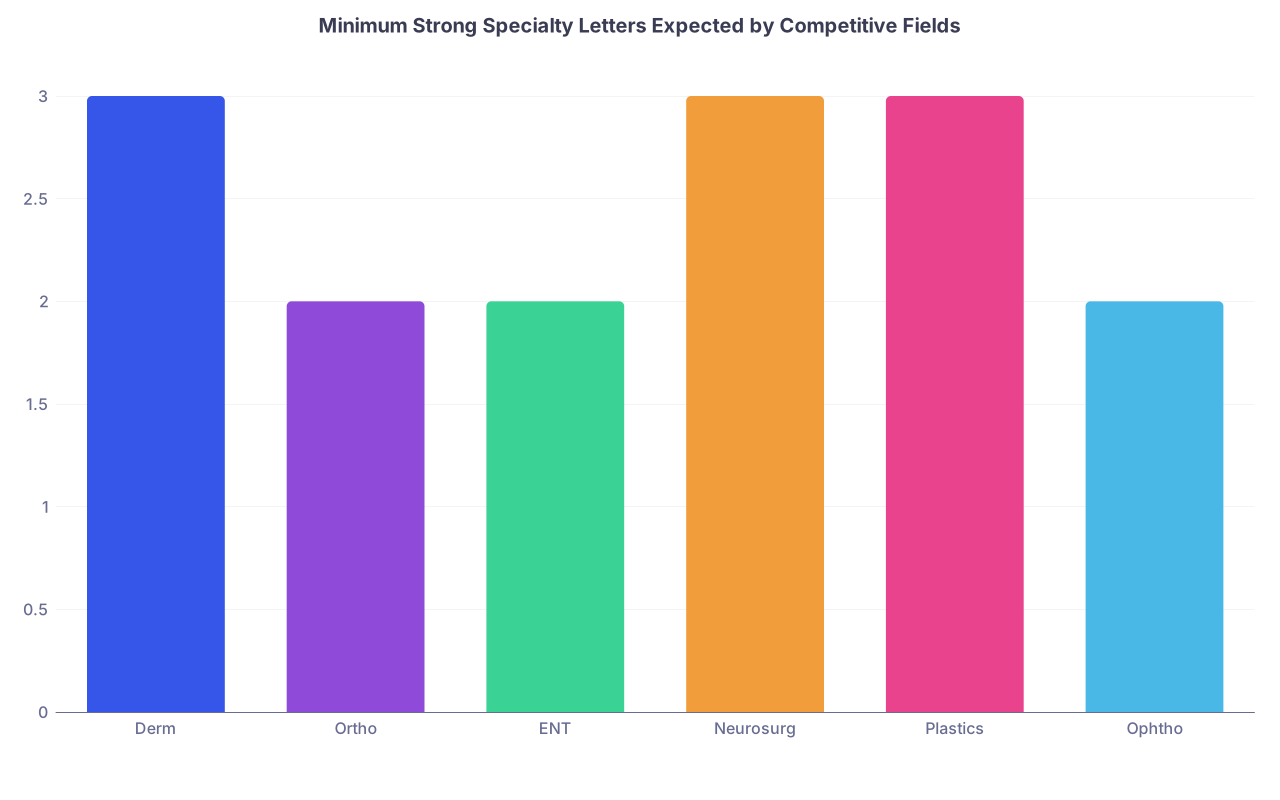
Mistake #2: Ignoring Specialty-Specific LOR Expectations
Every specialty has its unspoken letter culture. If you miss it, you silently tell programs: “I do not understand this field.”
| Category | Value |
|---|---|
| Derm | 3 |
| Ortho | 2 |
| ENT | 2 |
| Neurosurg | 3 |
| Plastics | 3 |
| Ophtho | 2 |
Example Patterns I Keep Seeing
- Expectation: Multiple derm letters, ideally with research or away rotation involvement.
- Common self-sabotage: 1 derm letter + 2 internal medicine letters “because they know me better.”
Result: They read it as lukewarm commitment to derm.
Orthopedic Surgery:
- Expectation: At least 2 ortho letters, preferably including residency program leadership or a well-known surgeon.
- Common self-sabotage: One ortho letter and then a surgery subspecialty (like vascular) + generic surgery faculty who barely worked with you.
Ophthalmology:
- Expectation: Ophtho letters are king. Research mentors in ophtho can be high yield if they know you well.
- Common self-sabotage: Excellent IM or neurology letters but only one vague ophtho letter from a clinic preceptor.
The Deadly Mixed-Signal Profile
Programs get suspicious when:
- Only 1 letter comes from your target specialty
- The strongest letter is clearly from a different specialty
- None of your letters come from academic faculty in that field
They assume:
- You decided late
- You were not that strong on that rotation
- Nobody in that department was willing to go to bat for you
And in competitive fields, that is enough to move you down the rank list.
Mistake #3: Underestimating Lukewarm Wording (Program Directors Read Between the Lines)
You need to understand how PDs and selection committees decode letters. They read them like pathology reports—every word has diagnostic value.

The Grade-Inflation Problem
Because nearly everyone asks for “strong” letters, language has become inflated. A “good” letter is actually bad. A “decent” letter is harmful. And a vaguely positive letter may be interpreted as a soft warning.
Common killer phrases:
- “Performed at the level expected of a [MS4/subintern].”
- “Met expectations on the rotation.”
- “I believe they will be a solid resident.”
- “Pleasant to work with.”
- “Will do well with appropriate supervision.”
These sound fine to you. To a PD, they mean:
- Middle of the pack
- Nothing special
- Probably not a top 1/3 student on the service
On the other hand, strong language usually looks like:
- “Top 5–10% of students I have worked with over my career.”
- “I would rank [Name] at the top of my own match list.”
- “Among the best students we have had on this service in several years.”
- “I would be thrilled to have [Name] as a resident in our program.”
If your letters lack comparative statements (percentiles, ranking among peers, “best in X years”), they are probably not strong enough for ultra-competitive specialties.
The “Damning With Faint Praise” Lines
Ultra-dangerous lines I have seen in real letters:
- “With continued support, [Name] has the potential to become an effective resident.”
- “Improved significantly over the course of the rotation.”
- “Once prompted, [Name] was able to complete tasks efficiently.”
- “While not the strongest medical student I have worked with, [Name]…”
- “Would likely do well in a structured, supportive program.”
These are huge red flags. You may never see them, because you waived your right to see the letter. But PDs see them. And they remember.
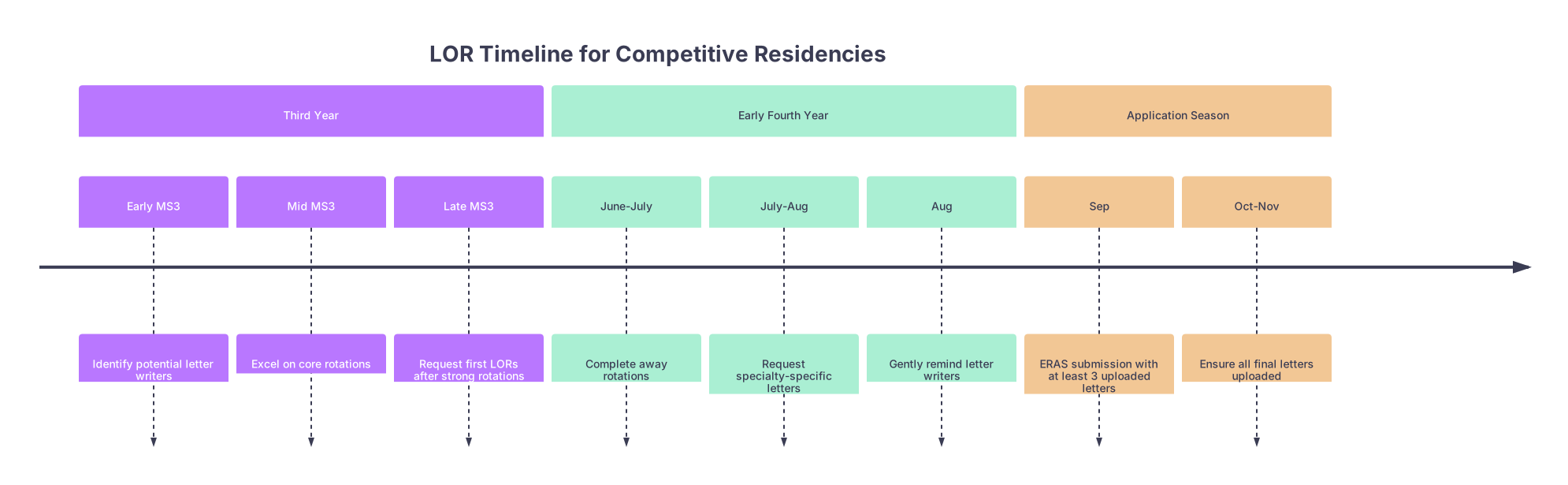
Mistake #4: Poor Timing and Logistics That Quietly Undercut You
Some of the worst damage comes from timing and logistics, not content.
| Period | Event |
|---|---|
| Third Year - Early MS3 | Identify potential letter writers |
| Third Year - Mid MS3 | Excel on core rotations |
| Third Year - Late MS3 | Request first LORs after strong rotations |
| Early Fourth Year - June-July | Complete away rotations |
| Early Fourth Year - July-Aug | Request specialty-specific letters |
| Early Fourth Year - Aug | Gently remind letter writers |
| Application Season - Sep | ERAS submission with at least 3 uploaded letters |
| Application Season - Oct-Nov | Ensure all final letters uploaded |
Late Letters That Arrive After Decisions
Programs start reviewing applications early. If your strongest letter trickles in 4–6 weeks after you submit ERAS, a lot of first-pass filters and preliminary ranking has already happened.
Common self-sabotage:
- Waiting until August or early September to request letters for a September application.
- Assuming “they know the deadline” and will upload on time.
- Never sending letter writers your CV, personal statement, or ERAS draft—so they procrastinate.
Programs notice when:
- Only 1–2 letters are uploaded at application release.
- Third or fourth letters dribble in after many interview invites are already out.
They will not usually go back and completely re-review your file just because a new letter appeared.
Sloppy Letter Portfolio
You also hurt yourself when:
- Different letters tell conflicting “versions” of you (one praises independence, another says you need close supervision).
- The letters overemphasize research for a clinically heavy program or vice versa.
- No letter actually speaks to your performance under pressure, team function, reliability—things PDs care about more than your pipette skills.
Your letters together should paint a coherent, consistent profile:
“This person is motivated, teachable, hard-working, clinically sound, and someone we would trust at 2 a.m. on call.”
If each writer just guesses what to emphasize, you get a fragmented, weaker story.
Mistake #5: Being Passive Instead of Actively Setting Up Strong Letters
The biggest meta-mistake: treating LORs as a black box instead of something you strategically set up.
You Never Clearly Signal You Want a Letter
On rotations:
- You work hard.
- You get positive feedback.
- But you never say: “I am interested in [specialty] and would value the chance to earn a strong letter from you.”
Then the rotation ends. Weeks pass. Faculty barely remembers you among 40 other students this year.
By the time you email, their memory is fuzzy. That fuzziness translates into generic descriptions. Generic descriptions will get you ignored in derm, ortho, ENT, plastics, and the rest.
You Do Not Give Writers the Tools
Another self-inflicted wound: sending a one-line email—
“Could you write me a letter for [specialty]? ERAS link attached. Thanks.”
No context. No reminders of cases you took ownership of. No mention of patient families who specifically mentioned you. No updated CV or personal statement.
You are asking them to write from memory. Under time pressure. About a student who did not make it clear they deeply cared about this specialty.
You should be sending:
- Your CV
- Draft of your personal statement
- A short, focused “highlights” paragraph: specific patient encounters, call nights, or contributions they might mention
- Clear deadline (earlier than the real one)
And yes, a polite reminder 2 weeks before your preferred deadline is not only acceptable; it is wise.
Mistake #6: Misjudging When to Waive Your Right to View Letters
This one gets people into trouble because they do not understand how PDs interpret waivers.
The Perception Problem
On ERAS, you can choose to waive or not waive your right to view your letters. Technically, you can keep the right. Practically, for competitive specialties, not waiving raises eyebrows.
Why? Because:
- Waived letters are assumed to be more candid.
- Programs worry that non-waived letters are “edited” or influenced by the applicant’s eyes on them.
In many competitive programs, a non-waived letter is an immediate question mark.
When You Try to “Check” Your Letters
Another mistake: trying to see or “approve” the letter before it is uploaded. Some letter writers will share voluntarily—that is fine. But if you are pushing hard to read and edit it, you are crossing a line.
Two bad outcomes:
- The writer gets annoyed and dials down their enthusiasm.
- The letter becomes vague and formulaic because they are disturbed by the lack of trust.
Better approach:
- Choose writers you trust.
- Ask explicitly for a strong letter.
- Waive your right.
- Control what you can control: who writes, when they write, and what context they have.
Mistake #7: Using Generic or Non-Specialty Letters for Away Rotations and Home Programs
Away rotations and home department experiences are supposed to generate your sharpest, most specialty-specific letters. When those letters end up bland, you are in trouble.
The Away Rotation That Produces a Useless Letter
I have seen this scenario repeatedly:
- Student does an away rotation in ortho at a big-name place.
- They get a letter from the “name” surgeon they barely worked with.
- The letter is glowing but vague.
Programs sniff this out immediately.
What they wanted:
- A detailed letter from someone who actually watched you present patients, scrub cases, see consults, stay late, help the team.
- Concrete examples of your ownership, attitude, and work ethic.
Instead, they get 3 paragraphs of “interested in the field,” “pleasant,” “completed tasks.” That letter will not save you.
The Home Institution Letter That Fails to Endorse
Even worse: your own home department letter is lukewarm.
If the department that has seen you the most cannot write a clearly enthusiastic letter, PDs infer one of two things:
- You were not a standout at home.
- The department does not feel comfortable endorsing you strongly.
For competitive specialties, this is lethal.
You must treat home rotations and sub-internships like an extended high-stakes audition. Show up early, volunteer for work, read on your cases, anticipate needs. Then explicitly ask the person who saw that best version of you for a strong letter.
Quick Reference: LOR Red Flags That Quietly Sink Competitive Applicants
| Red Flag Type | How Programs Interpret It |
|---|---|
| Only 1 specialty-specific LOR | Weak commitment / concern from field |
| Generic, short letters | Writer does not know you well |
| No comparative language | Middle-of-the-pack student |
| Late-arriving strongest letter | File reviewed without key endorsement |
| Non-waived letters | Question about candor / authenticity |
If you see any of these patterns in how your letter process is shaping up, you are playing with fire.
How To Fix This Now If You Are Still in the Process
If you are M3 or early M4, you still have time to avoid these mistakes.
Concrete steps you can take this month:
- List potential letter writers by specialty, seniority, and how closely they actually saw you work.
- Identify gaps: do you have at least 2–3 people in your target field who could plausibly write a strong letter?
- For any upcoming rotation with a potential writer, behave as if it is a month-long interview.
- When you ask, use the phrase “strong letter” and be willing to pivot if the response is lukewarm.
- Prepare a short “LOR packet” for each writer: CV, personal statement draft, bullet list of specific moments or cases.
- Set internal deadlines at least 2–3 weeks before ERAS release, and remind writers politely.
Do that and you will already be avoiding the mistakes that quietly knock out half of otherwise-qualified applicants.
FAQ (Exactly 3 Questions)
1. Is it better to have three “good” letters from my specialty or two strong specialty letters plus one amazing letter from another field?
For competitive specialties, two truly strong same-specialty letters plus one outstanding letter from another field usually beats three mediocre specialty letters. However, if your specialty expects three letters from within the field (like some derm, ortho, or neurosurg programs), you still need at least two robust specialty letters; the third can be from research or a closely related field if it is powerfully positive. What you must avoid is having your best, clearest advocacy come from outside your target specialty.
2. What if I suspect a letter might be lukewarm but I already requested it?
If you felt hesitation when you asked, or your relationship with the writer was mixed, you should line up backup letters. You cannot retract a requested letter, but you can choose not to assign it to all programs. Quietly secure at least one additional letter from someone who saw you at your best and communicate clearly that you are hoping for a strong letter. Then, on ERAS, prioritize assigning the letters you are most confident about to your most competitive programs.
3. How many total letters should I aim to have for a competitive specialty?
Most programs read 3–4 letters. A good target is to have 4–5 solid letters available, then selectively assign the best 3–4 to each program. For instance, two core specialty letters, one research or sub-internship letter, and one from a different but clinically rigorous service where you excelled. Overcollecting 7–8 letters is pointless if half are generic. Depth of enthusiasm and specificity beats sheer number.
Open your potential letter writer list right now. Next to each name, write either “sees me as top-tier” or “sees me as solid.” If you do not have at least two “top-tier” names in your target specialty, you have work to do—starting on your very next rotation.