
You are in your call room, post-op note half-finished, and NRMP’s Charting Outcomes PDF is open on your second monitor. You have three tabs side by side: Dermatology, Plastic Surgery, Otolaryngology (ENT). Your classmates keep saying, “They’re all crazy competitive, just pick what you like.” That is lazy thinking. You know the truth: how they are competitive is different, and it changes how you should build your application.
Let me break this down specifically: Derm vs Plastics vs ENT are three flavors of “hyper-competitive,” but with very different ecosystems—different gatekeepers, different applicant pools, different failure modes. If you treat them as interchangeable, you will make unforced errors.
We will walk through:
- The type of competitiveness for each field
- How Step scores, research, and AOA actually function in each
- Realistic match probabilities by category (US MD vs DO vs IMG)
- Strategy differences if you are aiming at all three vs pivoting between them
1. Big Picture: Three Different Animals
Step back for a second and look at what you are actually choosing between.
Dermatology:
- Outpatient-heavy, lifestyle-driven, small field.
- Research-heavy, academic-leaning applicant pool.
- Very low number of positions nationally.
- Long training, technical, prestige-driven.
- Extremely limited spots, tiny programs.
- Culture: portfolios, letters, research years, face-time.
Otolaryngology (ENT):
- Hybrid: clinic, OR, some call, some lifestyle.
- Mid-sized field among the “competitive surgicals.”
- Historically more welcoming to solid-but-not-perfect applicants… within limits.
But “competitive” is not one-dimensional. There are at least four axes:
- Raw applicant-to-position ratio
- Score inflation (Step 1/2 CK cutoffs)
- Research / academic expectations
- Subjective gatekeeping (letters, away rotations, “fit”)
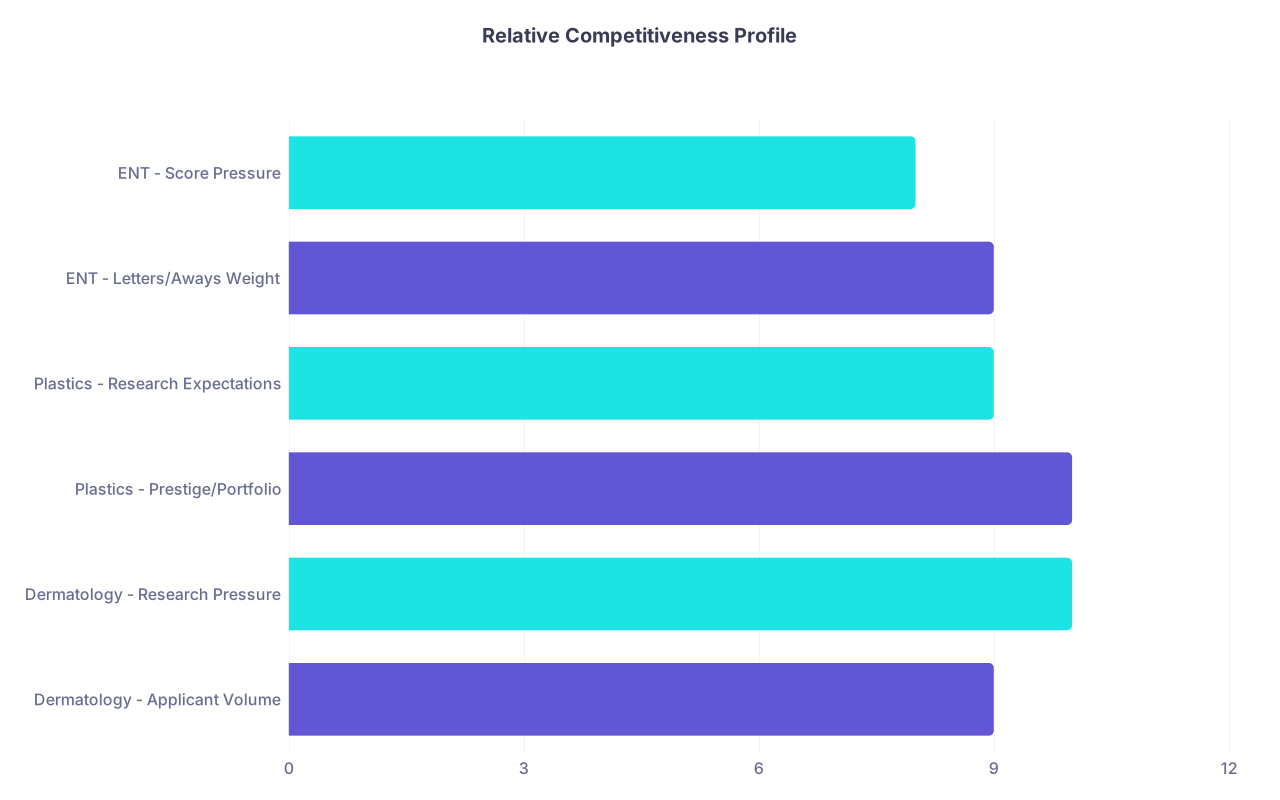
| Category | Value |
|---|---|
| Dermatology - Applicant Volume | 9 |
| Dermatology - Research Pressure | 10 |
| Plastics - Prestige/Portfolio | 10 |
| Plastics - Research Expectations | 9 |
| ENT - Letters/Aways Weight | 9 |
| ENT - Score Pressure | 8 |
(Scale 1–10, relative within this group; this is how I’d weight them in practical terms.)
The key mental model:
- Derm = “academic metrics and research filter”
- Plastics = “portfolio + elite mentorship + time investment”
- ENT = “strong but more balanced competitiveness with heavier emphasis on away rotation performance”
You build your application differently depending on which of those you are aiming at.
2. Raw Match Numbers: Who Actually Gets In?
Let’s synthesize what seriously matters from NRMP Charting Outcomes and program behavior. I am not going to regurgitate exact-year numbers; they drift slightly every cycle. Instead, I’ll give realistic ranges and tendencies.
US MD Seniors – Rough Match Rates
| Specialty | Approx Match Rate | Positions per year (approx) | Typical Program Size |
|---|---|---|---|
| Dermatology | 65–75% | ~500–550 | 3–6 residents/year |
| Plastics (Integrated) | 55–65% | ~200–220 | 2–3 residents/year |
| Otolaryngology | 75–85% | ~350–400 | 3–5 residents/year |
Interpretation:
- Dermatology: A lot of high-achieving people apply, some get burned.
- Plastics: Slightly harder percentage-wise for US MDs than Derm because the self-selection is brutal—almost everyone applying is strong.
- ENT: Still very competitive, but if you are a strong US MD with a coherent ENT portfolio, your odds are noticeably better.
DOs and IMGs
Bluntly:
- Integrated Plastics: DO and IMG match is rare. There are occasional DOs; IMGs are extremely uncommon.
- Dermatology: US-IMGs occasionally match, usually with insane portfolios and strong home / institutional backing. DOs match derm more often than plastics, but still low relative to most specialties.
- ENT: DOs match ENT more than they do Derm or Plastics. IMGs still uncommon but slightly less impossible than Plastics.
If you are DO or IMG and trying to choose among these three, ENT and Derm are at least on the board. Integrated Plastics is nearly closed unless your CV is exceptionally strong and you have serious inside advocates.
3. Step Scores and AOA: How Cutthroat, Really?
Even with Step 1 pass/fail, Step 2 CK has simply become the surrogate filter. Programs do not like it, but they are doing it.
Dermatology
Derm is the specialty where I have repeatedly heard, “Honestly, we screened at 250 for Step 2 this year because the volume was insane.”
Reality pattern:
- Historically Step 1: 245–255+ was the “comfortable” zone.
- Now Step 2: 250+ is effectively the “we will read your application seriously” zone at many mid-to-top programs. Top-tier can easily have average matched CK in high 250s or higher.
AOA:
- Strong signal in Derm.
- At academic-heavy programs (UCSF, Penn, NYU, Michigan) I have seen AOA plus a strong derm research CV essentially function as your baseline ticket to serious consideration.
- Non-AOA can still match, but you must compensate with:
- Substantial derm-specific research, and/or
- Exceptional letters from respected dermatologists.
Plastic Surgery (Integrated)
Plastics cares about scores, but not in the same “we live or die by the histogram” way as Derm.
Common pattern:
- Historically Step 1: 245–255 “competitive”; 260+ helps you stand out.
- Now Step 2 CK: Programs often using informal screens around 245–250, but they will make exceptions if your research, letters, or home sponsorship are strong.
AOA:
- Strongly positive, but not mandatory.
- Some of the best future plastic surgeons were not AOA but had 3+ years of productive research, early connections with faculty, and exceptional interview performance.
The crucial point: Plastics can sometimes “forgive” slightly lower scores if everything else screams “this person will be a star academic microsurgeon.”
ENT (Otolaryngology)
ENT lives a bit closer to gen surg mindset than Derm:
Typical Step 2 CK landscape:
- Solid competitive zone: 245–255.
- 255–260+ gives you clear breathing room at most programs.
- Sub-240s will start to hurt at academic ENT programs, unless you are otherwise exceptional.
AOA:
- Helpful but not the same hard filter as Derm.
- ENT programs tend to care deeply about how you did on your ENT rotations, your letters from otolaryngologists, and your operative / team performance on aways.
In short:
- Derm weaponizes Step and AOA more aggressively.
- Plastics uses scores as an initial screen but will bend for outstanding portfolios.
- ENT values scores but compensates more with clinical / rotation performance than Derm or Plastics.
4. Research: Volume, Quality, and Specialty Specificity
This is where people ruin their chances by misunderstanding the ecosystem.
Dermatology: Publication Arms Race
Derm is arguably the most unforgiving about research among these three.
What I see in successful derm applications at competitive programs:
- 10–20+ total publications, abstracts, or presentations is common among top-tier applicants.
- 3–8 dermatology-specific papers, case reports, or abstracts.
- At least one strong project with real ownership (not just 10th author on random chart reviews).
Is that insane? Yes. But it is reality at many places.
If you have:
- 250+ Step 2 CK
- 4–5 derm pubs or abstracts
- AOA or near-top of class
- strong derm letters
You are in the “realistic contender” category at most derm programs.
If you have:
- 240–245 Step 2 CK
- 0–1 derm projects
You will struggle significantly, even with AOA. Derm is ruthless about specificity.
Plastic Surgery: Depth > Raw Count
Plastics is research-heavy, but the culture is different. They value:
- Depth: Longitudinal involvement over multiple years with the same group.
- Significance: Clinical outcomes papers, reconstructive or aesthetic series, device development, and increasingly outcomes / health services research.
- Productivity: 5–15+ pubs/abstracts is common among serious integrated plastics applicants, but the story matters more than just the number.
Dedicated research years are common:
- Many successful plastics applicants do 1–2 years of research, often at high-powered programs.
- This is almost expected if you are not starting from a “top-of-class, early-involved, home-plastics” position.
The plastics question is always: “Does your portfolio look like you are already halfway to an academic plastic surgery career?”
ENT: Strong, But Slightly Less Maniacal
ENT wants research, but it is more reasonable:
Successful ENT applicants often have:
- 3–10 publications/abstracts total.
- 1–4 ENT-specific projects helps a lot, but being productive in another field plus a few ENT projects is acceptable.
- Some programs are research-heavy (Mass Eye and Ear, Iowa, Washington University), others care more about clinical work and letters.
If you are a clinically excellent student with:
- 250+ Step 2 CK
- Solid ENT letters
- 2–4 ENT abstracts or papers
You can be competitive at many programs, even without a dedicated research year.
5. Letters, Aways, and “Being Known”
This is where Plastics and ENT really diverge from Derm.
Dermatology
Derm:
- Away rotations matter, but less than in plastics or ENT.
- Research mentors’ letters can be absolutely decisive. If the department chair or highly respected derm faculty writes, “This is one of our best students in 10 years,” that moves the needle nationally.
- Home derm department support is huge. No home derm? You need very strong external mentorship.
Derm interviews are often heavily weighted by:
- Perceived academic trajectory.
- Professionalism and “easy clinic presence” (they want people who will not anger private practice attendings).
Plastic Surgery (Integrated)
Plastics is hyper-personal.
- Away rotations are often make-or-break.
- Many integrated plastics residents matched where they rotated or where their mentors had strong connections.
- A single chair or PD letter saying “I will take this person sight unseen” means far more than 20 generic positive letters.
Cultural reality:
- Programs value people they have seen operating, presenting, and suffering through long days without whining.
- The OR personality and team fit matter a lot. Tech skill matters, but reliability and attitude matter more than med students realize.
You should assume:
- At least 1–2 carefully chosen away rotations are expected if you are serious.
- You must treat every day on those aways like a month-long interview.
ENT
ENT is also very face-time driven.
- Aways are standard.
- On ENT aways, you are evaluated on:
- Work ethic
- How fast you integrate with the team
- Operative focus without being obnoxious
- Basic knowledge and sincere interest
Letters:
- Strong ENT faculty letters (especially PDs and chairs) are gold.
- ENT is a smaller world; many PDs know each other. A single negative phone call can sink you, and a single strong call can save you.
So:
- Derm: Slightly more paper and metric-driven; letters and face-time still matter, but not as OR-intense.
- Plastics: Relationship, face-time, and endorsements can override small metric deficits.
- ENT: Somewhere in between—still caring deeply about on-rotation performance.
6. Program Distribution and “Floor vs Ceiling”
Where each specialty sits in terms of “range” of competitiveness across programs.
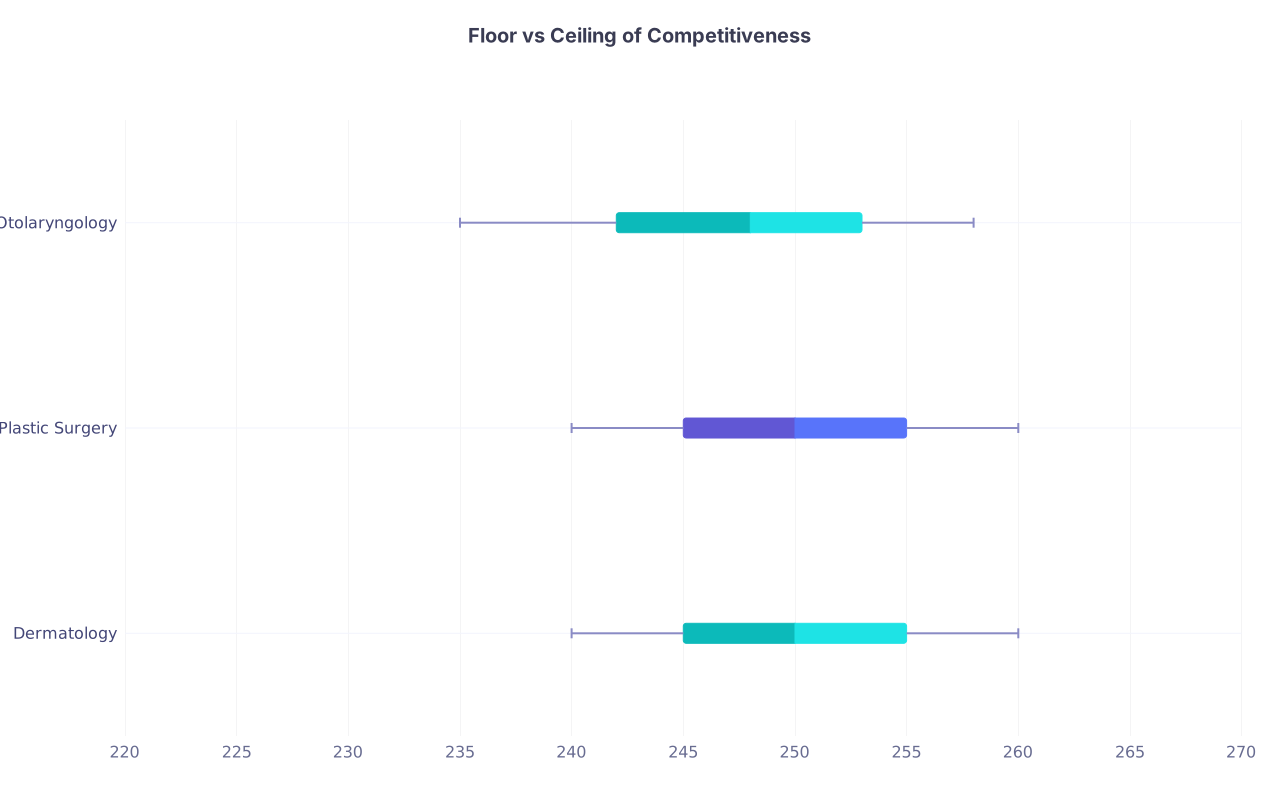
| Category | Min | Q1 | Median | Q3 | Max |
|---|---|---|---|---|---|
| Dermatology | 240 | 245 | 250 | 255 | 260 |
| Plastic Surgery | 240 | 245 | 250 | 255 | 260 |
| Otolaryngology | 235 | 242 | 248 | 253 | 258 |
(Interpret as approximate Step 2 CK distribution of matched US MDs at lower-tier to top-tier programs.)
The takeaway:
- Dermatology: High floor, high ceiling. Even at “less famous” derm programs, the Step 2 and research bar is nontrivial.
- Plastics: Very high floor, extremely high ceiling. Some community-ish programs exist, but integrated plastics overall is concentrated in relatively high-powered places.
- ENT: Slightly lower floor, still very high ceiling. There is more spectrum; some programs are relatively more forgiving if you are a good clinician and team player.
If you are targeting “I just want to match somewhere” vs “I need a top-10 program,” the choice behaves differently:
- Derm: Matching “anywhere” still requires serious metrics and derm-specific work.
- Plastics: “Any integrated plastics spot” remains extremely hard; there is no easy backdoor.
- ENT: There is more realistic diversity—some programs lean more “workhorse, strong clinician” than “research superstar.”
7. Strategic Planning: Who Should Aim Where?
Now the part no one wants to say out loud: advising based on actual profiles.
Profile 1: High-Metric Academic Gunner
- Step 2 CK: 255–265+
- AOA or top decile
- 10–20+ pubs, several in a specific field
- Likes research, likes subspecialization, not obsessed with OR
You can realistically aim at:
- Dermatology: Very strong shot if your research is derm or at least easily connectable to skin / immunology / oncology.
- Plastics: Strong if you are willing to invest in 1–2 research years and have early mentorship.
- ENT: Very competitive for academic ENT.
Advice: If you honestly prefer outpatient and controllable lifestyle, Derm is rational. If you are drawn to the OR and complex recon, choose between plastics and ENT based on what types of cases fascinate you in person, not what you imagine from Instagram.
Profile 2: Solid Student, No AOA, Late Start
- Step 2 CK: 245–255
- Middle of the class, not AOA
- 1–3 generic research projects, no clear specialty focus
- Decides between Derm/Plastics/ENT end of M2 or even M3
Real talk:
- Dermatology: You are behind. You can still do it with intensive derm research, but you will need to aggressively retool M3–M4 and probably consider a research year.
- Plastics: You are behind and integrated plastics is unforgiving if you do not build the right portfolio early. A research year (or two) plus strong mentorship becomes almost mandatory.
- ENT: Most plausible target among the three. You can build a competitive ENT application with 1 research year or even without one if you nail your rotations, aways, and letters.
If you want a hyper-competitive field but you are coming in late and not from the absolute top of the curve, ENT is, frankly, the most rational of the three.
Profile 3: DO or IMG with Strong Stats
- DO with Step 2 255+ OR IMG with 250+, strong clinical evaluations
- Some research, not in these specialties yet
Reality:
- Integrated Plastics: Almost closed. Possible in extremely rare circumstances with deep connections and 1–2 research years at top US institutions, but do not build your entire future on this.
- Dermatology: Difficult but not impossible. DO derm is achievable with the right derm mentors, away rotations at DO-friendly institutions, and a heavy derm research push. IMG derm is extremely rare in the U.S. system unless you are already embedded in a US academic derm group.
- ENT: DOs have a shot, especially at DO-friendly ENT programs and some university programs that have a track record. IMGs much rarer but not totally off the map.
If you must pick a goal that is ambitious but not delusional: ENT or Derm (with eyes open about the odds). Plastics integrated as your primary and only plan? Very risky.
8. Applying to More Than One: Derm vs ENT vs Plastics
People quietly try this and usually do it poorly.
Derm vs ENT
Overlap:
- Both can like high Step 2, good research, strong letters.
- Some people do derm research and ENT clinical work or vice versa.
But programs are not stupid:
- A PD can smell when they are your backup.
- Your personal statement, letter mix, and away choices will betray your primary interest.
If you are going to dual-apply (e.g., Derm primary, ENT secondary), you must:
- Build a coherent narrative that both can respect: interest in head and neck oncology, cutaneous malignancies, procedural work, etc.
- Have at least some research and exposure in both fields.
- Be prepared for awkward questions: “Why ENT if you have all this derm research?” or “Why Derm when you spent your aways in ENT?”
Dual-apply is most survivable when:
- Your primary is Derm or Plastics, and your secondary is ENT or another surgical field.
- You understand that you might never be allowed to “switch over” later at the same institution.
Plastics vs ENT
More natural overlap:
- Both are OR-heavy.
- Both value excellent performance on surgical rotations.
But integrated plastics programs will not be impressed if half your letters are from ENT, and vice versa. You must pick which one is truly primary.
If you are unsure, the honest move:
- Rotate in both early M3.
- Get real OR time.
- Listen to yourself on post-call days: Which kind of exhaustion actually felt meaningful?
Trying to “keep both fully open” until late is how you end up with a mediocre application to both.
9. Concrete Competitive Differences in Practice
Let me distill the subtle but real differences you will feel when you go through this process.
- In Derm, you will feel the spreadsheet pressure: number of pubs, Step score percentiles, AOA. You can almost taste the Excel filters.
- In Plastics, you will feel the network pressure: who knows you, who calls for you, how many hours you have spent in one OR with one attending.
- In ENT, you will feel the rotation pressure: daily performance on services, perceived fit with the resident culture, and your reputation on the trail.
So if you hate:
- Endless research projects, writing, structured academic hustle → You will suffer in Derm’s world.
- Political networking, long pre-residency research years, spending forever getting known → Plastics might drive you insane.
- Being “on stage” every single day of an away rotation, proving yourself repeatedly in the OR and clinic → ENT might be more emotionally draining than you think.
Choose your battlefield based on the type of competitiveness you are actually willing to fight in.
10. Timeline and Planning: What To Do When
Let me sketch a practical prep arc.
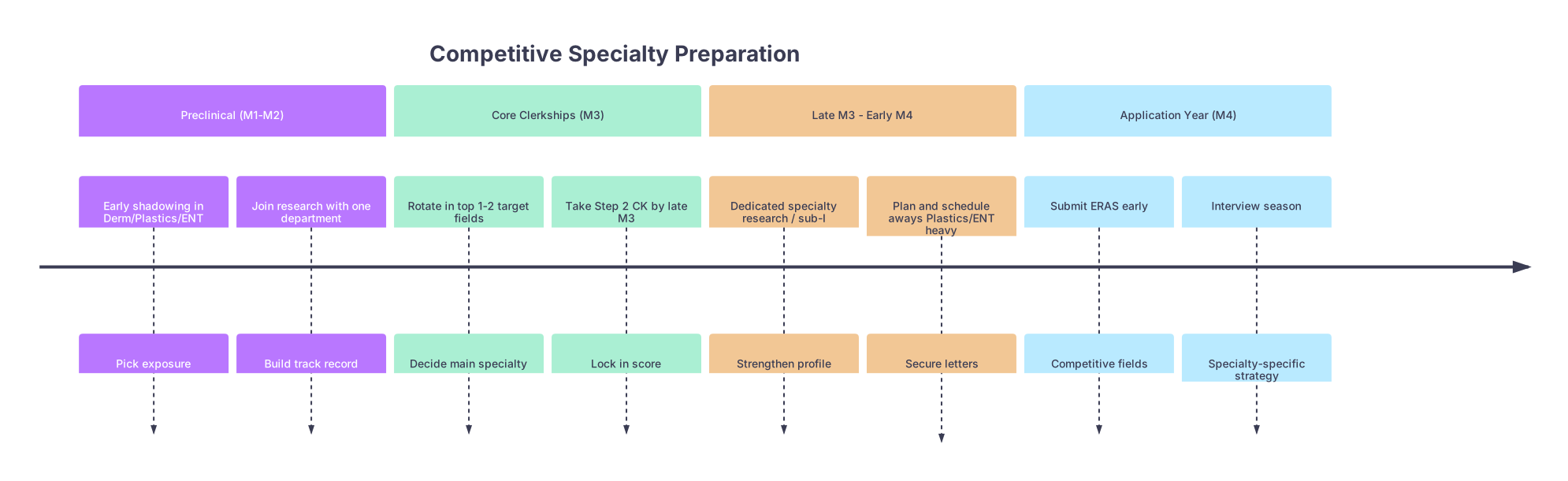
| Period | Event |
|---|---|
| Preclinical (M1-M2) - Early shadowing in Derm/Plastics/ENT | Pick exposure |
| Preclinical (M1-M2) - Join research with one department | Build track record |
| Core Clerkships (M3) - Rotate in top 1-2 target fields | Decide main specialty |
| Core Clerkships (M3) - Take Step 2 CK by late M3 | Lock in score |
| Late M3 - Early M4 - Dedicated specialty research / sub-I | Strengthen profile |
| Late M3 - Early M4 - Plan and schedule aways Plastics/ENT heavy | Secure letters |
| Application Year (M4) - Submit ERAS early | Competitive fields |
| Application Year (M4) - Interview season | Specialty-specific strategy |
Key points by specialty:
Derm:
- Start research by mid-M2 at the latest if you want to be aggressive.
- Try to have Step 2 CK done by early enough M4 so programs see it for interview offers.
Plastics:
- Strongly consider a research year if you did not start early.
- Plan aways very strategically: places that know your mentors, programs where you are realistically competitive.
ENT:
- Solidify your choice by mid-M3 so you can set up at least one, ideally two aways.
- Prepare early for ENT-specific letters and knowledge (basics of otology, sinusitis, head and neck cancer).
FAQs
1. If I am a top-of-class, 260+ applicant, which of the three is hardest to match?
Integrated Plastics is probably the hardest per slot because of extreme self-selection and very limited positions; however, top-of-class with dedicated research and mentorship makes all three realistic. Derm is brutal on metrics and research. Plastics is brutal on portfolio and networking. ENT is slightly more forgiving but still tough. “Hardest” depends on your non-score assets; purely numerically, integrated plastics often feels the tightest.
2. How much does a dedicated research year really help for each specialty?
Derm: One well-structured derm research year can transform a borderline app into a competitive one, especially if you are at a strong derm department and produce multiple pubs with big-name mentors.
Plastics: A research year (or two) is close to standard if you are not already heavily embedded; it can be the difference between no interview and several at serious places.
ENT: Helpful but not universally required. For ENT, a research year is most useful if you are trying to offset weaker scores or come from a school with limited ENT presence.
3. Is it realistic to apply to Derm and ENT in the same cycle?
Yes, but only if you commit to building a narrative that makes sense for both, and you accept that both sides may sense they are the backup. You will need some research and letters in each field and separate personal statements. It is stressful. If you are doing this purely out of fear rather than genuine dual interest, your application usually reads as diluted.
4. I do not have a home program in Derm/Plastics/ENT. Am I dead?
No, but you are disadvantaged. You must: aggressively seek out mentors at nearby institutions, use aways strategically to showcase yourself, and lean harder on research years or inter-institution collaborations. Many programs do not have a home plastics or derm department, and PDs know this. What they will not forgive is passivity. They want to see that you hustled to fill the gap.
5. If I miss in Derm or Plastics, can I switch into ENT later?
Occasionally, yes, but it is not something to bank on. Switching specialties depends on open PGY-2 or PGY-3 spots, PD politics, and your performance in your initial residency. ENT spots rarely sit open waiting for switchers. If you know ENT is a serious possibility for you, it is safer to apply for ENT up front than to assume a clean transition from another field later.
Key points to walk away with:
- Derm, Plastics, and ENT are all “very competitive,” but the type of competitiveness differs—Derm = metrics and research, Plastics = portfolio and connections, ENT = performance and fit.
- Your current profile (scores, research, timing, school type) should heavily influence which of these is rational versus fantasy.
- You cannot treat these three as interchangeable Plan A/B/C without diluting your application; pick your battlefield and build deliberately for that culture.