The way most students plan 3rd and 4th year rotations absolutely cripples their chances in competitive specialties.
They “keep options open,” bounce between unrelated rotations, and then panic-build a specialty story three months before ERAS. That might be fine for family medicine. It is a disaster if you want derm, ortho, ENT, plastics, neurosurgery, urology, or anything else where programs have ten excellent applicants for every spot.
You want a competitive field? You cannot treat rotations like a buffet. You need a targeted campaign.
This is how you build one.
Step 1: Decide Your “Single Competitive Field” Early – And Commit
You cannot optimize for everything. The earlier you commit to a primary target field, the more your rotations can work for you instead of against you.
Here is the rule I give students:
- You need a working specialty choice by:
- Start of M3 if you want derm, plastics, neurosurgery, ENT, ortho
- End of core clerkships (or very early M4) if you want EM, anesthesia, radiology, OB/GYN, or moderately competitive fields
This is not about being 100% sure forever. It is about having a direction so your schedule stops being random.
How to make that call in 2–3 weeks, not 6 months:
Reality check your CV against the field. Pull up recent NRMP Charting Outcomes and compare:
- Step 2 score range
- % with research
- AOA / class rank
- Honor rates in core clerkships
If you have:
- Step 2 projected < 235 and no research, and you want derm or plastics → you need a serious backup from day one.
- Solid scores (≥245 Step 2) but weaker research → surgical subspecialties are still possible, but you must crush rotations and letters.
Do 2–3 high-yield shadow days. Not “I think I’d like ortho because I like sports.” I mean:
- 1 OR-heavy day
- 1 clinic-heavy day
- 1 call / inpatient day if possible
Then ask yourself:
- Do I like the work when I am exhausted?
- Do I like the people on this service? (Because you are becoming them.)
Force a decision date. Put it in your calendar:
- “By [DATE], my default plan is: Target specialty = X, Backup = Y.”
You can pivot later, but your planning assumes this target.
- “By [DATE], my default plan is: Target specialty = X, Backup = Y.”
If you are already M4 and still undecided about a competitive field, you are behind. Not doomed, but behind. That means you must be even more ruthless with rotation planning.
Step 2: Build a Year-Long Rotation Strategy, Not a Random Schedule
Competitive programs want to see three things:
- You understand what the field actually is (substance, not fantasy)
- Faculty in the field know you well enough to write specific letters
- Your record shows sustained interest and performance, not a last-minute conversion
You get all three by deliberately staging your rotations over 12–18 months.
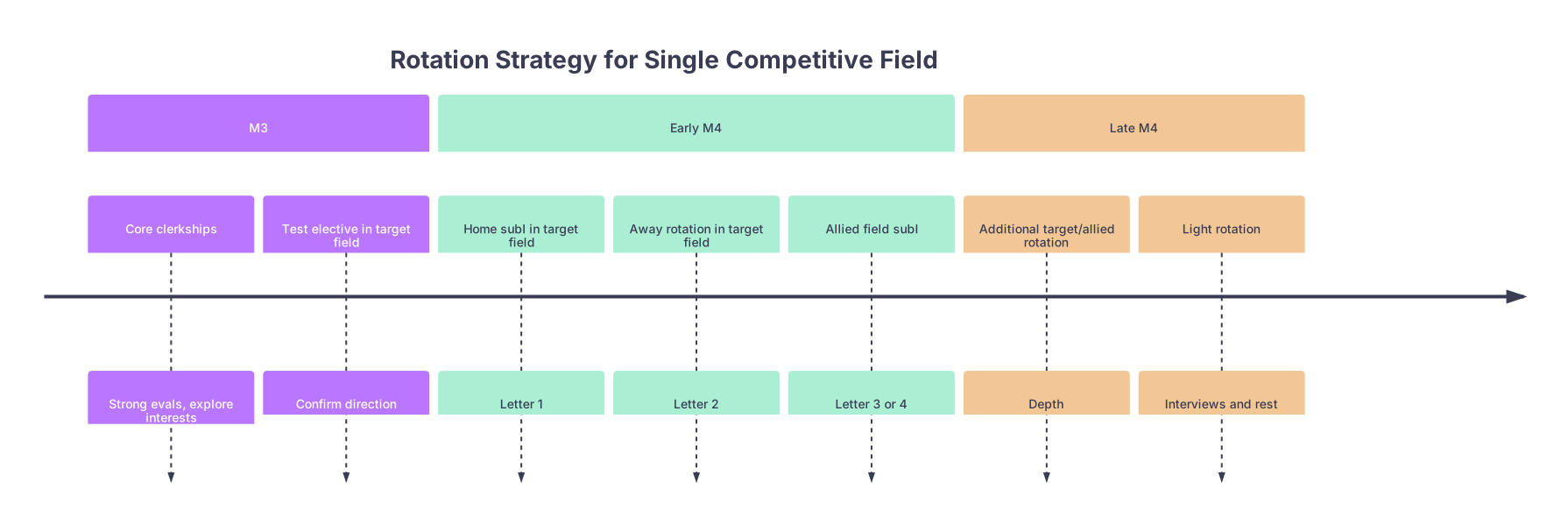
The Core Architecture
Here is the skeletal framework I push students to use for a single competitive target:
- M3:
- Crush core clerkships (med, surgery, psych, peds, OB/GYN, family)
- Add one “test the waters” elective in your target field if your school allows
- Early M4 (before ERAS opens):
- 1 home sub-I / acting internship in your target field
- 1 away rotation (if field uses them heavily) at a realistic reach or mid-tier program
- 1 letter-generating sub-I in either your target field or a closely allied field
- Late M4 (after applications submitted):
- 1–2 more rotations in target or related fields
- 1 lighter or interest-based rotation for sanity and interview travel
| Period | Event |
|---|---|
| M3 - Core clerkships | Strong evals, explore interests |
| M3 - Test elective in target field | Confirm direction |
| Early M4 - Home subI in target field | Letter 1 |
| Early M4 - Away rotation in target field | Letter 2 |
| Early M4 - Allied field subI | Letter 3 or 4 |
| Late M4 - Additional target/allied rotation | Depth |
| Late M4 - Light rotation | Interviews and rest |
Step 3: Map Your Target Field to High-Impact Rotations
Different specialties value different rotation patterns. If you pick the wrong ones, you waste time.
Example: Orthopedic Surgery
High yield:
- Home ortho sub-I (absolutely non-negotiable)
- 1–2 away rotations at programs where:
- Your Step scores are at or slightly below their average
- Your school or mentors have connections
- Allied rotations that actually help:
- Trauma surgery
- Plastics (hand)
- PM&R with heavy MSK
- Radiology MSK
Useless or low-yield in relation to ortho competitiveness:
- Random outpatient dermatology
- “Fun” niche electives with zero letter potential (e.g., wilderness medicine weeks) before you have key letters locked
Example: Dermatology
High yield:
- Home derm rotation / sub-I (sometimes multiple blocks)
- Research elective in derm with a productive mentor
- Away rotation(s) in derm at programs that know your mentor or are in your target region
- Allied:
- Rheumatology
- Oncology
- Pathology (esp. dermpath if offered)
Low-yield time sinks early:
- Long advanced medicine subspecialties that do not touch skin or immunology
- ICU electives before you have derm-specific experiences and letters
Example: Emergency Medicine
High yield:
- 1–2 EM rotations at sites that write SLOEs (Standardized Letters of Evaluation)
- 1 EM rotation at your home site (if available)
- 1 EM away at a place you would be happy to match
- Allied:
- ICU (MICU or SICU)
- Trauma surgery
Weak:
- Doing 3 different EM rotations after you already have 2 solid SLOEs
- Random electives that do not show acute care or procedural interest
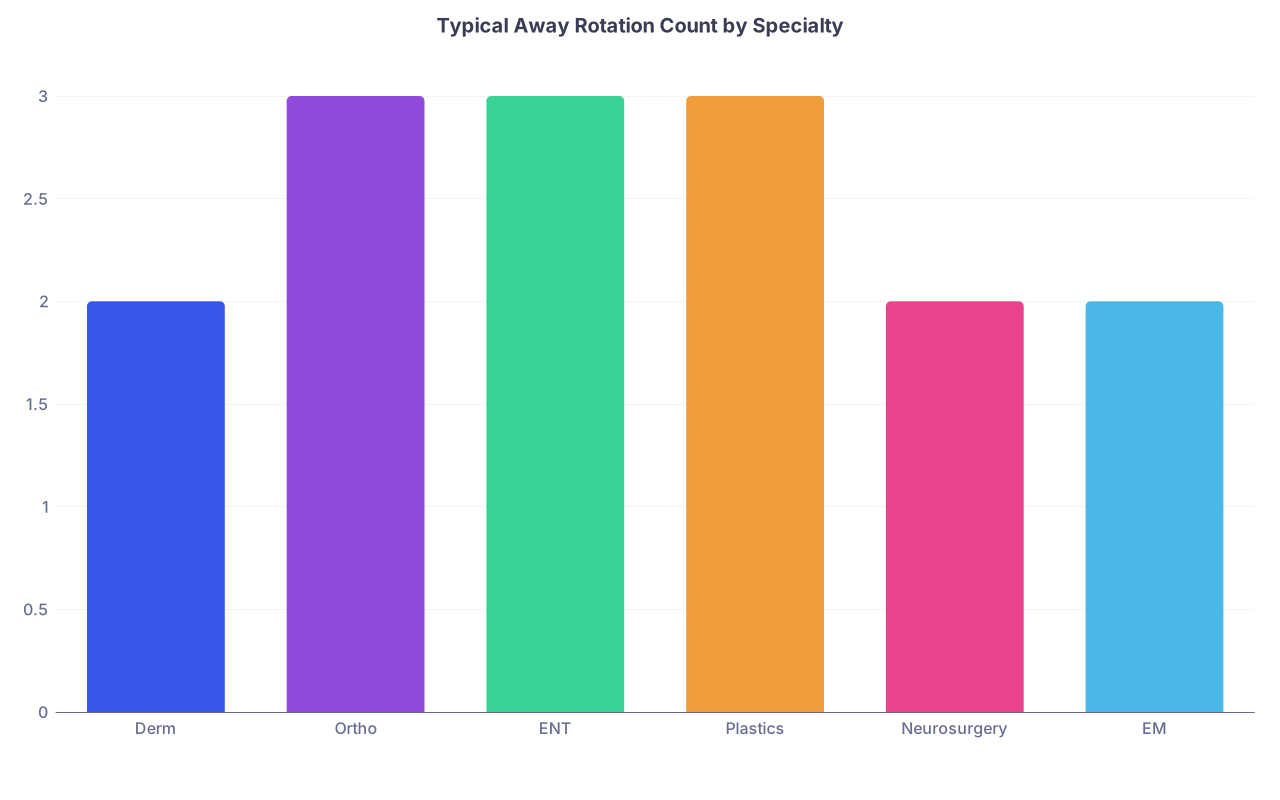
To make this more concrete, here is how different specialties “read” your rotation choices.
| Specialty | Critical Rotations | Useful Allied Rotations | Typical Away Count |
|---|---|---|---|
| Derm | Home derm, derm away, research | Rheum, Onc, Dermpath | 1–3 |
| Ortho | Home subI, ortho away | Trauma surg, Plastics, PM&R | 2–3 |
| ENT | Home subI, ENT away | Plastics, Neurosurg | 2–3 |
| Plastics | Home subI, plastics away | ENT, Ortho, Trauma | 2–3 |
| Neurosurgery | Home subI, neurosurg away | Neuro ICU, Neurology | 1–2 |
You see the pattern. A single competitive field → a core spine of rotations in that field and its logical neighbors.
Step 4: Design Your Home Sub-I to Produce a Killer Letter
Your home sub-I is your audition in front of people who can literally call other programs for you.
If you waste it by “just showing up,” you are handicapping your application.
What you want from your home sub-I:
- At least one letter writer who:
- Watched you over the full month
- Saw you manage patients with increasing independence
- Can comment on work ethic, team function, and clinical reasoning
- A clear narrative in your evals:
- “Top 10% of students I have worked with in 10 years” type comments
- Descriptions of initiative: stayed late, read on cases, followed up with patients
How to reverse-engineer that outcome:
Pre-rotation meeting
- Email the clerkship / rotation director 2–3 weeks before:
- Express that this is your intended field.
- Ask: “Who on this service is known for strong, specific letters for students?”
- Request to be scheduled with that person for at least part of the month.
- Email the clerkship / rotation director 2–3 weeks before:
Day 1 script Tell your senior or attending, bluntly:
- “I am applying in [field] and this is my core sub-I. I would like feedback each week on what I need to do to be in the top group of students you have worked with.”
Yes, say it that directly. You get better feedback when you signal that you actually care.
Weekly feedback loop Every Friday:
- Ask: “What is one thing I am doing that is on par with your best students, and one thing that is holding me back?”
- Then change the behavior by Monday. Make it obvious.
Last-week ask
- Go to 1–2 attendings you worked closely with.
- Ask directly: “Based on what you have seen, would you feel comfortable writing me a strong letter for [specialty]?”
- If they pause or hedge, thank them and do not use that letter. You need enthusiasm, not courtesy.
Step 5: Use Away Rotations as Targeted Auditions, Not Tourism
Away rotations in competitive fields are not about “seeing a new city.” They are 4-week job interviews.
You can absolutely tank your chances by:
- Doing an away at a program way above your academic range and burning that bridge
- Doing four aways and performing “fine” on all of them instead of outstanding on two
- Picking aways based on city desirability instead of match probability
How many away rotations?
- Ultra-competitive surgical subspecialties (ortho, ENT, plastics, neurosurg):
- 2 aways is usually optimal
- 3 max if your home program is weak or nonexistent
- Derm:
- 1–2 aways typically, heavy emphasis on derm research and home experience
- EM:
- Usually 2 SLOE-generating rotations total (home + 1 away or 2 aways)
| Category | Value |
|---|---|
| Derm | 2 |
| Ortho | 3 |
| ENT | 3 |
| Plastics | 3 |
| Neurosurgery | 2 |
| EM | 2 |
How to select away sites intelligently
Filter your options using:
Score range realism
- Compare your Step 2 to the program’s reported averages and to matched data.
- If your Step 2 is 238 and the program’s average matched resident is 255, that is probably not your audition site. Go where you can be above their median.
Regional and personal ties
- Programs are more likely to seriously consider you if:
- You have geographic ties (grew up nearby, undergrad in region)
- Your home faculty know someone there and will email on your behalf
- Programs are more likely to seriously consider you if:
Program culture
- Talk to residents. Some programs use away rotators almost exclusively to fill their rank list.
- Others hardly ever match their rotators. Guess which is higher value for you.
How to behave on an away rotation (so you leave with a letter and real interest)
You are not there to be impressive for 1–2 days. You are there to be relentlessly solid for 4 weeks.
Non-negotiables:
- Show up earlier than the interns. Every single day.
- Know your patients cold. Lab trends, imaging, overnight events, social situation. No shrugging.
- Read every night on:
- Tomorrow’s OR cases
- The top diagnosis on each patient you are following
On day 3–5, tell the chief or attending:
- “I am very interested in [Program Name] for residency. What do your top students / rotators do differently from the rest?”
Then do those things. If they tell you “take ownership of the list,” you build the list. If it is “know the literature,” you show up with at least one article on a major topic each week.
Step 6: Use Non-Target Rotations To Quietly Strengthen Your Application
Planning is not just about the obvious sub-Is. It is about turning “filler” rotations into assets for your single competitive target.
Here is how you do that.
1. Choose allied fields strategically
Example: You want neurosurgery.
Instead of:
- Rheumatology
- Endocrinology
You pick:
- Neurology
- Neuro-ICU
- Trauma surgery
- Interventional radiology (neuro if possible)
So now your application reads like:
“This person has lived in the neuro world across multiple settings, took care of critical patients, and still wants this path.”
2. Use medicine / surgery sub-Is to show you can function as an intern
Competitive programs do not want ornaments. They want workers.
A strong medicine or surgery sub-I:
- Proves you can handle sick, complex, non-elective patients
- Generates letters that say: “This student already functions at intern level”
You are not applying in internal medicine? Fine. But if the IM chair writes:
“I would be thrilled to have this student in our program”
– that line still carries weight in ortho or ENT.
3. Leave space in late M4 for interview flexibility
You cannot be in the OR for 14 hours a day while flying out for three interviews a week.
Plan at least one “lighter” block between October and January:
- Radiology
- Research elective
- Outpatient subspecialty with predictable hours
You protect your interview performance and avoid burning out. Programs notice when you show up exhausted and unprepared.
Step 7: Coordinate Letters With Your Rotation Calendar
Rotations and letters are not separate. The whole point of targeted planning is to get the right eyes on you at the right time so letters are ready when ERAS opens.
Minimum target for a competitive single field:
- 2–3 strong specialty-specific letters
- 1 strong non-specialty letter (IM, surgery, or significant allied field)
- Chair / department letter if your field expects one (derm, ortho, etc.)
Backwards planning from ERAS deadline
Assume:
- ERAS opens to programs mid-September
- You want all letters uploaded by then
Then you need:
- Core specialty letters secured by: early August
- That means:
- Home sub-I: May–June
- First away: June–July
- Second away (if needed): July–August
If your school runs on different blocks, shift, but the logic remains: do key letter-generating rotations in the 3–4 blocks before ERAS.
Step 8: What If You Need a Backup Specialty?
I see this mistake constantly: student wants ortho but spreads rotations between ortho, EM, IM, and anesthesia “to keep options open.” They end up mediocre in all of them. Programs can smell the indecision a mile away.
Here is how you do it properly.
Pick a compatible backup, not a random one
Good pairings:
- Ortho → PM&R or anesthesia
- ENT → anesthesia or internal medicine (with hospitalist / ICU focus)
- Derm → internal medicine or med-derm combined programs
- Plastics → general surgery
- Neurosurgery → neurology or internal medicine
Bad pairings:
- Ortho → pediatrics
- Derm → EM
- Plastics → psychiatry
Not impossible. Just harder to convincingly sell the story if things go sideways.
Structural rule
- 70–80% of your M4 rotation energy goes to your primary competitive field and its close allies
- 20–30% goes to backup rotations that can provide letters and a coherent Plan B
Concretely:
- 2 sub-Is in primary field (home + away)
- 1–2 allied rotations to strengthen your story
- 1 sub-I in backup field late enough that you know if you must lean into it
If by late summer:
- Your away evals are weak
- No one is offering to write you a strong letter
- Your Step 2 is below typical matched ranges
Then you start widening your application volume in the backup field. But you have at least one solid rotation and letter ready there because you planned for it.
Step 9: Red Flags and How to Fix Them With Rotation Choices
Let me be blunt. Some issues rotations can help you partially repair. Others they cannot.
Low Step Scores
Rotations can help if:
- You outperform expectations on sub-Is
- Letters explicitly say “scores under-represent this student’s ability”
How to use rotations:
- Do more than one high-intensity sub-I where you can shine:
- One in your field, one in medicine or surgery
- Ask attendings to comment on:
- Clinical reasoning
- Work ethic
- Rate of improvement
Programs will sometimes take a “low-score, fantastic worker” over a “260 but lazy.”
Mediocre Core Clerkship Grades
Rotations can help if:
- Your later rotations show a clear upward trend
- You actively ask for and implement feedback
What to do:
- Schedule your primary specialty rotations after you have improved your clinical skills, not as your first or second clerkship.
- On every sub-I: tell your senior you had some weaker core grades and that you want concrete steps to be in the top tier now.
No Department at Your Home Institution
Derm with no derm department. Neurosurgery with no home program. This is common at smaller schools.
Rotations become your lifeline:
- You must:
- Do early away rotations in the field
- Secure mentors and letters at those sites
- Often add a research month tied to one of those mentors
You are essentially “borrowing” a home department through your aways and research. You cannot wing this; you need to email programs and mentors 6–9 months ahead to set it up.
Step 10: A Concrete Example Schedule
Let me put this together. Say you are an MS2 finishing up, targeting ENT with anesthesia as backup. You have a 245 Step 2 projected, some research but not in ENT yet.
One realistic M3/M4 build:
Late M2 / Early M3:
- ENT shadow days x3–4
- Email ENT faculty, join a small QI or research project
M3 Year:
- Medicine, Surgery, OB/GYN, Peds, Psych, FM (core clerkships)
- During surgery:
- Request ENT exposure week or call nights
- Impress attendings and residents
End of M3:
- Short ENT elective at home if allowed (2–4 weeks)
Early M4:
- May: Home ENT sub-I → target Letter #1
- June: ENT away rotation at Program A (realistic match) → Letter #2
- July: ENT away rotation at Program B (another region) → Letter #3
- August: Anesthesia sub-I (backup, intern-level proof) → possible non-ENT Letter
- September: Radiology or research elective (during ERAS submission and first interviews)
Late M4:
- ICU or Trauma rotation (shows acute care ability)
- Lighter outpatient selective for later interview months
This schedule does three things:
- Makes your interest in ENT obvious and sustained
- Gives you 3 potential ENT letters plus a strong anesthesia / IM / ICU letter
- Leaves oxygen in the schedule for interviews and Plan B pivot if early signals are bad
Your Next Step (Today)
Open your current or projected M3–M4 schedule and do the following in writing:
At the top, write:
- “Primary target specialty: ______”
- “Backup specialty (if needed): ______”
Circle:
- All rotations that directly support your primary field
- All that are clearly allied
Put a big question mark next to:
- Any month that is not helping you either:
- Get a letter
- Build a coherent specialty story
- Demonstrate intern-level function
- Any month that is not helping you either:
Then ask: “What 2–3 rotations can I move or swap in the next 7 days to make this schedule a targeted campaign instead of a random tour?”
Do that now. Before the “default” schedule locks you into being just another generic applicant in a very non-generic field.