
The couples match will expose every weak spot in your relationship and your application strategy—especially when one of you is going for a hyper-competitive specialty.
If you are in a couple where one partner is targeting derm, ortho, plastics, ENT, neurosurg, IR, rad onc, or another “small numbers, high risk” field, your match is not like everyone else’s. The normal couples match advice people throw around on Reddit? Half of it will get you in trouble.
Let me walk you through what actually works when you’re in this specific situation: one hyper-competitive target, one “more flexible” partner, and only one shot at not blowing up your lives.
Step 1: Name the Power Dynamics Early (Or They’ll Name You)
Do not pretend both specialties are equally flexible if they are not. You both know they are not. Programs know it too.
You have three basic configurations:
| Setup Type | Competitive Partner | Other Partner | Risk Level |
|---|---|---|---|
| Max Prestige | Prioritized | Flexible only for prestige | Very High |
| Max Match | Prioritized but with wide net | Highly flexible (specialty/location) | Moderate |
| True Balance | Prioritized equally | Both set hard limits | High |
The most common mistake I see: couples say, “We’ll figure it out as we go, we just want to be together.” Then October hits, invites skew heavily to the competitive partner, and suddenly:
- The competitive partner feels guilty for “dragging” the other along.
- The other partner feels like a backup plan, not a priority.
- You start making impulsive, emotional decisions on interview offers instead of strategic ones.
Do this instead, now, before ERAS:
Sit down and answer, separately, then together:
- Who is less flexible in specialty?
- Who is less flexible in location?
- Who has the stronger overall application on paper?
- If one of us had to completely change specialties today, who would it be?
Say it out loud:
- “We’re prioritizing your field and my location flexibility.”
- Or: “We’re prioritizing us staying together over prestige, for both of us.”
Write down your shared priority in one sentence:
- Example: “Our priority is to match in the same city, even if it means you do community derm and I do IM at a less-known program.”
- Or: “Our priority is you matching neurosurgery at a solid program, even if I end up prelim + scramble or SOAP into something else.”
If you cannot write that sentence clearly, you are not ready for couples match in a hyper-competitive scenario. Keep at it until you can.
Step 2: Get Real About the Competitive Partner’s Actual Chances
I do not care what your advisor “feels” about your odds. Put numbers and reality around it.
For the hyper-competitive partner, list:
- Step 2 score (and Step 1 if numeric, plus pass/fail timing)
- Class rank or quartile
- AOA? Gold Humanism?
- Number of pubs/posters, and if any are in the target specialty
- Home program in that specialty: yes/no
- Letters from big-name people: yes/no
- Red flags: LOA, fail, professionalism issue, late switch
Then categorize yourself:
| Category | Typical Profile | Strategy Impact |
|---|---|---|
| Strong | Step 2 ≥ 250, AOA, home program, 2+ pubs | Can target broader geography and fewer super-backup options |
| Middle | Step 2 235–249, some research, maybe no home program | Needs wide net and very careful couples strategy |
| High-Risk | Step 2 < 235, late switch, minimal research | Must build real backup specialty or plan for prelim/SOAP |
If you’re in the “middle” or “high-risk” bracket and acting like a “strong” applicant, you’re about to drag your partner into a bad year.
You do not need to kill your dream. You do need to budget risk:
- Strong: primary specialty + light backup (maybe TY/prelim / slightly less competitive variant or broader geography).
- Middle: primary specialty + real backup that you’d actually rank above “no match.”
- High-Risk: either commit to backup as primary, or fully own that you may not match and your partner’s plan must account for that.
This is where a lot of resentment seeds. The “less competitive” partner quietly thinks, “We both know you won’t match neurosurg with a 225 and no research,” but does not say it because they want to be supportive. Then March comes.
Say it now. Kindly, directly.
Step 3: The Other Partner’s Role Is Not “Supporting Cast”
If you’re the “less competitive field” partner (think IM, peds, FM, psych, EM, anesthesia, OB in many places), you’re not just tagging along. You are the buffer that can actually make the couples strategy work.
You have levers:
- You can widen your geographic range more easily.
- You can target program tiers that align with where your partner is more competitive.
- You can adjust your specialty slightly (example: IM vs prelim + advanced, or FM vs IM in certain markets) to open more joint combinations.
But you also have rights:
- You’re allowed to say, “I am not willing to live in these 10 states, no matter what.”
- You’re allowed to say, “I won’t do a specialty I hate just so we can couples match.”
- You’re allowed to say, “If you don’t match derm, my baseline preference is still that we’re in the same city, with your prelim/transition year.”
So your job right now:
Decide your true flexibility:
- List your no-go regions (e.g., “I will not move to the deep South,” “I refuse to live somewhere without an airport within 1 hour.”)
- Decide 1–2 alternative specialties you’d actually tolerate in a worst-case scenario (for some people this is “I could do IM instead of EM,” etc.).
Align your application “tier” to your partner’s:
- If your partner is mid-tier competitive in ortho, your IM application shouldn’t only hit the most elite academic IM programs in cities where they are long shots.
Be honest about resentment:
- If you’re already bitter that everything is centered around their specialty, that’ll show up in a thousand micro-decisions. Talk it through now, not after rank lists lock.
Step 4: Application Strategy – How Many, Where, and How Overlapping?
Let me be blunt: with one hyper-competitive partner, you will both apply to more programs than your classmates who are not couples matching. Budget your money and time accordingly.
You need to engineer overlapping opportunity, not just individual success.
4.1 Build Overlap-First Program Lists
Do this on a spreadsheet, not in your heads. Columns: City, State, Program A (competitive specialty), Program B (other specialty), Notes (reputation, your impressions, dealbreakers).
Process:
Start with the competitive specialty.
- List every realistic program by city.
- Mark which are “stretch,” “target,” and “safety” (relatively—nothing is safe in these fields).
For each city on that list, search the other partner’s specialty.
- Does this city have at least one program in the other specialty?
- Rate those programs: acceptable / decent / great / only-if-desperate.
Add a second tier: “Other partner first” cities.
- If the other partner has dream programs where the competitive specialty also exists but maybe is not ideal, still include those.
What you are creating is a hierarchy of cities, not just programs. Because your rank list later will be combinations of city + program A + program B.
4.2 How Many Programs?
I see couples under-apply constantly. Rough ballparks (adjust for your stats and specialty):
Hyper-competitive partner:
- Strong: 60–80 programs.
- Middle: 80–120.
- High-risk: 100–150, plus backup specialty.
Other partner:
- Usually 40–80, targeted heavily to overlap with partner’s cities, plus a subset of independent “safety” programs.
The key: most of the other partner’s list should geographically track the competitive partner’s list. Then they can add 10–20 “individual safety” programs in case the couple strategy implodes, but not at the expense of overlap.
Step 5: Interview Season – Who Declines What, and When?
This is where couples either play it smart or light everything on fire.
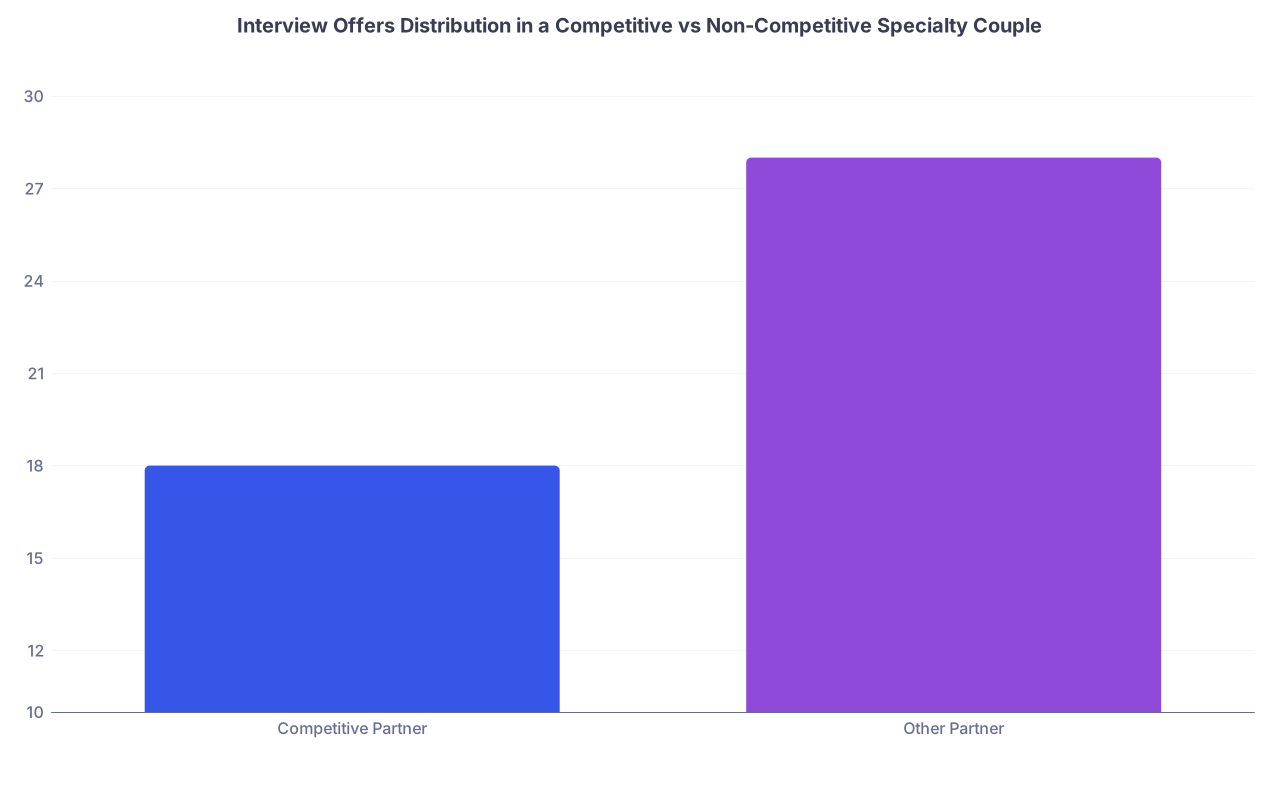
| Category | Value |
|---|---|
| Competitive Partner | 18 |
| Other Partner | 28 |
Typical pattern I’ve seen repeatedly:
- Competitive partner: fewer total invites, but often clustered in big academic centers.
- Other partner: more invites, distributed widely, including many places where the competitive partner has nothing.
Common dumb move: the other partner declines early interviews in cities where the competitive partner “hopes” to get one, but has not yet. Then the competitive invite never comes. Now you’ve both lost.
Better strategy:
Early season (first 3–4 weeks):
- Competitive partner: accept almost everything. You don’t know your true range yet.
- Other partner: accept all interviews in cities where competitive partner already has or is very likely to have interviews (strong fit, home region, etc.). For random isolated cities, you can still accept initially; you’ll prune later.
Mid-season (after you each have 8–10 invites):
- Sit down with your spreadsheet.
- Color-code cities:
- Green: both have interviews there.
- Yellow: only one partner has an interview, but other partner still has apps pending and it’s realistic.
- Red: only one has interview and other has been rejected or never applied.
Now:
- Keep all the green.
- For yellow: keep for now, but reassess weekly.
- For red: the partner with that interview decides: is this a place I’d actually consider going alone if we uncouple the match? If no, decline it and free the slot.
Late season:
- You should end up with:
- A core set of overlapping cities with interviews for both.
- A small set of non-overlap interviews for emergencies and leverage.
- You should end up with:
And you talk. Constantly. No solo decisions of “I canceled 3 interviews, it just felt like too much.” That’s fine if you’re solo. Disastrous when someone else’s life is attached.
Step 6: Building the Rank List – This Is Where People Panic
The couples rank algorithm is brutal if you don’t understand how it works. It doesn’t care how “romantic” your story is. It cares about your ordered list of pairings.
There are three big decisions you must make together:
- Are we ranking any combinations where one of us is unmatched and the other is matched?
- Are we ranking any combinations in different cities?
- What’s the line where we’d rather both go unmatched than accept X/Y combination?
6.1 Decide Your “Floor” Scenarios
You need to explicitly define your worst acceptable outcomes and your “we would rather both not match” scenarios.
Common options:
- Floor A: Both match, any specialty, any program, same city.
- Floor B: One matches, one unmatched, same city, with high confidence of SOAP opportunities.
- Floor C: Both match but in different cities (often 1-year prelim/TY situation).
I’ve seen couples quietly assume different floors and then get crushed by results that were actually “expected” by the algorithm.
If you say, “We will not rank any combination where we’re in different cities,” you accept higher risk of both not matching. Own that. Or adjust.
6.2 Use “Insurance” Pairs Intentionally
Insurance pairs are combinations like:
- Competitive partner: prelim/TY somewhere.
- Other partner: categorical in same city in a more flexible specialty.
This protects you when the main specialty does not work out but the city and relationship still matter.
For example, for a borderline ortho applicant:
- Top ranks: Ortho + IM/FM/Anes in overlapping cities.
- Then: Ortho + nothing (if you’re okay with one unmatched) OR Ortho + prelim year only.
- Then: Prelim surgery/TY + partner’s categorical IM/FM in same city.
These insurance pairs are how you avoid both being totally screwed if the main field doesn’t pan out. But they require that the other partner actually interviewed in those cities.
Step 7: Handling the Worst-Case Scenarios Before They Happen
If one of you is shooting for a hyper-competitive field, you must talk through three ugly-but-real possibilities before rank list certification:
- Competitive partner doesn’t match at all.
- Competitive partner matches prelim only.
- You match in different cities.
For each scenario, answer:
- Do we stay together long distance?
- Who moves after year 1 if a re-match happens?
- Does the competitive partner reapply, switch fields, or both?
- How many cycles are we willing to “chase” the hyper-competitive dream?
I’ve watched couples implode not on Match Day, but 6 months later when the reality of “You want to reapply derm a second time and keep us apart another year?” finally hits.
Write this down. I’m serious. One page. Bullet points. You’re not signing in blood, but you’re setting expectations while you’re still calm.
Step 8: Specialty-Specific Nuances You Should Not Ignore
Some competitive fields bring extra complications to couples matching that people forget until it’s too late.
Derm, Rad Onc, IR (and other advanced positions)
These often use:
- Transitional years (TY)
- Prelim medicine or surgery
- Advanced positions starting PGY-2
This means:
- Your partner may have to rank combinations like:
- Derm advanced in City A + TY in City B.
- Your other partner’s categorical in City A or B.
You must decide: are you willing to do 1 year apart if it leads to 3 years together after? For some couples: yes. Others: absolutely not.
Ortho, ENT, Neurosurg, Plastics
Often:
- Fewer programs per city.
- Heavy home-program bias.
- Very reputation-driven letters.
If your partner is applying to one of these and you have zero programs in your specialty in their strongest geographic region (e.g., their home institution plus all their away rotation sites are in a part of the country you hate), you need to be honest about that. They might actually have to adjust where they do aways to align with where you can live.
Step 9: Emotional Survival Plan (Because You’ll Need It)
Hyper-competitive plus couples match is a stress multiplier. Normal couples fight about dishes and social calendars. You’ll be fighting about:
- Whether to spend $600 to fly to an extra interview in a city you’re not sure you want.
- Whether one of you is being “selfish” with rank preferences.
- Whether the other one “really understands” how hard it is in derm/ortho/etc.
Do three simple things:
Set “no residency talk” times.
- One date night a week. No ERAS, no NRMP, no “but what if SOAP.” You’re still humans, not just applications.
Agree on how to handle envy or imbalance.
- If one of you is drowning in interviews and the other is getting radio silence, call it what it is. It’s normal for that to hurt. Hiding it makes it worse.
Bring in a third party when needed.
- A trusted advisor who actually understands couples match logistics.
- Not your class group chat. Not your mom. Not a random Reddit comment from “orthoBro1992.”
Quick Visual: Couples Match Flow When One Partner is Competitive

| Step | Description |
|---|---|
| Step 1 | Define priorities |
| Step 2 | Assess competitive odds |
| Step 3 | Build overlap program list |
| Step 4 | Apply broadly both partners |
| Step 5 | Track interview overlap |
| Step 6 | Prune non-overlap wisely |
| Step 7 | Define floor scenarios |
| Step 8 | Construct combined rank list |
| Step 9 | Discuss worst case plans |
| Step 10 | Certify rank list |
FAQs
1. Should the competitive partner apply to a backup specialty in the same cycle?
If you’re middle or high-risk in a hyper-competitive field and couples matching, I strongly lean yes—if you choose a backup you could actually tolerate doing. Example: an ENT applicant also sending applications to categorical IM or prelim surgery at the same institutions.
You’d then structure your combined rank list like:
- Top: primary specialty + partner’s best options.
- Middle: primary specialty + partner unmatched or prelim combos (if you’ve agreed that’s acceptable).
- Lower: backup specialty + partner’s categorical in same city.
What you do not do is “secret backup” applications the other partner doesn’t know about. That’s a trust nuke.
2. Is it ever smart to not couples match in this situation?
Yes. If:
- The competitive partner’s odds are genuinely low (multiple red flags, late switch, no research), and
- The other partner has strong prospects in highly desirable programs that don’t overlap well with the competitive field,
Then sometimes the healthier play is: apply separately, aim for the best each of you can get, then maneuver post-Match (reapplications, transfers, fellowships, etc.) to realign geographically.
It’s not romantic, but staying together long-term is about realism, not fantasy. If the couples match construct would tank both of your careers, walk away from it.
3. How many overlapping interviews do we “need” to feel reasonably safe?
No magic number, but patterns I see:
- If you have:
- 8–10 overlapping interviews in the competitive specialty’s primary city set, and
- The other partner has solid alternatives in those same cities,
You’re in a relatively good position.
Less than 5 overlapping cities? Your risk goes up fast, especially if you’re rigid on geography. Below 3, you’re basically gambling. Some couples still choose to, but don’t pretend it’s anything else.
4. Does being a couple help or hurt the competitive partner’s chances?
Program-dependent. For many hyper-competitive fields, being in a couple is neutral to slightly negative if the partner is tied to a geographic area the program doesn’t love. But if your partner is in a solid field (IM, peds, anesthesia) and applying to the same institution, some PDs actually like it—it signals stability and dual-income household support.
What matters more is how you present it on interview day. If you act like, “I will only come here if my partner also gets in nearby,” that can spook them. If instead you frame it as, “I’m very interested in building our life here; my partner is applying in X and we’d both be excited about this city,” that reads as grounded, not demanding.
Open a blank document right now and write one sentence together: “In this couples match, our top priority is _______ even if it means sacrificing _______.” If you cannot agree on both blanks, you’re not ready to submit ERAS as a couple—fix that first.