
You’re post-call, sitting in a call room that smells like old coffee and chlorhexidine. You matched into a competitive specialty — derm, ortho, ENT, plastics, radiology, whatever — the one everyone said was “impossible” to get. On paper, you won. But your stomach drops every time you walk into clinic or the OR. You’re scrolling job postings in other fields. You’re stalking Reddit threads about switching specialties at 2 a.m.
You’re not asking, “Am I burned out?” You’re asking, “Can I actually get out of this field without nuking my career?”
Here’s the blunt truth: switching out of a competitive residency is possible. People do it every year. Some pull it off quietly and land exactly where they want. Others blow themselves up by moving too fast, talking to the wrong people, or assuming “someone will take me because my scores are high.”
You’re here to avoid being in that second group.
Step 1: Get Very Clear On Why You Want Out
Before you tell anyone anything, you need to decide: is this a specialty problem or a situation problem?
Ask yourself, brutally:
- If I were doing this same specialty at a different program — different culture, better schedule — would I be happier?
- Is what I hate structural (the work itself) or local (this specific program or attendings)?
- When I picture myself as an attending in this field, with more control and better hours, does it still feel wrong?
If you’re early (PGY-1 or early PGY-2), everything is miserable. That’s normal. But there are red flags that this is more than “normal misery”:
- You dread the content of the work, not just the workload. For example: in ortho you hate the OR, hate fractures, hate the procedures — not just the hours.
- You feel fundamentally misaligned with the patient population and typical problems.
- You feel a weird relief when you’re pulled to help another service you actually like — medicine, peds, EM, psych — and a pit in your stomach when you have to go back to your own.
If it’s a program issue (toxic culture, malignant leadership, unsafe workload), switching specialties might not be the answer. Switching programs inside the same field is sometimes easier and safer.

| Step | Description |
|---|---|
| Step 1 | Unhappy in Residency |
| Step 2 | Consider specialty switch |
| Step 3 | Consider same specialty different program |
| Step 4 | Start confidential planning |
| Step 5 | Explore transfer options with PD or chair |
| Step 6 | Hate work itself or just program |
If you’re confident it’s the field itself — not just the program — keep going.
Step 2: Understand the Risk Profile (What You’re Actually Gambling)
You’re thinking about walking away from:
- A guaranteed training slot in a competitive field
- A clear path to a high-income job
- Years invested in matching here: research, away rotations, letters
And you’re walking toward:
- Uncertainty: no guaranteed open spot in your target field
- Possible periods of unemployment or prelim-only positions
- Needing help from the very people you might be leaving
You are not crazy to switch. But it is risky, and pretending it’s not is how people end up unmatched at 30.
The biggest risks:
- Losing institutional support. If your current PD or chair feels blindsided or insulted, they can quietly destroy your chances by not supporting you or, worse, calling around.
- Timing mismatches. You decide too late to enter the Match, or you miss mid-year vacancy opportunities.
- Burning bridges unnecessarily. Saying too much too early, or to the wrong person, before you have a plan.
- Financial strain. Gaps in training = gaps in salary + more loans accruing interest.
Your goal is not “switch at all costs.” Your goal is “switch with maximum safety net.”
Step 3: Map Out Your Exit Strategy Before You Speak
You need a working plan before you inform leadership. Think in scenarios, not wishes.
You should answer these questions quietly, for yourself:
- Which field(s) am I realistically targeting?
- Do I want to use the Match, or aim for an out-of-match vacancy/transfer?
- What’s my absolute drop-dead date to decide this year vs wait a cycle?
Here’s what most residents underestimate: timelines. Matching into another field is not instant. You’re dealing with academic year cycles, funding constraints, and ACGME rules.
| Path Type | Pros | Cons |
|---|---|---|
| Apply in regular Match | Structured, predictable, more spots | Long wait, must plan a year ahead |
| Take open PGY-1/2 spot mid-year | Faster, less formal | Fewer spots, messy logistics |
| Do a prelim/transitional year | Keeps you training, earns credit | Still uncertain, extra move sometimes |
| Research year then reapply | Builds CV, buys time | Lower pay, risk of drifting |
You want at least a primary plan and a backup plan. Example:
- Primary: Stay in current residency for rest of year, apply through ERAS into IM/EM/Anesthesia this fall, start new residency next July.
- Backup: If nothing hits in the Match, look aggressively for SOAP positions or mid-year vacancies and be prepared to do a prelim year.
Step 4: Reality-Check Your Target Specialty
You’re leaving a competitive field. That does not mean you’re automatically golden in your new one. Programs care mostly about fit, real interest, and how much of a headache it will be to bring you in.
You need to answer three things clearly for yourself (and later for PDs):
Why that new specialty — specifically?
“Better lifestyle” is not enough. You need experiences to point to: rotations, electives, cases where you felt engaged doing their work.How does your previous training help them?
Example:- A radiology resident going into EM: strong imaging skills, can read basic CTs independently, understands workflows with radiology.
- A neurosurgery or ortho resident going into anesthesia: comfortable in the OR, knows surgical pacing, good with procedures.
What year would you realistically enter?
Don’t assume all your current time will count. Many programs will restart you at PGY-1 or PGY-2 even if that feels insulting. Pride kills more switches than you’d think.
Step 5: Quiet Reconnaissance (Before You Out Yourself)
This is where people either do this smartly or blow it up.
You do not start by walking into your PD’s office and saying, “I want out.” You start with external information gathering.
Here’s how:
Identify 2–3 trusted attendings or faculty outside your chain of command.
Ideal: someone who knows you, is not your PD/assistant PD, and has no power over your evaluations. Could be:- An attending from medical school who liked you
- A faculty member from an elective in your target field
- Their junior faculty who remember being in your shoes
Send a short, focused email.
Something like:“I’m currently a PGY-2 in [Specialty] at [Program]. I’ve been seriously considering a switch to [Target Specialty] for well thought-out reasons related to fit and long-term goals, not burnout alone. Before I talk to my program leadership, I’d really appreciate 15–20 minutes of your honest perspective on feasibility and timing. I want to do this in a way that’s responsible and professional.”
On the call/meeting, ask specific questions:
- If you saw an applicant like me (X board scores, Y year, Z experience) trying to switch into your field, how realistic is this?
- How often do you see transfers? What makes the successful ones different?
- Would you recommend going through the Match or hunting for a direct transfer spot?
Do not ask them to call your PD or start lobbying. You’re still in recon mode.
Step 6: Protect Your Evaluations While You Plan
Keep performing. I know you’re over it. You still need solid evaluations and no professionalism red flags. PDs talk. Any hint of “checked out” or “attitude problem” will follow you.
So:
- Show up on time.
- Do the work.
- Do not vent about leaving to co-residents who can’t keep their mouths shut.
Program directors are much more willing to help a resident switch if that resident is clearly conscientious and not poisoning the well as they go.
Step 7: Timing the Conversation With Your PD
Once:
- You’re sure you want to switch fields,
- You’ve gathered outside intel that it’s feasible, and
- You’ve sketched a basic timeline…
…then you bring in your PD. Not before.
This conversation is delicate. Your goals:
- Be honest but not dramatic.
- Make it about long-term fit, not trashing the program.
- Signal that you want to leave professionally and minimize disruption.
Here’s roughly how I’d phrase it:
“I appreciate the opportunity I’ve had here and I’ve learned a ton. Over the past year, after a lot of reflection and talking with mentors, I’ve realized that long-term my interests and strengths line up better with [Target Specialty]. This isn’t about the program; you and the team have been supportive. It’s truly about fit with the day-to-day work.
I want to handle this the right way and on a realistic timeline. I’d like your advice on the safest way to explore transitioning into [Target Specialty] while continuing to contribute here and not leaving anyone in a bind.”
Then shut up and listen.
Most PDs fall into one of three buckets:
Supportive realists.
They’ll say, “Okay, let’s figure out how to make this work without wrecking your career.” These are gold. They may:- Help you time an ERAS application
- Reach out to other PDs
- Let you use elective time to rotate in the new field
Guarded but not hostile.
Slightly defensive, concerned about staffing. They may say, “Let’s see how you feel after this year,” and drag their feet. You’ll have to be persistent but polite.Hostile/controlling.
Minimize your concerns, guilt-trip you about taking a spot, or subtly threaten lack of support. Those are harder, but still not impossible. You will lean more on external mentors and possibly GME.
Whatever you do: don’t lie or play games with your PD once you open this door. That’s how people get labeled as “untrustworthy,” which is poison.
Step 8: Understand How Your Training Time Might Transfer
Different specialties and boards handle prior training in different ways. You need to know if your time will “count” or if you’re basically starting over.
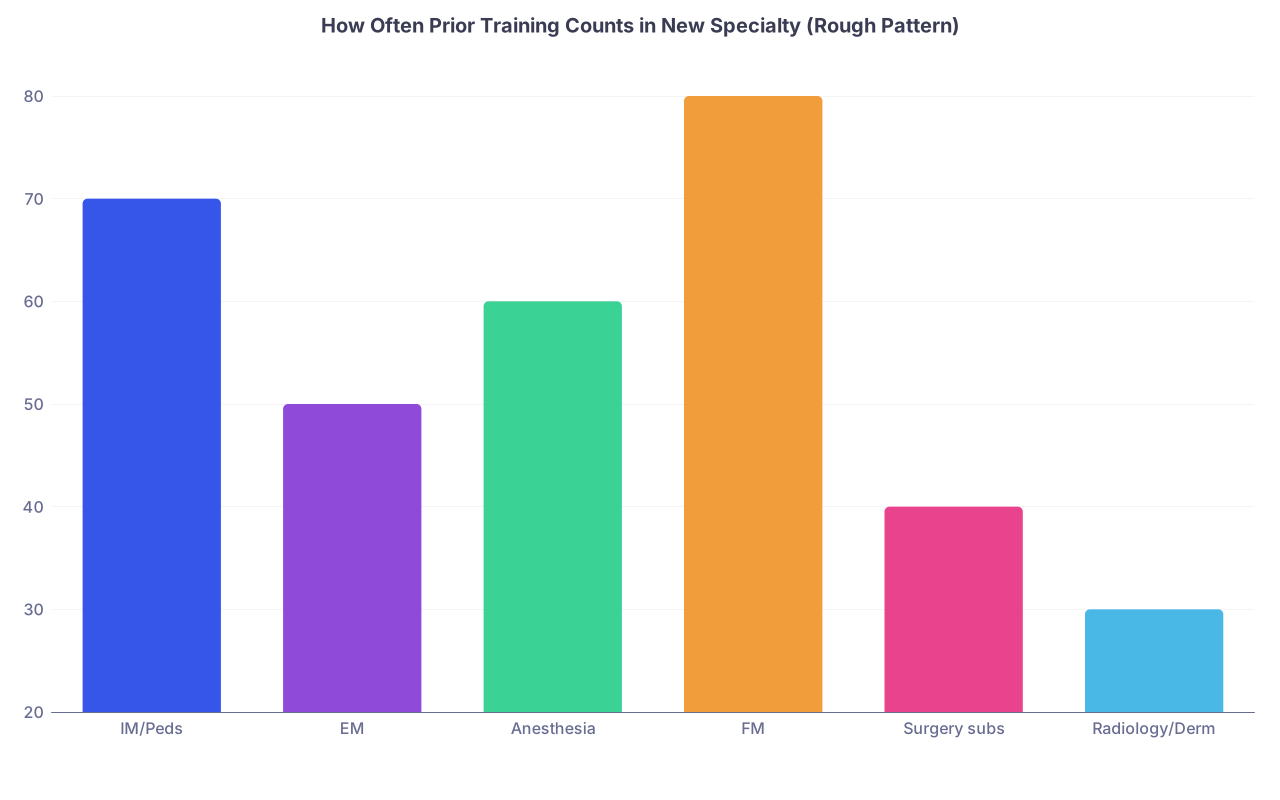
| Category | Value |
|---|---|
| IM/Peds | 70 |
| EM | 50 |
| Anesthesia | 60 |
| FM | 80 |
| Surgery subs | 40 |
| Radiology/Derm | 30 |
These are directional, not strict rules, but pattern-wise:
- Switching into IM, FM, Peds: often most prior clinical years count, especially if they included general inpatient work.
- Switching into Anesthesia or EM: some time may count; often you enter as PGY-2 but it varies.
- Switching into another surgical subspecialty: messy. They may credit some time but still want you earlier in their sequence.
- Switching out of radiology/derm into more clinical fields: less of your time counts because your work hasn’t been ward-based.
You confirm this by:
- Checking ACGME or specialty board rules on “advanced standing”
- Asking the target PD specifically what year you would be slotted as if they took you
Don’t let ego kill realistic opportunities because you feel you “shouldn’t have to repeat” a year. Sometimes repeating one year is the price of 30 years in a field you actually don’t hate.
Step 9: Strategize ERAS vs Direct Transfer
There are two main pathways to switch:
A. Apply through the Match (ERAS)
Better when:
- You’re early in training (PGY-1 or early PGY-2)
- You want a full search with multiple options
- You can tolerate staying in your current program until next July
You’ll need:
- A new personal statement that actually explains the switch without sounding unstable.
- Letters:
- At least one from your current field saying you’re solid and professional
- One or two from your target field, even if from med school electives or short observerships
- A smart list: some mid-tier/safety programs that actually take residents switching from other specialties.
B. Direct transfer to an open spot (out of Match)
Better when:
- You’re later in training and don’t want to wait a whole year
- A program has a known vacancy (resident moved, fired, left, etc.)
- You have a PD who’s willing to pick up the phone for you
These spots are found by:
- Word of mouth (your PD or chair calling colleagues)
- Emails to PDs in your target region: short, respectful, CV attached
- Occasionally posting lists (e.g., specialty listservs or program websites)
Direct transfer is faster but more chaotic. And you might have to move quickly with little geographic choice.
Step 10: Financial and Life Logistics (You Ignore This at Your Peril)
A lot of residents pretend the money logistics will “work itself out.” It doesn’t.
You need to sit down and do real math:
- How many more years of training will this add?
- What will your salary be during that time vs what you’d make if you stayed?
- Do you have dependents, a partner, a mortgage?
Then do something uncomfortable: call a financial advisor or at least use a calculator to compare:
- Scenario A: Stay in current field, finish on time, start high-paying attending job
- Scenario B: Switch, add 1–2 years of residency, possibly into a lower-paying field long-term
Sometimes the answer is still “switch.” But you’ll do it with your eyes open.
Step 11: How to Explain the Switch Without Sounding Flaky
Everyone you meet in your new field — PDs, attendings, interviewers — is going to ask, “So why are you leaving [Fancy Competitive Specialty]?”
Here’s what a good answer sounds like:
- Starts with something positive about what you learned where you are
- Then shifts to specific aspects of the new field that are a better fit
- Avoids trashing your old specialty or program
Example framework:
“In [Current Specialty], I’ve really appreciated [X skills/experiences], and I’m grateful for the training I’ve received. Over time, I realized that the parts of my day that were most satisfying were [describe things that align with new specialty — longitudinal patient relationships, acute decision making, procedures, etc.].
When I rotated in [Target Specialty], that same pattern was obvious. The work felt more natural to me — the pace, the patient relationships, the type of problem-solving. Long-term, I see myself building a career that looks like [describe realistic attending life in new field], and I don’t see that within [Current Specialty]. So this is a proactive decision to align my training with where I can do my best work for patients.”
If you start with, “I hated my residency; the hours were bad,” they’ll screen you out as just running away.
Step 12: Worst-Case Backups: If the Switch Fails
You need a contingency plan that’s not just “hope.”
If you:
- Apply in ERAS and do not match
- Fail to find a direct transfer spot
- Or your PD refuses to support you and doors close
Then what?
Common fallback paths:
- Stay and finish your current residency, then re-evaluate as an attending (and consider fellowship or practice type that’s a better fit)
- Do a one-year prelim or transitional year while re-applying (higher risk)
- Step away, do research/public health/industry work, and try again later (also risky, networking-dependent)
This is why you don’t resign your current spot until you have a signed contract for the new position or an absolutely firm GME-approved transfer plan. No dramatic exits. No “I’m done here” speeches.
A Quick Visual: The Safer Switch Path

| Step | Description |
|---|---|
| Step 1 | Realize poor specialty fit |
| Step 2 | Clarify reasons |
| Step 3 | External mentors recon |
| Step 4 | Choose target specialty and plan |
| Step 5 | Maintain performance |
| Step 6 | Talk with PD |
| Step 7 | Apply through ERAS |
| Step 8 | Search for open spot |
| Step 9 | Interview and accept offer |
| Step 10 | Coordinate GME-approved transition |
| Step 11 | Match vs Transfer |
You’re trying to stay on that path. Anytime you start veering into emotional blowups, secret half-plans, or torched relationships, you’re off it.
Key Takeaways
- Do the quiet work first: confirm it’s truly a specialty mismatch, get external reality checks, and map a timeline before you tell your PD.
- Protect your reputation and evaluations while you plan; your “exit letters” and PD support are the currency that buys your way into a new field.
- Never resign or mentally check out until you have a real, written plan for where you’re going next — you’re switching paths, not jumping off a cliff.