
The most dangerous part of your residency application is not what you wrote. It is what is missing.
Program directors in competitive specialties are not skimming your CV; they are hunting for gaps. Those gaps form your “shadow CV” – the hidden narrative they infer from what you did not do, did not finish, or did not bother to explain. In fields like dermatology, plastics, ortho, ENT, neurosurgery, radiology, ophthalmology, and integrated IR, your shadow CV can quietly kill your application long before anyone reads your personal statement.
Let me walk you through the mistakes that create a damaging shadow CV, why they matter more in tough specialties, and how to plug those holes before your application ever goes out.
What a “Shadow CV” Really Is (And Why It Hurts You Most in Competitive Fields)
Your formal CV lists activities, dates, titles, publications. Your shadow CV is everything a PD infers when those details do not line up.
You think you are saying:
- “I took a year for research.”
- “I switched interests late.”
- “I had some personal stuff going on.”
They see:
- “Could not commit.”
- “Low initiative.”
- “Red flag I will have to deal with at 2 a.m.”
In ultra-competitive specialties, they do not have to take chances on unclear stories. They have 10 other applicants with similar scores and cleaner timelines.
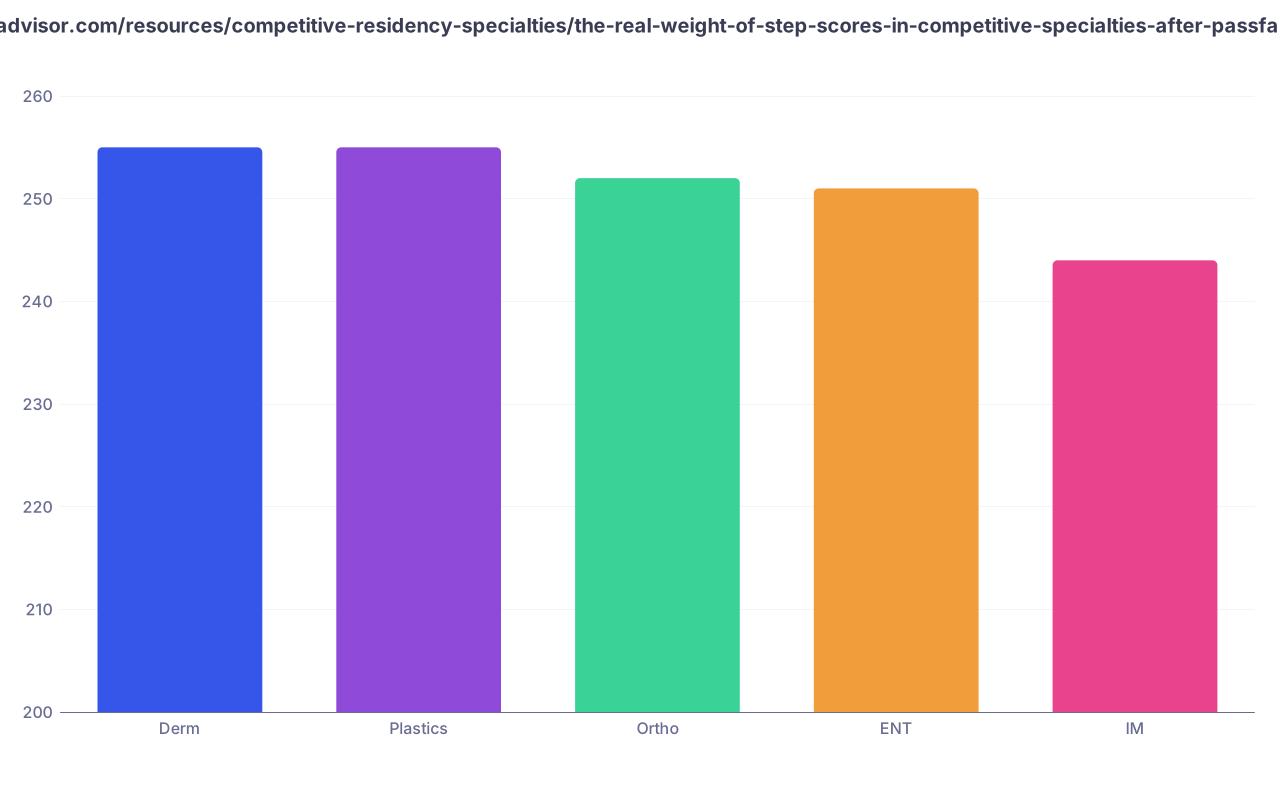
Look at what they are dealing with:
| Category | Value |
|---|---|
| Derm | 255 |
| Plastics | 255 |
| Ortho | 252 |
| ENT | 251 |
| IM | 244 |
When everyone at the top is clustered in the mid‑250s, they stop using scores to separate you. They use your trajectory, your consistency, and whether your story makes sense. That is where your shadow CV starts screaming.
Shadow CV Mistake #1: “Dead Air” in Your Timeline
The most obvious gap is time. Months or years that have no clear, constructive activity attached.
Common offenders:
- Eight months “off” between M3 and M4 with no listed work, school, or research.
- A “research year” with one poster and vague responsibilities.
- A gap after graduation before applying without explicit explanation.
- Significant leave (personal, health, family) that is never mentioned anywhere.
Program directors are not stupid. They know people get sick, burn out, have kids, switch paths. They are not offended by reality. They are offended by ambiguity.
What they may think when they see time-blackouts:
- Failed something and hid it.
- Academic probation.
- USMLE failures or multiple attempts not disclosed elsewhere.
- Behaviour or professionalism issues.
In competitive specialties, unexplained gaps are rarely forgiven. Not because they are cruel, but because they have more applicants than positions and they prioritize people whose reliability they can predict.
How to avoid the “dead air” trap
Do not pretend the gap is invisible.
That fantasy is for preclinical years, not ERAS. If there is a substantial period (3+ months) where you were not in coursework, clinicals, or formal employment, you must account for it.Populate the time with something real and documentable.
Not vague “self-study.” Examples that actually read well:- Clinical research assistant in cardiology, 0.5 FTE.
- Volunteer interpreter at free clinic, weekly sessions.
- Remote data analyst for QI project.
Use the experiences section to label the period clearly.
A bland but honest entry like: “Academic leave – personal/family reasons” with dates is better than nothing. You do not have to write your life story, but you must show that you are not hiding the time.Be ready with a one‑sentence, calm explanation for interviews.
Not a confessional. A clean line:- “I took a leave to address a health issue; it is fully resolved and I returned to full-time clinical duties without restrictions.”
- “I took a year to care for a sick family member and completed part‑time research during that period.”
Silence is the mistake. The gap itself is often survivable; secrecy kills you.
Shadow CV Mistake #2: “Tourist” Interest in a Competitive Specialty
One of the fastest ways to get filtered out in derm, ortho, plastics, ENT, or IR is to look like a tourist. Interested for six months. Nowhere to be found before that.
This shows up as:
- Zero specialty‑related activities before late M3, then suddenly 3 home electives and 2 away rotations.
- No specialty‑specific research until a last‑minute project the year you apply.
- A personal statement claiming lifelong passion for the field, while your CV shows three years of generic IM and neurology clinics.
Program directors look for sustained interest. Not last-minute conversions when you realized your Step score was high enough.
Here is what a “tourist” trajectory versus a “committed” one looks like:
| Year | Tourist Applicant | Committed Applicant |
|---|---|---|
| M1 | Generic preclinical | Shadowed in target specialty, joined interest group |
| M2 | Random non-related research | Early research with specialty faculty |
| M3 | Core clerkships only | Requested elective time in specialty, early |
| Late M3 | Sudden away rotation requests | Strong letters from home specialty faculty |
| M4 | 3–4 aways to compensate | Selective aways complementing solid home record |
Tourists make PDs nervous. They question whether you will bail on the field when it gets hard, or if you are simply chasing prestige.
How to avoid the “tourist” shadow
If you are early (M1/M2):
- Get one real contact in the specialty. Not just an interest group. An actual attending or fellow who knows your name.
- Attach yourself to any small project: chart review, case report, retrospective study. The aim is your name on something, not a Nature paper.
If you are late (M3 already, genuine switch):
- You cannot rewrite history, but you can avoid looking frivolous.
- Explain the pivot cleanly in your personal statement and in the MSPE if possible. Not “always wanted X.” Be honest:
- “After my surgery rotation, I realized I wanted longitudinal follow-up and clinic, which drew me to derm.”
- Show intensity to compensate for lack of duration:
- Rapidly start 1–2 focused projects.
- Lock in at least one home rotation and one away with meaningful faculty contact, not just “checking a box.”
What you must not do: pretend your three-month sprint equals someone else’s three‑year build. PDs can tell.
Shadow CV Mistake #3: Research That Quietly Screams “Passenger”
In competitive specialties, your research section is not judged only by output. It is judged by pattern.
Red flags that signal you were a passenger, not a driver:
- Multiple “submitted” papers, zero accepted, all first‑time submissions to mid-level journals.
- Case reports with you as middle author only, scattered across several specialties.
- Presentations where your name is 7th or 8th on a large team, with no linked mentor letter explaining your role.
- Big blocks of “Research assistant” with minimal specifics on methods, outcomes, or deliverables.
A shadow CV narrative forms: you showed up, but you did not lead. You were “there,” but you did not own anything. In derm, plastics, IR, or ENT, where almost everyone has “research,” this quietly pushes you down the pile.
How to avoid the “research passenger” label
Get at least one project where you are clearly the point person.
It does not have to be huge. A simple retrospective chart review with you as 1st or 2nd author is far better than being #9 on a giant registry paper.Write your research entries like someone who understood the work.
Compare these:Weak:
“Assisted with data collection for project in orthopedic outcomes.”Stronger:
“Retrospective review of 220 arthroplasty cases; extracted EMR data on complications and 90‑day readmissions, performed preliminary descriptive analysis in R.”The second entry tells a PD you were actually in the weeds, not just scanning charts.
Do not overinflate “submitted” and “in progress.”
Ten “submitted” articles signals overreach or padding. One or two is fine. Beyond that, people assume the worst.Make sure at least one recommender can articulate your research role.
If your letter says “X worked on my project,” but never explains what you did, PDs assume: minimal. Ask your mentor to be specific about your contribution.
The mistake is not “too little research.” It is unclear research that makes you look ornamental.
Shadow CV Mistake #4: Rotation Choices That Contradict Your Story
Your rotations are a visible allocation of your most precious resource: time. PDs look where you chose to spend it when you finally had some control.
Common contradictions:
- Applicant claims deep interest in ortho but did extra electives in cardiology and GI, not MSK or sports.
- IR applicant with zero ICU or vascular-surgery‑adjacent electives.
- Derm applicant loading M4 with away rotations in non‑competitive fields “for backup,” leaving minimal derm time.
- Student telling everyone they are “all in” for neurosurgery but only doing one neurosurgery elective, then a long stretch of non-surgical rotations.
These choices broadcast doubt, lack of planning, or an attempt to game the system. Especially when combined with vague statements of “lifelong interest.”
How to structure rotations so your shadow CV matches your stated goals
You do not need every elective to be in your chosen specialty. That looks desperate and narrow. But your pattern must make sense.
For a competitive specialty, a reasonable structure might be:
- 2–3 rotations in the target field (home + 1–2 aways).
- 1–2 closely related fields that clearly strengthen your application: ICU, trauma, rheum for ortho; rheum and allergy for derm; vascular and ICU for IR.
- 1–2 rotations in areas that broaden skills without undermining your claim: palliative, radiology for anatomy/imaging, hospitalist medicine.
What you should avoid:
- Long “mystery blocks” in fields you never mention in your application narrative.
- Overemphasis on an obvious backup specialty that makes you look half‑committed.
- Random non‑clinical electives that scream burnout without explanation.
If you already made questionable choices, your job now is to build a coherent explanation that ties them into your story instead of pretending they do not exist.
Shadow CV Mistake #5: Letters That Do Not Match the Rest of the File
Your letters are the most invisible part of your CV, but they shape your shadow more strongly than any line on your ERAS. PDs do not just read content; they match the letter to the rest of your story.
Here is where gaps appear:
- No letter from core faculty in the specialty (for a competitive field, this is almost fatal).
- Letter writers from random electives that do not align with your stated interests.
- A big derm research year but no letter from your derm research mentor.
- A senior student bragging about being “hard‑working and dependable,” but with rotation narratives that say “inconsistent performance” or “improved over time.”
Those misalignments tell PDs there is a reason key people did not write for you. They may not know what the problem is, but they assume there is one.
How to keep letters from sabotaging you
Identify the “must‑have” letter sources for your field early.
For most competitive specialties:- At least one letter from a home specialty faculty who saw you clinically.
- Ideally one from away rotation faculty (for some fields).
- One from your research mentor if you did a dedicated year.
Do not stack letters from safer fields at the expense of your target specialty.
A glowing letter from a family medicine attending will not salvage a derm application without strong derm letters.Make your letter packet coherent with your CV.
If you are selling your “trajectory in the specialty,” but none of the people you worked with in that trajectory are vouching for you, your application reads as hollow.Give your letter writers a brief, honest context email.
Mention: your target specialty, major projects, and any gaps you are worried about. Some attendings will explicitly address them in a way that neutralizes concern.
The mistake is assuming all “strong” letters help equally. They do not. Specialty‑aligned letters that echo your visible record carry far more weight.
Shadow CV Mistake #6: Board Scores That Do Not Fit Your Risk Profile
In highly competitive specialties, everyone knows the approximate score bands. PDs will not tell you their exact cutoffs, but they act like they have them.
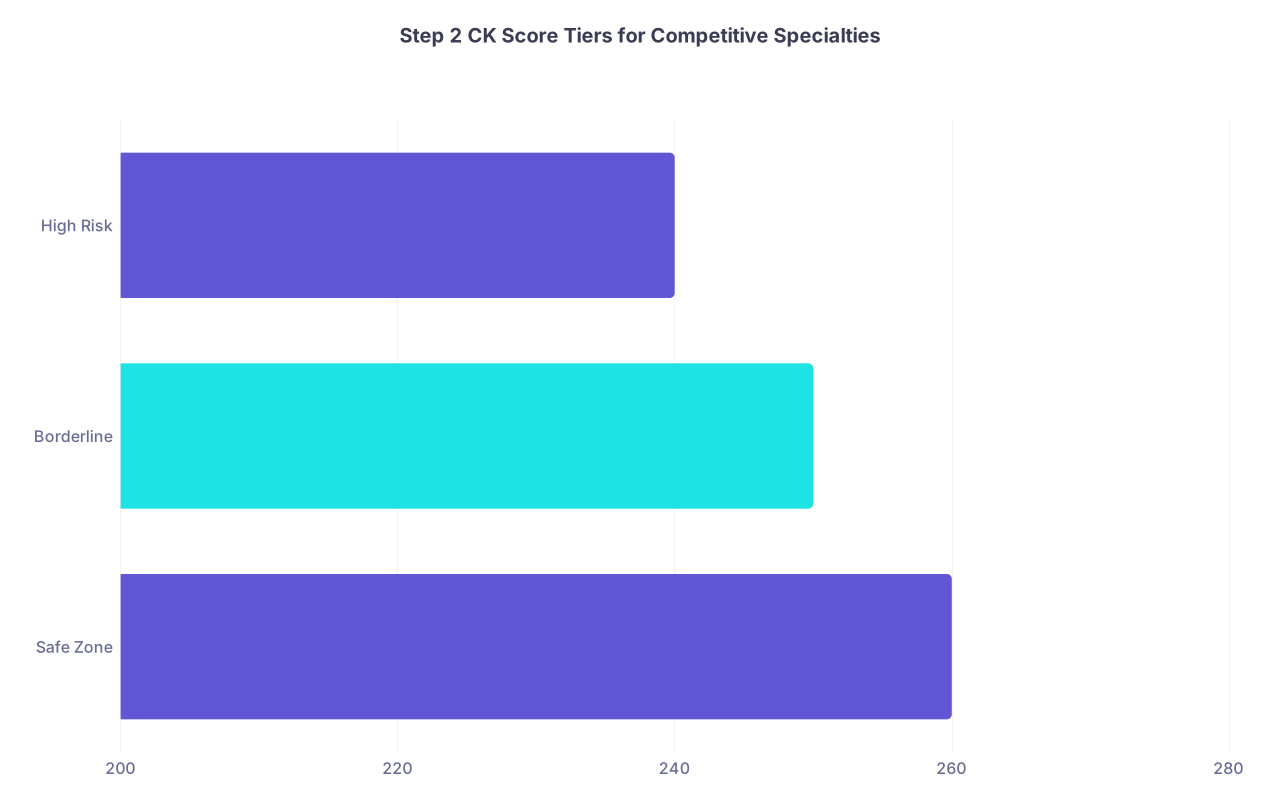
Here is the rough reality (Step 2 CK, post-Step 1 P/F environment; numbers shift slightly by year, but the pattern holds):
| Category | Value |
|---|---|
| Safe Zone | 260 |
| Borderline | 250 |
| High Risk | 240 |
Now combine this with your other gaps:
- A 239 for derm with minimal derm research and a late switch? That is a serious shadow.
- A 250 for plastics but with a one‑year unexplained gap and no plastic letters? PDs assume there is a hidden issue.
- A strong score but a pattern of repeated Step 1 attempts (even if pass on third) not addressed anywhere? Red flag.
The mistake many applicants make: they treat scores as standalone strengths, independent of the rest of their file. PDs never do that. They look for internal consistency: does your score level match the story you are trying to sell?
How to avoid the score‑shadow trap
Be brutally honest about where your score sits for your chosen field.
Talk to recent applicants who matched and unmatched. Ask them what score ranges actually made it through filters.If you are below “comfort range,” do not create additional unexplained gaps.
You are already asking them to take a small risk on scores. Do not layer on mysterious leaves, weak research, or unclear timelines.If there is any anomaly (multiple attempts, very late Step 2, big improvement):
You address it. Briefly. Either in your personal statement or an advisor-supported comment. Leaving it for PDs to interpret is inviting the worst assumptions.Align your application breadth with your risk profile.
Low score + gaps + ultra‑competitive specialty + narrow list of programs = predictable disaster.
You cannot change the score. You can avoid compounding the risk with a confusing shadow CV.
Shadow CV Mistake #7: Backup Plans That Leak Into Your Application
Here is the uncomfortable truth: program directors know most applicants hedge. What they despise is when that hedging bleeds into your visible record in a way that undermines your commitment.
Examples that hurt you:
- You are applying ENT but also sending full ERAS applications to internal medicine with nearly identical personal statements.
- Your CV lists you as “President – Internal Medicine Interest Group” in M4 while claiming to be fully committed to IR.
- You ask the same attending for a letter “for derm or for IM, depending,” and the letter ends up so generic it helps neither.
Your backup plan becomes part of your shadow CV. PDs see your uncertainty, and faced with a surplus of strong candidates, they choose the person who does not look like they are half‑out the door.
How to hedge without sabotaging yourself
Separate primary and backup application narratives completely.
Different personal statements. Different letter sets where possible. Different emphasis on your CV.Do not let your leadership and capstone activities contradict your primary target.
If you lead a big IM initiative in M4, explain the transition in your primary specialty materials instead of pretending it did not happen.Use faculty advisors who are not naïve about competitiveness.
Someone who has actually seen students crash trying to dual apply in nonsense combinations will tell you straight when your backup strategy is suicidal.If you truly dual apply, commit in each setting.
Nothing screams “I do not belong here” like telling a PD in an interview that their specialty is your “backup.”
The mistake is not having a backup. The mistake is making it obvious in a way that poisons your primary application.
How to Audit Your Own Shadow CV Before You Apply
You cannot fix what you do not see. Most applicants are blind to their own gaps because they know the “real story” in their head and assume others will too. They will not.
Do this instead:

| Step | Description |
|---|---|
| Step 1 | Print ERAS PDF |
| Step 2 | Hide Personal Statement |
| Step 3 | Mark All Unexplained Gaps 3+ Months |
| Step 4 | Circle Activities Not Aligned With Target Specialty |
| Step 5 | Check Research For Clear Roles |
| Step 6 | Match Letters To Key Experiences |
| Step 7 | Ask Honest Senior Resident To Review |
| Step 8 | Write Brief Explanations For Each Gap |
Key questions to ask yourself ruthlessly:
- If I knew nothing about me, what story would I build from this timeline?
- Where would I suspect something bad happened?
- Where does my stated interest in X not match what I actually spent time doing?
- Is there any period where a PD would reasonably think: “What were they doing then?”
If you cannot answer those without twisting, you have work to do.
Open your ERAS draft or CV right now and do one thing: highlight any stretch of 3 or more months with no clear, constructive activity listed. For each of those, write a single sentence explaining what you were doing. If you cannot produce a clean, honest line for every gap, that is your priority this week. Plug those holes before they become the shadow that sinks your chances.