
Program directors in dermatology, plastics, and orthopedics are not looking for the same “top applicant.” They are all playing different games with different rules—and most applicants have no idea.
I’ve sat in those ranking meetings. I’ve listened to PDs argue over a 240 vs 250, over “he’s a beast in the OR” vs “she’s got 3 first-author papers.” Let me walk you through what actually drives the rank list in these three ultra-competitive specialties. It’s not what Reddit tells you.
We’ll go specialty by specialty, then I’ll show you how they stack up when the doors close and the committee starts fighting over slots.
The Common Ground: What All Three PDs Actually Care About
Before we split them, let’s be blunt: at the highest tier, all three fields want the same baseline:
- You are not a liability.
- You can handle the workload without melting down.
- You make the program look good on paper and in the match data.
They all screen on numbers first. Yes, even in the “holistic” era. They won’t say it in public sessions, but the first pass is brutal.
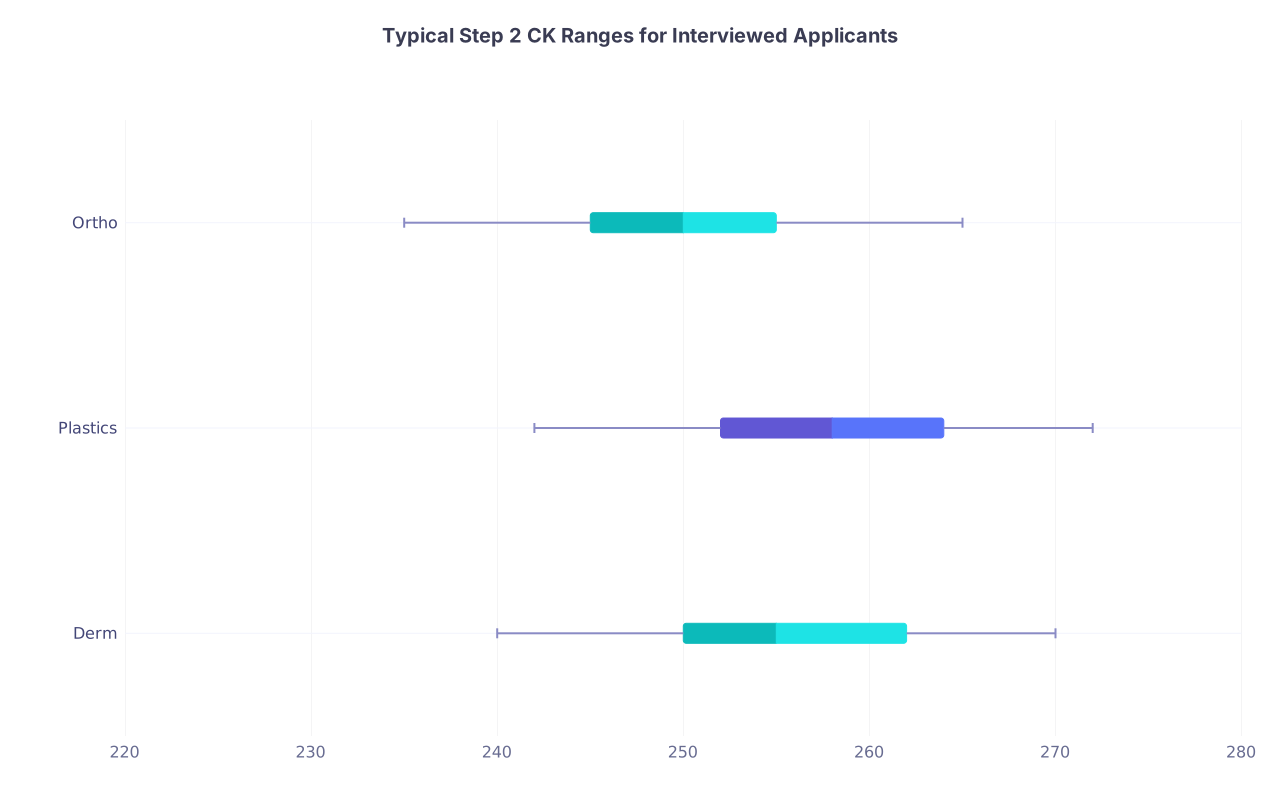
| Category | Min | Q1 | Median | Q3 | Max |
|---|---|---|---|---|---|
| Derm | 240 | 250 | 255 | 262 | 270 |
| Plastics | 242 | 252 | 258 | 264 | 272 |
| Ortho | 235 | 245 | 250 | 255 | 265 |
Here’s the quiet truth: by the time files hit the “ranking” discussion, 90% of what pre-meds obsess over—exact score, minor ECs, pre-clinical awards—is already resolved. The rank meeting is about three big questions:
- Will this person thrive in our culture?
- Does this person advance our program’s priorities? (research, reputation, OR volume, fellowship placement)
- Is anyone in this room willing to go to bat for them?
That last one is where derm, plastics, and ortho split dramatically. The kind of “champion” you need is different in each field.
Dermatology: The Academic Arms Race
Derm PDs pretend to be chill in public. They’re not. Behind closed doors, derm is the most neurotic and status-conscious of the three.
How derm PDs actually build the rank list
At many derm programs—especially university-based—your file gets mentally sorted into tiers right away:
- Tier 1: “Obvious yes” – high Step 2, strong derm research, derm home rotation, big-name LORs.
- Tier 2: “Context-dependent” – good scores, some derm interest, maybe weaker research or letters.
- Tier 3: “We need a reason” – lower metrics, late switchers, off-brand schools, or minimal derm exposure.
The ranking meeting is mostly reordering Tiers 1 and 2. Tier 3 occasionally gets rescued by a powerful advocate.
What quietly drives derm PD decisions:
Research pedigree, not just volume
They don’t care that you did “research.” They care where and with whom. A PD will skim your CV and say, “This is all case reports from a private practice derm group,” and your supposed “research strength” evaporates.
Three first-author papers with a known name at a top-30 institution can outweigh ten weak abstracts.Derm letters from insiders
This is where derm is the most insider-rigged specialty. A short, specific letter from a known academic dermatologist often beats a flowery, generic letter from someone unknown.
I’ve seen this happen:
“Her chair wrote this. He never writes this strongly.”
And she moves up ten spots.Perceived future academic value
Many derm PDs want future faculty or at least future thought leaders. If your file screams “future community cosmetic practice, zero academic intention,” that can quietly hurt you at academic programs—unless they specifically want community track people. They’ll never say this to you on interview day, but they say it to each other.Polish and “low drama”
Derm is small and political. They are terrified of bringing in someone who will create drama, complain constantly, or detonate on social media. Anything in your file that hints at volatility gets magnified.
This is why flawless professionalism on rotations matters more here than in ortho or plastics. You can’t be the “edge-lord resident” in derm and last long.
So what actually breaks ties between two similar derm applicants? Usually:
- The letter writer’s reputation.
- More serious research at a real derm institution.
- Obvious professionalism and maturity on interview and away rotation.
- A PD saying, “I can see this person as our chief.”
Orthopedics: The Cult of the Workhorse
Orthopedic surgery has a very different culture. They’ll deny the stereotypes, but the selection process proves them.
Here’s the truth: ortho PDs love three things—workhorse residents, procedural comfort, and “being one of us.” They don’t want a fragile genius. They want someone who will show up at 4:30 AM, do cases all day, and not whine.
How ortho PDs stack your file
When the committee sits down, the conversation sounds nothing like derm.
You’ll hear:
- “He was a machine on our service.”
- “She ran the list like a second-year.”
- “He’s a beast in the OR but a little rough with nurses. That’s a problem.”
The things that secretly weigh heavier than you think:
Rotation performance > everything
Away rotations and your home rotation define you. I’ve watched PDs barely glance at a CV for a student they already loved on rotation. The resident opinion matters a ton in ortho.
If the entire PGY-2 and 3 class is saying, “Take her, she crushes it,” you’re near the top of the rank list, even if your research is unimpressive.Operative potential and coachability
Ortho PDs want to know:- Are you coordinated in the OR?
- Do you listen the first time?
- Can you take feedback without sulking?
They rely heavily on informal comments like: “He picked up the technique quickly,” or “She was already comfortable with power tools and reduction maneuvers.”
Physical and mental stamina
Nobody says this at interview days, but in the back room they absolutely talk about it. Residents mention who faded by noon, who disappeared during long cases, who complained about Q3 call.
“He was vertical but not present after 4 PM” is a real phrase I’ve heard.Cultural fit with the “team sport” mentality
Ortho leans heavily toward “this is a family” branding, but they mean it in a very specific way. They want people who socialize, who will come to sports events, who don’t hide in the call room.
If you felt “off” with the residents, trust me—they noticed you too, and it comes up when ranking.
Research matters in ortho, but in a different way than derm or plastics. Clinical ortho research is a plus, but a workhorse with one poster can outrank a non-functional researcher with five papers. Pure PhD-level basic science without any evidence you can handle clinical life actually raises red flags.
Plastics: The Hybrid Beast (Surgery + Aesthetics + Academia)
Plastic surgery PDs are the most conflicted of the three. They are trying to select for:
- technical excellence,
- academic/innovation potential,
- aesthetic judgment,
- and surgical toughness,
all at once. That’s not easy.
For combined/integrated plastics programs, the applicant pool is tiny but hyper-curated. By the time you reach the rank meeting, everyone looks impressive on paper. Step scores, AOA, research—far above average.
So how do plastics PDs separate them?
How plastics PDs actually think
Technical talent and hands
Plastic surgeons are obsessed with fine motor skills and attention to detail. This obsession bleeds into how they interpret rotations.
Residents will say things like, “She had really good hands,” or “He was clumsy around delicate structures.” That feedback carries significant weight.Sophisticated understanding of the field
They’re looking for people who get that plastics is not just “boobs and Botox.” They want an applicant who can talk intelligently about reconstruction, microsurgery, congenital work, trauma, and yes, aesthetics, without sounding superficial.
In ranking, you’ll hear, “He’s clearly only interested in cosmetics,” said as a negative at academic programs that pride themselves on reconstruction.Research—but targeted, deep, and with mentors they know
Plastics PDs love to see you embedded in a serious research group, ideally plastics or at least surgical. Case reports from med school with random preceptors don’t impress them.
What moves the needle: early, consistent involvement in a plastics group, especially if the PI is someone PDs know from national societies.Maturity and composure
Plastics has a lot of high-stakes, unforgiving situations. PDs read your professionalism and composure as a proxy for how you’ll do when a free flap is dying at 3 AM.
If you sounded arrogant or image-obsessed in subtle ways on interview day, someone in that room will remember and say so.
The Real Ranking Differences: Side-by-Side
Here’s where people get it wrong: they assume “competitive” means the same thing across all three fields. It doesn’t. They’re competitive for different traits.
| Factor | Dermatology Priority | Plastics Priority | Ortho Priority |
|---|---|---|---|
| Step 2 CK score | Very High | High | High |
| Specialty-specific research | Very High | Very High | Moderate |
| Away rotation performance | High | Very High | Extremely High |
| Prestige of letter writers | Extremely High | Very High | High |
| Perceived work ethic | High | Very High | Extremely High |
| “Hands” / technical potential | Moderate | Extremely High | Very High |
| Academic career potential | Very High | Very High | Moderate |
Let me translate that into what happens at 7 PM in the conference room when the committee is tired and the rank list has to be finalized.
In dermatology
You’ll hear:
- “We have to keep our research reputation strong.”
- “Her numbers and pubs will help our match stats and fellowship placements.”
- “He’s solid but doesn’t bring anything special academically.”
They’ll move up the person with elite research and elite letters even if the away rotation feedback was just “good, not amazing.” Derm is absolutely willing to take the brilliant-but-less-charismatic introvert if the academic upside is obvious and the professionalism is unquestioned.
In plastics
You’ll hear:
- “Between these two, who do you see as chief?”
- “Who would you trust with a free flap at 2 AM in PGY-4?”
- “He is technically gifted but I’m not sure about judgment.”
They’re balancing three things: technical potential, academic credibility, and emotional stability. The applicant who’s “just a grinder” with no apparent spark or creativity loses to someone clearly capable of innovation—if that person is not a diva.
In ortho
You’ll hear:
- “Residents loved him. He works like crazy.”
- “Scores are a bit lower but he’s one of us.”
- “She’s impressive on paper but didn’t really connect with the team.”
The “one of us” comment is fatal or golden, depending which side you’re on. In ortho, personality fit and perceived grind absolutely can trump a 10–15 point Step difference, especially at mid-tier programs.
How PDs Really Use Your Letters and Rotations
This is one of the biggest “behind-the-scenes” realities: letters and rotation comments are not read in isolation. They’re filtered through what PDs think about the author and the site.

The tiering system no one tells you about
PDs and faculty have mental tiers of letter writers:
- Tier A: “If they say ‘outstanding,’ I believe it.” Chairs, well-known national figures, reliable educators.
- Tier B: Solid but generic. Good for confirming competence.
- Tier C: Inflaters. Everyone is “excellent,” so their praise is discounted.
- Tier D: Unknown or untrusted. Their letters carry very little interpretive weight.
So “exceptional” from a Tier C writer might equal “performed well” from a Tier A writer.
I’ve seen conversations like:
“Who’s this letter from?”
“Some community derm in the Midwest I’ve never heard of.”
“Okay, but what do our own residents say?”
Or in ortho:
“Yeah, but Dr. X always says ‘top 1–2%’ about everybody. Ignore that.”
For away rotations, the pattern is:
- Derm: Heaviest weight on home + derm-specific away at reputable institutions.
- Plastics: Heaviest weight on home PLASTICS rotation + any integrated plastics aways.
- Ortho: Heaviest weight on away rotations at programs where they know the residents and faculty personally.
If you impressed a program where your home PD is close friends with their PD, you effectively get an extra booster shot to your rank position.
What Actually Gets You Moved Up (or Down) the List
Let’s get even more concrete. When PDs adjust the rank list late in the game, it’s almost never because somebody discovered a hidden poster or remembered your community service.
It’s because of these kinds of comments thrown out mid-meeting:
“She handled a difficult patient situation really well.”
Translation: safe, mature. Up a few spots.“He seemed more interested in lifestyle questions than the work.”
Translation: possible underperformer or flight risk. Down.“Our residents said she was the hardest worker on the team that month.”
Translation: culturally perfect. Up.“His research is impressive, but I’m worried he’ll just use us and leave for a mega-academic job elsewhere.”
Translation: maybe okay at big-name programs, but smaller places want someone who might stay.
This is where specialties diverge again:
- Derm will more often accept slightly lower grind if your brain and CV are off the charts. They are hiring “mindshare” and prestige.
- Ortho will more often accept slightly weaker research if you’re obviously a warhorse and the residents already trust you.
- Plastics tries to thread the needle—moderately high everything, no glaring weakness, with clear upward trajectory.
Hidden Agendas: What Programs Won’t Say on Interview Day
Time for the uncomfortable part.
Programs don’t tell applicants their internal politics and fears. But those absolutely color the rank list.

Typical hidden agendas:
- A derm program that just slipped in US News rankings? They suddenly overvalue heavy research candidates to rebuild publication output.
- A plastics program that had a resident flame out? They become hypersensitive to any whiff of arrogance or instability.
- An ortho program that got accused of being malignant? They start prioritizing “collegial, team-oriented” personalities to rehab their image.
You’ll never hear this on the tour. But in that closed room, they say it almost explicitly.
For example, I heard this line at a derm meeting:
“We’ve been too top-heavy academic the last few years. We need a couple rock-solid clinicians who will stay in the region.”
And just like that, a hyper-academic applicant dropped, and a slightly less research-heavy but very grounded, local-ties applicant moved up.
If You’re Applying: What You Should Actually Optimize For
Let me be blunt.
If you understand how PDs think, you’ll stop trying to win the wrong game.

| Step | Description |
|---|---|
| Step 1 | You - Applicant |
| Step 2 | Prioritize research, letters, professionalism |
| Step 3 | Balance research, hands, maturity |
| Step 4 | Crush aways, prove workhorse status |
| Step 5 | Targeted aways at academic derm programs |
| Step 6 | Embed in plastics research group early |
| Step 7 | Get residents to advocate for you |
| Step 8 | Derm? Plastics? Ortho? |
For each:
Dermatology:
You must look like future academic or at least high-level specialist material at most university programs.
- Deep, focused derm research with real mentors.
- Impeccable professionalism—no rumor of drama.
- Letters from people PDs actually respect.
Plastics:
You’re auditioning as future microsurgeon and reconstructive leader.
- Show you have “hands” and coachability on rotations.
- Align your story: you understand the breadth of plastics, not just aesthetics.
- Get embedded early with real plastics faculty and stay there.
Ortho:
You’re auditioning as reliable battle buddy for 5 years.
- Absolutely devastate your aways and home rotation.
- Get residents to like working with you—this is more powerful than you realize.
- Show up as the person who gets things done without excuses.
FAQs
1. Is it true that at a certain point, all applicants look the same to PDs?
No. They look similar on paper, but PDs and residents remember very specific things about you: your attitude post-call, how you handled being wrong, whether you pitched in without being asked. The file might blur; the impression does not.
2. Can a strong away rotation really overcome a weaker Step score?
For ortho and plastics, at many programs, yes—to a point. A 230 with god-tier rotation performance and resident advocacy can beat a 255 with bland or negative feedback. For derm, it’s harder; the score threshold is more rigid, especially at top places, but a powerful letter from a derm chair still moves mountains.
3. How many publications do I “need” for derm or plastics?
There’s no magic number. I’ve seen derm matches with 2–3 real derm papers with strong mentors and plastics matches with 1–2 solid projects tightly aligned with the specialty. Ten weak case reports scattered across random fields won’t save you. Depth with the right people beats raw count.
4. Do PDs actually care what residents think, or is that just for show?
They absolutely care. Especially in ortho and plastics. A unified resident voice—positive or negative—can swing you up or down dozens of spots. In derm, residents’ opinions matter too, but faculty research and letters may override more often. If the residents love you and the PD hates your vibe, you’re in trouble. If both love you, you’re golden.
Key takeaways:
PDs in derm, plastics, and ortho are selecting for different “types,” not the same generic superstar. Numbers get you to the table; rotation performance, letters from meaningful people, and cultural fit decide where you sit on the rank list. If you’re smart, you’ll stop chasing every metric and start building the exact profile your specialty’s PDs fight over behind closed doors.