
You did not “fail the Match.” You tried to walk through the narrowest doors in medicine and got blocked. Different problem. Different solution.
Derm and ortho are brutal. Even strong applicants get squeezed out. I have seen applicants with 260+ Step scores and multiple publications sit on the unmatched list on Monday of Match Week. So do not waste time on shame. You need a plan.
Here is the step-by-step approach I recommend when derm or ortho does not work out on the first try.
Step 1: Stabilize Your Head Before You Touch Your Application
You will be tempted to start emailing PDs within 30 minutes of getting that “you did not match” notification. Do not.
Take 24–48 hours to do three things:
Control the story you are telling yourself
- Not helpful: “I am not good enough for competitive specialties.”
- Accurate: “I chose one of the tightest bottlenecks in the Match. I need to manage risk differently this year.”
- Your worth as a physician is not determined by the NRMP fill list.
Decide what is non‑negotiable
- Examples:
- “I must be in an OR-based specialty long-term.”
- “I am willing to do a research year.”
- “I will not move to a prelim-only state far from family.”
- You cannot optimize for everything. You need 2–3 priorities.
- Examples:
Tell the right people the right amount
- Program director or dean’s office: tell them early. You need their help.
- Family/friends: a short script helps:
- “Derm/ortho is extremely competitive. I did not match this year. I am working with my school to secure a solid path forward—either a preliminary year, research spot, or reapplication strategy.”
- Do not crowdsource your strategy from 50 Reddit strangers.
Once your emotions are not running the show, then you can fix the problem.
Step 2: Get Objective About Why You Did Not Match
Do not guess. Do not flatter yourself. Do not catastrophize. You need hard data.
2.1 Collect everything in one place
Print or save as PDFs:
- ERAS application
- Personal statement(s)
- CV
- Letters list and authors
- Step/COMLEX scores and attempts
- Transcript and class ranking/quartile
- List of programs and how many interviews you actually attended
- Any feedback you have received (formal or informal)
Now bring in outside eyes:
- Your home specialty advisor (derm or ortho)
- A non-derm/ortho program director if available (IM, surgery)
- A dean or clinical coach
Ask them directly: “Based on applicants you have seen match derm/ortho, what are the 2–3 biggest reasons you think I did not match this cycle?”
Push for specifics, not generalities.

2.2 Typical failure points for derm and ortho
Here are the patterns I see again and again:
- Insufficient interviews
- Derm: fewer than ~8–10 interviews is high risk.
- Ortho: fewer than ~10–12 interviews is high risk.
- If you had 3 derm or 4 ortho interviews, this is the main problem, not your interviewing.
- Board scores / class rank
- Derm: sub-240 Step 2 or multiple failures is a real barrier at many programs.
- Ortho: sub-235 Step 2 or failures put you at a serious disadvantage, especially without strong home-advocacy.
- Research quantity or quality
- Derm: almost mandatory to have derm-specific research with posters/pubs.
- Ortho: ortho-related research is heavily favored, especially multi-institution or with well-known faculty.
- Weak home or away rotations
- Mediocre evaluations on derm clinic or ortho away rotations will quietly kill your application.
- Letters that did not really advocate
- “Solid, hardworking student” letters are death for competitive specialties. You need “top 5% I have seen” language.
Be brutally honest: which of these applies to you? That drives the next steps.
Step 3: Understand Your Three Main Pathways Forward
After not matching derm or ortho, most people have three broad options:
- SOAP into something now (prelim or categorical)
- Take a dedicated gap year (research, prelim year, or both) and reapply derm/ortho
- Pivot specialties permanently
The biggest mistake is trying to keep all three fully open without committing to one. You need a primary path and a backup.
3.1 Quick comparison: what each path is actually for
| Pathway | Best For | Main Goal |
|---|---|---|
| SOAP Prelim (IM/Trans/Surg) | Short-term damage control | Stay clinically active, reapply |
| Formal Research Fellowship | Strong re-applicants | Upgrade CV, publications, letters |
| Pivot to Other Specialty | Ready to change direction | Secure stable, realistic career |
Step 4: If You Are in Match Week Now – How to Handle SOAP
If you are reading this during Match Week and you are unmatched, the SOAP timeline is not negotiable. You have hours, not weeks.
4.1 Decide your SOAP priority in 30 minutes
You need to answer one question immediately:
“Do I want to keep derm/ortho on the table, or am I done with that battle?”
If you want to keep derm/ortho viable:
- SOAP priority:
- Prelim medicine
- Prelim surgery or transitional year
- Possibly a categorical IM program that is re-application-friendly and heavy in procedural exposure if you may pivot later.
If you are ready to pivot:
- SOAP priority:
- Categorical programs in your new target specialty (IM, FM, PM&R, pathology, anesthesia, etc.)
4.2 What to avoid during SOAP
I have seen people lock themselves into bad positions out of panic:
- Do not:
- SOAP into a categorical program you know you will hate just because it is “a job.”
- Take a random prelim in a malignant environment without asking current residents.
- Grab a prelim with zero track record of placing people into derm/ortho or other good spots afterward.
4.3 SOAP application and communication script
When contacting programs during SOAP:
Subject line: “SOAP Applicant – Prelim Medicine – [Your Name], Strong Interest”
Email body (short):
Dr [Last Name],
I am an unmatched applicant this cycle after applying to dermatology/orthopedics. I am very interested in your [prelim IM / prelim surgery / TY] position because I intend to pursue a career in [operative field / dermatology / musculoskeletal medicine] and value a strong clinical foundation.Briefly: Step 2 CK [Score], [#] publications (including [specialty-related] work), [medical school], completed [number] audition rotations in [specialty]. My ERAS is updated and available through SOAP.
I would be grateful for consideration and am happy to speak by phone at your convenience.
Sincerely,
[Name, AAMC ID, phone]
You do not have time for a novel. You need a clean, coherent story.
Step 5: How to Use a Prelim or TY Year Without Wasting It
If you take a prelim or transitional year, you either:
- Reapply derm/ortho, or
- Use it as a bridge into a new categorical field (IM, radiology, anesthesia, etc.)
Here is how to make that year work for you instead of against you.
5.1 Non‑negotiables during your prelim year
You must:
Be a top performer clinically
- You cannot be the “derm/ortho reject who does not care about medicine/surgery.”
- Show up early, stay late, volunteer for procedures, be easy to work with.
- You want letters that say: “Despite initial interest in derm/ortho, this resident was one of the best interns we have had.”
Secure at least 2 powerful new letters
- For derm reapplicant:
- One from a medicine attending (shows you can handle inpatient)
- One from a derm mentor from research or clinic sessions you squeezed in.
- For ortho reapplicant:
- One from a surgery/trauma attending
- One from an orthopaedic surgeon who supervised you during call, clinic, or research.
- For derm reapplicant:
Keep specialty contact alive
- For derm:
- One half-day clinic per week or per month if possible.
- Regular derm journal club, path sessions, or research meetings.
- For ortho:
- Help with weekend call, fracture clinic, or sports coverage.
- Join an ortho research group.
- For derm:
5.2 Time management by month
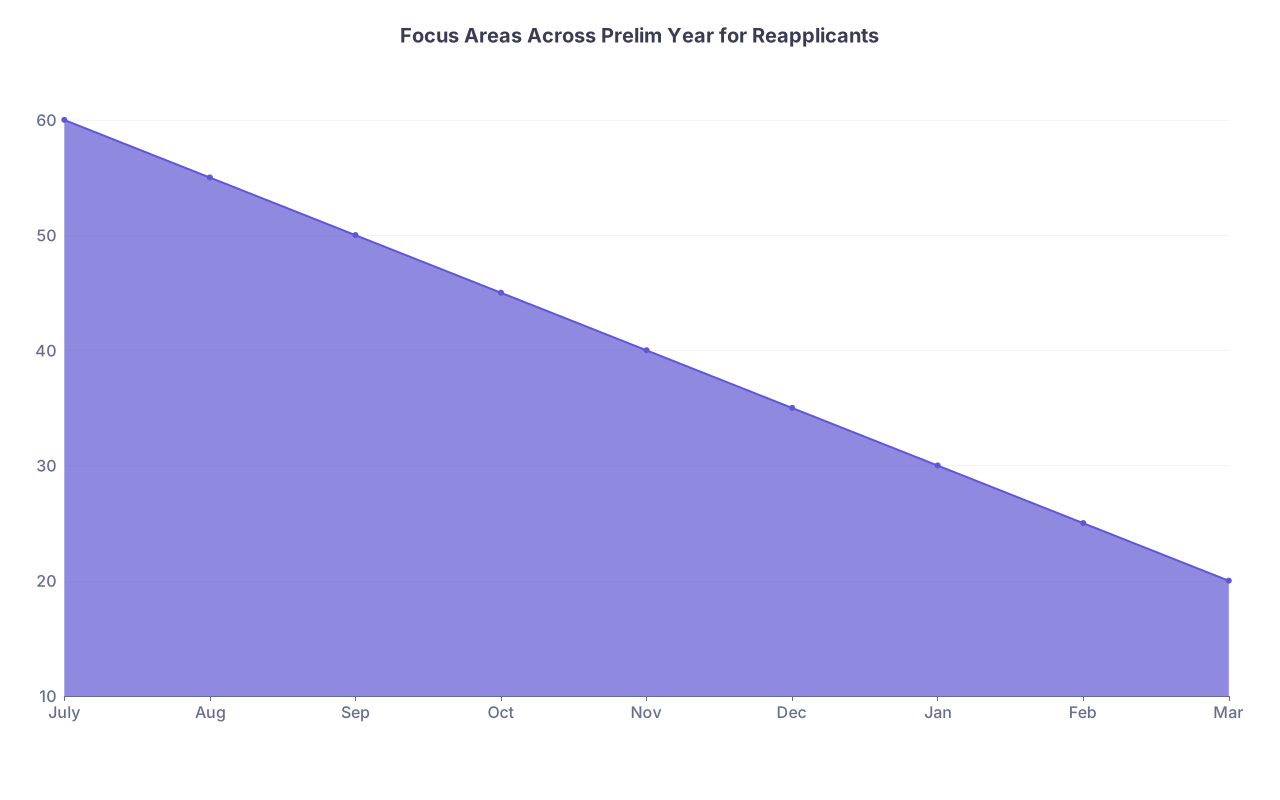
Rough sketch for a prelim planning to reapply:
| Category | Value |
|---|---|
| July | 60 |
| Aug | 55 |
| Sep | 50 |
| Oct | 45 |
| Nov | 40 |
| Dec | 35 |
| Jan | 30 |
| Feb | 25 |
| Mar | 20 |
(Values approximate percent of effort on pure clinical survival; the rest goes to research, networking, and application work.)
- July–September
- Learn how to be a safe intern.
- Start 1 small, realistic research project.
- Meet with specialty mentor monthly.
- October–December
- Intensify research: aim for at least 1 abstract submission.
- Start drafting updated personal statement and CV.
- Ask early about letters from strongest attendings.
- January–March
- Finalize ERAS strategy with mentors.
- Submit manuscripts or case reports.
- Start emailing programs you are serious about with updated CV and explanations of your prelim year.
Step 6: If You Take a Research Year – Make It Count
A “research year” is not automatically helpful. A vague volunteer gig where you “might get involved in projects” is a waste of time.
You want one of three scenarios:
- Formal derm research fellowship (ideal for derm reapps)
- Orthopaedic research fellowship (ideal for ortho reapps)
- High-output research position with a known name in related fields (MSK radiology, rheumatology, plastic surgery, etc.)
6.1 How to judge a research year before saying yes
Ask these questions explicitly:
- “On average, how many posters / papers do fellows produce in one year?”
- “How many past fellows matched derm/ortho, and where?”
- “Will I have my own projects, or just help with data entry?”
- “How often will I work directly with faculty who write letters for applicants?”
If they cannot answer clearly, or if fellows usually produce 0–1 abstracts a year, that is not enough for a serious reapplicant.
6.2 Structure your research year like a job
Treat it as a 60–70 hour/week commitment, not a gap year.
Basic weekly template:
- 40–45 hours: data collection, analysis, manuscript writing
- 5–10 hours: clinic / OR / path conferences
- 3–5 hours: reading recent specialty literature
- 2–3 hours: application prep (updating ERAS, drafting PS, networking emails)

6.3 Deliverables you should aim for by 12 months
For a competitive reapplication in derm/ortho, I want to see:
- 3–5 posters or presentations (regional or national)
- At least 1–2 pubmed-indexed papers (case report, retrospective study, review)
- 1–2 strong letters from well-known faculty who know you well
If your current trajectory will not reach those numbers, adjust aggressively by month 3–4. Add projects. Co-write reviews. Offer to help with someone else’s stalled manuscript.
Step 7: Decide Honestly – Reapply Derm/Ortho or Pivot?
This is the hardest part. And yes, some people need to stop chasing derm or ortho after one failed cycle. Others absolutely should reapply.
7.1 When reapplying actually makes sense
Consider reapplying if:
You had:
- Reasonable interview numbers (say 5–8 derm or 7–10 ortho),
- No professionalism red flags,
- And you are willing to do real damage control (research year, strong prelim year, expanded program list).
You can clearly fix a specific weakness:
- Example: “I had no derm publications. Now I will have 4+.”
- Example: “I applied late to ortho. Next time I will apply day 1 and to more programs.”
You are truly willing to widen your target:
- Community programs.
- Smaller cities.
- Less glamorous regions.
7.2 When it is smarter to pivot
I push people to pivot if:
You had:
- Near-zero interview invites despite broad application,
- Below average Step performance with attempts,
- Or major academic issues that will not disappear next year.
You actually enjoy another field:
- Many derm reapps end up in:
- Internal medicine → rheumatology, allergy, heme/onc
- Family medicine → outpatient, procedural-heavy clinics
- Pathology → dermpath focus
- Many ortho reapps end up in:
- PM&R → sports, spine, MSK
- Anesthesia → pain, regional
- Radiology → MSK or neuro
- Many derm reapps end up in:
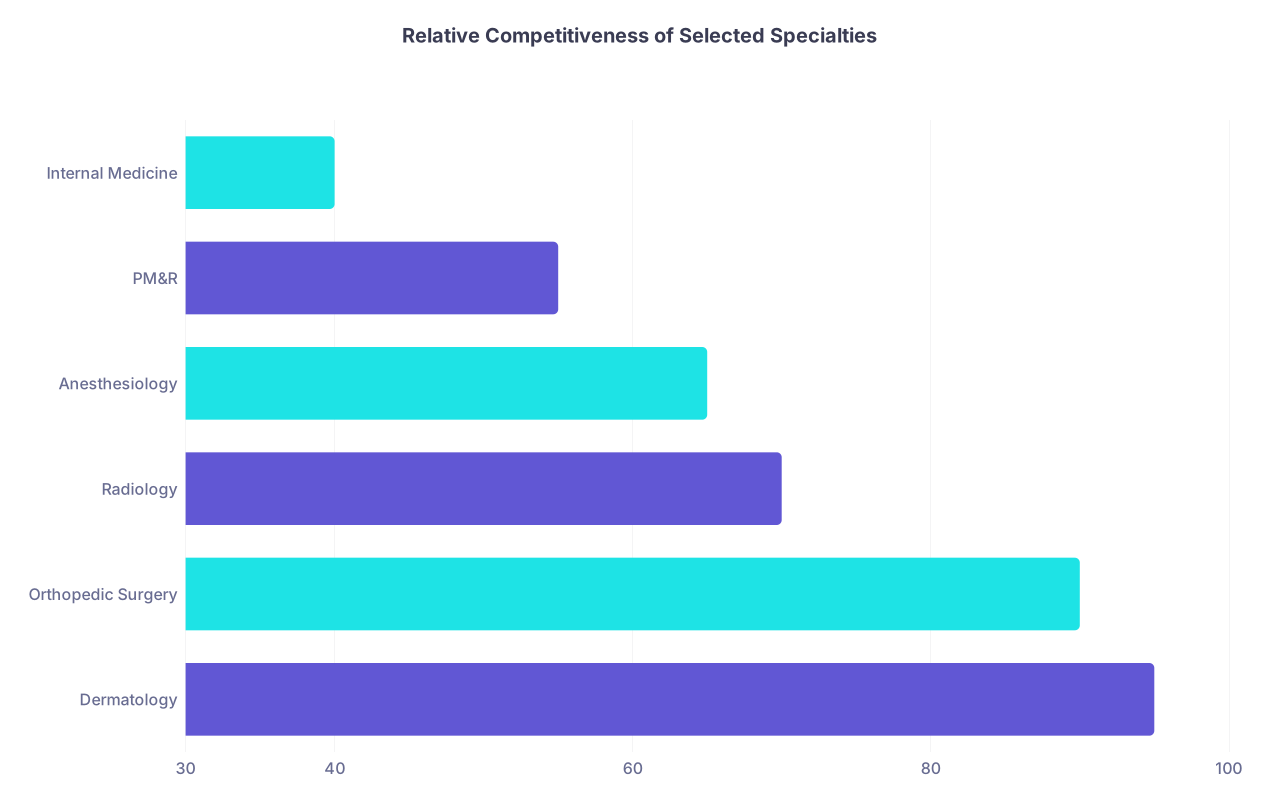
Here is how the competitiveness really looks side by side:
| Category | Value |
|---|---|
| Dermatology | 95 |
| Orthopedic Surgery | 90 |
| Radiology | 70 |
| Anesthesiology | 65 |
| PM&R | 55 |
| Internal Medicine | 40 |
(Value = rough relative competitiveness index, not exact data. Derm/ortho at the top for a reason.)
If matching something you like and starting your career is more important than the derm/ortho label, stop fighting the wrong war.
Step 8: Fix Your Application, Not Just Your CV
Reapplying with the same narrative is a waste of everyone’s time.
You need to change four things:
- Where you apply
- How you present yourself
- Who is speaking for you
- How you explain the gap/unmatched status
8.1 Expand and recalibrate your program list
For reapplicants:
- Apply to more programs than the first time:
- Derm: 100+ is not crazy if you can afford it.
- Ortho: 80–100 programs is common for serious reapps.
- Add:
- Community-heavy or newer programs.
- Programs known to have taken reapplicants.
Do not over‑weight “prestige” this time. You are playing a probability game.
8.2 Rewrite your personal statement for reality
Your new PS must:
- Directly acknowledge the non-traditional path:
- “I applied to dermatology/orthopedics in [Year]. I did not match, which forced me to reassess my preparation and commitment.”
- Show growth, not self-pity:
- “During my preliminary year/research fellowship, I strengthened my clinical skills, contributed to [X] projects, and confirmed that [specialty] is where I can contribute most meaningfully.”
- Backup your claims with specifics:
- Mention one or two concrete experiences: a complex rash case, a trauma night, a clinic experience with longitudinal patients.
You do not need a confessional essay. You need a coherent, adult explanation.
8.3 Upgrade your letters strategically
You want at least:
- One letter that speaks to your current clinical performance (prelim or TY)
- One or two letters from specialty faculty heavily involved in resident selection
- For derm: ideally a derm PD or well-published academic dermatologist
- For ortho: an ortho PD, department chair, or fellowship director
If a previous letter was weak or generic, drop it. Yes, even if you like the person.
Step 9: Talking About Being Unmatched Without Sinking Yourself
You will be asked about it. At interviews, on the trail, sometimes even casually by residents.
You need a clean, three-part script:
Acknowledge plainly
- “I applied dermatology/orthopedics the previous cycle and did not match.”
State what you did next
- “I then completed a preliminary medicine year where I took care of high-acuity patients and worked on improving my clinical and research profile.”
End on growth and fit
- “The experience clarified that [specialty] is where I am best suited long-term. I am bringing stronger clinical maturity, a better understanding of team dynamics, and concrete research contributions this time.”
Keep it under 30–45 seconds. No rambling, no excuses.
Step 10: Protect Your Long-Term Career, Not Just Next July
The tragedy is not “I did not match derm or ortho.” The tragedy is “I burned 5 extra years for a label and now hate my day-to-day work.”
You need to measure success by:
- Matching into:
- A field you can tolerate and preferably enjoy.
- A program that will not break you psychologically.
- Maintaining:
- Your reputation as reliable, teachable, and collegial.
- Enough procedural or intellectual challenge to keep you engaged.

| Step | Description |
|---|---|
| Step 1 | Unmatched Derm Or Ortho |
| Step 2 | SOAP Categorical Other Specialty |
| Step 3 | SOAP Prelim Or TY |
| Step 4 | Plan Research Or Gap Year |
| Step 5 | Excel As Intern |
| Step 6 | Reapply Derm Or Ortho Or Pivot |
| Step 7 | Research Fellowship Or Extra Clinical Year |
| Step 8 | Build Career In New Specialty |
| Step 9 | Keep Derm Or Ortho Goal? |
| Step 10 | SOAP Available? |
Here is the key mindset:
- You are not behind. Many excellent physicians start with a prelim, a pivot, or a research stopover.
- Your future subspecialty options remain wide:
- Derm: allergy, rheum, heme/onc, dermpath via pathology, high-procedure FM.
- Ortho: PM&R sports/spine, pain, MSK rads, interventional pain, sports medicine via FM/IM/EM.
You are building a 30‑year career, not winning a 12‑month contest.
Final Takeaways
- Not matching derm or ortho is a signal, not a sentence. Diagnose why objectively, then pick a clear path: SOAP prelim, research year, or pivot.
- If you reapply, you must change more than your CV. Expand your program list, fix letters, rewrite your narrative, and produce real, tangible growth.
- Protect your long-term career happiness over prestige. The right combination of specialty, environment, and mentors matters far more than the name on your Match email.