
Most applicants build their ERAS strategy completely backwards. They pick one specialty, blast applications everywhere, add a token “backup,” and hope the Match gods are merciful. That is how people end up unmatched with a 240+ Step 2 and decent letters.
You are going to do something smarter: deliberately optimize your ERAS for one stretch specialty tier and one safety tier—on purpose, with math, and with a clear protocol.
This is not about “having a backup.” It is about engineering two realistic paths to Match that do not sabotage each other.
Step 1: Define Your Stretch vs Safety Tier Like an Adult, Not a Dreamer
“Stretch” and “safety” are meaningless until you anchor them in actual data. Vibes do not count.
You will define:
- Stretch specialty tier = The most competitive specialty (or tier of programs within a specialty) where you still have a non‑zero but <50% shot if everything goes right.
- Safety specialty tier = A less competitive specialty where, based on your stats and application quality, you should be >70–80% likely to match if you commit to it.
This is not strictly “derm vs FM.” Often it is “top‑25 IM academic programs vs mid‑tier community IM” or “university EM vs community IM”.
1.1 Get honest about your baseline competitiveness
Before choosing tiers, you need to know which world you live in.
At minimum, write down:
- US MD vs US DO vs IMG (and visa status if IMG)
- Step 2 CK score (or practice NBME if pending)
- Preclinical performance (H/HP/P)
- Clerkship grades in core rotations
- Any AOA / Gold Humanism
- Research: publications / posters / number of projects
- Home institution strength in your target specialty
Now pull up NRMP Charting Outcomes (last available cycle) and compare your numbers to matched vs unmatched in various fields.
Here is a quick rough comparison (for US MD, general ballpark):
| Tier | Specialty Examples | Typical CK for Matched (approx) |
|---|---|---|
| Ultra-high | Derm, Plastics, Ortho, ENT, Neurosurgery | 250+ |
| High | Radiology, Anesthesiology, EM (varies), Ophtho (SF), Urology | 240–250 |
| Moderate | IM categorical (good programs), Gen Surg, OB/GYN, Pediatrics | 235–245 |
| Lower | FM, Psychiatry, Pathology, Neurology, IM prelim/TY | 225–235 |
These are broad strokes. Individual programs differ a lot. But you need a working framework.
1.2 Decide your stretch / safety pairing
Now pick:
Stretch tier – Either:
- A competitive specialty (e.g., Ortho, Derm, EM, Radiology), or
- A top tier of programs within a less competitive specialty (e.g., “university IM with strong research,” “surgical prelim at big name hospitals”).
Safety tier – Must be:
- Less competitive in reality, not just in your head.
- Acceptable to you as a real career (you must be able to live with it).
- A field where your current profile is at least “solid.”
Common realistic pairings:
- Derm (stretch) + IM (safety)
- Ortho (stretch) + Gen Surg prelim or IM (safety)
- EM university (stretch) + IM or FM (safety)
- Academic IM (stretch) + Community IM / FM (safety)
- ENT (stretch) + Gen Surg (safety-ish, depending on your numbers)
- Radiology (stretch) + IM or TY/Prelim (safety hybrid strategy)
If your stretch is ultra‑competitive (Derm, Plastics, Ortho, ENT, Neurosurg) and your Step 2 is <240, your safety should probably be significantly less competitive (IM, FM, Psych, etc.), not just “slightly less crazy.”
Step 2: Build a Dual-Specialty Strategy That Actually Works
You are not doing “spray and pray.” You are balancing:
- Enough commitment to the stretch to be taken seriously.
- Enough depth in the safety to be believable and matchable.
- Without cloning your ERAS into two competing personalities.
2.1 The non‑negotiable rule: one real primary identity
Programs have a radar for fake “backup” energy. When your entire record screams EM and you send a generic FM personal statement, they roll their eyes and move on.
So pick:
- Primary identity = the specialty you’re clearly “built for” based on:
- Rotations
- Letters
- Research
- Leadership
Your stretch usually ends up being your primary identity. But not always. Example: you are a strong IM applicant aiming for top‑tier academic IM as stretch and mid‑tier IM as safety. Identity is obvious there.
Where this matters most: how you frame experiences and letters.
You will:
- Anchor your narrative in one coherent clinical identity.
- Then redirect part of it toward your “safe harbor” specialty in a believable way.
I will show you how in a minute.
Step 3: Allocate Rotations and LORs Without Sabotaging Either Tier
Rotations and letters are where most dual‑specialty applicants blow it.
They either:
- Go all‑in on stretch, then look fake in safety.
- Or they water everything down and look lukewarm to everyone.
Here is how you avoid that.
3.1 Rotation strategy: months and types
You get limited audition/sub‑I time. Use it deliberately:
- Stretch specialty:
- Home rotation (mandatory).
- 1–2 away/audition rotations if the field expects it (Ortho, ENT, EM, etc.).
- Safety specialty:
- 1 core or sub‑I in the safety field.
- Optional: one additional elective that aligns with that field’s priorities (e.g., geriatrics for IM, addiction for Psych, OB clinic for FM).
If you can only carve out one rotation in the safety specialty, that is still enough if you do it well and secure a strong letter.
3.2 Letters of recommendation: an actual blueprint
You need to protect three things:
- Stretch credibility.
- Safety credibility.
- Flexibility to redistribute if one path heats up or dies.
Typical target setup (for someone doing two specialties):
- Total LORs collected: 5–6.
- Uploaded to ERAS: You can assign up to 4 per program.
Example configuration:
- 2–3 letters from stretch specialty attendings.
- 2 letters from safety specialty attendings.
- 1 “general” letter (e.g., IM ward attending, research PI, Medicine Sub‑I) that is credible for both.
Then assign:
- Stretch programs:
- 2–3 stretch specialty letters
- ±1 general letter
- Safety programs:
- 2 safety specialty letters
- 1 general letter
- ±1 stretch letter only if it still sounds broadly internal‑medicine-ish / patient‑care focused and not hyper‑niche.
Bad move I see: using 3 letters from Ortho for FM programs. They see right through it.
Ask letter writers explicitly:
“I am applying primarily to Orthopedic Surgery but also to Internal Medicine as a parallel plan. Would you feel comfortable writing a letter that speaks broadly to my clinical abilities and work ethic that I can use for both?”
If they hesitate, keep that letter for stretch only and get someone else for safety.
Step 4: Construct Two Coherent, Non-Contradictory Personal Statements
You cannot send the same personal statement to Derm and IM and expect anyone to buy it. You also cannot send two wildly different career stories and hope no one connects the dots.
You need:
- 1 stretch specialty PS
- 1 safety specialty PS
- Optional: 1 generic medicine-type PS if you are applying within one broad area (e.g., IM + Neuro + Psych). Use sparingly.
4.1 How to frame the stretch PS
Goal: This reads like you are fully committed, prepared, and realistic about the field.
Include:
- Origin of interest: concrete clinical moment or series of experiences.
- Longitudinal engagement: research, leadership, QI, away rotations.
- Clear understanding of the specialty’s day‑to‑day reality.
- Long‑term career goals that align (academic vs community, subspecialty interests).
Avoid:
- Any mention of backup.
- Vague “I love procedures and continuity of care and work‑life balance and everything.”
4.2 How to frame the safety PS without sounding like a bitter backup
Goal: This reads like an independent, authentic choice rooted in what you actually like about that work.
Here is the trick: tie it to patient population, clinical style, or system problems you care about. Not prestige.
For example, Ortho (stretch) + IM (safety):
- For Ortho PS: focus on MSK pathology, OR, procedural work, team logistics, specific Ortho mentors, research in bone healing, etc.
- For IM PS: focus on complex multi‑morbid patients, diagnostic reasoning, inpatient team leadership, continuity clinics, your IM sub‑I experience.
Do not:
- Talk about missing out on a surgical “dream.”
- Signal regret, resentment, or “I guess I will take IM if I must.”
You can reuse some experiences, but the interpretation must change.
Same case, different angle:
- Ortho PS: “Watching an elderly patient go from bedbound to walking independently after hip fracture fixation showed me the impact of surgical intervention on function and independence.”
- IM PS: “Following an elderly patient with recurrent heart failure from hospitalization to outpatient clinic showed me the importance of continuity, medication optimization, and shared decision making.”
Same patient, two legitimate takeaways.
Step 5: Program List Engineering – Numbers, Types, and Distribution
Your program list is where strategy becomes math. Hand‑waving is how you end up in SOAP.
5.1 How many programs per specialty?
Assuming US MD with average risk profile:
- High‑risk stretch (Derm, Plastics, ENT, Ortho, Neurosurg):
- 40–80+ programs in stretch field.
- 40–70+ programs in safety (IM/FM/Psych/etc.).
- Moderately competitive stretch (Radiology, EM, Anesthesia, OB/GYN, Gen Surg):
- 30–50 stretch.
- 25–40 safety.
- Same specialty, different tiers (e.g., academic IM vs community IM):
- 15–30 top‑tier academic.
- 25–40 mid/lower‑tier community / university‑affiliated.
If you are DO or IMG, those numbers climb. I have seen IMGs applying to 100+ IM programs and still sweating.
5.2 Mix of program types
For each specialty tier:
- Avoid program lists that are all “name brand.”
- Include:
- Highly competitive university programs (reach)
- Solid mid‑tier university / university‑affiliated community
- True community programs, especially in less desirable locations.
If your stretch specialty is already high‑risk, your safety tier must not also be stuffed with only coastal, top‑tier academic programs.
5.3 Quick numeric sanity check
You want your overall probability of matching somewhere to be high.
Hypothetical example:
- You apply to 40 stretch Ortho programs. Realistic interview expectation with your stats: 2–4 interviews → maybe 20–40% chance of matching if all go well.
- You apply to 60 IM programs with your stats (solid, but not stellar). Expect 8–12 invites → 80–90%+ chance of matching.
Combine both: your overall chance of matching somewhere now sits in a much safer zone.
Is this exact? No. But you are no longer flying blind.
Step 6: ERAS Content – One Application, Two Stories
You only get one ERAS core (Experiences, Publications, Awards). The trick is to:
- Choose experiences that play decently in both specialties.
- Use descriptions that highlight universal qualities AND specialty‑relevant angles.
- Then leverage personal statements and letters to specialize the narrative.
6.1 Experience selection hierarchy
Order of operations:
- Clinical experiences where you clearly performed at a high level (Sub‑Is, key clerkships, meaningful longitudinal clinics).
- Research experiences, especially if in or near your stretch or safety fields.
- Leadership / teaching roles (student leader, tutor, committee work).
- Service / outreach that fits either specialty (underserved clinics, addiction, geriatrics, etc.).
You are not building two different ERAS experiences lists. You are building one very strong clinical identity that can be plausibly interpreted into both fields.
If your stretch is Derm and safety is IM:
- Include your Derm research and Dermatology interest group leadership, of course.
- Also include hospital medicine QI, inpatient IM sub‑I, primary care clinic. These sell IM nicely and do not hurt Derm at all.
6.2 How you describe experiences
Two levers:
- Focus on skills/qualities both fields value:
- Teamwork, communication, reliability, following through.
- Teaching juniors, handling complex patients, systems thinking.
- Include subtle specialty‑aligned language where safe:
- Stretch‑neutral terms: “diagnostic reasoning,” “acute care,” “multidisciplinary teams.”
- Avoid niche jargon that would sound strange to safety fields (or vice versa).
Your Derm research experience description:
- Do not write only about cosmetic lasers and brand‑name drugs.
- Talk about study design, data analysis, patient counseling, adherence, etc. Still sounds good to IM.
Step 7: Interview Season – How to Talk About Your Two‑Tier Strategy Without Lying
Programs talk. Interviewers can see where else you are interviewing. You cannot be a different person in each room.
You need a consistent, honest, non‑self‑sabotaging script.
7.1 What to say if asked, “Are you applying to other specialties?”
You do not dodge. You answer directly, calmly, and with a prepared explanation.
For stretch specialty interviews:
“Yes, I am primarily committed to [stretch]. I have focused my clinical time, research, and mentors here, and this is where I see myself long term. Because the Match can be unpredictable even for strong applicants, I am also applying to [safety] programs where I believe my skill set would translate well to taking care of complex patients. That said, if I am fortunate enough to match in [stretch], that is the path I intend to pursue.”
For safety specialty interviews:
“Yes. I explored [stretch field] early and invested significant time there. Over the last year, spending more time on my [safety specialty] rotations and sub‑I has pulled me strongly in this direction. I am applying to both this year because I would be genuinely happy training in either field, but I am increasingly drawn to the kind of patient care and team environment I have experienced in [safety].”
Key points:
- No apologizing.
- No “I failed at my dream.”
- Emphasize genuine fit and realistic planning, not desperation.
7.2 Rank list strategy when the time comes
By February, you will usually know:
- Which specialty likes you more (based on interview count and vibe).
- Where you felt you fit best.
The rational rule:
- Rank all programs in the specialty you prefer more as a career above the other specialty, unless you have strong evidence your chance of matching there is near zero.
- Within each specialty, rank purely by preference, not perceived competitiveness.
If you get 2 Ortho interviews and 15 IM interviews:
- It is still reasonable to rank those 2 Ortho programs at the very top if you truly want Ortho.
- Then list all the IM programs.
Do not play amateur statistician and try to “game” the algorithm by mixing them up out of fear. The algorithm rewards your true preference order.
Step 8: Special Case – Same Specialty, Different Tiers as Stretch vs Safety
Not everyone’s stretch/safety split is across different fields. Sometimes it is:
- Academic IM vs community IM.
- Big‑name EM vs smaller community EM.
- Surgical prelim at major center vs categorical at a smaller one.
This changes a few details.
8.1 You may not need different personal statements
If both tiers are the same specialty, one well‑written PS can cover:
- Interest in the specialty itself.
- Value you bring in academic vs community contexts.
- Flexible career goals (e.g., possible fellowship, teaching, or community practice).
You might tweak a few lines in a separate version emphasizing:
- Research / academics for top university programs.
- Bread‑and‑butter clinical work and community engagement for smaller programs.
But you will not sound like two different people.
8.2 Letter mix shifts slightly
You can mostly reuse letters:
- 2–3 letters from high‑caliber faculty (ideally at your home or visiting academic centers).
- 1 letter from a strong community or mid‑tier site.
For competitive academic IM vs community IM:
- Academic programs love heavy research mentors.
- Community programs love ward/sub‑I attendings who say you are safe, hard‑working, and kind to nurses.
Step 9: Time, Money, and Sanity – Avoiding Burnout With Dual Applications
Two specialty tiers doubles certain burdens:
- Extra personal statement(s)
- Extra letters
- More programs
- More interviews
- More travel (or Zoom fatigue)
You need a logistics protocol, not just ambition.
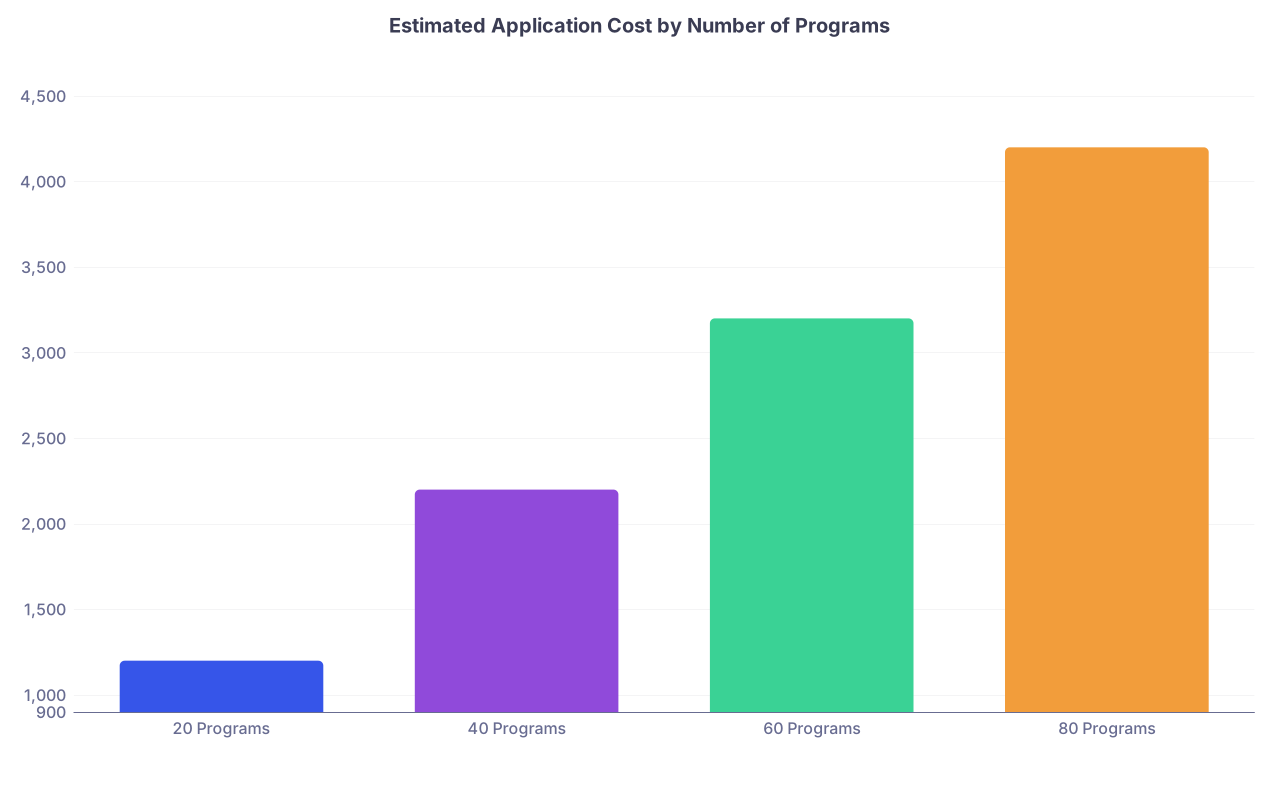
9.1 Budget your season realistically
Application + travel costs add up fast.
| Category | Value |
|---|---|
| 20 Programs | 1200 |
| 40 Programs | 2200 |
| 60 Programs | 3200 |
| 80 Programs | 4200 |
This is crude, but you get the point: two specialties with big lists is expensive.
Plan:
- Cap the absolute maximum number of programs (e.g., 80–100).
- Prioritize where marginal additional apps add the most benefit (often safety tier).
- Use virtual interviews when offered, especially for safety specialty.
9.2 Schedule interviews smartly
The nightmare is overlapping interview offers in both specialties on the same days.
Protocol:
- Before invites: Decide which specialty gets priority on limited dates (usually the stretch).
- When invites arrive:
- Accept stretch specialty invites first.
- Schedule safety interviews around them.
- If direct conflict:
- Ask safety program politely if there is an alternative date.
- Only reschedule or cancel stretch if you have many in that field and very few in safety (rare).
Step 10: Decision Points During the Season – When to Pivot
There are a few inflection points where you may need to adjust.
10.1 After interview invites stabilize
If by early November:
- You have 0–1 invites in stretch, and
- You have many in safety,
You mentally accept that safety is likely your actual match field. Still go to the stretch interviews if you truly want that field, but do not sabotage safety visits or signal half‑interest.
If the opposite happens (shockingly strong stretch response, weak safety), you lean your emotional energy toward stretch while still engaging fully at safety interviews.
10.2 SOAP contingency
If you unfortunately go unmatched:
- The safety specialty you already applied in becomes your starting point.
- If that market is saturated in SOAP, you widen to adjacent fields (prelim, TY, less competitive areas).
The big advantage of having run a safety specialty in the main Match: your ERAS is already aligned, and you likely have at least a few programs who saw your file.

| Step | Description |
|---|---|
| Step 1 | Assess Stats and CV |
| Step 2 | Plan Rotations and LOR Mix |
| Step 3 | Write Dual Personal Statements |
| Step 4 | Build Program Lists Both Tiers |
| Step 5 | Submit ERAS |
| Step 6 | Interview Season Priorities |
| Step 7 | Rank List by True Preference |
| Step 8 | Match Outcome or SOAP Plan |
| Step 9 | Choose Stretch Tier |
| Step 10 | Choose Safety Tier |
Key Takeaways
- You are not “cheating” the system by having a stretch and a safety specialty. You are building two realistic paths to becoming a physician instead of gambling on one.
- The whole game is coherence. One credible clinical identity, two believable narratives, with letters, rotations, and personal statements that support both—without contradicting each other.
- Program list engineering and interview behavior matter as much as your scores. Numbers get you looks; strategy gets you a Match.