
The residency match does not care about your excuses. A weak MS3 year is a liability—but it is not a death sentence. If you handle it correctly, it becomes a narrative of resilience and late surge that program directors respect.
You are not trying to erase a bad MS3 year. You are trying to overpower it.
This is a rescue strategy. Not optimism. Not “hope it works out.” A concrete, stepwise plan to convert a shaky third year into a credible, even compelling, match application.
Step 1: Diagnose What Went Wrong (With Surgical Precision)
You cannot fix “a weak MS3 year.” That phrase is useless. You fix specific, measurable problems.
Break your MS3 into components:
- Core clerkship grades
- Shelf exam scores
- Evaluations / narratives
- Professionalism / any formal issues
- Timing of improvement (if any)
Sit down with a pen, not just your feelings, and map it out.
A. Classify Your Weakness Type
You are typically in one (or more) of these buckets:
Low or inconsistent clerkship grades
- Several passes where most peers got high pass/honors
- A fail or conditional pass that had to be remediated
- Strong comments but weak grades (or vice versa)
Weak shelf exams / test performance
- Shelf scores below class average in multiple rotations
- Needing retakes
- Obvious pattern: you did “fine” clinically but could not back it up with objective scores
Unflattering narrative comments / professionalism concerns
- Comments hinting at disorganization, poor communication, lack of initiative
- Formal professionalism note, complaint, or remediation
- Attendance or punctuality issues
Late awakening
- First half of MS3 mediocre
- Second half significantly better once you figured it out—but the damage on paper is done
Write it out rotation by rotation. Example:
- IM: Pass, shelf 25th percentile, comments “quiet, needs more initiative”
- Surgery: Pass, shelf 35th percentile, “hardworking but needs to read more”
- Peds: High Pass, shelf 60th percentile, strong comments
- OB: Pass, shelf 30th percentile
- Psych: Honors, shelf 75th percentile
Now you know your pattern: late improvement, objective scores weak early then better, narrative strengthening.
This diagnostic step matters because the rescue moves are different depending on whether your main problem is:
- “I look average and I want a competitive specialty”
- “I have real red flags and need to prove I am safe and reliable”
- “I woke up late and need to show my current level, not my old level”
Step 2: Get Real About Specialty Competitiveness
You cannot “rescue” every specialty from every MS3 record. Some doors will narrow. That is reality.
If your dream specialty is derm with a transcript full of Passes and no research, this is probably not a rescue plan; it is a pivot plan.
Here is the blunt hierarchy most students do not want to hear.
| Specialty Tier | Examples |
|---|---|
| Ultra-competitive | Dermatology, Plastic Surgery, Orthopedic Surgery, Neurosurgery |
| Highly competitive | ENT, Ophthalmology, Radiation Oncology, Interventional Radiology |
| Moderately competitive | Anesthesiology, Emergency Medicine, OB/GYN, General Surgery |
| Broad access but selective at top | Internal Medicine, Pediatrics, Family Medicine, Psychiatry |
Weak MS3 + no other major strengths:
- Ultra-competitive: essentially closed, unless you have something extraordinary (e.g., PhD with strong publications, top Step scores, elite letters, and a real “off year” story).
- Highly competitive: severe uphill battle; you need a near-perfect rescue in MS4 AND strong scores.
- Moderate / broad-access: still very salvageable with a smart strategy.
I am not telling you to abandon your first choice immediately. I am telling you to run a sober risk assessment:
- Look at your class rank (if reported)
- Look at your Step 2 CK practice scores / potential
- Look at your research output in that specialty
- Ask 1–2 trusted faculty who actually know your application: “Is [SPECIALTY] a realistic primary target for me, or should it be a reach with a stronger backup?”
If two honest attendings raise their eyebrows and gently say, “You could try… but you need a solid backup,” listen.
A rescue strategy is not just how to improve; it is how to avoid matching into unemployment.
Step 3: Use MS4 to Create a New Data Set
Programs will not be convinced by your intentions or promises. They want new, better numbers and concrete performance.
Your primary MS4 tools:
- Step 2 CK
- Home and away sub-internships (sub-Is / acting internships)
- Letters of recommendation
- Application timing and narrative
A. Step 2 CK: Your Fastest Reputation Change
If your MS3 was weak, Step 2 CK becomes non-negotiable. You need a strong performance relative to your peers in your target specialty.
For many programs now, Step 2 CK is the objective anchor score. You want to fall into these ranges (approximate, and yes, they vary):
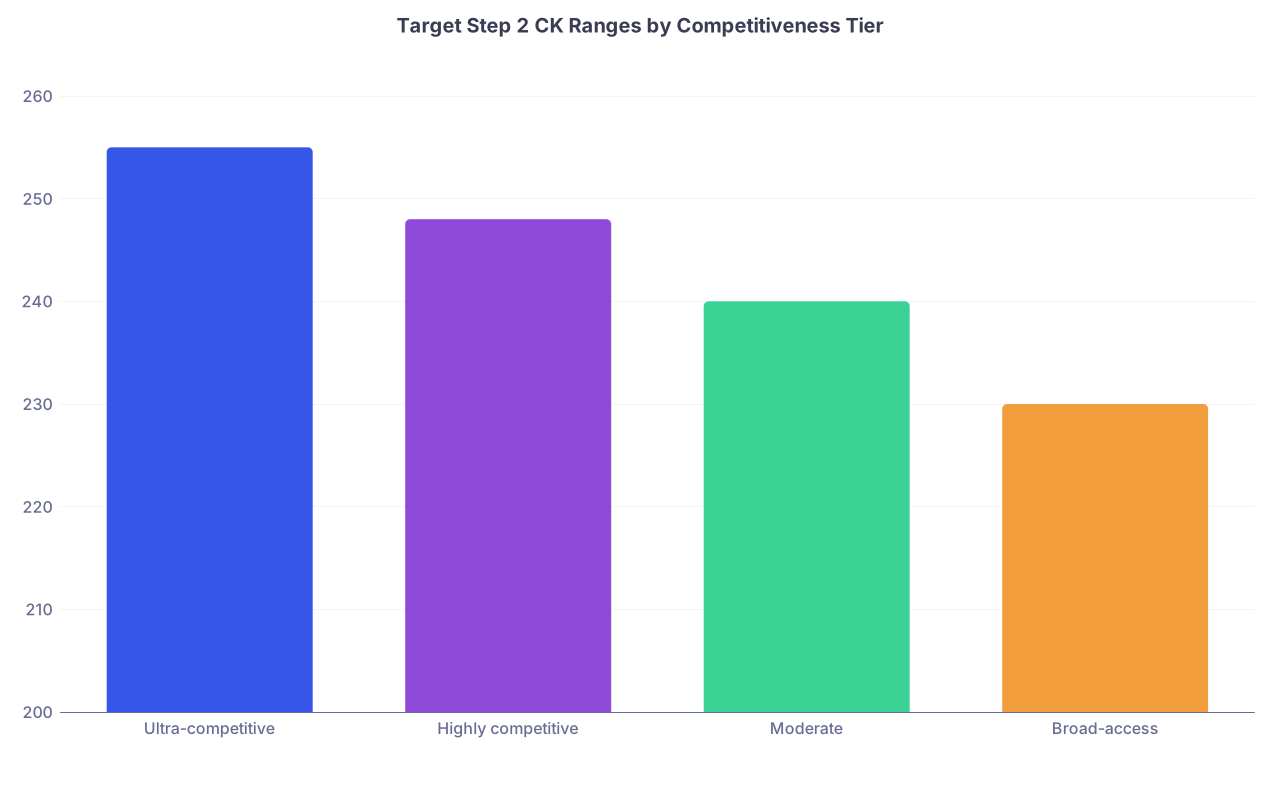
| Category | Value |
|---|---|
| Ultra-competitive | 255 |
| Highly competitive | 248 |
| Moderate | 240 |
| Broad-access | 230 |
Use it this way:
Take Step 2 CK after a serious, uninterrupted study block.
No half-effort “I will just wing it and see.” You do not have that luxury.Treat it as part of your rescue narrative.
Weak MS3 → realized gaps → structured study → excellent Step 2 demonstrating your true level.
That is a story programs accept. I have seen it work.If your practice tests are far below target, you have a larger problem than MS3.
In that case, adjust specialty choice as well as application strategy. Do not pretend a 225 practice average will become a 250 on test day.
B. Sub-Internships: Your Controlled Audition
Your sub-I is your chance to overwrite the impression of “average MS3” with “strong MS4 functioning at intern level.”
Design your sub-I plan deliberately:
- At least one sub-I in your intended specialty at your home institution
- For more competitive fields or if your home program is weak: one or two away rotations at realistic target programs
Key behaviors on sub-I:
- Be early. Every day. Not on time. Early.
- Know your patients cold. Labs, imaging, overnight events. No excuses.
- Volunteer for the “boring” work and do it perfectly (discharge summaries, calling consults, following up labs).
- Have a daily reading plan aligned with your patient list. If you saw three CHF exacerbations, you had better be able to discuss guideline-directed therapy intelligently.
- Ask for feedback early: “Dr. X, I want to function at the level of a strong intern by the end of this month. What is one thing I can focus on improving this week?”
Your goal: At least one attending who will say, honestly:
“This student performed at the level of a strong intern, showed significant growth from prior performance, and will be an asset to your program.”
That kind of letter can blunt a lot of MS3 damage.
Step 4: Rehab Your Letters of Recommendation Strategy
You cannot afford generic letters. You especially cannot afford generic letters that subtly confirm you are “fine but unremarkable.”
You need three things from your letter package:
- At least one letter that is on fire (strong, specific, clearly enthusiastic).
- At least one letter from your target specialty.
- If MS3 performance was weak, at least one letter that explicitly points out your growth and current reliability.
Who should write your letters?
Prioritize:
- Attendings who directly supervised you for at least 2 weeks (ideally on a sub-I)
- People who know your work ethic and your improvement trajectory
- Faculty with some weight (PD, APD, chair, or respected educator) if they know you well
Avoid:
- “Big names” who barely worked with you and will write a bland letter
- Residents as primary authors (they can draft, but the attending must truly know you)
Ask like this:
“Dr. Smith, I am applying to [SPECIALTY]. I had a weaker MS3 year, but I have worked very hard to improve. Based on how I performed on this sub-I, do you feel you could write me a strong, supportive letter that reflects that growth and my readiness for residency?”
If they hesitate, or say, “I can write you a letter,” without the words “strong” or “supportive,” thank them—but do not use that letter.
Step 5: Reframe the Story Without Sounding Like an Excuse Machine
Programs will see the weak MS3. You are not hiding it. You are contextualizing it and showing a different ending.
There are three main places this happens:
- Personal statement
- MSPE (Dean’s Letter) – you cannot control it, but you can anticipate it
- Interviews
A. Personal Statement: Controlled Transparency
You are not writing a confession. You are writing a professional narrative.
Bad approach:
“I struggled a lot during third year and got some low grades, but that was because I was overwhelmed and had personal issues and the residents were mean…”
Better approach (paraphrased structure):
- Very brief acknowledgment:
- “My third year did not initially reflect the standard I hold myself to.”
- Clear, accountable language:
- “Early in the year, I struggled with clinical efficiency and translating knowledge into action on busy inpatient services.”
- Concrete change:
- “Mid-year, with feedback from my IM clerkship director, I rebuilt my approach: pre-round checklists, structured daily reading tied to my patient list, and scheduled debriefs with residents.”
- Evidence of improvement:
- “Since then, my performance on later clerkships, my sub-internship evaluations, and my Step 2 score more accurately represent my current capabilities.”
- Forward focus:
- “This experience forced me to become systematic, coachable, and resilient—traits I will bring to residency.”
Short, direct, no drama. You own your part. You show change. You move on.
B. MSPE: Know What is Coming
Your Dean’s Office will usually share a draft MSPE. Read it carefully.
- Identify any harsh or ambiguous language.
- Ask for clarification changes if something is factually inaccurate or grossly misleading. Be professional. You are asking, not demanding.
- Expect them to keep some of the less flattering comments. That is their job.
Your strategy is not to sanitize the MSPE. Your strategy is to ensure everything else in your application contradicts the idea that you are still that same struggling MS3.

Step 6: Tailor Your Program List Like a Tactician, Not a Tourist
The fastest way to turn a salvageable profile into a failed match is to build a fantasy program list.
Your goal: Maximize probability of matching into a program where you will be trained well, not just somewhere that flatters your ego.
Think in tiers based on your final profile (Step 2, letters, MS3, school reputation, research).
Rough structure for a realistic but ambitious list:
- 10–20% reach programs
- 60–70% realistic target programs
- 20–30% safety programs you would genuinely attend
Use concrete factors to assess where you stand:
- Are you at or above that program’s average Step 2?
- Does your school usually match into that program or similar ones?
- Do you have letters from faculty who know someone there or trained there?
- Does your transcript look obviously weaker than their typical matched list?
For a weaker MS3 record, your best leverage is often:
- Community or university-affiliated programs not flooded with top-tier applicants
- Geographic regions less saturated (Midwest, non-coastal regions, places not near glam cities)
- Programs where your school has matched multiple graduates recently
Do not waste 15 applications on brand-name programs that look nice on Instagram but will not look twice at your file. Spend those applications where they can actually turn into interviews.
Step 7: Fix How You Behave in Clinical Spaces—Right Now
A rescue strategy falls apart if your MS4 rotations look like MS3: inconsistent, unprepared, passive.
You need a concrete behavior upgrade:
A. Daily Structure on Rotations
Use a simple template:
Morning:
- Arrive 20–30 minutes before team
- Pre-round on your patients, update data, anticipate issues
- Write or pre-chart key notes before rounds
During the day:
- When given a task, repeat it back: “I will call GI about X and Y, and then update you.”
- Write down every task. No “I will remember.”
- Ask one focused clinical question per day when appropriate.
Evening:
- Spend 20–30 minutes reading about one patient’s key diagnosis from a reputable source (UptoDate, guidelines, review article)
- Jot down 2–3 teaching points and test yourself the next day
If you had comments like “needs to speak up more,” fix that with specific behaviors:
- Present clearly without reading verbatim
- Make one management suggestion per patient during rounds (“Given his rising creatinine, should we consider adjusting the ACE inhibitor?”)
- Volunteer for procedures or admissions when appropriate
B. Feedback Loops
End of week 1 on every rotation, ask:
“Dr. X, I want to leave this rotation with you confident in my ability to start internship. What is one thing I should change or improve over the next week to get there?”
Then you do it. And you tell them you did it.
That is how you generate comments like, “Took feedback seriously and showed rapid improvement”—which are gold for a rescue narrative.
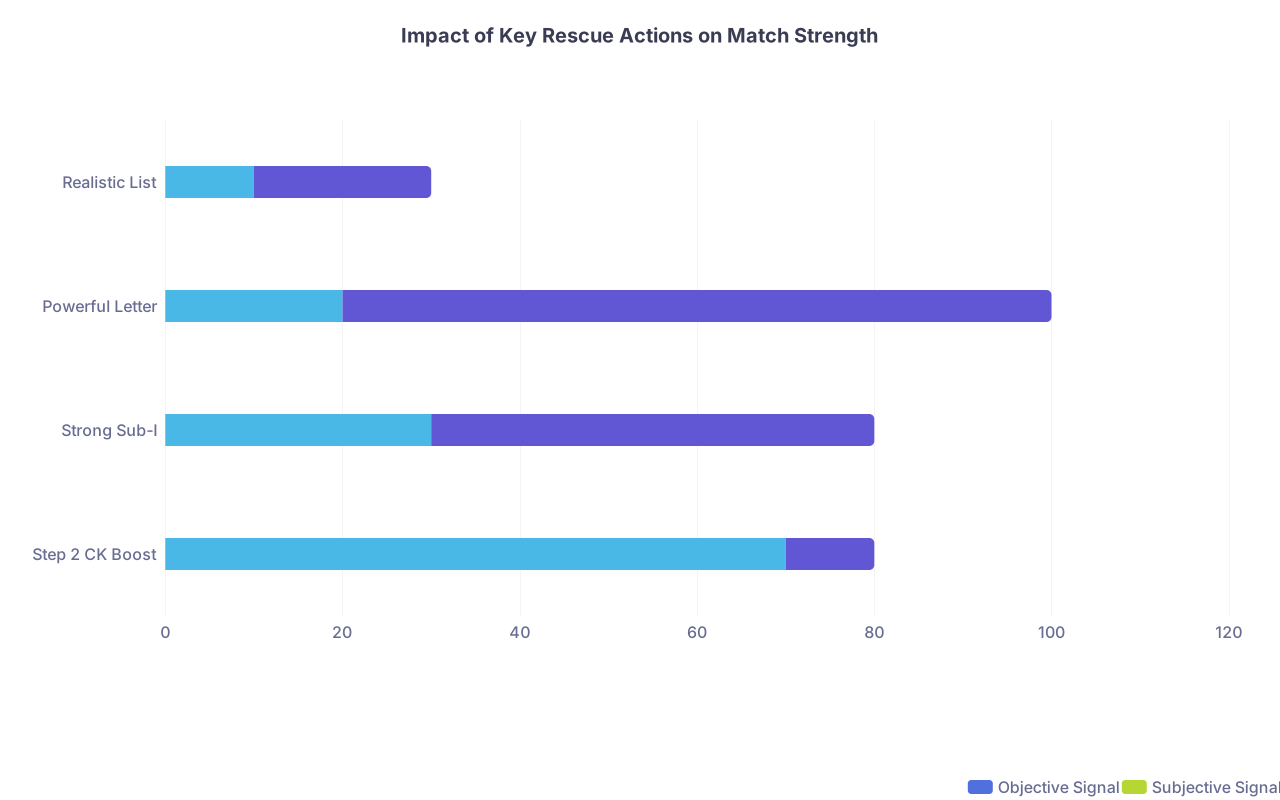
| Category | Objective Signal | Subjective Signal |
|---|---|---|
| Step 2 CK Boost | 70 | 10 |
| Strong Sub-I | 30 | 50 |
| Powerful Letter | 20 | 80 |
| Realistic List | 10 | 20 |
Step 8: Build a Timeline So You Do Not Miss the Window
A rescue strategy fails if you simply run out of time. Map your next 6–12 months like a project, not a vibe.
Here is a sample structure for someone who just finished a weak MS3 and is entering MS4:
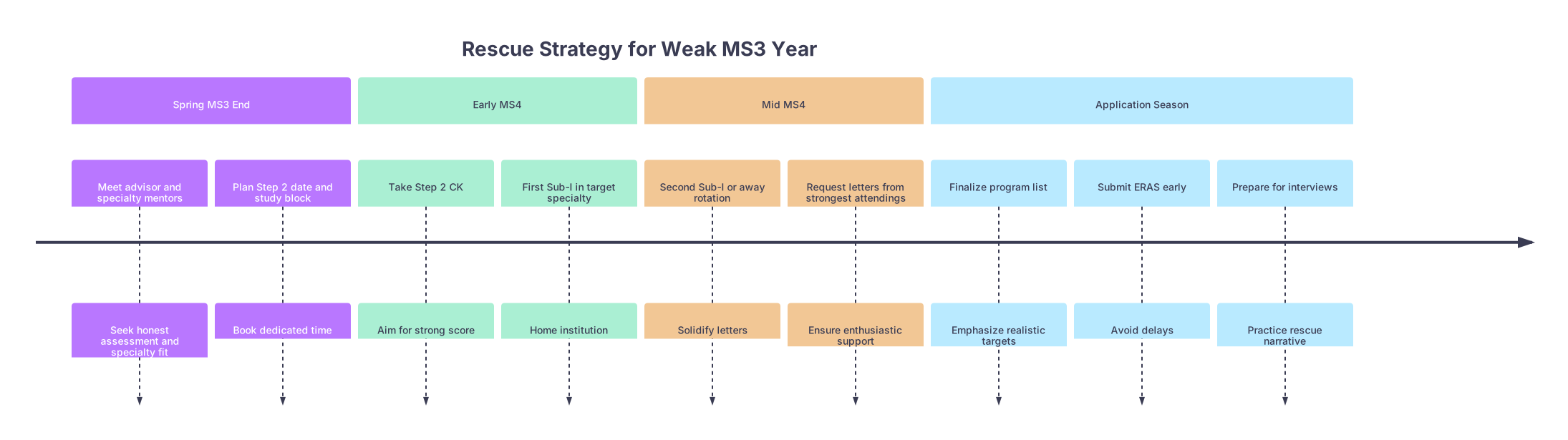
| Period | Event |
|---|---|
| Spring MS3 End - Meet advisor and specialty mentors | Seek honest assessment and specialty fit |
| Spring MS3 End - Plan Step 2 date and study block | Book dedicated time |
| Early MS4 - Take Step 2 CK | Aim for strong score |
| Early MS4 - First Sub-I in target specialty | Home institution |
| Mid MS4 - Second Sub-I or away rotation | Solidify letters |
| Mid MS4 - Request letters from strongest attendings | Ensure enthusiastic support |
| Application Season - Finalize program list | Emphasize realistic targets |
| Application Season - Submit ERAS early | Avoid delays |
| Application Season - Prepare for interviews | Practice rescue narrative |
You adjust details to your school calendar, but the skeleton stays:
- Honest specialty assessment and advisor meeting
- Step 2 with real prep
- Strategic sub-Is
- Targeted letters
- Realistic program list
- Early, clean application submission

Step 9: Handle Interviews Like Someone Who Grew Up, Not Someone Making Excuses
You will be asked, explicitly or implicitly: “What happened in MS3?”
Prepare a 30–45 second answer that:
- Accepts responsibility
- Shows insight
- Demonstrates specific changes
- Ends in the present, not the past
Example structure:
- “Early in third year, I struggled with [brief description: organization, translating knowledge into action, managing the pace].”
- “I got candid feedback on [rotation], and instead of being defensive, I rebuilt my approach: [one or two concrete strategies].”
- “Since then, you can see the change in my later clerkship comments, my sub-I evaluations, and my Step 2 score, which I think better reflect my current level.”
- “The experience humbled me, but it also made me much more systematic and coachable, which is how I approach clinical work now.”
Then stop talking. Let them respond.
You are not asking for pity. You are showing that you can take a hit, adapt, and come back stronger. Residency programs deal with setbacks all the time. They value people who have already proven they can climb out of a hole.
Step 10: Decide When to Pivot vs. Double Down
There is one more hard truth: sometimes the “rescue” is not about forcing your way into Specialty A. It is about recognizing that your combination of MS3 performance, Step scores, and letters will make you far more competitive—and happier—in Specialty B.
Here is a very simplified decision matrix:
| Situation | Recommended Move |
|---|---|
| Weak MS3 + low Step 2 + no research + aiming for ultra-competitive field | Pivot to less competitive specialty |
| Weak MS3 + strong Step 2 + great sub-I + strong letters | Double down on realistic programs in that field |
| Mixed MS3 + average Step 2 + decent letters | Apply to target field + solid backup specialty |
| Strong MS4 recovery + clear upward trend | Stay the course, but widen program list tiers |
If you pivot, do it early. Get a sub-I, get a letter, and build a real story around the new specialty. Do not treat your backup like a side piece; programs smell that and rank you accordingly.

The Bottom Line: Weak MS3 Is a Problem, Not a Verdict
You cannot rewrite your third year. You can absolutely outgrow it.
A competent rescue strategy for a weak MS3 year rests on:
- A brutally honest diagnosis of what went wrong
- A specialty choice that matches your actual profile, not your ego
- A standout Step 2 CK score, if at all possible
- Sub-Is that generate glowing, specific letters about your current capabilities
- A narrative that owns your mistakes and showcases your growth
- A program list that is ambitious but not delusional
Programs do not expect perfection. They do expect a trajectory. Upward is what matters.
Do this today:
Open your transcript and clerkship evaluations side by side. For each MS3 rotation, write a one-line summary of what went wrong or right and a one-line action you will take in MS4 to counterbalance it. When you are done, schedule a 30-minute meeting with an advisor or trusted attending and walk through that list with them. That conversation is the first real move in your rescue strategy.