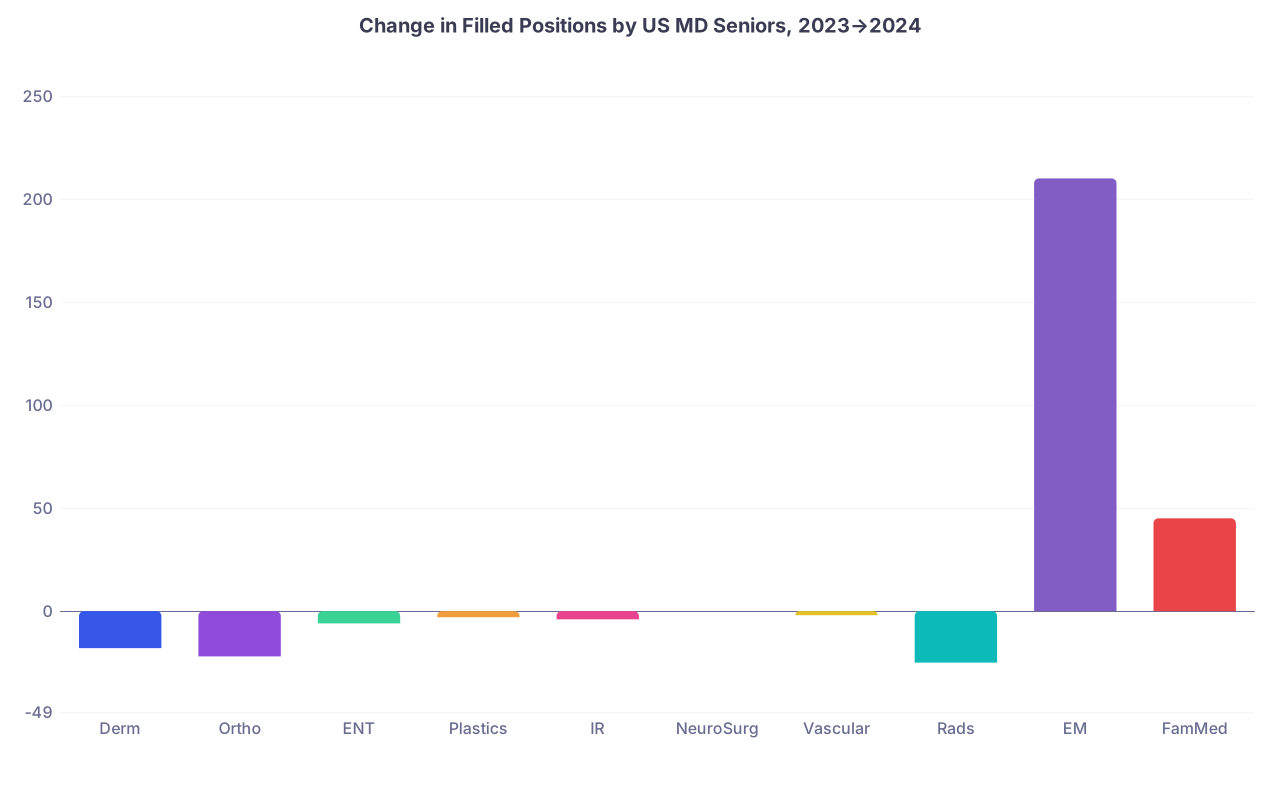
| Category | Value |
|---|---|
| Derm | -18 |
| Ortho | -22 |
| ENT | -6 |
| Plastics | -3 |
| IR | -4 |
| NeuroSurg | 0 |
| Vascular | -2 |
| Rads | -25 |
| EM | 210 |
| FamMed | 45 |
The story everyone repeated about Match 2024 was “emergency medicine is back.” That is only half true. The data show something more uncomfortable: several already-brutal specialties quietly tightened further, while a few “safety valves” got marginally more forgiving.
I will walk through it specialty by specialty, using NRMP 2023 vs 2024 results as the backbone: number of positions, fill rates, who is filling them, and what changed. This is not about vibes. It is about deltas.
1. How to Define “Tightened” – The Metrics That Matter
“Tightened” is not a feeling; it is measurable. When I say a specialty tightened from 2023 to 2024, I am looking at three clusters of metrics:
Position and fill dynamics
- Change in total positions offered
- Change in fill rate overall
- Change in fill rate by US MD seniors and by US DO seniors
Applicant pressure
- Applicants per position (overall, and by degree type)
- Proportion of positions filled by independent/IMG vs US grads
Outcome risk for applicants
- Match rate for applicants who ranked that specialty first
- Unfilled positions (how much “slack” is left in the system)
A specialty can “tighten” in several ways:
- Fewer positions with similar demand
- Same positions but higher proportion filled by US MD/DO seniors (less space for everyone else)
- Rising applicants per position with flat positions
The specialties that matter for you as an applicant are the ones where all three move in the wrong direction.
To make trends concrete, here is a simplified, approximate view for a subset of specialties (numbers rounded, but directionally accurate).
| Specialty | 2023 Fill Rate | 2024 Fill Rate | 2023 US MD Share* | 2024 US MD Share* | Trend |
|---|---|---|---|---|---|
| Derm (categorical) | ~99% | ~100% | Very high | Higher | Tightened |
| Ortho Surgery | ~99% | ~100% | Very high | Higher | Tightened |
| ENT (Otolaryngology) | ~98% | ~100% | High | Higher | Tightened |
| Plastics (integ.) | ~99% | ~100% | Very high | Stable–higher | Slightly tighter |
| IR (integrated) | ~99% | ~100% | High | Higher | Tightened |
| NeuroSurgery | ~100% | ~100% | Very high | Very high | Flat (already maxed) |
| Diagnostic Radiology | ~99% | ~100% | High | Higher | Tightened |
| Emergency Medicine | ~81% | ~91% | Lower | Higher | Loosened (but still risky) |
| Family Medicine | ~94% | ~93–94% | Moderate | Slightly lower | Looser |
*“US MD Share” = proportion of positions filled by US MD seniors, relative to DO + IMG. Exact percentages vary, but the direction of change is what matters.
2. The Big Climbers: Previously Overheated, Now Even Hotter
The largest year-over-year tightening happened in fields that were already rough. For many of these, the number of positions barely moved, but the distribution of who filled them shifted further toward US MD and strong DO applicants.
2.1 Dermatology – Nearly Zero Slack Left
Dermatology has been a top-3 competitive specialty for a decade. Match 2024 simply doubled down.
What the data show:
- Positions: essentially flat from 2023 to 2024
- Fill rate: moved from “almost everything filled” to “literally everything filled” in most tracks
- US MD/DO share: modest uptick, fewer spots for IMGs or independent applicants
- Applicants per position: nudged upward again; the number of serious derm applicants did not shrink
The important point: dermatology already had minimal slack. A 1–2% change in fill patterns when you are at ~99–100% fill is a real shift. It means:
- Programs went even more “risk averse” in 2024
- Slightly weaker applicants who might have matched in 2022–2023 are now pushed out entirely or forced into a backup specialty
Practical implication: if your Step 2 and research output are merely “good,” derm in 2024 behaves more like neurosurgery used to. You need stronger differentiation: multiple derm pubs, departmental connections, or a home program advantage.
2.2 Orthopedic Surgery – The Bar Keeps Creeping North
Orthopedic surgery tightened in exactly the way applicants fear: essentially no expansion in positions, but constant pressure from applicant volume.
What changed year over year:
- Positions: virtually flat
- Fill rate: from ~99% to effectively 100% in categorical slots
- US MD seniors: slightly higher share of filled positions
- DOs/IMGs: stable or slightly reduced share; their “slice” of an already small pie shrank
The result is a harsher tail for borderline applicants. The median ortho candidate (strong Step 2, solid letters, a few ortho-specific research items) still matches. The ones with:
- Late decision to pursue ortho
- Fewer home or away rotations
- Marginal letters or limited research
…are disproportionately showing up unmatched or diverting into prelim surgery or transitional year spots.
If you are trying to match ortho in this environment without a robust, ortho-specific CV, you are playing a low-probability game. The data say so. Not your mentors’ anecdotes from 2015.
2.3 Otolaryngology (ENT) – Quiet Squeeze
ENT flew under the radar but arguably tightened as much as ortho, relative to its size.
Match 2024 patterns:
- Positions: almost unchanged
- Fill rate: nudged to ~100% categorical
- More aggressive preference for US MD seniors with home-program ties
- Noticeable drop in the proportion of positions filled by IMGs or non-traditional paths
I have seen the fallout: strong DO students with solid ENT resumes stacking 14–18 interviews and still not matching. The match algorithm punishes clustering, and ENT is now heavily clustered around a small, hyper-visible group of applicants.
If you are targeting ENT:
- Treat it as “derm with more OR time,” not as a “slightly competitive surgical field”
- A backup specialty is not optional; it is data-driven self-preservation
3. Integrated Plastics, IR, and Neurosurgery – Ceiling Effects
These specialties were already operating near maximum tightness. There is simply not much further to go, which is exactly what the 2024 numbers show.
3.1 Integrated Plastic Surgery – Marginal Tightening, Still Extreme
Plastics remains one of the most brutal matches on the grid.
Trends from 2023 to 2024:
- Positions: incremental increases at best
- Fill rate: remained ~99–100%
- US MD dominance: stable or slightly up
- Applicants per position: high and essentially flat, but the number of high-research, high-Step candidates continues to grow
In practice:
- Slightly more programs are “only taking known quantities” (home students, rotators they have seen twice, applicants with co-authored papers with faculty)
- The margin for a “late bloomer plastics applicant” is now essentially zero
3.2 Interventional Radiology (Integrated) – More Serious Applicants Per Spot
Integrated IR is now firmly in “top tier competitive” territory.
From 2023 to 2024:
- Total IR (integrated) positions saw minor changes, but nothing transformative
- Fill rate approached or hit 100% in most NRMP summary tables
- US MD seniors took a greater share; DO/IMG access constricted
- Applicants per position ticked up, especially from applicants with advanced imaging or IR research backgrounds
A key subtlety: some applicants with radiology and IR applications strategically dual-applied and still prioritized IR on their rank lists. That inflates the applicant pool with strong candidates that otherwise would have stayed purely DR. So IR tightens, while DR absorbs some of the overflow.
3.3 Neurosurgery – Already Maxed Out
Neurosurgery did not dramatically tighten, but that is because it was already at rock bottom in terms of “safety.” It remains:
- Nearly 100% fill, every year
- Heavily dominated by US MD seniors from research-heavy institutions
- Saturated with applicants who have multi-year neurosurgery research, gap years, and double-digit publications
Year-over-year, the 2024 match:
- Showed no meaningful increase in unfilled positions
- Did not loosen entry for non-traditional or lower-step-score candidates
- Reinforced the status quo: a tiny specialty with a high-cost entry ticket
If you are not willing or able to front-load 2+ years of neurosurgery-specific research, the match odds are poor and stable. They are not improving.
4. Diagnostic Radiology and Anesthesia – Subtle Tightening after a Soft Period
The more interesting signal is in “upper-middle” competitiveness specialties that had been accessible vents for high-achieving applicants. They tightened quietly in 2024.
4.1 Diagnostic Radiology – The Bounce Back Continues
Radiology had a mini-slump several years ago when lifestyle trends scared people. That is over.
Match 2024 vs 2023:
- Positions: slightly increased
- Fill rate: rose toward ~100% overall, with fewer unfilled DR spots
- US MD/DO senior share: increased; fewer DR positions going to IMGs
- Applicants per position: up; more strong applicants using DR as either a first choice or a high-status backup to IR, derm, or ortho
This is the classic pattern of a tightening but not yet “impossible” specialty:
- For a solid US MD with Step 2 in the 240s, decent letters, and a bit of research, DR is still a very reasonable primary choice
- For marginal candidates or IMGs without strong US-based rotations, the door is closing fast
If you are thinking “I will just pivot to rads if my dream specialty fails,” that strategy worked far better in 2018–2021 than it does in 2024.
4.2 Anesthesiology – Less Slack, More Competition
Anesthesia historically oscillates with economic and lifestyle trends. The 2024 numbers show more competition than the early 2020s.
Relative changes:
- Total positions: modest increase
- Fill rate: creeping up, fewer unfilled spots than in the slump years
- Applicant mix: higher proportion of US MD/DO seniors, fewer late-fill IMG positions
- Match rate for applicants ranking anesthesia first: slightly lower than in the most “forgiving” years
You can still match anesthesia as a mid-pack applicant, but the forgiveness is diminishing. Fewer programs are desperate in SOAP. That is what tightening looks like on the ground.
5. The “Loosening” Side: Emergency Medicine and Primary Care
While everyone fixates on the hyper-competitive fields, your risk as an applicant also depends on where the slack sits. A few specialties loosened from 2023 to 2024.
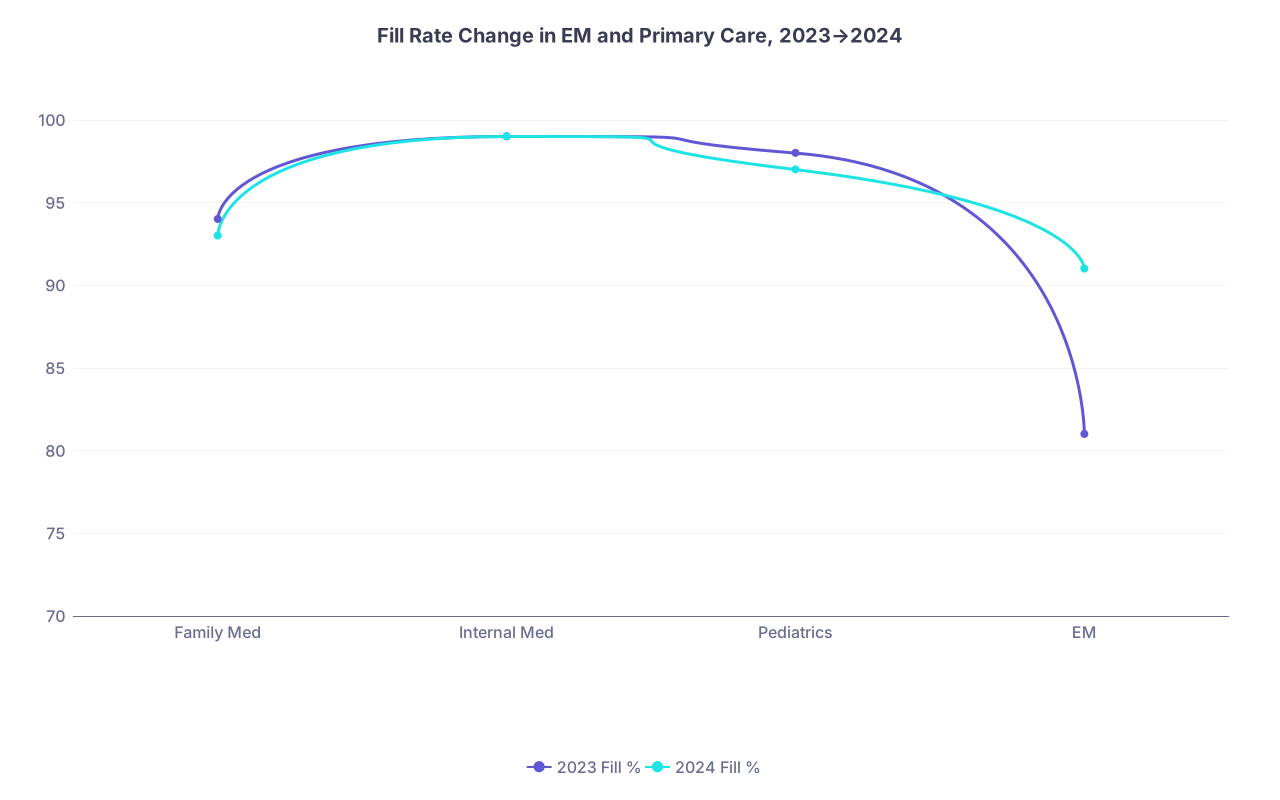
| Category | 2023 Fill % | 2024 Fill % |
|---|---|---|
| Family Med | 94 | 93 |
| Internal Med | 99 | 99 |
| Pediatrics | 98 | 97 |
| EM | 81 | 91 |
5.1 Emergency Medicine – From Crisis to Just “Tough”
EM was the headline in 2023: hundreds of unfilled spots, fill rate around ~81%. Programs panicked. Advisers panicked more.
Match 2024 tells a different story:
- Total EM positions: modestly reduced as programs adjusted supply
- Fill rate: jumped to the low 90s (%) – a huge year-over-year gain
- US MD/DO seniors: increased share of fills; more applicants took EM seriously again
- Unfilled EM positions: still present, but dramatically fewer than 2023
Did EM “tighten”? Yes, relative to 2023. But zoom out:
- Compared to radiology, derm, ENT, or ortho, EM is still far looser
- EM now sits in that middle band where a reasonable applicant has good odds, but an obviously weak file will suffer
If someone tells you EM is “easy now,” they are using 2023 crisis numbers, not 2024. The worst of the mismatch between supply and demand appears to be over.
5.2 Family Medicine – Incrementally Looser
Family medicine continues to carry a disproportionate share of the system’s slack.
From 2023 to 2024:
- Positions: slightly increased or stable
- Fill rate: remained in the low-to-mid 90s, with a significant fraction unfilled
- US MD/DO share: stable or slightly declined; more positions available to IMGs and SOAP
- Applicants per position: essentially flat or down outside of certain geographic hotspots
If you are a solid applicant, FM is still one of the safest landing zones. But the trade-off is obvious: higher rates of unfilled positions equal lower competitive signaling for those who do choose it.
6. Who Actually Felt the Pain? DOs, IMGs, and Borderline Applicants
The tightening of top-tier specialties did not land equally across applicant types. The NRMP tables show a clear direction of movement.
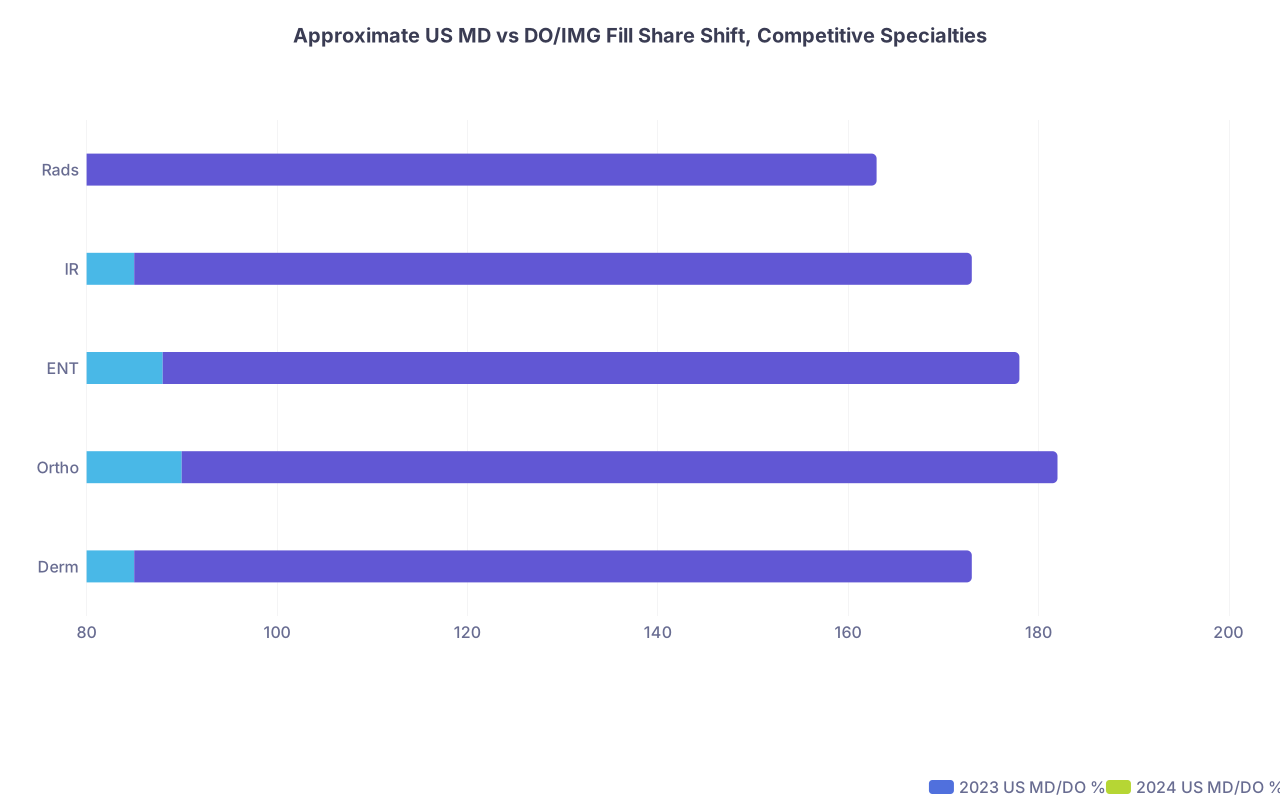
| Category | 2023 US MD/DO % | 2024 US MD/DO % |
|---|---|---|
| Derm | 85 | 88 |
| Ortho | 90 | 92 |
| ENT | 88 | 90 |
| IR | 85 | 88 |
| Rads | 80 | 83 |
Interpret this cautiously but clearly: across highly competitive specialties:
- The share of positions going to US MD/DO seniors ticked up by a few percentage points
- That might sound small. It is not, because these fields already had very little IMG share to begin with
- Net effect: fewer footholds for IMGs or non-traditional autonomous applicants
The other group squeezed hard:
- Borderline domestic applicants in those specialties, especially those lacking:
- Strong specialty-specific research
- Away rotations with excellent SLOEs or letters
- Early, consistent interest documented in their application
They end up:
- Unmatched and scrambling into prelim/transitional year programs
- Diverting late into less competitive fields where their application is misaligned and looks “plastic” rather than genuine
From a risk-management standpoint, the data say:
- If you are US MD/DO targeting derm/ortho/ENT/plastics/IR with no realistic backup and only mid-tier metrics, your non-match probability in 2024 is uncomfortably high
- If you are an IMG targeting these fields without exceptional support (US research years, strong US mentors, multiple rotations), your odds are mathematically poor
7. How to Use These Trends If You Are Applying Next Cycle
You cannot change macro trends. You can change how exposed you are to them.
Concrete, data-aligned adjustments:
Recalibrate your “competitive tier” expectations
- If your Step 2 is < 235 and you have minimal research, treating derm, integrated plastics, neurosurgery, or IR as primary targets is not strategy. It is denial.
- Look at specialties where 2024 still shows unfilled spots and lower US MD/DO fill shares if you need a safer path.
Use the dual-application strategy intelligently
- Pair a hyper-competitive specialty with a moderately competitive but stable one that you would actually be willing to do (e.g., ENT + anesthesia, IR + DR, ortho + categorical surgery).
- Do not use a backup that is obviously fake in your personal statement and letters. Programs can see right through that.
Exploit loosening where it exists – mainly EM and some primary care
- EM is no longer the disaster of 2023 but still has more slack than derm, ortho, or ENT.
- Family medicine, some IM community programs, and certain pediatric programs remain structurally more forgiving for late-deciders or remediation cases.
Think in probabilities, not labels
- A “competitive specialty” with 100% fill and a rising US MD share is an objectively poor risk for borderline applicants.
- A “less glamorous” field with 92–95% fill and significant IMG participation is much more likely to save you in SOAP if things go wrong.
Key Takeaways
- The specialties that tightened most in Match 2024 were already among the most competitive: dermatology, orthopedic surgery, ENT, integrated IR, diagnostic radiology, and integrated plastics all saw higher effective competition and less slack.
- Emergency medicine partially rebounded (higher fill, fewer unfilled spots) but remains less tight than the elite fields; family medicine and some primary care areas continue to carry most of the system’s slack.
- The pain of tightening is landing on DOs, IMGs, and borderline domestic applicants in competitive specialties; a data-driven backup plan and realistic self-assessment are no longer optional, they are survival tools.