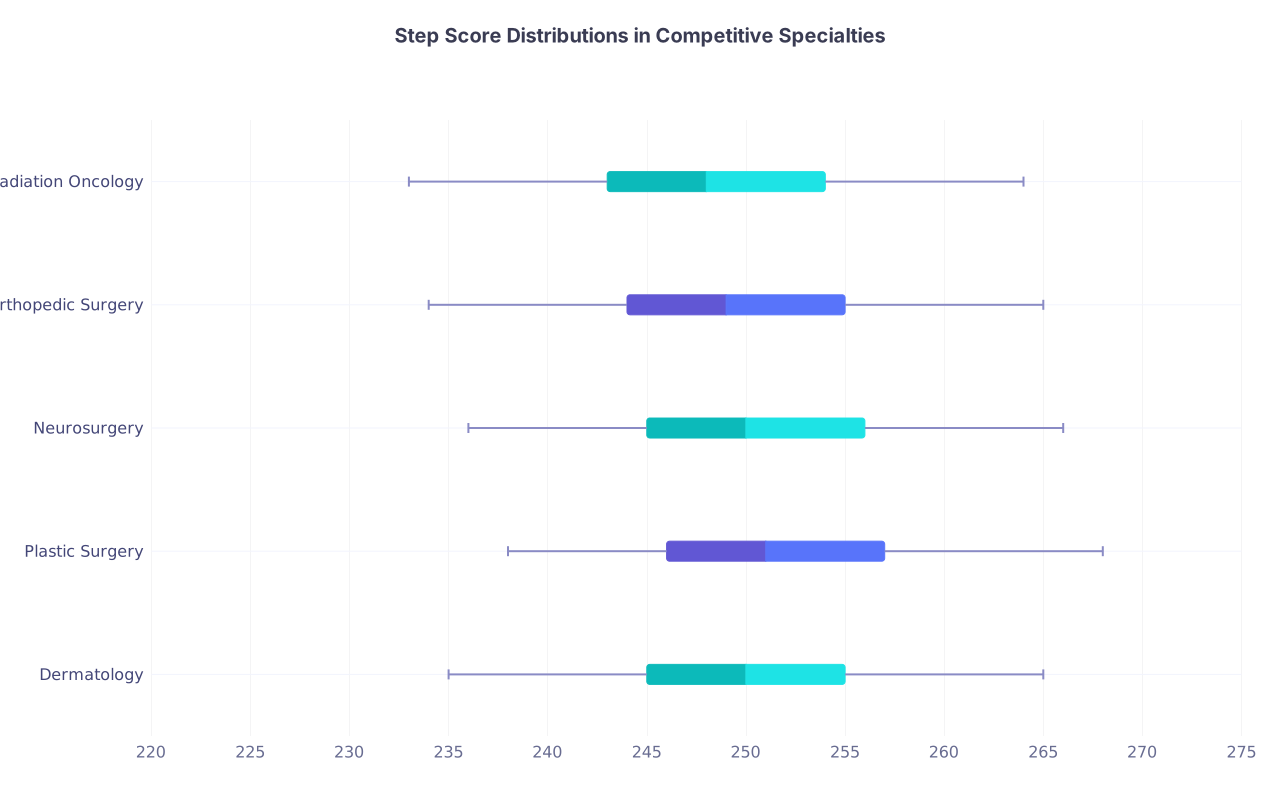
| Category | Min | Q1 | Median | Q3 | Max |
|---|---|---|---|---|---|
| Dermatology | 235 | 245 | 250 | 255 | 265 |
| Plastic Surgery | 238 | 246 | 251 | 257 | 268 |
| Neurosurgery | 236 | 245 | 250 | 256 | 266 |
| Orthopedic Surgery | 234 | 244 | 249 | 255 | 265 |
| Radiation Oncology | 233 | 243 | 248 | 254 | 264 |
The story most applicants tell themselves about Step scores and competitive specialties is incomplete. The data shows something harsher: in the top specialties, you are not competing against a cutoff, you are competing against a distribution. And the entire curve is shifted high.
I am going to treat this exactly like what it is: a selection problem with measurable inputs, noisy outcomes, and asymmetric risk. If you want dermatology, plastics, neurosurgery, ortho, ENT, optho, or integrated IR, you cannot afford to think in binaries like “above 240 = fine.” You need to think in percentiles, tails, and overlap between specialties.
Let’s quantify what you are up against.
The Score Landscape: How High Is “High” Now?
USMLE Step 1 went pass/fail. That moved almost all numerical signal to Step 2 CK (and to a lesser extent COMLEX Level 2 for DOs). Programs did not stop stratifying. They just shifted the filter.
From recent NRMP data and program-reported ranges, you can think roughly in these Step 2 CK medians for matched US MD seniors in the most competitive specialties:
| Specialty | Approx Median Step 2 CK | Typical Competitive Band* |
|---|---|---|
| Dermatology | 255–258 | 250–265 |
| Plastic Surgery (Int) | 255–258 | 250–265 |
| Neurosurgery | 253–256 | 248–262 |
| Orthopedic Surgery | 251–254 | 245–260 |
| Otolaryngology (ENT) | 251–254 | 245–260 |
| Integrated IR | 250–253 | 245–260 |
*“Competitive band” = approximate IQR-like band where a large share of interviewed / matched applicants cluster.
These are not cutoffs. They are the centers of distributions. Meaning: there are plenty of applicants above those numbers who do not match, and a minority below who do.
But the key signal: if your Step 2 is under 245, the data shows you quickly slide from “around median” to “outlier low” for these specialties.
To make this more visual:
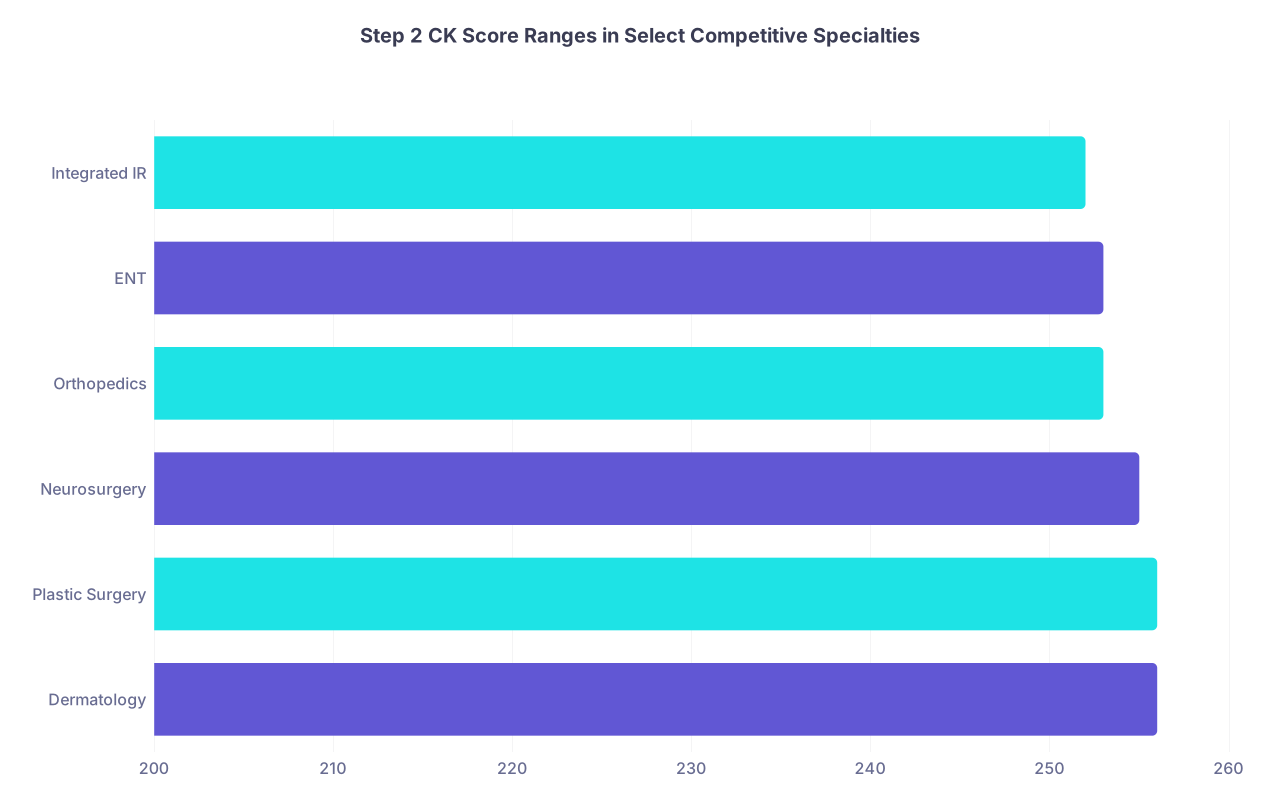
| Category | Value |
|---|---|
| Dermatology | 256 |
| Plastic Surgery | 256 |
| Neurosurgery | 255 |
| Orthopedics | 253 |
| ENT | 253 |
| Integrated IR | 252 |
Each bar is roughly the median. The spread around each is wide, but you get the point: all the peaks live in the 250 neighborhood.
Distributions, Not Cutoffs: Why 250 Is Not “Safe”
Applicants love magical thresholds: “250 and you are golden.” The actual distributions say otherwise.
Conceptually, imagine a normal-like distribution for dermatology Step 2 CK scores among matched applicants:
- Mean around 256
- Standard deviation roughly 8–10 points
That means:
- One standard deviation below mean: ~246–248
- Two standard deviations below mean: ~236–238
If your Step 2 is 240 and you are trying to match derm, you are operating around the 10–15th percentile of scores among matched applicants. It is not impossible, but you are starting the race far behind.
You can think in match probability bands that look something like this (for the most competitive specialties, aggregated):
| Step 2 CK Band | Approx Match Odds* |
|---|---|
| 265+ | Very high |
| 255–264 | High |
| 245–254 | Moderate |
| 235–244 | Low |
| <235 | Very low |
*This is conceptual, not an official NRMP curve. It reflects patterns seen in NRMP Charting Outcomes: match rates rise sharply with score, then plateau.
The biggest misconception I hear: “Once you are past 250, scores do not matter.” That is false for two reasons:
- The volume of high scorers is huge. You are not one of 20 people above 250. You are one of thousands.
- Many hyper-competitive applicants cluster 255–270. The selection then leans heavily on research and letters, but extreme scores (e.g., 268 vs 252) still catch attention.
The more mature way to think: scores are an initial sorting mechanism. Above roughly the 70th percentile, incremental points matter less than publications, home performance, and away rotations. Below ~50th percentile, incremental points matter a lot because they are the difference between screened out and “at least take a look.”
Specialty-by-Specialty: How the Score Curves Shift
Let’s break down several of the very competitive specialties and how the Step 2 distributions actually function in practice.
Dermatology: Peak Shifted Highest
Derm is the poster child for score inflation.
Typical pattern I see in derm applicants at large academic centers:
- Step 2 CK range among interviewed candidates: ~240–270
- Heavy clustering 250–262
- Outliers ≤240 who match: almost always with one or more of:
- Multiple first-author derm publications
- Strong home derm mentorship / advocacy
- Research year at a major derm department
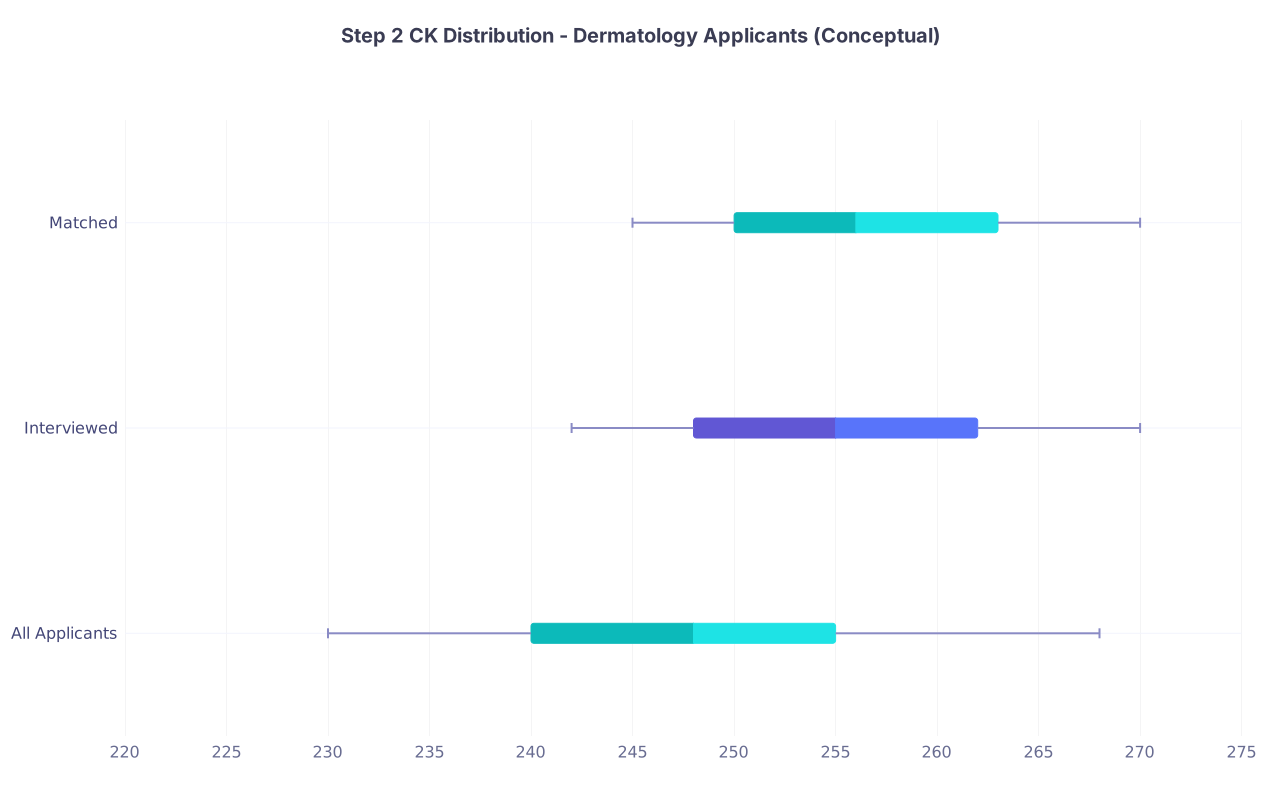
| Category | Min | Q1 | Median | Q3 | Max |
|---|---|---|---|---|---|
| All Applicants | 230 | 240 | 248 | 255 | 268 |
| Interviewed | 242 | 248 | 255 | 262 | 270 |
| Matched | 245 | 250 | 256 | 263 | 270 |
You can see the pattern: the curve shifts right at each stage.
Derm programs use scores aggressively for screening. If they have 800 applications for 4 spots, the first pass is often something like: filter below 245–248, then sort by publications / institutional connections / letters.
Concrete implication: with Step 2 CK <245, your chances in derm are not “zero,” but you are relying on being a statistical outlier on other dimensions.
Plastic Surgery (Integrated): Small N, Heavily Sorted
Integrated plastics is deceptive. Lower total positions, intense self-selection, and a huge fraction of “gunners” with multiple research years.
Score ranges I see:
- Interviewed candidates: almost all ≥245
- Many clustered 255–265
- Multiple 260+ not uncommon, especially at top-10 programs
In plastics, the distribution is narrower but skewed high. You have fewer low-score success stories because the N is small and programs can be extremely picky.
If you are sitting at 245 with strong research, you are not dead in the water, but relative to others:
- You are likely below the median for the cohort trying for integrated plastics.
- You must compensate via:
- 10+ pubs / abstracts in plastics / craniofacial / hand
- Strong home program support
- Impeccable away rotation performance
The data reality: programs can fill their entire interview list with 250+ if they want. Many do.
Neurosurgery: High Scores + Severe Self-Selection
Neurosurgery is one of the best examples of a self-selected pool.
Applicants typically:
- Decide early
- Stack research (lab years, basic science, or clinical neurosurg)
- Take Step 2 early and aim high
Approx distribution among matched US MD seniors:
- Median: ~255
- Interquartile range: maybe 248–262
- Outliers: yes, but heavily compensated by research, often PhDs / dual degrees
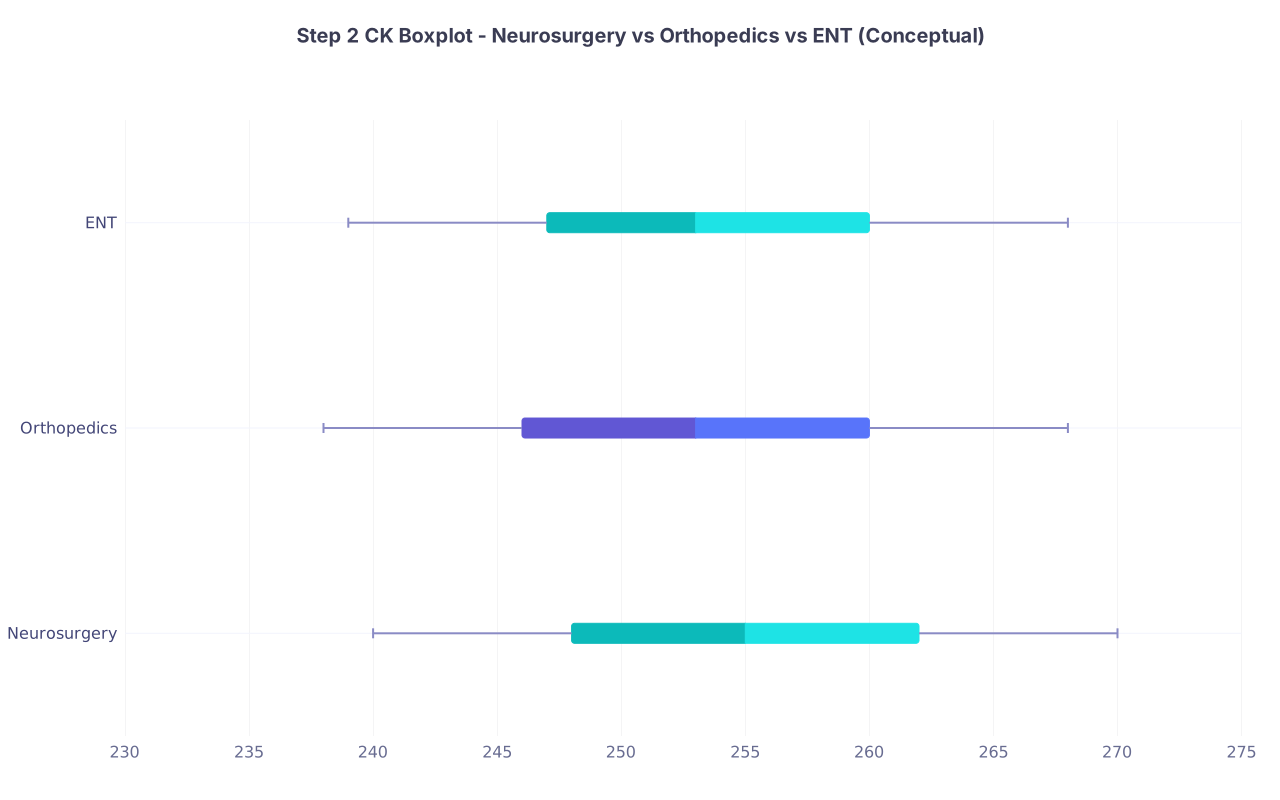
| Category | Min | Q1 | Median | Q3 | Max |
|---|---|---|---|---|---|
| Neurosurgery | 240 | 248 | 255 | 262 | 270 |
| Orthopedics | 238 | 246 | 253 | 260 | 268 |
| ENT | 239 | 247 | 253 | 260 | 268 |
All three are high. Neurosurgery slightly higher median, but the overlap is substantial.
Key difference: neurosurgery tends to scrutinize research and letters even more. I have seen people with 260+ not match neurosurgery because their neurosurgery-specific research was thin compared to peers.
Orthopedic Surgery and ENT: Similar Curves, Slightly Broader
Orthopedics and otolaryngology (ENT) generally show nearly identical score dynamics:
- Medians around 251–254 for matched US MD seniors
- Many programs using informal Step 2 filters in the 240s
- More total positions than derm / plastics, so a bit more room for “middle” scores with strong clinical performance
The interesting part: the width of the distribution. You see more 240–245 matches in ortho and ENT than in derm or plastics, thanks to:
- Larger program sizes
- More emphasis on away rotation performance
- The ability of a single strong attending championing you to override concerns about a borderline score
Still, if you are below ~240 and aiming for ortho or ENT, you are throwing yourself into the shallow end of the probability curve.
Where the Curve Drops Off: Score Thresholds and Screening
Programs often will not publicly admit this, but behind closed doors the language is blunt:
- “We do not have time to review 900 files. We just auto-screen below X.”
- “I do not want to interview anyone under 240 unless they are from our school or come recommended.”
The value of X varies by:
- Specialty competitiveness
- Program tier
- Total application volume
You can approximate common Step 2 screening bands like this:
| Program Tier | Typical Soft Screen | “Very Unlikely” Below |
|---|---|---|
| Top academic (Derm/Plastics/Neuro) | 245–250 | 240 |
| Mid–high academic (Ortho/ENT/IR) | 240–245 | 235 |
| Strong community / hybrid | 235–240 | 230 |
These are not fixed rules. A DO from a lesser-known school with a 257 and zero research can still struggle to get a derm interview at a top academic program. A home student with 238 but 6 pubs and glowing letters can still get ranked highly.
But from a data-analysis lens, the lower you fall below these soft screens, the steeper the drop in probability. Not linear. More like a cliff.
Step 2 CK vs Step 1 (When Step 1 Still Has Data)
If you are in a cohort that still has a numerical Step 1, the joint distribution matters.
Programs often scan Step 1 first out of habit. If it is mid-range, they glance at Step 2 to see if you trended up.
Patterns that help:
- Step 1: 233, Step 2: 252 – You look like someone who improved with clinical exposure.
- Step 1: 246, Step 2: 248 – Fine, stable, around derm/ortho medians.
- Step 1: 210, Step 2: 245 – A strong rescue narrative, but in top specialties you are still significantly below the median for the applicant pool.
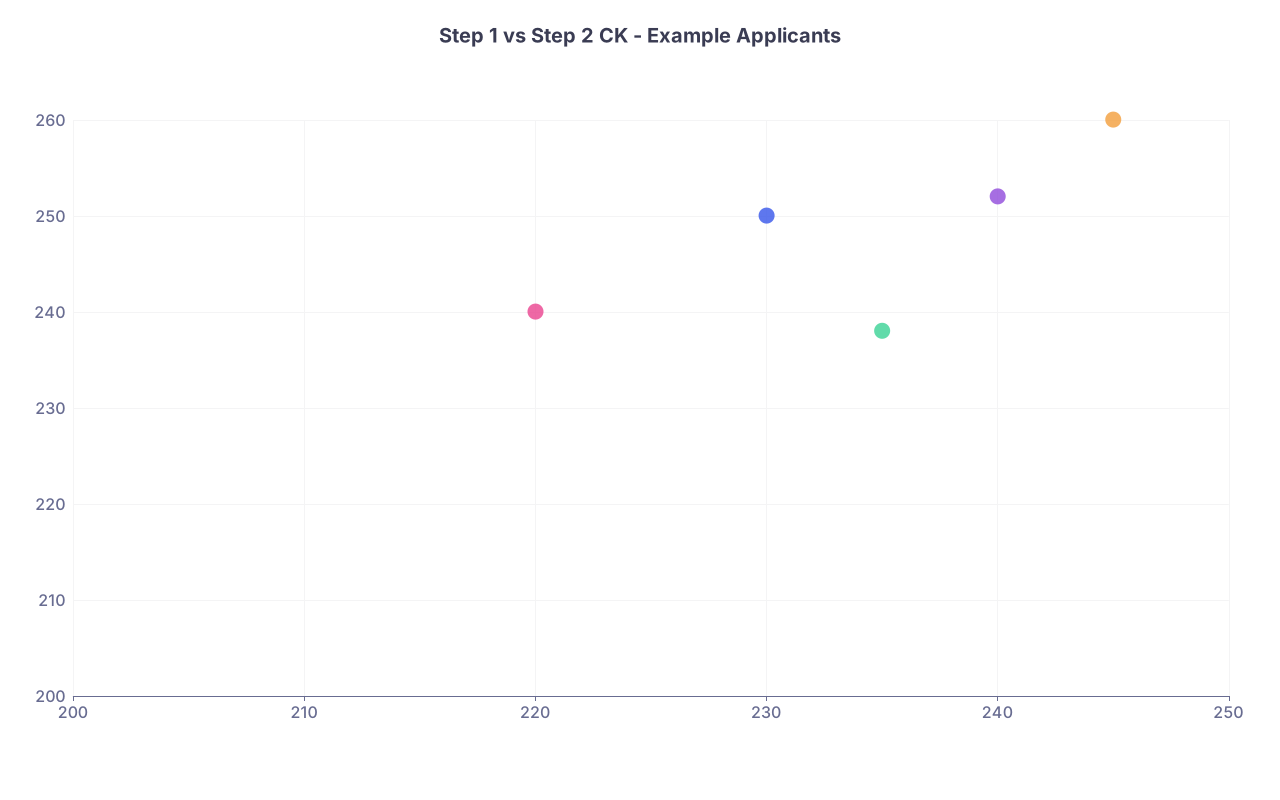
| Category | Value |
|---|---|
| Applicant A | 230,250 |
| Applicant B | 240,252 |
| Applicant C | 235,238 |
| Applicant D | 245,260 |
| Applicant E | 220,240 |
- Applicants near the diagonal (Step 1 ≈ Step 2) look consistent.
- Those far above the diagonal (big Step 2 jump) can rebrand somewhat for mid–high competitiveness, but top-tier derm/plastics/neuro will still see the combined record.
For cohorts where Step 1 is pass/fail, Step 2 becomes the only hard numerical stratifier. That shifts more weight onto it, not less.
DO and IMG Applicants: Same Curve, Different Baseline
The brutal piece for DO and IMG applicants is that they are playing in a similar score distribution, but starting from lower prior probability due to:
- School reputation
- Less institutional presence in competitive specialties
- Fewer home program slots in derm, plastics, etc.
Consider competitive specialties with 80–90% of spots filled by US MD seniors alone. That leaves:
- A small residue for US DOs
- An even smaller residue for IMGs
To be blunt: a DO or IMG often needs to be on the high end of the score distribution to be seen as equivalent to a mid-range US MD.
Think:
- US MD derm applicant: “competitive” at 255
- DO derm applicant: often needs ≥260 plus substantial research and connections just to get in the same interview pile at many programs
The distribution visually:
- The US MD pool: mean ~250+, tight variance
- The DO/IMG pool that actually applies: often bimodal – a bunch of risk-takers around 230–240 with almost no realistic chance, and a smaller spike of very strong applicants 255–270 who actually compete.
If you are a DO or IMG aiming at these specialties, the smart analytical move is:
- Benchmark against matched DO/IMGs in NRMP / specialty-specific data, not against “all applicants.”
- Realize that the threshold for “actually competitive” is frequently 5–10 points higher than it is for US MDs.
How to Use This Data to Make Rational Decisions
Let me be blunt. You are not going to math your way into a derm spot with a 235. But you can use the data intelligently to:
- Decide whether your target specialty is still rational.
- Adjust your application strategy if you proceed.
Here is a simple decision flow that reflects how I would advise based on distributions:

| Step | Description |
|---|---|
| Step 1 | Get Step 2 CK Score |
| Step 2 | Competitive for top specialties |
| Step 3 | Target competitive but broaden list and maximize research |
| Step 4 | Consider less competitive backup specialty seriously |
| Step 5 | Strongly pivot to more attainable specialties |
| Step 6 | Score 250 or higher? |
| Step 7 | Score 240 to 249? |
| Step 8 | Score 230 to 239? |
If you are:
≥260: you are in the top tail of almost every specialty. Focus on research, letters, and institutional fit.
250–259: you are at or above median for the most competitive fields. Reasonable to go all-in if the rest of your file is solid.
240–249: you are below median but not catastrophically. Pursuing derm/plastics/neuro is possible if your research and letters are stellar, but you should:
- Apply broadly, including mid-tier and community-leaning programs.
- Carry a realistic backup specialty on your rank list.
230–239: you are in a risk zone. You can still try for a competitive specialty if you accept a high probability of not matching on the first attempt, but from a data standpoint, your expected value is higher in a slightly less competitive field.
<230: for derm/plastics/neuro/ENT/ortho, you are operating in the noise. Almost all match success in this band involves unique circumstances.
The Real Levers Once Scores Plateau
One last reality check. Among applicants who already sit in the “competitive” section of the distribution (say ≥250), match outcomes diverge based on:
- Quantity and quality of specialty-specific research (especially first-author work)
- Letters of recommendation from recognizable, specialty-specific names
- Performance and reputation on away rotations
- Home program affiliation and advocacy
In data terms, Step scores are a high-variance, early-stage filter. Once you clear that, other features of your “model” become more predictive of match success.
Put differently: a 258 with five derm publications and a department chair letter will beat a 268 with no derm research and generic letters at most programs. The distributions are not everything. They are just the first gate.
Key Takeaways
- In the most competitive specialties, Step 2 CK distributions are centered around the mid‑250s, with very few matched applicants below the mid‑240s.
- Scores function less as “cutoffs” and more as distributional filters: being 10–15 points below the mean moves you into the low-probability tail where only exceptional research and mentorship can rescue you.
- Once you clear the high-score band (roughly 250+), research output, letters, and institutional connections dominate match outcomes more than squeezing out a few extra points on Step.