
The idea that “MDs always outcompete DOs in the toughest specialties” is lazy, outdated, and wrong in the way that matters to you: it’s a bad guide for your actual strategy.
Yes, MDs still dominate the hyper-competitive specialties. No, that does not mean DOs are shut out. And no, the letters alone do not decide who gets those spots.
Let’s tear this apart with data, not hallway gossip.
The Big Picture: Who Actually Matches Where
Start with the macro view: MDs and DOs don’t even apply to the same specialties at the same rates. So the “MD vs DO competitiveness” talking point is already skewed.
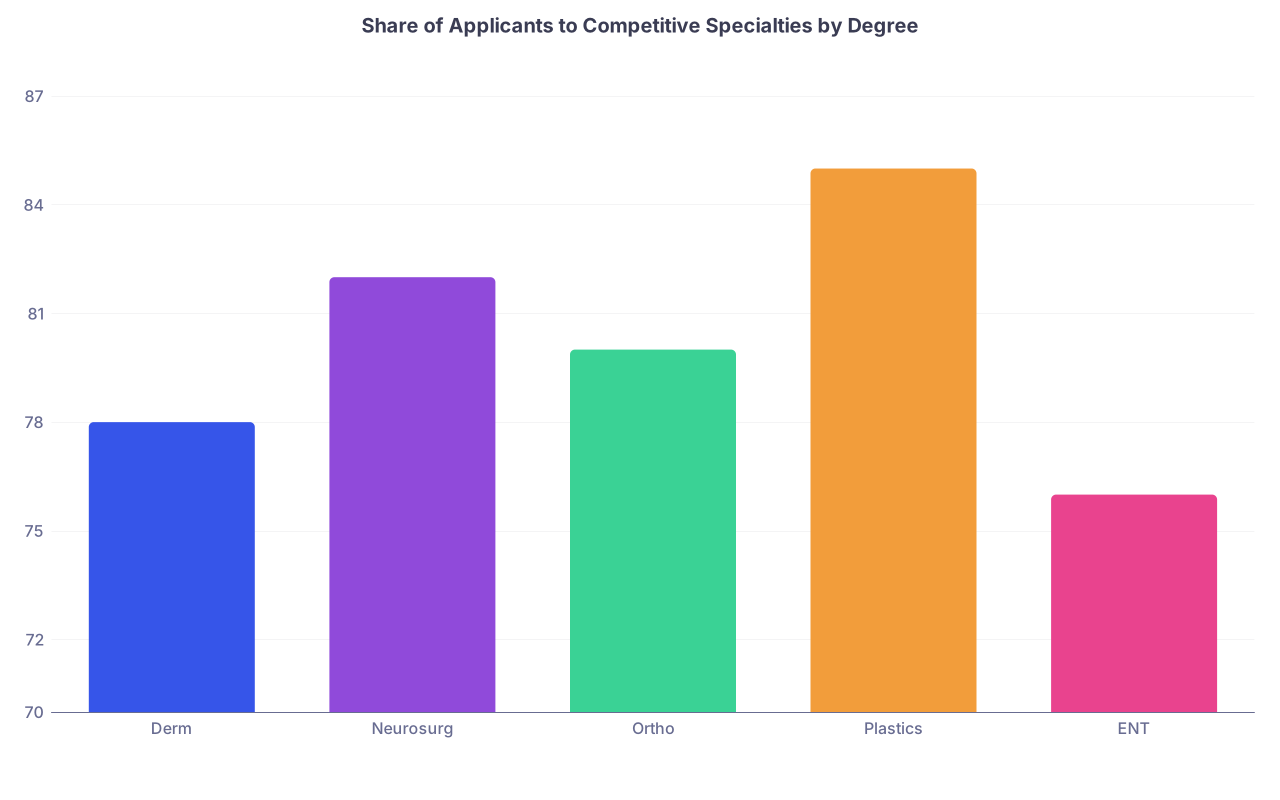
| Category | Value |
|---|---|
| Derm | 78 |
| Neurosurg | 82 |
| Ortho | 80 |
| Plastics | 85 |
| ENT | 76 |
Interpretation: in many “tough” specialties, the overwhelming majority of applicants are MDs. Partly pipeline. Partly self-selection. Partly DOs being told for years not to even try.
So what looks like “MDs always outcompete DOs” is often “DOs were filtered out three steps earlier by advising, school culture, or Step prep access.”
Here’s what’s actually happening in the match:
- MDs have higher match rates in the most competitive fields.
- DOs still match into all of them: derm, ortho, ENT, neurosurgery, plastics, urology, IR, etc.
- Within the same score band and with similar resumes, DOs can absolutely beat MDs for spots.
The myth is that the letters are the primary filter. They’re not. They’re a secondary filter applied on top of already huge differences in scores, research, and networking.
Where DOs Really Stand in “Tough” Specialties
Let me be concrete. “Toughest specialties” usually means:
- Dermatology
- Plastic surgery
- Neurosurgery
- Orthopedic surgery
- ENT (otolaryngology–head & neck)
- Interventional radiology
- Early urology
If you dig into NRMP and specialty match reports (and I have, repeatedly), the pattern is monotonous:
- DOs are a small fraction of total applicants
- Within that smaller pool, a non-trivial number match
- Those DOs who match usually look indistinguishable from MDs: same Step ranges, same research grind, same away rotations, same letters
Here’s a simplified snapshot that captures the structure, not the exact annual values (which shift slightly year to year):
| Specialty | DOs Apply? | DOs Match? | MD Advantage Mostly From… |
|---|---|---|---|
| Dermatology | Yes | Yes | Higher scores, more research, pipeline |
| Plastic Surgery | Yes | Yes | Stronger home programs, research |
| Neurosurgery | Yes | Yes | Early mentorship, research, Step |
| Ortho Surgery | Yes | Yes | Bigger applicant volume & scores |
| ENT | Yes | Yes | Networking, academic centers |
If the myth “MDs always outcompete DOs” were literally true, those “DOs match?” boxes would be “No.” They’re not.
What is true: MDs statistically win more of the available seats in those specialties. But that’s because:
- There are way more MDs in the pool
- MDs as a group average higher on Step 2
- MDs cluster more heavily at institutions that sponsor those competitive programs and research
That’s not an MD vs DO ceiling. That’s an MD vs DO starting position problem.
The Real Gatekeeper: Step and Shelf Performance
Let me be blunt: programs don’t sit in a conference room saying, “We hate DOs.”
They sit in a conference room saying, “We have 900 applications and 8 interview spots. Filter by Step 2 score, then research, then letters, then we’ll skim the rest.”
The biggest structural issue for DOs in the competitive match is this:
- DO schools historically emphasized COMLEX and sometimes treated USMLE as optional.
- Many DO students took USMLE late, underprepared, or not at all.
- A lot of competitive programs still want USMLE, even if they say “COMLEX accepted.”
So MDs appear to “outcompete” DOs because they walk in the door with clean, comparable USMLE data and often better prep infrastructure.
Here’s roughly how program directors think when they’re being honest, not politically correct:
- Did you take USMLE Step 2? If not, why should I spend time normalizing COMLEX when I have 400 MDs with easy-to-compare scores?
- If you took it, is your score in the same band as my usual interview pool?
- Are your clinical evals and letters convincing that you can handle the grind?
When DOs crush Step 2 and have legit clinical letters, they get interviews. When they don’t, they don’t. Same as MDs.
Blaming the degree is easier than admitting your 237 isn’t competitive for ortho at a major academic center.
The MD “Network” Advantage Is Real – But Not Absolute
Another quiet factor: geography and institutional power.
Most DO schools are not attached to big academic hospitals with neurosurgery labs, NIH grants, and residents cranking out 10 papers a year. MD schools are.
That means:
- MDs are more likely to have home programs in derm/ENT/neurosurg.
- They get early shadowing, niche research projects, and letters from names that program directors recognize.
- They can rotate internally instead of begging for away spots.
Does that advantage exist? Yes. I’d be lying if I denied it.
Does it mean DOs are locked out? No. It means DOs who match those specialties usually do three things:
- Take USMLE Step 2 and crush it.
- Hustle hard for away rotations at target programs.
- Attach themselves to any research opportunity they can find that touches the specialty.
I’ve seen DOs end up at top-tier ortho and neurosurg programs because they did that. They weren’t exceptions due to magic. They aligned their application with the actual selection criteria instead of relying on motivational posters.
Where DOs Actually Have Strategic Advantages
The myth is one-dimensional: MDs “win” competitive specialties; DOs don’t.
Reality is messier. The MD pipeline is obsessed with prestige. That creates weird inefficiencies that DOs can exploit.
A few examples I’ve seen over and over:
- Anesthesiology, EM (pre-EM-crisis), PM&R, and radiology: Historically, plenty of strong DO matches at mid-to-high-volume academic and community programs. Many MDs ignore solid community programs because they’re chasing top-20 name brands.
- Geographic loyalty: DOs from a region who rotate at and commit to a hospital system sometimes beat out MDs with slightly better stats but no intention of sticking around. Programs know who’s likely to stay.
- Underserved systems: Safety-net hospitals and regional programs often care more about: “Will this person work hard and not quit?” than: “Is their diploma MD or DO?”
Where MD prestige really bites is at the extreme top of the prestige food chain: brand-name derm, plastics, and neurosurg programs that basically recruit from a handful of med schools and research labs. But that’s a tiny slice of the entire residency ecosystem.
If your goal is “ortho somewhere solid” rather than “ortho at the single most famous institution in the country,” being DO is a speed bump, not a wall.
Program Bias: How Much Is Real Prejudice vs Noise?
Let me not sugarcoat it: some programs are still openly biased.
You see it in ERAS filters: “MD only” or “DOs rarely interviewed.” You see it in PD talk at conferences when the recording stops. You see it in the way certain faculty reflexively equate MD with “traditional, normal” and DO with “alternative.”
But here’s the part the doomers always leave out:
- Many programs don’t care at all, as long as your scores, letters, and clinical performance are strong.
- Some programs like high-performing DOs because they’ve watched them grind, be grateful, and avoid entitlement.
- Once you’re in the program, the MD vs DO distinction evaporates fast. You’re judged on call notes, not your diploma.
At the application stage, bias is usually a tiebreaker, not the primary filter. If you’re weaker on paper, being DO gives some programs permission to cut you early. If you’re strong on paper, being DO often becomes irrelevant.
Is that fair? No. Is it the main reason most DOs don’t match derm? Also no. The main reason is that matching derm is brutally hard for almost everyone, and the DO pipeline sends fewer fully-armed candidates into that war.
What Actually Moves the Needle for a DO in a Competitive Field
If you want an honest, non-motivational-poster answer to “Can I do X competitive specialty as a DO?”, here’s the hard standard I’ve seen work:
First, your mindset: assume your letters don’t get you the benefit of the doubt. Your application needs to look obviously strong at a glance.

| Step | Description |
|---|---|
| Step 1 | Decide on competitive specialty |
| Step 2 | Commit to taking USMLE Step 2 |
| Step 3 | Target high Step score |
| Step 4 | Secure specialty mentor |
| Step 5 | Get involved in research |
| Step 6 | Plan away rotations strategically |
| Step 7 | Apply broadly and smartly |
What this usually means in practice:
- USMLE Step 2 score in the competitive range for that specialty. Not “good for DO,” not “respectable.” Competitive for anyone. If ortho at solid programs is pulling 250+ Step 2 interview averages, you want to be touching that ballpark.
- Specialty-specific letters from people who actually operate or practice in that field and can compare you to prior matched residents.
- Evidence of commitment: research, case reports, QI projects, presentations at that field’s conferences.
- Away rotations at places that regularly take DOs or at least historically give them interviews.
This is the part most premeds and early med students ignore while complaining about “bias.” By the time the MD vs DO difference matters, they’ve already lost the Step 2 and research arms race by two years.
Step 1 Pass/Fail: Did It Help DOs? Not Like You Think
People love to say: “Now that Step 1 is pass/fail, DOs are on an even playing field!”
No. That’s not what happened.
Programs just shifted their obsession directly to Step 2 and clinical performance.
- If your school’s preclinical rigor was weaker, that won’t show up in Step 1 anymore. It will show up in Step 2 and shelf exams instead.
- If you were planning to “prove yourself” with a monster Step 1 and coast later, that door is gone.
For DOs, this means you have to treat Step 2 as your flagship score. Many of the same structural issues remain: less standardized prep, more variable preclinical rigor. That’s fixable on your end, but it’s not magically fixed by the exam change.
The Harsh Truth and The Useful Truth
Here’s the harsh truth:
- MDs, as a group, outperform DOs in the match for the most competitive specialties.
- Not because they’re universally smarter. Because more of them start with stronger metrics, better institutional support, and built-in access to those specialties.
Here’s the useful truth:
- DOs still match those specialties every single year.
- The DOs who match don’t play by the “average DO” metrics. They meet or exceed MD standards in scores, research, and clinical evaluation.
- The letters on your diploma are one variable in a much bigger function. They’re not the constant that overrides everything else.
So no, MDs don’t “always outcompete” DOs in the toughest specialties. They just start the race closer to the finish line. Some DOs still win. Many more could win if they trained for the right race instead of complaining about the track.
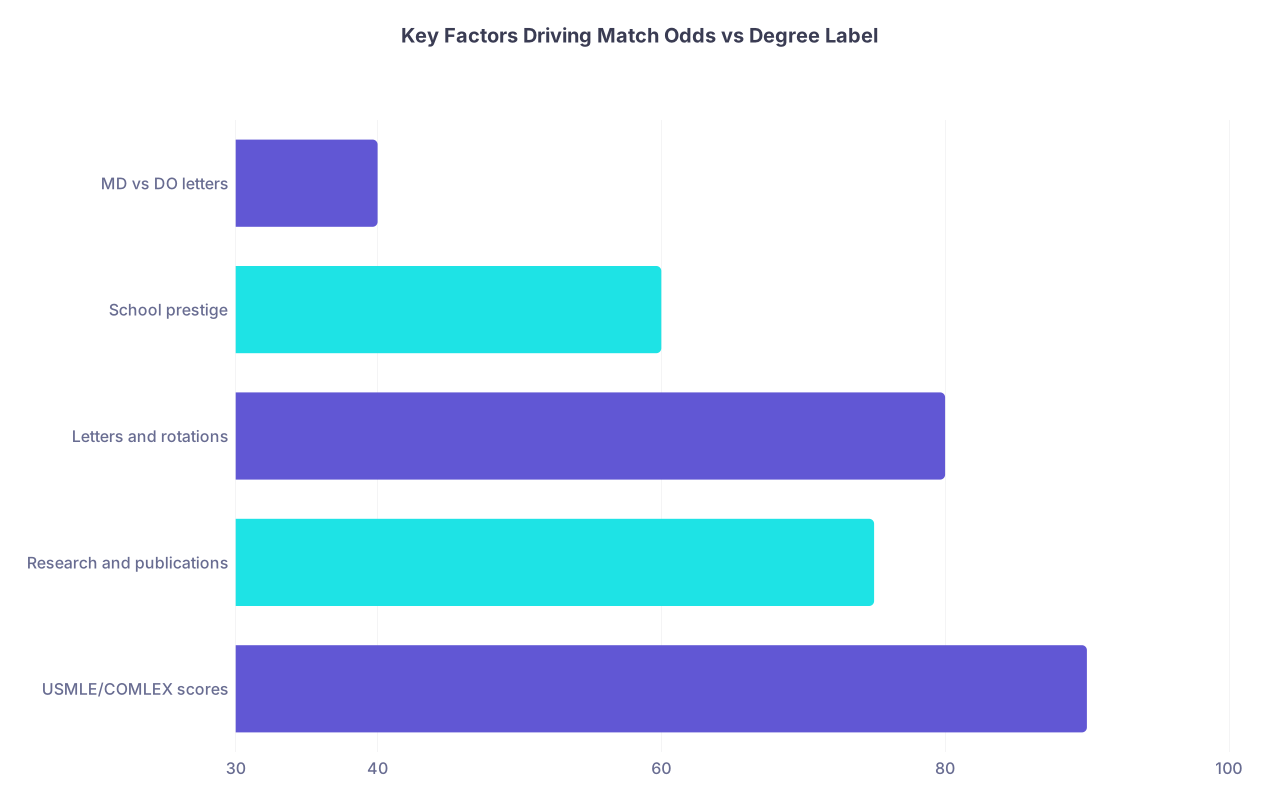
| Category | Value |
|---|---|
| USMLE/COMLEX scores | 90 |
| Research and publications | 75 |
| Letters and rotations | 80 |
| School prestige | 60 |
| MD vs DO letters | 40 |
Two Things to Remember
- The MD vs DO label is a tiebreaker for competitive specialties, not the main deciding factor. Scores, research, and letters move the needle far more.
- If you are a DO aiming high, you cannot be “average DO” on paper and expect a derm or ortho miracle. Aim for “top any‑school” metrics, and suddenly the door isn’t mythical anymore—it’s just heavy, and you have to push harder.