
The idea that “combined” or “integrated” residency programs are automatically more competitive is lazy thinking. It sounds sophisticated. It is also flat‑out wrong.
They can be competitive. Some are brutally so. But the competitiveness comes from the same old forces that drive everything else in the Match: supply, demand, self-selection, and applicant behavior. Not from the magic words “combined” or “integrated” in the program name.
Let’s dismantle this properly.
What People Think “Combined/Integrated” Means
When students say “combined” or “integrated,” they usually mean one of three very different things:
True dual-training programs that lead to two full board eligibilities
Think:- Med-Peds (Internal Medicine–Pediatrics)
- Triple boards (Peds–Psych–Child Psych)
- Internal Medicine–Psychiatry
- Family Medicine–Psychiatry
- EM–IM, EM–Peds, etc.
Integrated categorical programs where preliminary training is built in
Examples:- Integrated vascular surgery (0+5)
- Integrated plastic surgery (0+6)
- Integrated thoracic surgery
- Some interventional specialties with structured tracks
“Combined” in a casual way (e.g., “IM with a research track,” or “FM with OB focus”).
These aren’t combined residencies. They’re standard programs with a flavor.
People then mash all of these together and confidently announce: “Combined or integrated programs are more competitive.” Which is like saying “anything that’s not plain vanilla must be gourmet.” Sometimes true. Often not.
How Competitiveness Actually Works
Forget branding for a second. Competitiveness in the Match boils down to three boring but reliable levers:
- Number of positions (denominator problem)
- Number and type of applicants (who actually applies)
- Applicant self-sorting (which filters are already in place before ERAS is even submitted)
Look at NRMP data tables and something becomes obvious: small programs and niche tracks look competitive even when they’re not attracting the same level of applicant firepower as, say, integrated plastics.
If you offer 4 Med-Peds spots and 160 people apply, your interview-to-rank ratios will look intense on paper. That does not mean every one of those 160 is a 260+, AOA, 10‑pubs superstar.
To make this less hand-wavy, here’s how some archetypes usually compare.
| Program Type | Usual Competitiveness Pattern |
|---|---|
| Integrated Plastic Surgery | Extremely competitive, top-tier applicants |
| Integrated Vascular Surgery | High but below plastics, strong self-selection |
| Med-Peds | Moderate; often similar to strong IM |
| IM–Psych / FM–Psych | Small N, self-selected, not universally “hard” |
| Triple Boards | Very niche, more fit-driven than score-driven |
Headline: the word “integrated” is not a competitiveness multiplier. The market decides.
The Med-Peds Myth: “Double Boards = Double Competition”
Internal Medicine–Pediatrics is the most abused example of this myth.
The classic MS3 line: “Med-Peds is crazy competitive because you’re basically doing two residencies.”
No. You’re doing a structured four-year program that meets the requirements of both boards. That has almost nothing to do with the score thresholds of applicants who match.
Look at what the data and real behavior show:
Applicant pool: Med-Peds applicants are heavily self-selected. They tend to be:
- People who genuinely like inpatient medicine and kids.
- Students who like complexity, continuity, and flexibility.
- Often more “generalist” or academic-primary-care oriented than derm/ortho types.
Score profile: At many institutions, the Med-Peds matched group looks very similar to the categorical IM class at the same hospital. Sometimes slightly stronger research, sometimes slightly weaker Step scores. It’s not orthopedics.
Program scale: Many Med-Peds programs offer 4–8 spots a year. So yes, each spot has a lot of applications. That’s a small-numbers illusion, not necessarily a sky-high bar.
I’ve seen this at mid-tier university programs: Categorical IM interview pool median Step 1 (back when it was scored) was ~235. Med-Peds: ~236–238. Not exactly a different species.
Is Med-Peds “more competitive than IM” everywhere? Absolutely not. Some places, yes. Some places, arguably less so. The difference is usually marginal and heavily dependent on specific program reputation, not on the fact it’s combined.
What actually filters Med-Peds applicants is fit, not some brutal score cut-off. Med-Peds PDs will happily turn down a 255 gunning for cards if it’s obvious they’re just using Med-Peds as a backdoor into IM.
Integrated Plastics and Vascular: Where “Integrated” Really Does Bite
Now, integrated plastic surgery. This one actually is savage.
Integrated plastics is one of the prime examples where “integrated” correlates with insane competitiveness—but not because of the word itself. Because of:
- Very few spots nationwide.
- Extremely high prestige and earning potential.
- Heavy pre-residency CV inflation: research, presentations, away rotations, letters from names you recognize from textbook covers.
Same for integrated vascular, though a notch below plastics in raw hype. It’s still surgery-adjacent, still competitive, and still dominated by people who were all-in early.
This is not because “integrated” residencies are magically hard. It’s because these particular specialties have all the classical ingredients of hyper-competitive fields: low supply, high perceived payoff, and high pre-screening by mentors.
But look around outside of plastics/vascular/thoracic. The “integrated = brutal Match” story falls apart fast.
Psych Combined Programs: Competitive on Paper, Quieter in Reality
Take Internal Medicine–Psychiatry or Family Medicine–Psychiatry.
These are 5-year combined programs that graduate you eligible for two boards. Sounds glamorous. “Wow, that must be crazy competitive, it’s like getting two residencies.”
Except what PDs will tell you behind closed doors is usually closer to:
- They get a small applicant pool that is very specific.
- Many applicants have decent but not sky-high scores.
- The real selection factor is commitment to dual practice and resilience, not a 260 Step.
Are they harder to match than plain FM in a low-demand state? Usually, yes. Harder than top-tier categorical psych at a national name program? Often, no.
Here’s the key nuance: a lot of combined psych applicants could have matched solid categorical programs more easily. They voluntarily limit themselves because they want the dual path. That self-limitation makes the pool look more “competitive” for each spot—without meaning the average applicant is derm-level.
Supply, Demand, and the Small-N Illusion
Part of why combined/integrated programs get this aura of competitiveness is simple math.
When a program offers 2–4 spots:
- It must be picky about interviews because it has very few seats.
- Any single unmatched applicant looms large in percentage stats.
- The program can easily say yes to only people who “feel” like a perfect fit.
Contrast this with a big categorical IM program with 40 spots. It can fill in a very wide spectrum of competitive tiers and still look “not that competitive” on paper.
Let me illustrate the illusion:
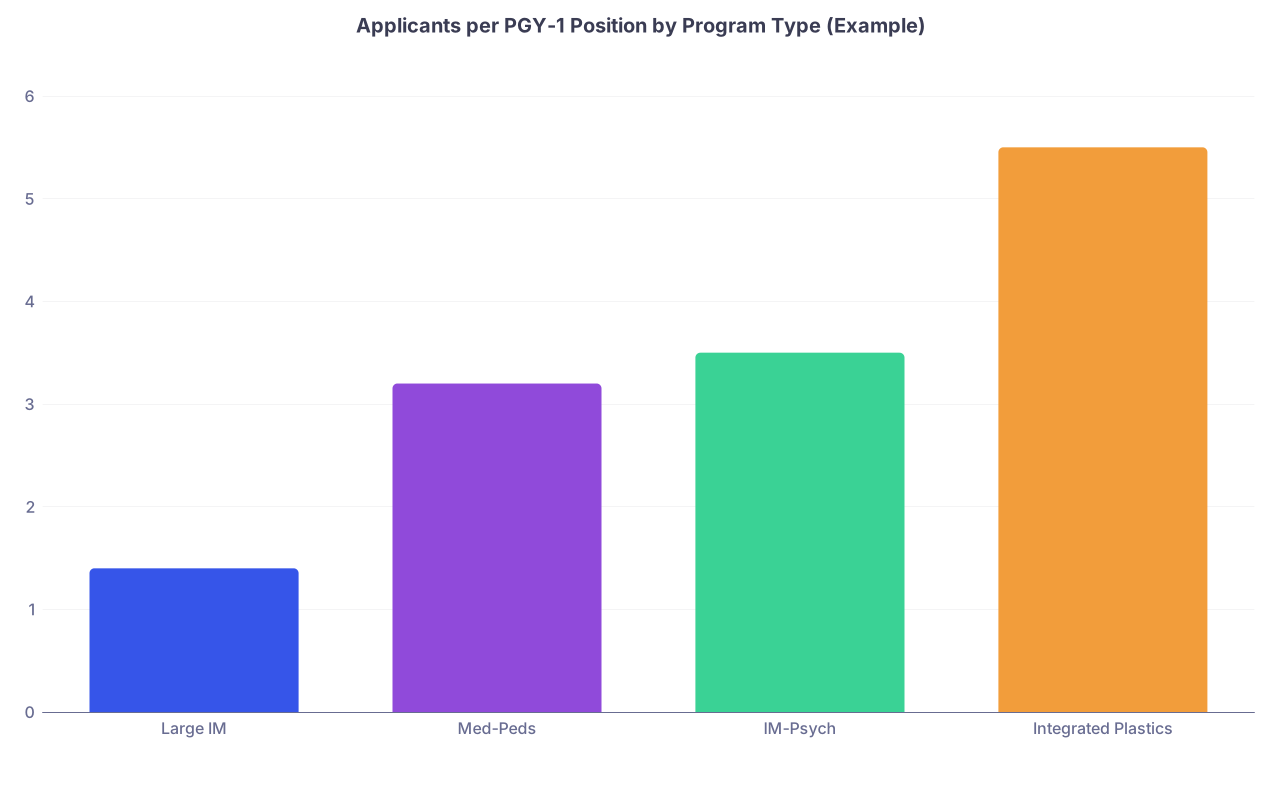
| Category | Value |
|---|---|
| Large IM | 1.4 |
| Med-Peds | 3.2 |
| IM-Psych | 3.5 |
| Integrated Plastics | 5.5 |
If you just stare at “applicants per position,” they all look “competitive,” especially the tiny programs. But you and I both know the median CV in integrated plastics is nothing like the median CV in IM–Psych, even if their ratios are vaguely similar.
Small denominator ≠ same competitiveness tier.
Integrated vs “Prelim + Categorical”: The Orthopedic Fallacy
Another way this myth spreads is with surgical paths.
Students sometimes say: “Integrated X is more competitive than doing a general surgery residency then fellowship, because integrated is shorter and more efficient.”
Reality:
- Some integrated pathways are more competitive (e.g., plastics).
- Some are roughly parallel in competitiveness to the fellowship path.
- In a few cases, doors are still wide open from categorical training, and integrated is simply one structured route—not the only prestige lane.
If you’re comparing “integrated vascular” vs “general surgery then vascular fellowship,” what matters is not a global label like “integrated.” What matters is:
- How many integrated spots exist.
- How many of your peers at your med school are realistically aiming there.
- How program directors in that niche historically treat outside entrants (from categorical routes).
This is specialty-by-specialty, program-by-program. Anyone giving you a one-liner like “integrated is always more competitive” is compressing reality because it makes advising sound clever.
What The Data Quietly Shows
When you sit down with the NRMP’s Charting Outcomes (for MDs and DOs) and Combined Program tables and actually compare, three patterns keep appearing:
Combined internal medicine-pediatrics
Match rates and score distributions cluster close to solid internal medicine applicants, skewed slightly upward at the most prestigious institutions, but nowhere near neurosurgery or plastics.Combined psych pathways
Match rates are lower than FM, often lower than categorical psych simply because there are fewer spots and self-selected applicants. Yet the absolute score “floor” is not in the extreme range. Many applicants are strong in narrative, letters, and long-term interest rather than raw metrics.Highly integrated surgical specialties
Integrated plastics stands out as an actual outlier. Vascular and thoracic are quite competitive but are held back a bit by being less “sexy” to many students.
In short: where competitiveness is truly off the charts, it is the specialty driving it. Not the combined/integrated label.
How This Myth Actually Hurts Applicants
This isn’t just a harmless misunderstanding. It messes with people’s planning in two stupid ways.
First, fear.
I’ve watched students who are perfectly suited for Med-Peds or IM–Psych back away because someone told them “combined is insanely competitive.” They pivot to a less aligned categorical option out of misplaced anxiety. Five years later they’re trying to jury-rig their career back toward what they wanted in the first place.
Second, false backdoors.
Others do the opposite: they think combined programs are some secret side entrance into a competitive world. “I can’t match categorical IM at that big-name place, but maybe I can get in through Med-Peds.” Program directors see this a mile away. If your narrative screams “cards or bust,” Med-Peds is not fooled. You just wasted an application.
Fit matters more in combined programs than in many categorical ones. PDs care about whether you will tolerate five intense years of dual-identity training, not whether you’re minutely above their Step cutoff.
What You Should Actually Ask Yourself
Instead of “Are combined or integrated programs more competitive?”, ask questions that are actually useful for your application strategy:
- For this specific combined/integrated program, what do recent matched applicants look like on paper and in person?
- How many spots do they offer, and how many realistic applicants fight for those seats?
- Do my interests and clinical narrative clearly match why such a program exists?
- If I were the PD, would I buy my story as someone planning to practice both components long term?
You can learn more from talking to one recent Med-Peds grad at a place like Michigan or UAB than from ten Reddit threads regurgitating “combined is crazy competitive.”
If you want a process view of how to even think about this kind of decision, here’s a simple map.

| Step | Description |
|---|---|
| Step 1 | Interest in two fields |
| Step 2 | Focus on categorical |
| Step 3 | Research combined options |
| Step 4 | Plan categorical then fellowship |
| Step 5 | Talk to residents and PDs |
| Step 6 | Apply to combined and key categorical |
| Step 7 | Sustained over time |
| Step 8 | Programs exist that fit goals |
| Step 9 | Story aligns with dual practice |
Nothing in this flowchart asks “Is it integrated?” It asks “Does this fit what I’ll actually do with my life and what the market is asking for?”
A Quick Reality Check Table
To land this plane, here’s a rough comparative snapshot. Not precise numbers—just realistic patterns I’ve seen over and over.
| Path | Competitiveness vs Categorical | What Actually Drives It |
|---|---|---|
| Med-Peds vs IM | Slightly higher at big names; similar overall | Fit, small N, academic focus |
| IM–Psych vs IM or Psych | Higher than FM; similar or lower than top psych | Niche interest, tiny class sizes |
| FM–Psych vs FM | Higher than FM, far below derm/surg | Self-selection, lifestyle fit |
| Triple Boards vs Peds | Comparable or slightly higher | Niche, youth mental health focus |
| Integrated Plastics vs GS | Much higher | Low spots, prestige, early gunners |
| Integrated Vascular vs GS | Higher, but not plastics-level | Specialty interest, early commitment |
You’ll notice there’s no row labeled “Any Integrated Program vs Anything Else.” Because that category isn’t real.
Years from now, you won’t remember the exact match rate percentages for Med-Peds or integrated vascular. You’ll remember whether you chose a path because it made sense for how you wanted to practice—or because a vague myth about “integrated equals more competitive” scared you away or lured you in.