You’re a rising M4. It’s late June. ERAS opens in a few weeks.
Your dream has been orthopedic surgery / derm / plastics / neurosurgery (pick your poison) since M1. You’ve done the research year, the away rotation, the 260+ Step 2, the whole thing. But your last few months have been…ugly.
You’re not getting the responses you expected. That away rotation eval was “solid” instead of “outstanding.” Your mentor casually mentioned “broad strategy.” You heard about three classmates with better numbers going unmatched last year.
And now you’re staring at one brutal question:
Do you stay the course with a competitive specialty or pivot before it’s too late?
Here’s your timeline-based reality check. Month by month, week by week, what to watch, and when to pull the ripcord.
Big Picture: The Last 12 Months Before Match
Let’s zoom out. Competitive specialties have very little margin for error. You need to be honest about risk early, not in February when you’re crying in a call room.
Think of the year like this:
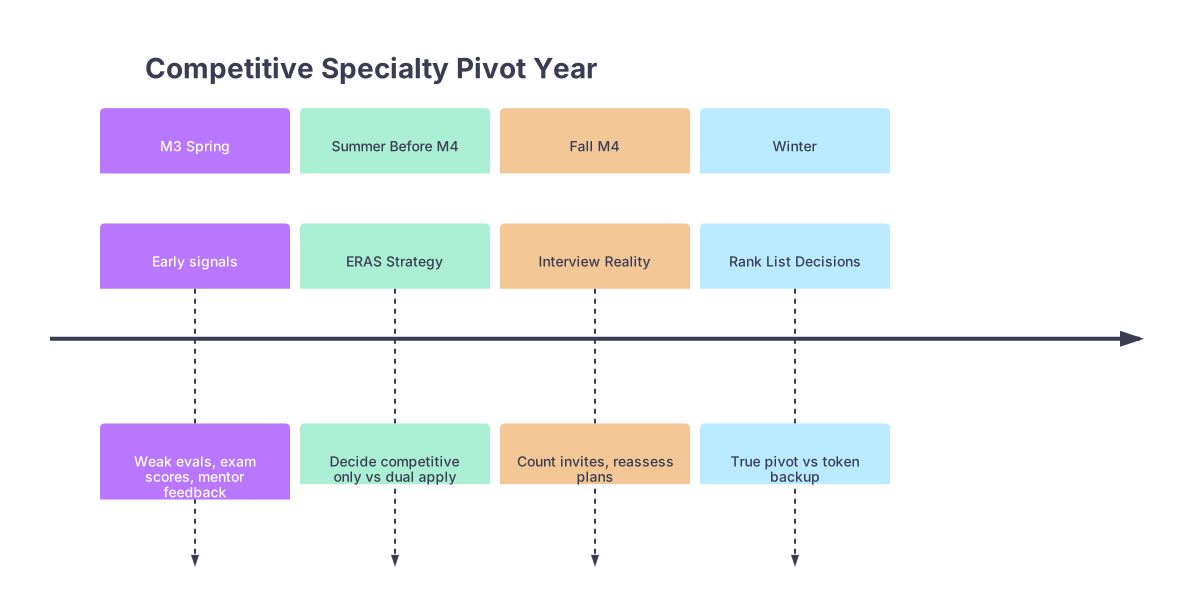
| Period | Event |
|---|---|
| M3 Spring - Early signals | Weak evals, exam scores, mentor feedback |
| Summer Before M4 - ERAS Strategy | Decide competitive only vs dual apply |
| Fall M4 - Interview Reality | Count invites, reassess plans |
| Winter - Rank List Decisions | True pivot vs token backup |
Each phase has specific “if X, then you pivot” triggers. Let’s walk it in order.
Phase 1: Early Red Flags (M3 – Early Spring of M3/M4 Year)
At this point you should not be “deciding your life.” You’re just collecting data that will later tell you if your competitive plan is delusional or smart.
March–April (Late M3)
You’re on core rotations, maybe starting to angle toward your dream field.
Pay attention to:
- Shelf scores and Step 2 trajectory
- How attendings in the competitive field talk about you
- Your own energy level when doing that work
Concrete signs you’re in trouble for ultra-competitive specialties:
- Step 2 score <240 for the most cutthroat fields (derm, plastics, ortho, ENT, neurosurg)
- Repeated comments in evals like “pleasant, reliable” but nothing about “exceptional,” “top 10%,” “would strongly recommend”
- No real advocate in the specialty willing to pick up the phone for you
- Zero research in that field and no realistic path to produce anything substantive before ERAS
At this point you do not pivot yet. You do this instead:
- Book a 30-minute brutally honest meeting with:
- One core clerkship director
- One faculty in your target specialty
- Ask them three questions directly:
- “If I apply in [specialty], what tier of programs should I realistically expect?”
- “Would you be comfortable strongly recommending me?”
- “If I were your kid, would you tell me to go for this or have a backup?”
If both people hedge or give vague encouragement without specifics (“you’ll be great wherever you go”)—that’s an early yellow flag.
Phase 2: The Summer Fork in the Road (May–August Before ERAS)
This is the critical pivot planning window. At this point you should be deciding between:
- Going all‑in on the competitive specialty
- Dual applying (competitive + safer field)
- Fully pivoting out before you waste a year
May–June: Reality Check and Strategy Setting
By June, you should have:
- Your Step 2 score or at least practice NBME data that predicts it
- Some sense of letters of recommendation you can get
- A clear idea of how your application stacks up
Here’s how to think concretely:
| Factor | Strong for Competitive | Borderline | Concerning |
|---|---|---|---|
| Step 2 CK | ≥ 250 | 240–249 | < 240 |
| Specialty Research | 2+ pubs/abstracts | 1 project ongoing | None or weak |
| Letters | 2+ “top 10%” letters | 1 strong, 1 generic | All generic |
| Home Program | Yes, supportive | Yes, neutral | No home program |
If you’re in the “Concerning” column in more than two rows for derm/ENT/plastics/neurosurg/ortho, I’d seriously consider dual applying at minimum.
Late June–July: Build the Backup Path
At this point you should:
- Decide your backup field with a human being who knows the match, not just Reddit
- Tell at least one trusted advisor in each field (primary and backup) that you’re considering dual applying
- Draft two personal statements:
- One for the dream field
- One for the realistic field (and yes, they need to sound like you genuinely care)
Also, you need to stop lying to yourself about “just in case” applications. Backups work only if you treat them seriously:
- You need at least 20–40 realistic programs in the backup field, not 5 token apps
- You need at least one letter from that backup specialty
- You need answers on interview day that don’t sound like “I’m only here because derm might not work out”
August: Final Pre‑ERAS Go/No‑Go
ERAS opens in early September. By mid‑August, you should have made a clear decision:
- Green light all‑in if:
- You have strong metrics, meaningful advocacy, and at least one mentor saying, “You should absolutely go for it.”
- Dual apply if:
- People you trust say, “You could match, but risk is real,” or your metrics are mixed.
- Full pivot if:
- A respected advisor flat-out says, “I’d worry you might not match,” and you don’t have the stomach or time to risk a SOAP disaster.
If you’re still “thinking about it” on August 25, you’re already behind.
Phase 3: ERAS Submission and the Point of No Easy Return (September)
ERAS opens for submission in early September. Programs start downloading applications mid‑September.
At this point you should be done with indecision.
Early September: How Your Application Mix Should Look
Rough rule of thumb for competitive fields (adjust for your stats, obviously):
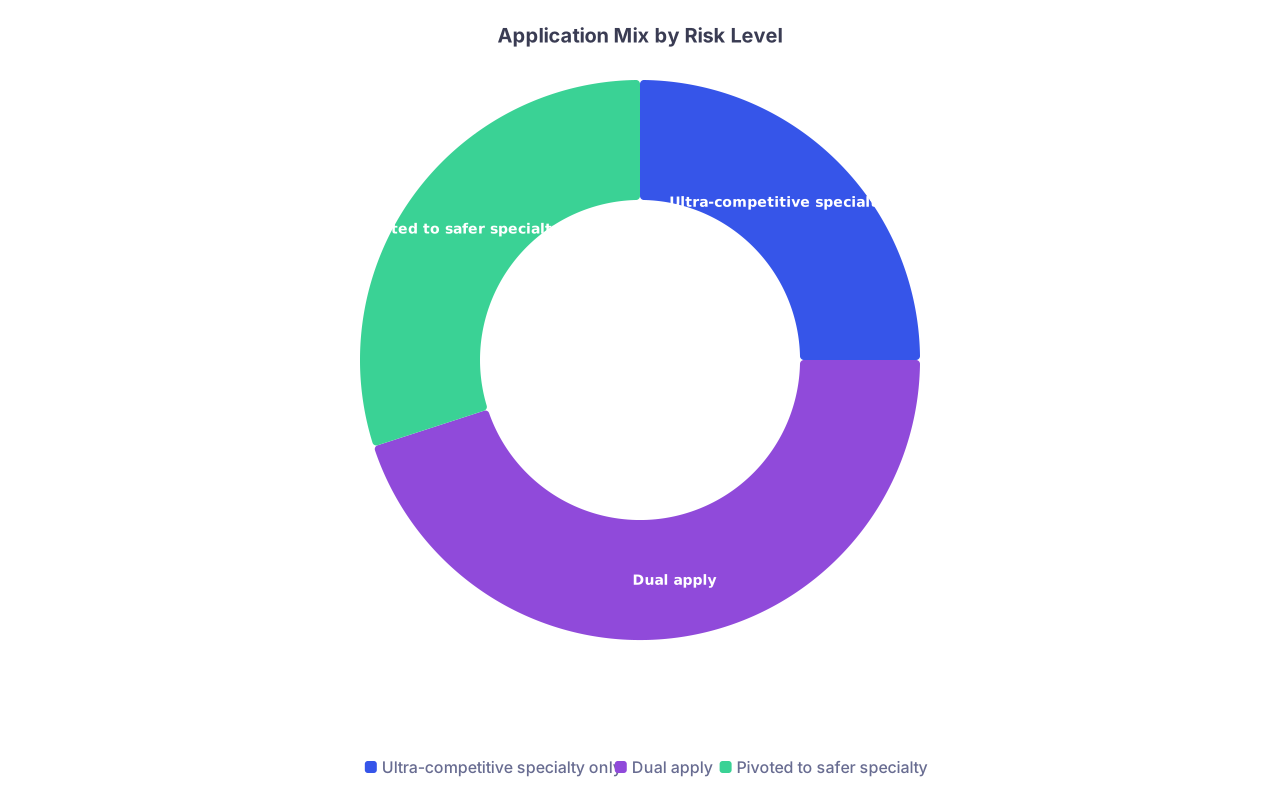
| Category | Value |
|---|---|
| Ultra-competitive specialty only | 25 |
| Dual apply | 45 |
| Pivoted to safer specialty | 30 |
If you choose:
Competitive only: Aim for:
- 50–80+ programs in that field (again, depends on field and your strength)
- A mix of reach, target, and realistic safety within that specialty’s tier
Dual apply:
- 30–60 in competitive specialty
- 30–80 in your backup (medicine, peds, FM, psych, etc., depending how nervous you are)
If you’re applying to 20 derm and 5 IM “just in case,” you haven’t really pivoted. You’re gambling.
Late September: After Applications Go Out
Once ERAS is submitted, changing specialties becomes much harder but not impossible. Realistically, your last meaningful chance for a full pivot without total chaos is gone. Now we’re talking about in-season course corrections, not rewrites.
At this stage, your job is to:
- Track:
- How many programs in each specialty downloaded your app
- How many sent generic acknowledgments vs actually showing interest (survey invites aren’t interest)
- Keep ears open for early interview offers from classmates with similar profiles
You’re still mostly in “wait and watch” mode. But mentally, be ready for the next phase: the interview invite reality check.
Phase 4: The Interview Invite Reality Check (October–December)
This is where people get burned. They cling to a dying competitive plan way too long.
At this point you should be watching the calendar like a hawk.
October: First Wave of Invites
For most competitive specialties, the majority of interview invites go out between early October and mid‑November.
If by:
- October 31 you have:
- 0–1 interviews in the competitive field
- And you applied broadly (40+ programs)
You’re in serious danger. That’s not “slow start.” That’s the market telling you the truth.
Key move here: You do not just “wait and hope it picks up.” You schedule another round of blunt conversations:
- Meet your home program director or main mentor
- Show them your interview count
- Ask a clear question:
- “Based on where we are now, what are my odds of matching in [specialty]?”
- “Do you think I should be aggressively pursuing my backup now?”
If they start using phrases like “there’s still time,” “you never know,” or “let’s see what happens” without giving actual numbers or specific plans—that’s a bad sign.
November: Last Call to Pivot via Backup Invitations
By mid‑November, your competitive specialty interview picture is mostly set.
At this point you should:
- Decide your true priority:
- Is matching somewhere this year more important than this specific field?
- Or would you rather risk going unmatched than pivot?
There’s no morally correct answer. There’s only the answer you can live with.
Concrete thresholds I’ve seen play out:
- Ultra‑competitive fields:
- <4–5 interviews → extremely high risk of not matching
- 5–7 interviews → borderline; could go either way
- 8+ interviews → reasonable shot (still not guaranteed)
If your backup specialty is giving you a lot more interest—10+ interviews—and your dream field gives you 1–3? That’s your sign.
Phase 5: Winter – The Rank List Pivot (January–February)
This is the last stop before the train hits Match Day.
At this point you should be brutally honest about probabilities, not feelings.
January: Post‑Interview Inventory
Make a simple table for yourself:
| Specialty | Number of Interviews | Gut Feeling of Fit |
|---|---|---|
| Competitive Field | X | Strong/Medium/Weak |
| Backup Field | Y | Strong/Medium/Weak |
Now ask:
- If these were the only interviews I had, how shocked would I be to go unmatched in the competitive specialty?
- Do I have programs in the backup specialty where I’d be genuinely content training? Not ecstatic. Just content.
If your honest internal answer is:
- “I’d be devastated but not shocked to go unmatched in the competitive field,” and
- “I have several backup programs where I’d be okay”
Then your rank list needs to reflect that.
February: How to Actually Pivot on the Rank List
This is where people make career‑level mistakes.
Two common bad strategies:
- Ranking all your competitive interviews first, then sliding the backup ones underneath “just in case”
- Not ranking backup programs you consider “beneath you” even though you’d rather match there than SOAP
Better approach:
- Decide your “line in the sand”:
- The last competitive program below which you’d rather be a resident in your backup field than at a low‑fit, low‑support competitive program
- Rank everything in the exact order of where you’d actually want to be on July 1
If that means:
- IM at a mid‑tier university program > your 6th ortho program where residents look miserable
Then that’s what your list should show.
Do not try to “game” the algorithm. It won’t work. It will just expose how little you trust your own priorities.
Special Case: When to Pivot Completely and Skip the Match This Year
There’s one more harsh option: do not match at all this cycle in the competitive specialty and regroup.
You consider this if:
- You got 0–1 interviews in your dream field
- You have no real backup apps out
- You’d rather delay than SOAP into a field or program you actively do not want
In that case, your pivot timeline looks like:
- November–December: Accept this is a “data gathering year,” not a real shot
- January–March: Decide whether to rank only a couple competitive programs as a lottery ticket vs withdraw
- Post‑Match: Plan a research year or prelim year intentionally, not out of panic
I’ve seen people pull a near‑miraculous derm/ENT/plastics match on the second attempt with a structured plan. I’ve also seen people YOLO the first cycle, SOAP badly, and spend three years trying to undo that snap decision.
How Your Attitude Should Shift at Each Point
Quick reframe by time:
M3 Spring–Early Summer:
- Curiosity phase. “Could I be competitive?”
- You’re exploring, not committing.
Late Summer Before ERAS:
- Strategy phase. “What’s my risk‑adjusted plan?”
- You lock in all‑in vs dual vs pivot.
October–November of M4:
- Data phase. “What does the market think of my application?”
- You react to real numbers, not vibes.
January–February:
- Acceptance phase. “What future am I actually ranking into?”
- You build the list you can live with.
Last Thing: How to Tell If You’re Rationalizing Instead of Deciding
A few mental red flags that mean you’re avoiding a necessary pivot:
- “I know I only have 2 interviews, but I interview really well.”
- “Programs probably sent most invites already, but there are always a few last‑minute ones.”
- “I put in too much work to switch now.”
- “If I don’t match, I’ll just SOAP into something decent.” (You probably won’t like what’s actually available.)
When you hear yourself saying those, stop. Those aren’t plans. Those are defense mechanisms.
What To Do Today
Open a blank document and write four headings:
- Stats and objective strengths
- Honest weaknesses for my dream specialty
- Interview numbers I’d need by November 1 to feel safe
- Backup specialty scenario I could live with
Fill it in. Then email one faculty member in your dream field and one in your potential backup and ask for a 15–20 minute meeting this week to go over that document.
That’s your next step. Before you’re too far down a road you can’t walk back from.