
The riskiest ERAS strategy is pretending you can seriously apply to two competitive fields without a ruthless timeline and a brutal filter for what actually matters.
You are not “dual applying.” You are running two (or more) nearly full applications in parallel, on a countdown clock, while on rotations, with everyone pulling you in different directions. If you do not plan this season week by week, it will run you over.
Here is how to structure ERAS season if you are targeting multiple competitive specialties (think derm + IM, ortho + prelim, ENT + TY, gas + IM, rads + prelim, etc.).
Big Picture: 12-Month Season Overview
At this point, you need to know the whole year’s shape before worrying about the tiny checkboxes.
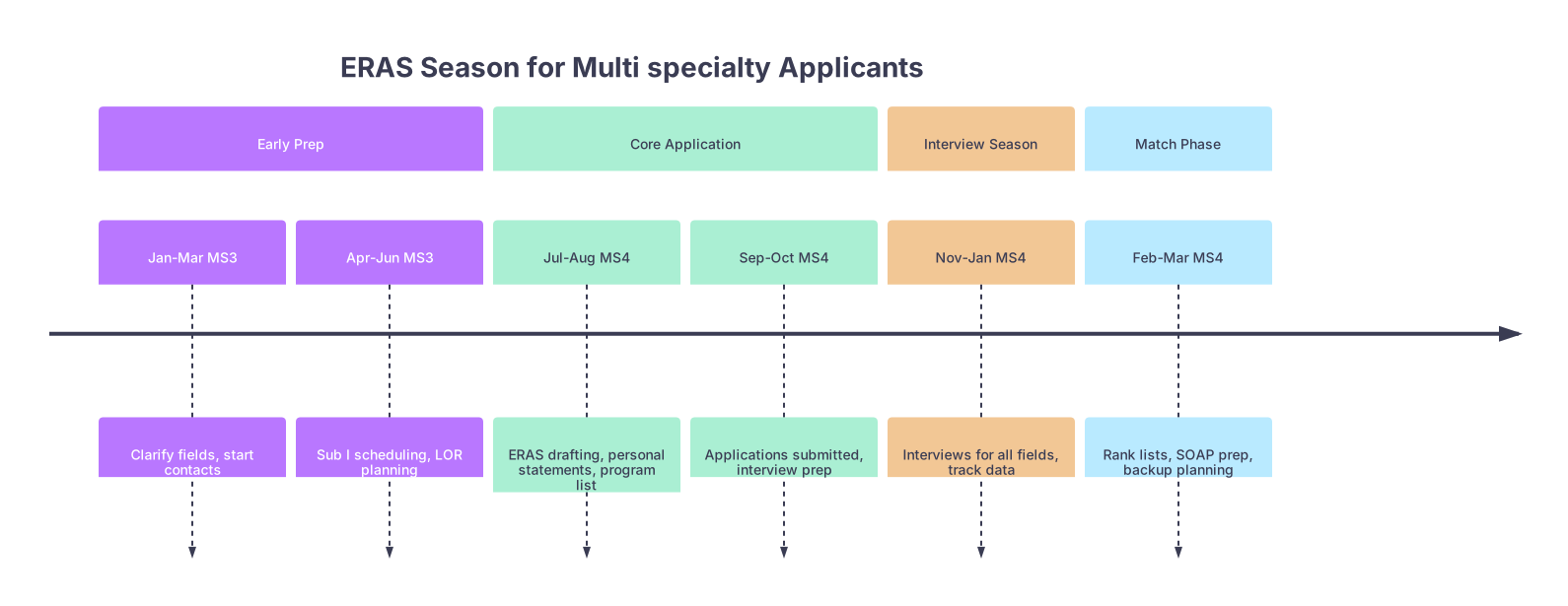
| Period | Event |
|---|---|
| Early Prep - Jan-Mar MS3 | Clarify fields, start contacts |
| Early Prep - Apr-Jun MS3 | Sub I scheduling, LOR planning |
| Core Application - Jul-Aug MS4 | ERAS drafting, personal statements, program list |
| Core Application - Sep-Oct MS4 | Applications submitted, interview prep |
| Interview Season - Nov-Jan MS4 | Interviews for all fields, track data |
| Match Phase - Feb-Mar MS4 | Rank lists, SOAP prep, backup planning |
At a high level, your year breaks into:
- Jan–Mar (MS3): Decide your “primary” and “backup” fields, map rotations, start LOR strategy.
- Apr–Jun (MS3): Do key aways/sub‑Is, get seen, confirm your story.
- Jul–Aug (MS4): Build ERAS, write multiple personal statements, finalize program list.
- Sep–Oct (MS4): Submit, manage supplements, triage early interview signals.
- Nov–Jan (MS4): Interview across fields without burning bridges, keep stories consistent.
- Feb–Mar (MS4): Rank lists and backup plan, SOAP contingency if needed.
We will go month by month, then zoom into a week‑by‑week structure for crunch time.
January–March (MS3): Decide Your Fields and Build a Skeleton Plan
At this point, you should stop pretending you are “keeping everything open.” Competitive fields hate indecision.
January: Reality Check and Field Selection
By January:
- You know your Step/COMLEX scores.
- You have at least a partial sense of what you actually enjoy on rotations.
Your tasks this month:
Pick a primary competitive field.
Examples:- Dermatology primary, internal medicine backup
- Orthopedic surgery primary, prelim surgery backup
- ENT primary, TY or prelim surgery backup
Do not pick two equally competitive fields as “co‑primary” unless your metrics are excellent and you understand the risk.
Define your backup field.
It should:- Actually take you if the competitive one fails.
- Have enough programs geographically acceptable.
- Be credible with your existing CV (e.g., IM, transitional year, prelim medicine/surgery, FM, psych).
Sketch your year.
You want:- 1–2 rotations in primary field before August.
- 1 rotation in backup field before August (even if short).
- Enough medicine/surgery exposure to not look like a tourist.
By the end of January, you should have:
- A working primary and backup specialty.
- A rough rotation map from now until September.
- A list of 3–4 attendings per field you might eventually ask for letters.
February–March: Rotation and LOR Strategy
Now you start playing chess, not checkers.
Focus on:
Identifying where your best LORs will come from in each field.
For a multi‑field strategy, you need:- 2–3 strong letters in your primary competitive field.
- 1–2 serious letters in your backup field or core discipline (IM, surgery, peds, etc.).
Meeting department leadership.
At this point you should:- Introduce yourself to the program director or clerkship director in your primary field.
- Say explicitly: “I am strongly interested in [field X] and planning to apply this fall. I am also considering [backup field Y] depending on how things evolve. I would appreciate your advice on rotations and letters.”
Being honest early is better than springing it on them in September.
Deciding on away rotation applications.
For competitive fields (derm, ortho, ENT, plastics, neuro, rad onc), aways are often critical.
Decide:- How many aways you will attempt for your primary field (usually 1–3).
- Whether your backup field even needs aways (often not).
By the end of March, you should have:
- A concrete rotation calendar through at least November.
- Target away rotation sites identified and VSLO timelines on your calendar.
- Specific faculty in each field you are consciously working to impress.
April–June (MS3): Aways, Visibility, and Letter Lock‑In
This is where things start to diverge sharply for multi‑field applicants. Your main risk is looking half‑in to both fields.
April: Plan Aways and Clarify Narrative
By April:
- Submit VSLO applications for primary field aways as soon as their portals open. Competitive fields fill fast.
- Check each specialty’s norms. For example:
- Dermatology: research + home + 1–2 aways can matter a lot.
- Ortho/ENT: aways almost mandatory for many programs.
- Anesthesia/rads: aways helpful but not always mandatory.
You need a clear narrative:
- Primary: “I am committed to [field X], with focused experiences, research, letters.”
- Backup: “I also bring skills that translate well to [field Y], and I am genuinely open to a career in it.”
If your “backup” sounds like a desperation move, programs can smell it.
May–June: On‑Rotation Performance and Letter Requests
At this point, you should be:
- On a home rotation or early away in your primary field.
- Lining up a strong IM/surgery letter if your backup is in that world.
Your checklist while on key rotations:
- Show up early. Know your patients cold. Volunteer for procedures and teaching.
- Ask for feedback mid‑rotation. Fix what they tell you.
- Two weeks before end of rotation, identify your best attending and say:
- “I am applying to [field X] as my primary field and [field Y] as a backup. I would be honored if you felt you could write a strong letter to support me for [X/Y].”
Make it specialty‑specific where possible. A generic letter that “can go anywhere” is usually vague and weak.
By the end of June, you should have:
- Verbal commitments for:
- 2 letters in primary field.
- 1–2 letters in backup/core discipline.
- At least one rotation evaluation that clearly supports your primary specialty (and ideally one for backup).
July–August (MS4): ERAS Build and Multi‑Field Application Architecture
This is execution season. Too many people improvise here and then hate their own ERAS output.

Early July: ERAS Profile and Document Infrastructure
At this point, you should:
Create the ERAS “spine” that is identical for all specialties.
- Demographics, education, exams, experiences, publications.
This part is one story: who you are as a physician in training.
- Demographics, education, exams, experiences, publications.
Identify experiences that “swing” either direction.
Example:- An ICU sub‑I looks great for both anesthesia and IM.
- A derm research year might need a different spin for IM programs (systems, QI, chronic disease, etc.).
Draft your specialty‑specific personal statements.
You need at least:- One for your primary competitive specialty.
- One for your backup field.
Sometimes: - One generic medicine/surgery statement for prelim/TY programs if separate from backup field.
You are writing distinct statements, not a global essay with the field name swapped.
Mid–Late July: LOR Management by Specialty
Here’s where multi‑field applicants either look organized or chaotic.
Build a clear letter map:
| Letter Type | Primary Field (e.g., Derm) | Backup Field (e.g., IM) |
|---|---|---|
| Home specialty | 2 | 0–1 |
| Away specialty | 1 | 0 |
| Core IM/Surgery | 1 | 2 |
| Research mentor | 0–1 | 0–1 |
In ERAS, you choose which letters go to which programs. At this point you should:
- Have all letter writers invited in ERAS with clear labels (e.g., “Derm – Dr. Smith – Home,” “IM – Dr. Lee – Wards”).
- Email each writer:
- Remind them which specialty(s) they are supporting.
- Attach your CV, draft personal statement for that field, and a short bullet list of key things they observed.
By August 1, you should have:
- All letters requested and most uploaded or confirmed in progress.
- Clear mapping of which letters will go to which field.
August: Program List and Strategy for Each Field
Now you make decisions that your ranking brain will thank you for later.
At this point, you should:
Determine target numbers per field.
Rough (not perfect) guidance for multi‑field applicants:Derm/ENT/Plastics/Rad Onc primary:
- 40–60 programs in primary field.
- 30–60 in backup (IM, TY, prelim).
Ortho primary:
- 50–80 ortho programs (depending on competitiveness).
- 20–40 prelim/TY/IM backup.
Anesthesia/rads primary with IM backup:
- 40–60 primary.
- 25–40 IM backup.
Adjust for your board scores, school, visa status, and red flags.
Build separate lists with tiers.
For each field, categorize:- Reach.
- Reasonable.
- Safety (relative).
Check for geographic synergy.
Example: If you target Boston for derm, line up IM programs in New England to keep options aligned.
By the end of August, you should have:
- Finalized program lists in a spreadsheet with columns for:
- Field, city, tier, LOR set, personal statement version.
- A working ERAS draft with all experiences entered and proofread.
Early September: Submission Week – Multi‑Field Checklist
Submission week is not the time to discover your letters are misassigned.
At this point, you should:
Finalize all personal statements.
- Run them past someone in each field. They will catch tone issues outsiders miss.
Lock your experience descriptions.
- Make sure your top 3 “most meaningful” entries support your primary specialty narrative.
- Backup field programs will still see the same list; that is fine.
Assign letters per specialty.
Rule of thumb:- For primary competitive field: 2–3 letters from that field + 1 strong core letter.
- For backup: 2 core/field‑appropriate letters + 1 from someone who can speak to your overall clinical performance.
Double‑check ERAS for cross‑contamination.
- No mention of “lifelong dream of derm” in the IM personal statement.
- No “committed to a career in surgery” in an anesthesia statement.
Plan to submit on or very near opening day. Multi‑field applicants cannot afford to be late.
Late September–October: Early Signals and Interview Triage
Once applications are out, the mistake is going passive.
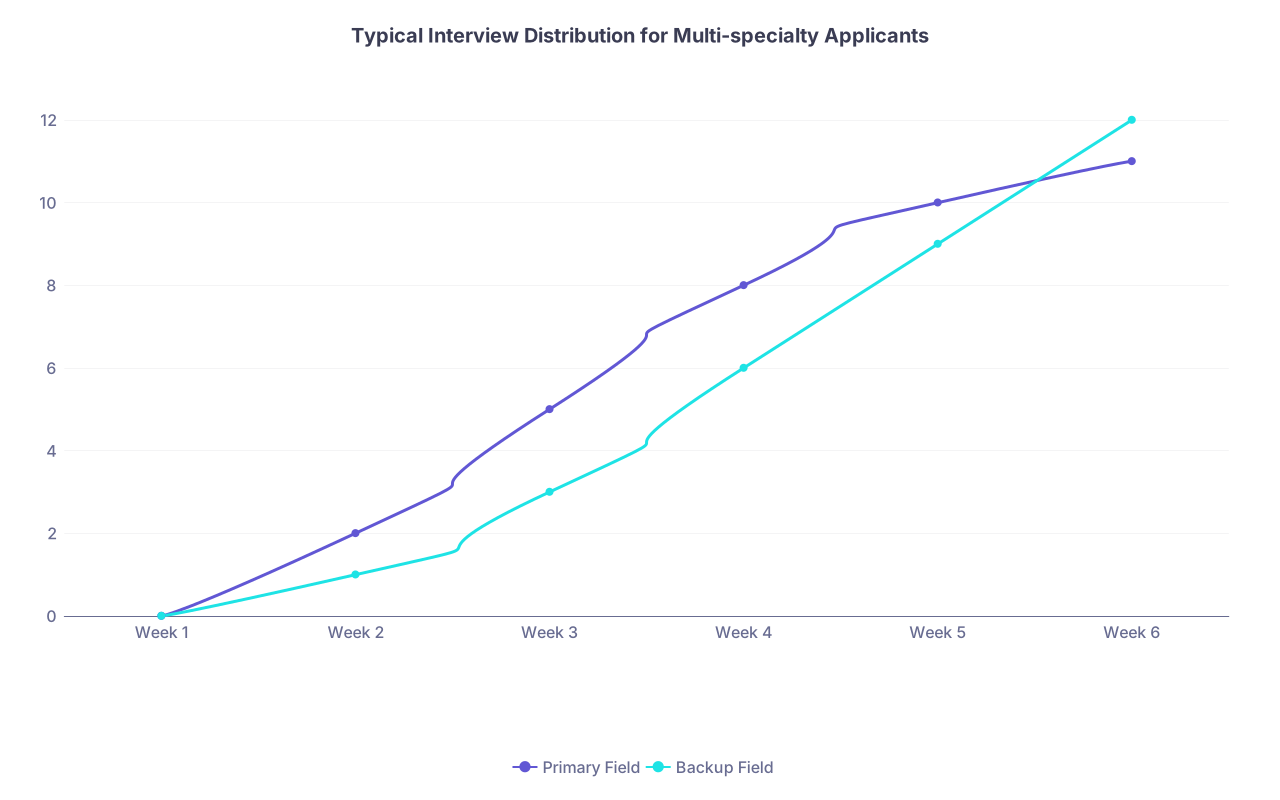
| Category | Primary Field | Backup Field |
|---|---|---|
| Week 1 | 0 | 0 |
| Week 2 | 2 | 1 |
| Week 3 | 5 | 3 |
| Week 4 | 8 | 6 |
| Week 5 | 10 | 9 |
| Week 6 | 11 | 12 |
At this point, you should:
Track interviews by week and by field.
Simple sheet with:- Date received, field, program, reply status, date scheduled.
Watch for early red flags.
Example:- By mid‑October, you have 1 ortho interview and 8 prelim/TY invites.
Translation: probability of matching ortho is dropping; you may need to lean harder into backup field.
- By mid‑October, you have 1 ortho interview and 8 prelim/TY invites.
Calibrate outreach.
Reasonable, not desperate, communication:- An interest email to a small number of top‑choice programs in each field about 3–4 weeks after application submission, if you have relevant ties or updates (a new paper, strong rotation evals, etc.).
By end of October, you should have:
- A realistic sense of which field is currently more viable.
- A plan for how many interviews you will actually attend in each (you cannot be in two places at once).
November–January: Interview Season Across Multiple Fields
This is the juggling act. You must appear committed in each room without lying.

Before Interviews Begin
At this point, you should:
Know your talking points for each field:
- “Why this specialty?”
- “Tell me about a patient that confirmed this choice.”
- “How did you decide between fields?” (Yes, some will ask.)
Prepare a truthful but composed story about multiple interests:
- Example for derm + IM:
“Most of my structured research and electives have been in dermatology, which I find very compelling for [reasons]. At the same time, I have really enjoyed and excelled on my internal medicine rotations, and I am also applying in IM because I would be very happy with a career that emphasizes complex medical care and longitudinal relationships.”
- Example for derm + IM:
During Interview Season
You must manage:
Scheduling conflicts.
- Use the fact that many programs now offer multiple virtual dates.
- Be willing to decline a lower‑priority backup interview to attend a solid primary‑field interview, especially early in the season.
Information consistency.
- Do not tell a program in one field you “would only be happy in X” and then have a letter or PS floating around saying something opposite. People talk.
Signals and preference.
- If a program in your primary field is clearly interested, treat that seriously.
- Do not over‑promise to programs you know will end up low on your rank list.
By mid‑January, you should have:
- A final list of completed interviews by field, categorized as:
- High, medium, low enthusiasm.
- A rough sense of where you would actually want to live and train, regardless of field.
February–March: Rank Lists, Risk Tolerance, and Backup Mechanics
This is where theoretical “dual applying” becomes real consequences.
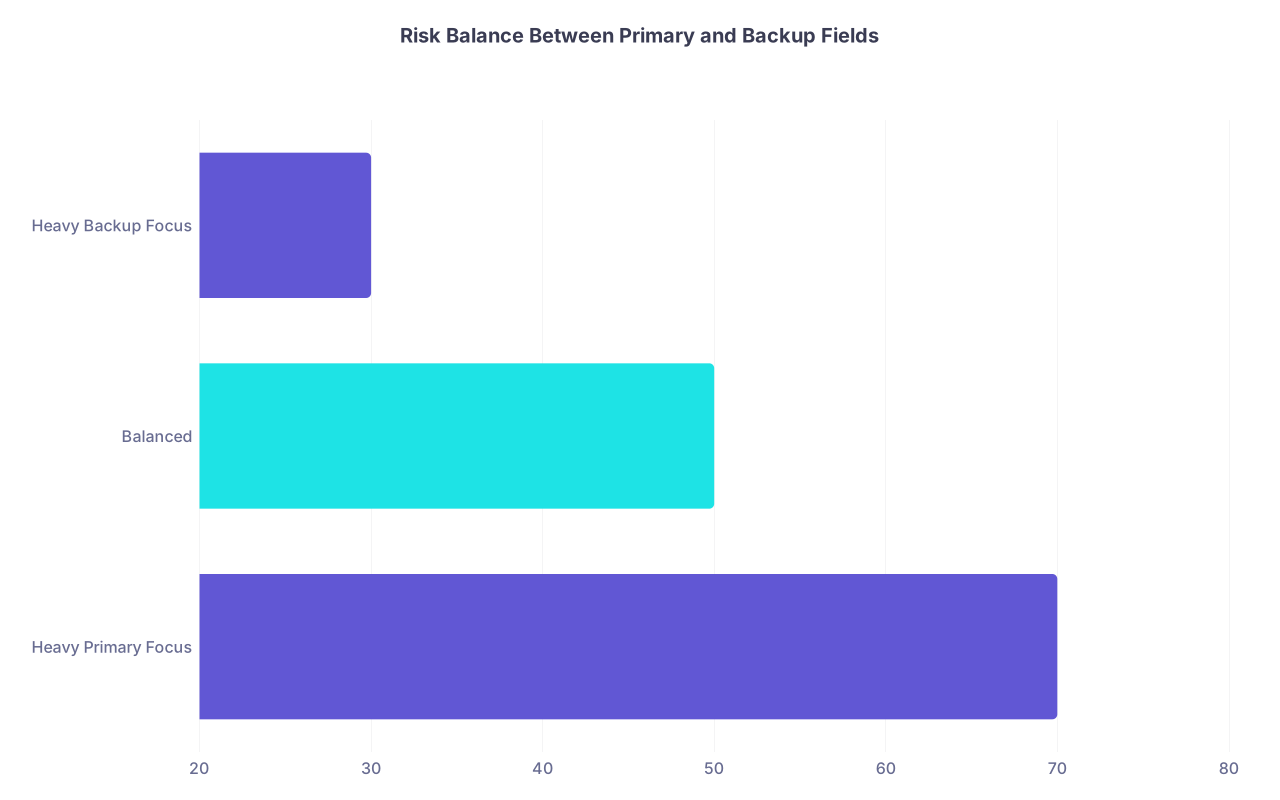
| Category | Value |
|---|---|
| Heavy Primary Focus | 70 |
| Balanced | 50 |
| Heavy Backup Focus | 30 |
Think in terms of risk.
Early February: Rank Strategy by Field
At this point, you should:
Decide your true priority.
E.g., if your heart is derm but you have 3 derm + 18 IM interviews, ask yourself:- “Am I willing to risk not matching this year for a small chance at derm, or do I need a guaranteed match in IM?”
Build your primary field rank list straight first.
No backup programs mixed in yet. Decide pure internal order.Then build your backup list.
Full sequence in that field.
Mid–Late February: Combined List and SOAP Contingency
Now you merge.
Two common strategies:
- High‑risk: Rank all primary field programs first, then backup programs.
Use if:- You have a decent number of primary interviews and a strong profile.
- Risk‑averse: Interleave backup earlier, especially strong IM/TY/prelim programs in locations you love.
Use if:- Primary interviews are sparse or felt lukewarm.
You also quietly prepare for SOAP:
- Know which specialties and programs typically SOAP in your backup area.
- Update your CV and a SOAP‑appropriate personal statement (short, direct).
- Clear your schedule for Match Week, including Monday–Thursday availability.
By Match Week, you should have:
- A rank list that truly reflects your risk tolerance and life priorities.
- A realistic SOAP plan if you go unmatched.
Final Key Points
- Multi‑field applications are two full jobs, not a tweak. Commit to a primary field, design a credible backup, and map rotations and letters for both by March.
- Your ERAS architecture must be deliberate: separate personal statements, letter sets, and program lists for each specialty, all built and checked by late August.
- Interview and rank season is where most people lose discipline. Track interviews by field, be honest but not self‑sabotaging about your interests, and construct a rank list that matches your actual risk tolerance, not your fantasy self.
If you hit those three, you give yourself a real shot at matching into something you can live with—and maybe even your top choice.