The idea that “all ortho programs are basically the same level of competitive” is wrong. Academic and community orthopedic surgery programs live in different ecosystems, and if you do not understand that split, you will misread your chances and misplay your application.
Let me break this down specifically.
You are not applying to “orthopedic surgery” in some abstract way. You are applying to a portfolio of programs that sit on a spectrum:
- pure academic powerhouses
- strong hybrid academic–community departments
- high-volume community programs with little or no research footprint
Each slice of that spectrum selects, filters, and weighs your file differently. Same specialty. Different game.
1. First principle: competitiveness is not one-dimensional
People love Step 2 numbers and fill-rate charts. They are incomplete. Orthopedic competitiveness depends on what programs you are targeting and what kind of applicant you are.
Think of three overlapping but distinct “markets”:
- National academic ortho market
- Regional “academic-light” or hybrid programs
- Regional community-dominant market
They share some basic filters (you must clear a floor of exam performance, clinical competence, and professionalism), but beyond that, they diverge sharply.
- Academic programs are capacity-limited by research mentors, fellowships, and reputation protection.
- Community programs are capacity-limited by call coverage, case volume, and service needs.
That drives how they select residents.
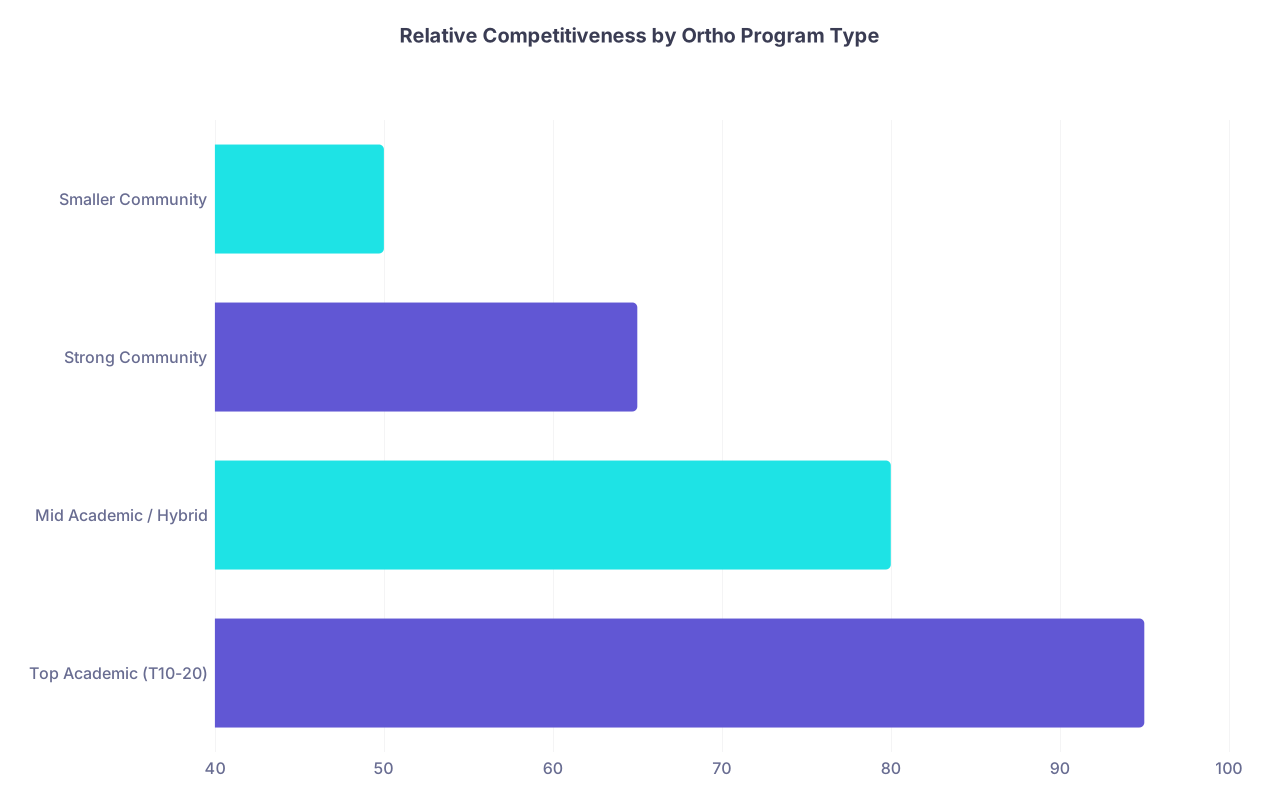
To make this less abstract, look at the current pattern (approximate, but very close to what I have seen reading rank lists and talking to PDs):
| Category | Value |
|---|---|
| Top Academic (T10-20) | 95 |
| Mid Academic / Hybrid | 80 |
| Strong Community | 65 |
| Smaller Community | 50 |
Think of those values as “relative difficulty to match for a generic U.S. MD with average research and solid letters,” not as any official scale. The point is the gradient, not the exact numbers.
2. What defines “academic” vs “community” in ortho?
People misuse these words constantly, so let’s put formal language aside and talk about how they behave.
Academic orthopedic programs tend to have:
- A medical school affiliation with a big-name university (Michigan, UCSF, Duke, WashU, etc.).
- NIH or major industry funding, with an expectation of resident research.
- Multiple subspecialty fellowships in-house (sports, joints, trauma, spine, hand, pediatrics, oncology).
- A culture where promotion, reputation, and publications matter for attendings.
- A history of sending residents to competitive fellowships across the country.
Residents there are expected to:
- Produce papers, posters, or at least serious QI.
- Present at national meetings.
- Be competitive for fellowships anywhere.
These places recruit like professional sports teams. They fight for the top of the national applicant pool.
Community orthopedic programs tend to have:
- Primary affiliation with a regional hospital or health system, sometimes with a smaller med school tie-in.
- Less consistent or minimal grant-supported research; more chart-review or QI style projects.
- Case volume driven by local catchment area, heavy emphasis on bread-and-butter pathology.
- Many attendings are high-volume private or employed surgeons, not promotion-track academics.
- Fellowship placements skew more regional and practical: trauma at the nearest Level I, sports at a regional name, etc.
Residents there are expected to:
- Operate. A lot.
- Keep the service running, with strong emphasis on autonomy.
- Graduate as practice-ready surgeons, maybe with one or two research items, not an H-index.
Neither model is “better.” They are optimized for different outcomes. But their applicant selection logic diverges.
3. How academic programs filter applicants (and why it feels brutal)
Academic ortho programs are where competitiveness gets extreme. This is the world where students whisper numbers: “250+,” “10+ pubs,” “home ortho letter from [famous name].”
Let us dissect the filters.
3.1. Step 2 CK and exam performance
With Step 1 now pass/fail, Step 2 CK is the sharp-edged tool.
Patterns I keep seeing:
- Top academic programs: most interviewees have Step 2 CK ≥ 250. The “acceptable” band often runs 245–260+.
- Mid-tier academics: 240–255 is common among serious contenders.
- Below about 235, academic interview odds drop off hard unless something else is exceptional (PhD-level research, D1 athlete, elite diversity story, or very strong home backing).
No one posts official cutoffs, but do not kid yourself: they exist at most academic places, even if they call them “guidelines.” I have seen spreadsheets with color-coding around 245.
3.2. Research intensity
Academic ortho is research-hungry. Volume and quality both matter, but volume gets your foot in the door.
At a typical top-20 academic department, the median matched resident has:
- Multiple ortho-related projects (5–15 line items on ERAS, including abstracts, posters, manuscripts).
- At least a few PubMed-indexed publications, often first- or second-author.
- A year of dedicated research (formal research year or gap year) is extremely common.
By contrast, showing up with “1 poster, 1 local presentation” and nothing else makes it an uphill battle for the heavy-hitting academics.
You are being screened for signaling: “Will this person keep the department’s research output alive for the next 5 years?”
3.3. Letters and pedigree
The academic world is small and political.
Three patterns that change your competitiveness drastically:
- Letters from known orthopedic faculty (the “name brand” factor). A Duke, HSS, or Mayo letter—written well—can offset modest research more than you think.
- Home program influence. If your home ortho PD knows the PD at the place you are applying, backchannel calls carry enormous weight. I have seen average applications rescued by one strong phone call.
- Institutional prestige. A solid 245/“top-half” AOA at a high-prestige school can look stronger to some academic PDs than a 255 from an unknown or newer school, because they know your grading curve and faculty.
This is why “stats” discussion online is so misleading. A 245 is not “just a 245” if it is backed by UCSF, 10 ortho pubs, and a letter from a nationally known sports surgeon.
3.4. Signaling, away rotations, and perceived “fit”
The new ERAS signaling system made academic competition more intense and more efficient. Top programs receive:
- A very high proportion of their interview offers from applicants who signaled them,
- And many of those applicants are research-heavy, high-score candidates.
If you signal a top academic program without the profile to back it up (by their standards), you effectively waste a signal.
Away rotations at academic sites are double-edged:
- If you crush it (work ethic, fund of knowledge, getting along with residents), you jump up their list.
- If you are “fine” but not outstanding, you can hurt yourself. They have 60 rotating students; they remember the top 5–10, and the truly problematic. Everyone else blurs.
Academic ortho cares deeply about “will this person be promotable and good for our brand?” They are not simply filling slots. They are preserving an institutional identity.
4. How community programs filter applicants (and where the doors quietly open)
Community programs are not “easy.” But their competitiveness curve looks different, especially as you slide away from the brand-name Level I trauma centers.
Where academic programs filter heavily on research and Step 2 CK, community programs tilt more toward:
- “Will this person be reliable on call?”
- “Will residents like working with this person at 2 a.m.?”
- “Will they stay in the region and feed our workforce pipeline?”
Let us break down the main axes.
4.1. Exam performance: a real floor, but softer ceilings
Most community PDs I have spoken with will say something like:
- “We want > 230–235 Step 2 CK if possible.”
- “We can work with a 225–230 if the rest of the file is strong, especially if they did an away here and we liked them.”
The distribution is shifted slightly lower than high-end academic programs. Not low. Just less skewed to the far right tail.
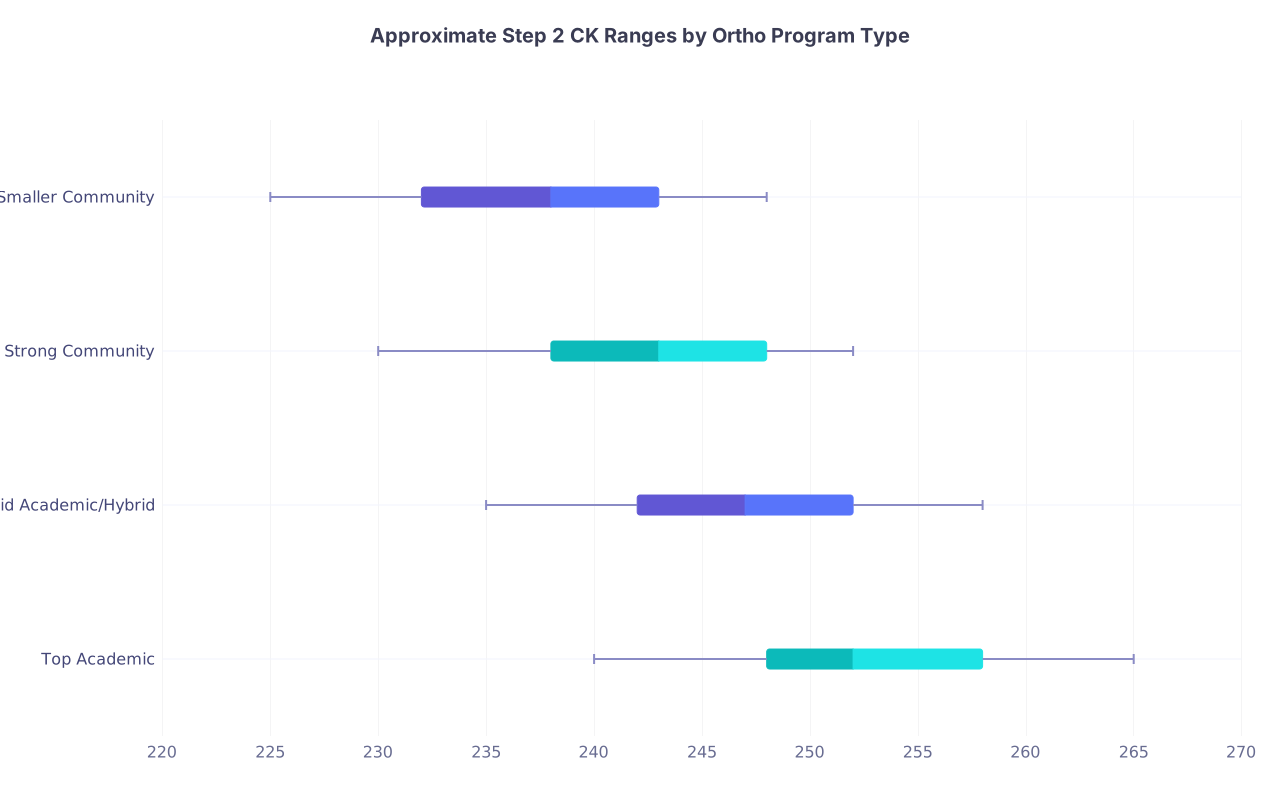
A conceptual view:
| Category | Min | Q1 | Median | Q3 | Max |
|---|---|---|---|---|---|
| Top Academic | 240 | 248 | 252 | 258 | 265 |
| Mid Academic/Hybrid | 235 | 242 | 247 | 252 | 258 |
| Strong Community | 230 | 238 | 243 | 248 | 252 |
| Smaller Community | 225 | 232 | 238 | 243 | 248 |
Again, not exact. But the shape is right.
4.2. Research: nice to have, not a central filter
For many community programs:
- Having 0 research is not ideal, but it will not automatically kill you.
- One or two decent projects (case report, retrospective chart review, QI) is often enough to check the box.
- They do not require a dedicated research year and sometimes frankly prefer students who did not disappear for two years and forget clinical medicine.
They care far more about:
- Your MS3 ortho and surgery evaluations.
- How you functioned on away rotations (workhorse vs ghost).
- Whether your letters describe someone residents want on their team.
4.3. Letters and regional ties
Community PDs think in terms of risk. A mis-hire is painful when you have only 2–4 residents per class.
Letters from people they personally know—often other regional community attendings, or PDs at similar-tier programs—carry major weight. A blunt “this student is tireless, down-to-earth, and extremely coachable” from a known source sometimes trumps a more flowery letter from a big-name academic who they do not know.
Regional ties matter more than applicants like to admit:
- Grew up in the state
- Family nearby
- Spouse job in the area
- Completed multiple rotations in that health system
This signals you might actually stay. Many community PDs would absolutely rather take the “230, one-pub, local grinder” over the “255, ten-pub coastal researcher” who obviously wants big-name fellowships and will leave.
4.4. Cultural fit and service mentality
Here is the quiet filter in community ortho: service.
You are there to see consults, reduce fractures in the ED, staff clinics, and keep ORs running smoothly. A resident who thinks they are above that because they have a research year and a name-brand med school will poison a small department.
So community PDs listen closely for:
- Entitlement in your answers
- How you talk about nurses, techs, and community medicine
- Whether your application screams “using you as a stepping stone”
At interview dinners, residents are brutally honest with PDs afterward. “I do not want that person on call with me” is essentially a veto. That is where some strong-paper, high-score applicants quietly die in the process.
5. Hybrid programs: the middle ground where many real opportunities live
A huge chunk of orthopedic programs are not pure academic ivory towers or tiny stand-alone community hospitals. They are hybrids:
- Large health-system based
- Some subspecialty fellowships
- Active but not world-famous research
- Heavier emphasis on operative volume and community outreach
Think: many state universities, large regionals like OHSU, Iowa, Colorado, UT Memphis, etc. (I am not labeling any specific program here as “mid” or “top,” just giving you the idea.)
These programs are dangerous to ignore. Competitiveness here is nuanced:
- They still like good scores (235–245+ is common among matched residents).
- They appreciate some research, but 3–5 solid experiences can be enough.
- They are usually quite sensitive to “fit,” teamwork, and operative interest.
They can be better targets for applicants who are:
- Below the Step 2 band needed for top-10-15 departments,
- But clearly above the floor for most community programs,
- And willing to work hard clinically with some research on the side.
This is also where away rotations matter a lot. You can bump yourself from “mid-list” to “top third of rank list” with one excellent month.
6. Applicant profiles: how competitiveness shifts by program type
Let me show you how the same applicant looks very different across program types.
| Applicant Profile | Top Academic | Hybrid Academic | Strong Community |
|---|---|---|---|
| 255, 12 pubs, research year, T20 med school | Very strong | Strong | Overqualified vibe possible |
| 243, 4 pubs, no research year, solid letters | Borderline | Competitive | Very competitive |
| 235, 1 poster, strong away rotation performance | Weak | Borderline | Competitive |
| 228, no research, strong home letter, regional ties | Very weak | Weak | Possible at smaller/community-heavy programs |
Again, not rigid categories, but this is how PDs talk behind closed doors.
You can feel the shift:
- The research-heavy 255 applicant is coveted by academics, but some community PDs quietly worry they will not stay or will be unhappy.
- The 243/4-pub applicant is in an excellent spot to do very well in the hybrid tier and still get looked at by a subset of academics.
- The 235/1-poster grinder who crushed a community away rotation may be overlooked by big academics—yet be a top choice at a strong community or hybrid program, especially with regional ties.
7. Away rotations: the orthopaedic sorting hat
For ortho, away rotations (sub-Is) are not optional decoration. They are probabilistic weapons. Used correctly, they can change your competitiveness more than another 10 research abstracts.
Here is how they play differently across program types.
7.1. At academic programs
- Purpose: prove that your file matches your performance in person.
- Risk: getting labeled “average” in a class of 10–15 superstar rotators.
- Upside: if you are strong, you become “our student” and move up the rank list significantly.
Academic programs often rank:
- Home med students (if any).
- Away rotators they liked.
- Everyone else they only saw on interview day.
So if you have academic stats and research, your away rotations should usually target those programs you would actually attend and that are realistic given your numbers and letters.
7.2. At community programs
- Purpose: show your work ethic, team orientation, and reliability.
- Risk: minimal if you are not toxic. People remember bad attitudes more than average ones.
- Upside: massive. A community program where you crushed your rotation can catapult you into very high ranking even with mid-range scores.
I have seen multiple cases where a 230–235 Step 2 student matched their top-choice community program over external applicants with better paper stats because they were a known quantity on the service.
7.3. Strategy that actually makes sense
You do not need six aways. That is insanity and residents will tell you the same.
For most students:
- 1–2 aways at realistic academic/hybrid targets
- 1 community-leaning away (ideally in your preferred region)
That blend lets you test both markets and hedge against overreaching.
8. How to build a rational program list by type
The dumbest thing I see every year is the “spray and pray” list: 80+ applications, heavily skewed to top-name academic programs that do not match the applicant’s profile at all.
You should be stratifying intentionally. Roughly, something like this for a solid but not superstar applicant:
- 10–15 academic programs where your Step 2, research, and letters are in the realistic range.
- 15–25 hybrid state/university-affiliated programs with good operative volume.
- 10–20 strong community programs, emphasizing regions where you have ties or did rotations.
If your metrics are weaker (Step 2 < 235; minimal research), shift more of your list into the hybrid + community buckets.
If your profile is elite (Step 2 > 250, heavy research, big-name letters), you can weight more heavily toward the academic and strong hybrid side. But even then, you ignore community-type backups at your own risk.
Here is the key: for each program on your list, know which market it belongs to and why you might be competitive there. Do not just apply because you recognize the name.
9. Common myths that get applicants burned
A few bad beliefs that I hear repeatedly.
“Community programs are for people who could not match academics.”
Blunt answer: no.
I have met residents at very strong community and hybrid programs who absolutely could have matched at many academic places but chose:
- Geographic stability
- A surgically heavy training model
- A specific mentor or trauma volume
Some community programs quietly train absolute monsters in the OR, with great fellowship placements, and they get their pick of applicants within their region.
“If I do a research year, I am automatically competitive for top academic ortho.”
Not if:
- Your Step 2 is still borderline (e.g., 235–240) compared to their interview pool.
- Your research output is mostly low-quality or non-ortho.
- Your letters are lukewarm.
A research year amplifies an already strong application. It does not fully rescue a weak one.
“If I do not have research, I can only do community.”
Plenty of hybrid and even some academically-inclined programs will take a clinically strong, high-work-ethic student with modest research, especially if:
- They have superb clinical letters
- They performed well on rotations there
- They have a clear story for fellowship and career
You are not locked into one lane by having 0 vs 3 vs 10 pubs. But it shapes which doors open more easily.
10. Translating this into your next steps
Let me put this into a practical sequence.

| Step | Description |
|---|---|
| Step 1 | Assess Metrics |
| Step 2 | Target Academic + Hybrid |
| Step 3 | Target Hybrid + Community |
| Step 4 | Strong Community / Backup Planning |
| Step 5 | Align Research and Letters |
| Step 6 | Heavier Focus on Region and Fit |
| Step 7 | Step 2 CK >= 245? |
| Step 8 | Step 2 CK >= 230? |
Realistically, you should:
- Be brutally honest about your Step 2 band, research volume/quality, and letters.
- Decide where you are actually competitive: top academic, mid academic/hybrid, strong community, smaller community.
- Choose away rotations that give you exposure to at least two of those tiers.
- Build a program list that is intentionally diversified by type, not just by reputation.
- In your personal statement and interviews, signal that you understand the program’s identity—academic vs community vs hybrid—and that your goals line up with theirs.
Because that is the final layer of competitiveness people forget: alignment.
Academic programs want future fellowship-bound, research-engaged faculty or at least academically credible surgeons who will reflect well on the brand. Community programs want high-functioning, team-oriented surgeons who will serve their population and often stay in the region. Hybrid programs want a bit of both.
If you try to sell “I want to be a world-famous researcher” to a heavy community program that just needs someone to run three fracture rooms and see 20 clinic patients a day, you will lose to the local applicant who says, “I grew up here, I love this hospital, and I want to practice in this town.”
Understand the market you are entering. Then play that game, not the imaginary national one you see on Reddit.
With that framing in place, you are ready for the next real question: how to tailor your aways, letters, and interview narrative so each type of program sees you as “one of ours,” not just “another ortho applicant.” That deserves a full breakdown of its own.