Everyone lies about how “regional” competitiveness is. The reality: ENT and Ortho are brutally cut‑throat in specific geographic pockets, and pretending it’s all just Step scores and research is naïve.
Let me break this down specifically. Because this is where a lot of strong applicants get burned—aiming at the wrong region with the wrong profile, then acting surprised on Match Day.
We are going to talk about where ENT (Otolaryngology – Head & Neck Surgery) and Orthopaedic Surgery are most viciously competitive, why those hotspots exist, and how you should modify your strategy if you insist on playing in those arenas.
1. Why “Regional Hotspots” Exist in the First Place
ENT and Ortho are already top‑tier competitive nationally. But certain regions create a perfect storm:
- High desirability (lifestyle, city prestige, partner jobs).
- Over‑concentration of “name‑brand” academic centers.
- Local medical schools that feed those programs with home‑grown, well‑mentored applicants.
- Strong alumni pipelines and in‑group bias that quietly favors “known quantities.”
So what happens? Everyone with a 260+, AOA, and 5+ pubs circles the same dozen cities. PDs in those places can be absurdly choosy. “Great” applications are just the starting point.
| Factor | Effect on Competitiveness |
|---|---|
| City desirability | Increases applicant volume |
| Big‑name institutions | Raises score/research threshold |
| Strong local med schools | Home applicant advantage |
| Tight alumni networks | Favors known schools/rotators |
If you want ENT or Ortho and you only rank LA, NYC, Boston, San Diego, and Austin? Good luck. You are asking to play on “hard mode.”
2. ENT Hotspots: Where It Gets Ridiculous
Otolaryngology is already niche and neurotic. Small field. Strong academic slant. Programs can cherry‑pick.
2.1 Northeast Corridor: Boston, NYC, Philly
This corridor is the classic bloodbath for ENT.
Think: Mass Eye and Ear / MGH, Brigham, NYU, Mount Sinai, Columbia, Cornell, Penn, Jefferson.
Why it is so brutal:
- Multiple top‑tier academic centers packed into a small geographic area.
- Heavy research emphasis; many applicants coming from research‑heavy med schools.
- Insane density of home applicants (Harvard, BU, Tufts, Columbia, Cornell, NYU, Einstein, Penn, Jefferson, etc.) plus visiting rotators.
A typical Boston/NYC ENT rank list candidate:
- Step 2 CK: 255–265+
- AOA or top decile
- ENT‑targeted research: posters, multi‑author publications, maybe a first‑author paper
- Multiple away rotations at “brand name” institutions
- Strong letters from well‑known faculty who all know each other
The unspoken truth: Community or mid‑tier med school grads absolutely do match here—but often with exceptional stats and a specific mentor/alumni connection. The average strong applicant is outgunned.
2.2 West Coast Flagships: California and Pacific Northwest
California ENT is a different universe.
Programs like:
- UCSF
- Stanford
- UCLA
- UCSD
- USC
- Plus strong community‑academic hybrids (e.g., Kaiser‑based programs)
Add in the Pacific Northwest:
- OHSU
- UW
Why it is brutal:
- Extreme lifestyle desirability (SF, LA, San Diego, Seattle, Portland).
- Limited total number of ENT spots compared with number of applicants who want to live there.
- Strong home pipelines: UCSF, Stanford, UCLA, UCSD, UW, OHSU all produce local students who do not want to leave.
I have watched otherwise stellar applicants with 260+ and publications blanket California ENT and come out with 0 interviews. No in‑state ties, no home ENT department with connections, no aways at those specific sites? You are essentially an unknown.
2.3 Texas & the South: Big Names, Tight Networks
Texas is deceptively competitive for ENT, especially if you have zero tie to the region.
Clustered programs:
- UT Southwestern
- Baylor
- UT Houston (McGovern)
- UTMB
- San Antonio
- Texas Tech
Plus Southeastern ENT hubs:
- Vanderbilt
- Emory
- UNC
- Duke
- UAB
Key features here:
- Strong preference for regional ties (Texas especially cares about this).
- Solid in‑state medical school systems that fill a lot of spots with “known” students.
- High‑volume clinical programs, strong operative experience, and increasingly solid research.
If you are from the Northeast with no Southern or Texas tie and you list “Dallas/Houston/Atlanta/Nashville only” for ENT, you are deliberately making your own life harder.
3. Ortho Hotspots: The Arms Race Cities
Orthopaedic Surgery is notorious. High Step scores, athletes turned surgeons, research arms race, and a strong “who you know” component.
3.1 California and the West: Sun, Tech Money, and Too Few Spots
California Ortho is probably the single most over‑targeted region in the country.
Hot programs:
- UCLA
- USC
- UC San Diego
- UC Irvine
- UC Davis
- Stanford
- UCSF
- Cedars‑Sinai
- Kaiser programs
Why it is so intense:
- Everyone wants to live in LA, SF, or San Diego. Orthopods especially care about outdoor lifestyle and sports culture.
- Many of these are powerhouse programs with strong fellowships and name recognition.
- California medical schools (UCSF, UCLA, UCSD, Stanford, UC Irvine, USC, etc.) already feed them with strong applicants.
A typical California Ortho match profile:
- Step 2 CK: 255–265+
- High or honors evaluations in all surgical rotations
- Multiple Ortho research projects, often sports/trauma/joints oriented
- Two or more away rotations at West Coast institutions
- Letters from recognizable faculty in Ortho
People underestimate how many very strong applicants do not match California, even with stellar CVs. Pure volume kills.
3.2 East Coast Power Corridor: NYC, Boston, Philly, DC
Same story as ENT, but with an Ortho flavor.
Big‑name Ortho programs:
- HSS (Hospital for Special Surgery)
- NYU
- Columbia
- Penn
- Jefferson/Rothman
- MGH/Brigham
- BU
- Brown
- Georgetown, GWU, Hopkins, Maryland, etc.
Why it is intense:
- Massive research output. These places pump out sports, joints, spine, trauma papers non‑stop.
- High density of Ortho‑hungry students from T10/T20 schools.
- Elite surgical culture. Being “just strong” does not differentiate you.
You will find entire Ortho applicant groups building their rank lists around trying to get into the HSS/Penn/MGH orbit. That concentrates competition even further.
3.3 Midwest “Name Brands”: Not As Safe As You Think
People think “I’ll just apply Midwest—it’s less competitive.” That is too simplistic and often wrong.
Midwest Ortho hotspots:
- Mayo Clinic
- Cleveland Clinic
- University of Michigan
- Northwestern
- WashU
- University of Chicago
- University of Wisconsin, Iowa, Minnesota
These programs pull:
- Very high Step scores
- Heavy research
- National applicant pools
They also like Midwesterners, but they are not “backup” destinations. I have seen applicants from coastal med schools treat these like safety nets and be stunned when they get no interview.
4. How Regional Hotspots Change the Numbers Game
Let me be blunt: the “national average” profile that might be competitive for ENT/Ortho in a broad, geographically flexible strategy is often not enough when you compress your target list into only hotspot cities.
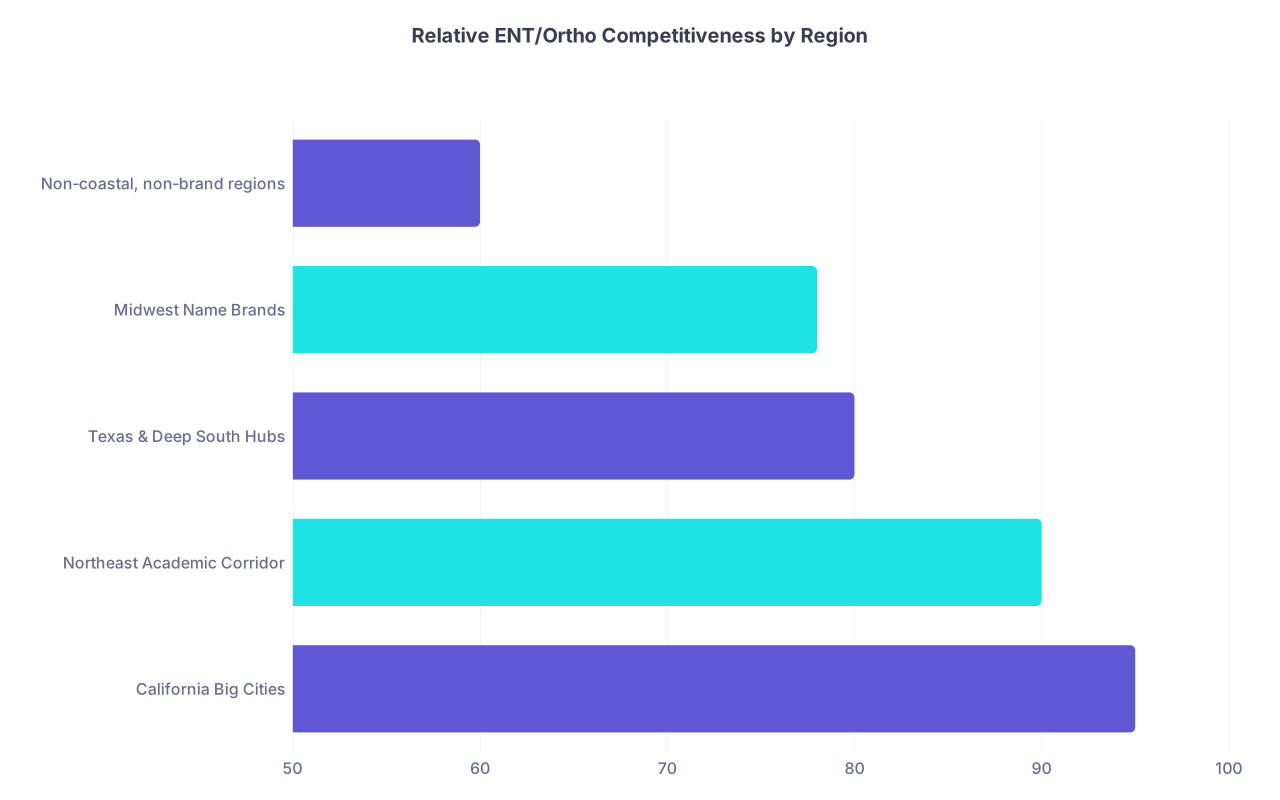
| Category | Value |
|---|---|
| California Big Cities | 95 |
| Northeast Academic Corridor | 90 |
| Texas & Deep South Hubs | 80 |
| Midwest Name Brands | 78 |
| Non‑coastal, non‑brand regions | 60 |
Think of competitiveness as a rough index out of 100. California and the NE corridor sit near the top. The middle of the country with solid but less name‑recognition programs can still be very competitive—but relatively more forgiving.
4.1 ENT – What “Competitive” Actually Looks Like by Region
Not hard rules, but realistic clusters.
| Region | Step 2 CK (Typical Matched Range) | Research Expectation | Regional Tie Importance |
|---|---|---|---|
| Boston/NYC/Philly | 255–265+ | Multiple ENT projects, pubs | Low–moderate |
| California/PNW | 255–265+ | Strong, preferably ENT | Moderate–high |
| Texas/Southeast hubs | 250–260+ | ENT or strong clinical research | High for in‑state |
| Midwest academic centers | 248–258+ | ENT-focused helpful | Moderate |
| Non‑coastal, smaller metros | 245–255+ | Some research, not always ENT-only | High advantage |
In practice:
- California: If you are not from there, you almost always need at least one West Coast away to be seriously considered.
- NE ENT: Aways at a Boston/NYC/Philly site can vault you into their “known” category.
- Texas: Away rotations strongly help show commitment and create local champions.
Where people screw this up:
- Doing aways only at ultra‑reach programs and nowhere else.
- Failing to do an away in a less‑branded but realistic region where they could match and be happy.
- Behaving timidly on away—staying anonymous, failing to seek feedback, not asking to scrub in.
You either turn an away inversion into an asset (great resident, great letters, strong performance) or you waste a precious opportunity.
6. Realistic Strategy if You Want ENT or Ortho in Hotspots
You can absolutely aim high. Just do it with your eyes open.
6.1 Step One: Brutal Self‑Audit
Skip the false modesty or delusion. Look at:
- Step 2 CK score
- Class rank / AOA / clinical honors
- Research volume and quality (ENT/Ortho‑specific or at least surgical)
- Your med school’s historic match footprint (does it place into your target regions regularly?)
- Quality and fame of your letter writers in those specialties
If your profile is:
- ENT: <250, minimal ENT research, no home ENT, no strong letters from recognized faculty.
- Ortho: <245–248, no Ortho research, no away rotations yet.
And your dream path is: “California or Boston only.” That is fantasy, not planning.
6.2 Step Two: Expand the Map Intelligently
You do not need to “settle for anywhere.” But you do need to widen beyond the classic magnets.
Regions that are still high‑quality but less absolutely insane:
- Secondary metros in the Midwest (Cincinnati, Columbus, Indianapolis, Kansas City, Omaha, Milwaukee, St. Louis outside WashU’s orbit, etc.).
- Southeast but not only Atlanta/Nashville/Miami (think Carolinas, Alabama, Arkansas, Kentucky).
- Mountain West: Utah, Colorado, Arizona, New Mexico (still competitive, but less saturated than coastal cities).
- Certain Texas programs outside the biggest marketing names.
These programs train excellent surgeons. Their graduates match sports, spine, joints, head and neck, otology, whatever you want. But applicants ignore them because the city is not on a postcard.
6.3 Step Three: Deliberate Use of Aways
If you insist on targeting a hotspot:
- ENT: One away in a dream region + one in a realistic region where you would happily match.
- Ortho: Two aways is common; at least one should be in a region/program where your stats are in the top third, not the bottom.
Steer away from doing all your aways at ultra‑prestige sites if your application is “just good” rather than elite. Better to be a star at a realistic program than a background character at an empire.
6.4 Step Four: Own Your Geographic Story
Programs want to know: if we invest in you, are you likely to stay in the region or at least genuinely want to be here?
Help them answer “yes” by:
- Making your personal statement consistent with your rank list (if your partner is from the Midwest and you want to settle there, say it).
- Having your letter writers highlight your fit for that region or program culture.
- Explicitly voicing (on interview day) reasons you like that city beyond generic “great food and outdoor activities.”
7. Who Gets Burned in Hotspots (And How to Avoid Their Mistakes)
Patterns I see over and over:
7.1 The Prestige Chaser
Profile:
- Solid stats (e.g., 250 ENT, 252 Ortho).
- Moderate research. Good but not extraordinary.
- From a mid‑tier med school with no huge national brand.
Strategy:
- Applies heavily to Boston, NYC, LA, SF, San Diego, Miami, Chicago, DC only.
- Few or no applications to mid‑sized cities or less glitzy states.
- Limited aways, mostly at big names.
Outcome:
- Fewer interviews than expected.
- Rank list that is both short and regionally narrow.
- High risk of not matching or having to SOAP.
Fix:
- Keep some prestige shots, but allocate at least half your applications to realistic, high‑quality but less insane markets.
7.2 The “I’ll Be Fine With My Score” Optimist
Profile:
- ENT: Step 2 CK ~245; Ortho: ~240–245.
- Above average clinically, decent evals.
- Minimal specialty‑specific research.
Strategy:
- Believes that “I’m a good team player” will offset numbers and that “programs are holistic.”
- Applies to standard competitive regions with no differentiation.
Outcome:
- Screening filters kill them before anyone learns they are nice and hardworking.
- A handful of interviews at slightly less competitive places, but not enough to feel safe.
Fix:
- Choose regions where your score positions you above their typical floor, not at the line.
- Stack your application with strong specialty‑specific letters and concrete evidence of commitment.
7.3 The Geographic Purist
Profile:
- Strong applicant actually competitive nationally.
- Extreme geographic constraint (e.g., “I will not leave SoCal / New York / one specific city”).
Strategy:
- Applies to only 15–20 programs, all in one region.
- Banks on being “strong enough” to overcome volume.
Outcome:
- Might match—but I have seen incredibly strong people fail from pure geography.
- Massive stress; zero backup.
Fix:
- If you must stay in one area, you need everything: top scores, strong research, home‑field advantage, away rotations, letters from local heavyweights. If even one of those is missing, widen the radius.
8. Quick Reality Check: ENT vs Ortho Regional Behavior
A few practical contrasts that matter for your planning.
| Aspect | ENT | Ortho |
|---|---|---|
| Overall spots | Fewer | More |
| Academic tilt | Stronger (research heavy) | Strong but slightly more clinical |
| Hotspot clustering | NE, CA, select South hubs | CA, NE giants, Midwest powerhouses |
| Research expectations | High, often ENT‑specific | High, Ortho‑specific preferred |
| Home/away importance | Critical for smaller field | Critical, especially aways |
Translation:
- ENT hotspots skew very academic. If you lack ENT research and want Boston/NYC/California ENT, that is a structural mismatch.
- Ortho hotspots value research but will also weigh how you performed on aways and in the OR heavily. The “athlete‑workhorse with great letters” archetype can still do well—if you pick sane regions.
9. How to Use This Without Going Crazy
You do not need an Excel model of 80 programs and 10 variables. You just need to stop lying to yourself about geography.
Practical next steps:
- Mark your genuine hotspots (places you would love to be).
- Add at least an equal number of programs in second‑tier competitive regions where your profile is above their typical averages, not barely meeting them.
- Plan aways so that at least one away is in a region you would actually match into with your stats.
- Make your story consistent: geographic preferences, personal statement, letters, and rank list need to line up.
You can still end up in LA or Boston or San Diego. People do. But the ones who match there usually did not rely purely on hope.