You’re a fourth-year staring at your rank list. You love derm. Or ortho. Or plastics. You’re looking at your home program, then at that big-name place across the country whose residents all have 260s and 40 pubs.
In your head: “If I can just get in the door at Top Program X, I’ll be set.”
What you do not see is the email thread between the PD, the chair, and the chiefs that basically says:
“Our own students first. Then our rotators. Then everyone else.”
Let me walk you through how that really plays out, because ultra-competitive specialties absolutely have a bias. A quiet but very real “grow our own” culture. And if you do not understand it, you’ll misread your chances and play the Match on hard mode.
The uncomfortable truth: the home-advantage is not subtle
Let’s start with the bottom line: in derm, ortho, plastics, ENT, neurosurgery, urology, integrated vascular and CT — the “don’t-even-bother-without-a-250” specialties — home applicants sit in a different category. Literally.
Behind closed doors, many programs split their rank meetings like this:
- “Home students”
- “Rotating students / known quantities”
- “External paper apps”
Three different piles. Three different levels of scrutiny.
I’ve sat in these rooms. I’ve watched a marginal home student get more discussion than an external with stronger scores. Seen PDs say, “We know what we’re getting with her.” That line alone has tipped more decisions than any single away rotation.
Here’s why they prefer home-grown residents, even if nobody writes that on the website.
Why ultra-competitive specialties like to keep it in the family
1. They know exactly how you perform when nobody’s watching
An away rotation gives a program 4 weeks of you on your absolute best behavior. Full performance mode.
Your home department? They’ve watched you for two years. They’ve seen you:
- On core rotations when you’re tired and think it “doesn’t matter as much”
- On random consults at 3 a.m.
- In teaching sessions where you didn’t prep
- In awkward, boring clinic days
They know if you show up to conferences late. They know if you disappear when things get busy. They know whether nurses roll their eyes when your name comes up.
For a PD, that’s risk reduction. With a home student, the variance is low. They may not be a superstar, but they’re unlikely to be a disaster. In high-intensity fields like neurosurgery or ortho trauma, that stability is gold.
An external 260/260, AOA, 15 pubs? Impressive on paper. But what are you like at 2 a.m. on your sixth call night in a row? Nobody really knows. And if they guess wrong, they’re stuck with you for 5–7 years.
2. Political capital: Chairs want “their” students to match
In ultra-competitive specialties, departments keep score. Chairs want to brag: “We matched all of our applicants into top programs.”
So when a home student wants to stay, this happens behind the scenes:
- Chair to PD: “She’s one of ours. I’d like to keep her.”
- PD to faculty: “We should seriously consider ranking her high.”
- Faculty to chiefs: “Let’s find space for her; we know she fits here.”
Nobody posts that on the website, but it’s real.
I’ve seen chairs go down the hall and say, “We can’t lose both of these students; what will that look like to the Dean?” Those conversations don’t happen for an external applicant.
3. They’ve already tested your personality fit
A toxic resident in a small, intense program will poison the whole group. In derm you can sometimes hide it for a bit. In neurosurgery or ortho? Absolutely not.
Your home attendings have seen:
- How you handle being corrected in front of others
- Whether you take feedback or get defensive
- If you’re nice to staff when you think no one important is around
They’ve watched you sit through grand rounds. They remember if you were the one slumped in the back scrolling your phone.
So when they sit down to rank, the conversation is not just “Is she smart enough?” It’s “Can we be in the trenches with him at 3 a.m. for the next five years without losing our minds?”
With home students, everyone in that room has data. Stories. “Remember when he stayed late to help…” “Yeah, but he also vanished during that big trauma…” That level of detail never exists for an outside applicant.
4. Department culture is fragile — home students already know the rules
Every ultra-competitive department has its unwritten rules:
- The attending who hates being called “doc”
- The chief who wants scrubs folded a certain way in the call room
- The “we always round in this order” policy that nobody writes down
Home students already speak that language. They don’t need six months of “learning how things are done here.” They just migrate from student to intern.
And programs care about that more than they admit. A smooth culture is efficient. A known entity who already knows where the bodies are buried (metaphorically… usually) is low-maintenance.
5. Home research machine: they’ve already invested in you
Ultra-competitive specialties are research-sensitive. Departments pour time into their students’ projects:
- Mentoring on case series and retrospective reviews
- Adding you on as middle author for departmental studies
- Letting you present at regional / national meetings under the institution’s name
When you’ve been part of that ecosystem for 1–3 years, there’s a sunk cost. Faculty have their name attached to your work. They’ve brought you to conferences. They’ve talked you up in the hallway.
Matching you into their own program lets them keep that pipeline intact. They know your interests, your projects, your skills. They’re not starting from zero like with an outside candidate.
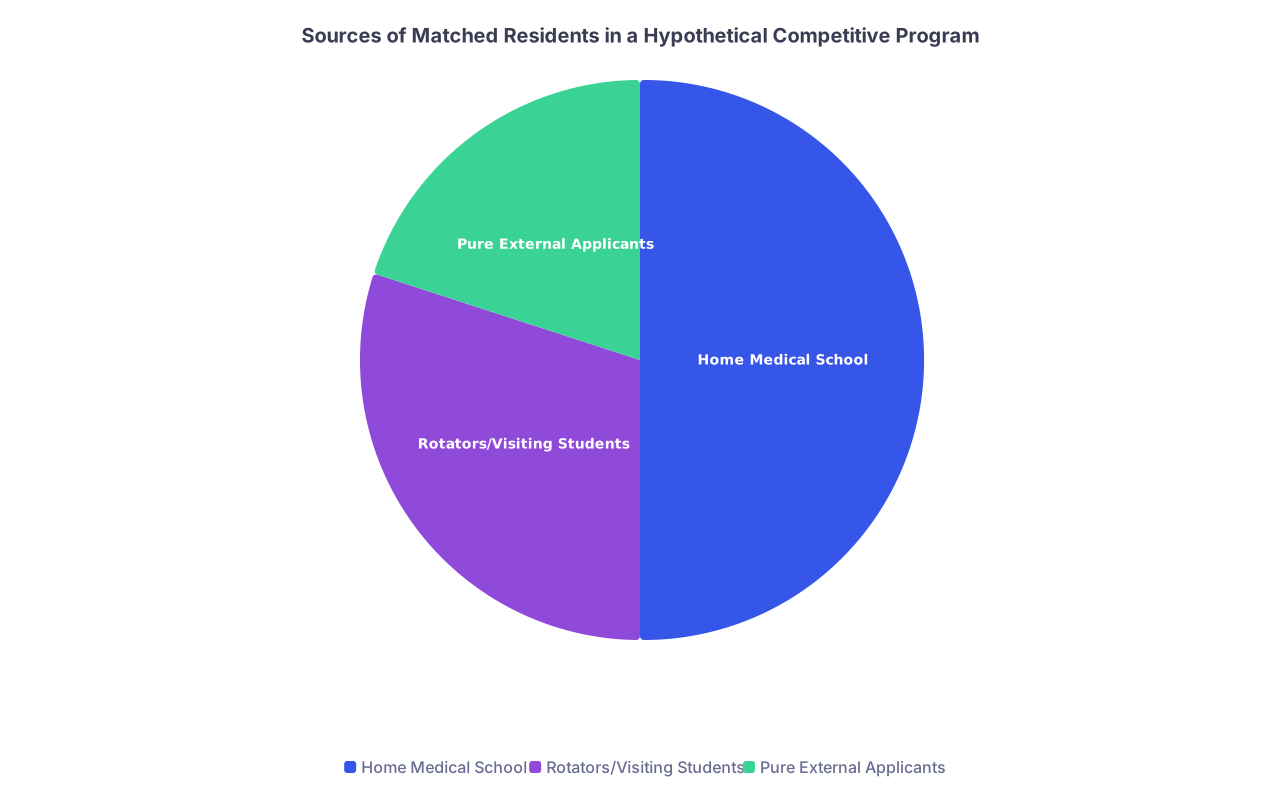
| Category | Value |
|---|---|
| Home Medical School | 50 |
| Rotators/Visiting Students | 30 |
| Pure External Applicants | 20 |
How the ranking room really works at competitive programs
Picture a real derm or ortho ranking meeting. Everyone’s a little tired. There’s pizza boxes and cold coffee. Someone’s throwing up PDFs on a big screen.
They do not just scroll alphabetically and “objectively” rank based on scores. That’s the fantasy version.
What you see instead:
- First slide set: “Home applicants”
- Second slide set: “Rotators”
- Third slide set: “Other interviewed candidates”
The conversation for the home group is completely different. I’ve literally heard:
- “We cannot let her go; she’s been here every summer.”
- “His Step is lower, but he’s reliable and knows the system.”
- “Look, if we do not rank him high, it’ll be awkward in the department for years.”
Awkwardness is underrated as a driver. Faculty would rather live with a slightly weaker resident than deal with three years of hallways conversations about “why didn’t we take our own?”
That is why a home derm applicant with a 240 and outstanding department reputation can outrank an external 260 with a glossy CV. It’s not “fair” in the abstract. It’s absolutely how it works.
Who benefits most from the home-field bias?
Let’s be precise. The home advantage is strongest in certain scenarios.
1. Solid but not superstar applicants in elite departments
If you’re at a strong institution with a big-name program — UCSF derm, HSS ortho, MGH plastics, Mayo ENT — and you’re “good but not perfect,” your best shot at that tier is almost always your home program.
Why? Because if they know you and like you, you’re running a very different race than the national applicant pool. You’ll get credit for all the soft stuff that doesn’t show on ERAS.
2. Late bloomers
Home programs are much more forgiving of:
- A rough pre-clinical start
- An early failed exam you redeemed
- A mediocre third-year eval before your switch flipped
Because they’ve watched your trajectory. They’ve seen “Version 1.0 you” and “Version 3.0 you.” They can believe in your growth narrative.
Outside programs just see the red flags on a PDF and shrug.
3. The “culture fit” winner
Every PD has had this experience: brilliant resident, toxic teammate. Never again.
So when a home student is universally liked — nurses, techs, residents, attendings — that is an enormous selling point. I’ve seen PDs say:
“He’s the glue. We can build a class around him.”
That kind of advocacy almost never happens for an external they met on Zoom and worked with for four weeks, tops.
When being “home-grown” does NOT help you
Let’s be honest. The home advantage is not magic. It will not save everyone.
1. If your own department won’t seriously support you
There are home students whose departments quietly do not push them.
Red flags:
- You ask about a letter and get, “Let’s see how this rotation goes first” — in September of M4
- No one offers to make calls on your behalf
- You aren’t invited to the small “residency interest” meetings with the chair or PD
If your own program doesn’t want to keep you, other programs notice that. PDs talk.
I’ve heard: “So, wait, their derm didn’t take her? Why not?” That alone has torpedoed external chances for some applicants.
2. When there are too many strong home applicants
Some places have four derm spots and eight outstanding home derm applicants. Or three ortho spots and six AOA home students with 260+.
In those cases, yes, the home advantage still exists — but it’s redistributed. They’ll bend over backward to get their excess strong students placed elsewhere. But they physically can’t keep everyone, and they won’t sink the program quality to do it.
3. When you’ve made a bad impression they can’t unsee
Here’s the flip side of intense familiarity: if you’ve repeatedly been:
- Unreliable on consults
- Disrespectful to staff
- Checked-out or arrogant on rotations
Your home program will not forget. You’re not mysterious. You’re the known problem.
An external program might give you a chance if your letters are vague but not damning. Your home program? They’ve seen the whole movie.
| Specialty Tier | Examples | Home Advantage Strength |
|---|---|---|
| Ultra-competitive surgical | Ortho, Plastics, ENT, Neurosurg | Very High |
| Ultra-competitive non-surgical | Derm, Rad Onc (historically) | High |
| Mid-competitive procedural | Anesthesiology, EM, Radiology | Moderate |
| Broad-field medical specialties | IM, Peds, FM | Variable by program |
How to actually leverage the “home-grown” bias
If you’re at a med school with the specialty you want, you should be playing a very specific game from early on. Not random shadowing. Strategic embedding.
1. Become a familiar, positive presence — early and consistently
The residents should know your face before you ever step on a formal sub-I. The chief should already know, “Oh yeah, she’s around a lot.”
That means:
- Show up at resident teaching conferences
- Volunteer for small projects, chart reviews, case write-ups
- Ask the junior faculty doing actual work, “Is there anything I can help with?”
You’re not trying to be a fanboy/fangirl. You’re signaling: “I’m investing here. I want to be part of this place.”
2. Attach yourself to a mentor who actually has a voice in the room
Not all letters are equal. The letter from the likeable but powerless adjunct vs. the one from the section chief who sits next to the PD at every meeting? Night and day.
Insider move: In many departments, there are 2–3 real decision-makers for residency class composition. You want at least one of them to know you well enough to argue for you.
The quality of the advocacy in those rank meetings often sounds like:
- Weak: “Yeah, she was… good, I guess.”
- Strong: “I would be completely comfortable taking call with him on day 1. I’d take him over many of our applicants from the last three years.”
You want the second.
3. Don’t make them guess about your interest
PDs and chairs hate guessing. They want to know:
- Are you genuinely interested in this field?
- Are you truly okay staying here?
- Will you be resentful if you don’t match at Fancy Program Y?
You don’t have to grovel. But you do have to be explicit, especially in ultra-competitive fields where they know you’re also aiming high.
Telling a PD, “This program is absolutely in my top group and I would be very happy to train here” lands differently than vague politeness.

| Step | Description |
|---|---|
| Step 1 | MS1 Early Interest |
| Step 2 | Shadow and Meet Residents |
| Step 3 | Join Research Projects |
| Step 4 | Regular Conference Attendance |
| Step 5 | Strong Sub I Performance |
| Step 6 | Mentorship and Letters |
| Step 7 | Ranked Highly by Home Program |
What if your dream specialty doesn’t exist at your med school?
Here’s the cruel twist: the home advantage is huge where it exists… and you might not have it.
Say you’re at a community-based school without derm or neurosurgery. You’re walking into a game already down 10 points.
You compensate by manufacturing a “near-home” status in one of three ways:
- Longitudinal research at a nearby academic center in that specialty
- Multiple away rotations at one institution (if allowed) to simulate long-term familiarity
- Year-out research position in the department you’re targeting
The point is to turn “random external” into “we sort of know this person the way we know our own.”
I’ve seen a neurosurgery PD rank a research-year student as if they were home-grown: “He’s been with us a year and a half, he’s basically ours.” That language matters.
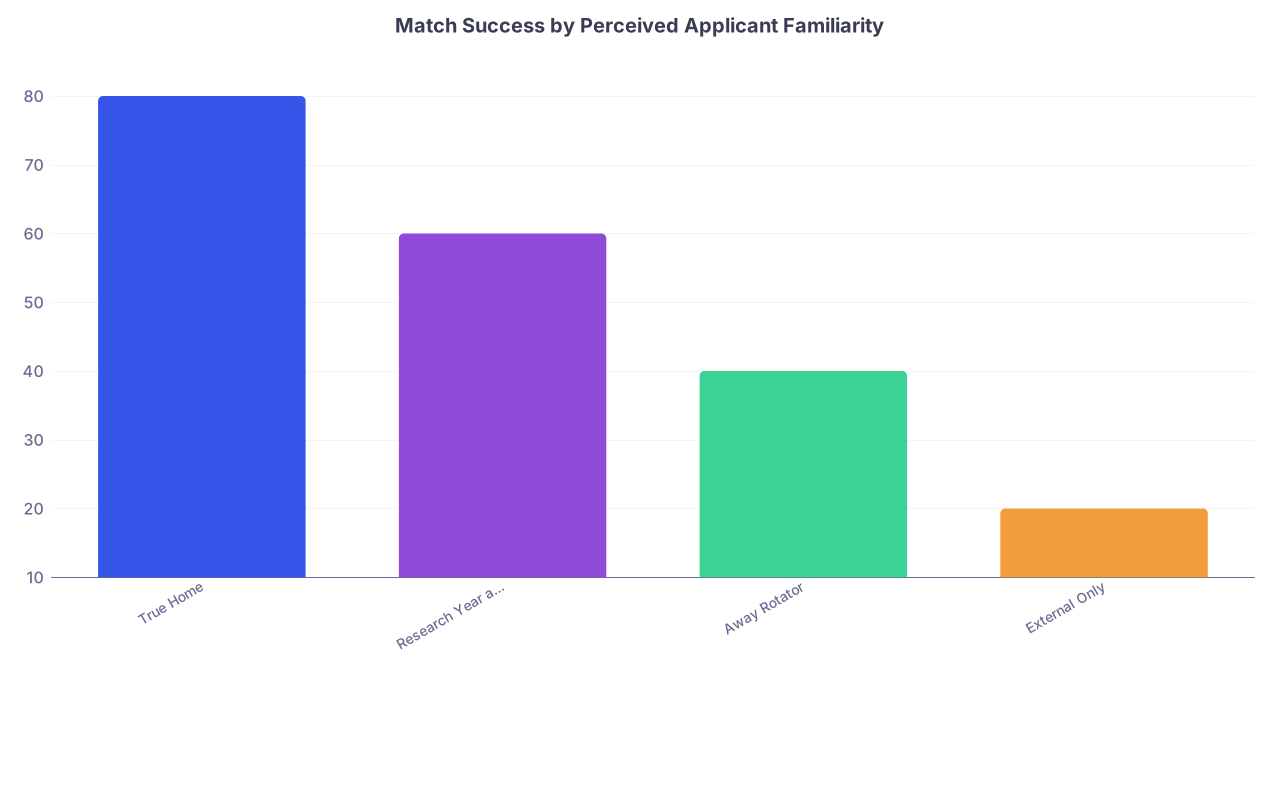
| Category | Value |
|---|---|
| True Home | 80 |
| Research Year at Program | 60 |
| Away Rotator | 40 |
| External Only | 20 |
(Percentages represent relative likelihood of being ranked in a matchable range at a highly competitive program, not real data but a faithful reflection of how PDs think.)
The quiet hierarchy of “known vs unknown” in rank decisions
Let’s strip away the PR language and give you the mental model many PDs actually use:
- First priority: The home student they all like and respect.
- Second: The rotator who came, crushed, and fit like a glove.
- Third: The research-year applicant they trust.
- Fourth: The external with spectacular paper stats and decent interviews.
They’ll still pull external stars. They have to; reputation matters. But if it’s a close call between a known, solid home student and an unknown but shinier external? The home student wins far more often than the internet believes.

How this changes your application strategy
If you understand this “home bias,” you stop making a very common mistake: treating every program as an equal lottery ticket.
Some implications:
- If you have a strong home program in your chosen ultra-competitive specialty, you should almost always do a sub-I there, and you should not treat them like a backup. They’re one of your highest-yield shots.
- If your home program is mid-tier but you’re gunning for top-tier, you still leverage your home as your stability anchor, then stretch with a few ambitious aways.
- If you have no home program, you have to create “pseudo-home” relationships via research years or repeated, substantial contact.
The worst position to be in is “unknown external who thinks stats will save them” while competing against home students the faculty already trust.

What comes next for you
You’re not just “applying broadly.” You’re stepping into a system that weighs familiarity and internal politics far more than anyone posts on FREIDA.
If you’re early in med school, your job now is to quietly become “one of theirs” in the department you want. Get in the rooms, take on the work, let them see you on bad days as well as good ones—then show that your floor is still high.
If you’re already in the application cycle, you reframe: Which programs truly know me? Where do I have someone in the ranking room who will push for me like I’m home-grown?
Because the ultra-competitive specialties do not just want the “best” residents on paper. They want residents they can live with, trust, and predict. Their own students fit that profile by default.
Your next step is to decide whether you’ll be someone’s “known quantity” — or just another impressive PDF in a very large pile. How you answer that will shape which doors quietly swing open for you during Match season.