
Last cycle, I watched two applicants on the same interview day at a high-powered ortho program. One had average stats but a LOR from a chair everyone in the room knew. The other had stellar scores from a lesser-known community program. Guess which one the faculty argued for at the rank meeting—before anyone even opened the personal statement.
Let’s talk about that quiet, slightly dirty truth: in some specialties, where you did your training and whose name is printed on your badge follows you for years. In others, nobody really cares as long as you are competent and easy to work with. The problem is, students almost always misjudge which is which.
The Uncomfortable Reality: Reputation Is a Proxy
You will hear attendings tell you “just find the best fit” and “you can get anywhere from anywhere.” That’s partially true. But behind closed doors, reputation is used as a shortcut. A mental filter.
Why? Because program directors are sifting through hundreds, sometimes thousands, of applications. They don’t have time to deconstruct every résumé from scratch. So they use what they know.
In some fields, that shortcut is decisive. In others, it’s background noise.
Here’s the underlying rule nobody states directly: the more a field depends on networks, referrals, and prestige-sensitive patients or employers, the more your program’s name matters. The more a field is ubiquitous, service-heavy, and locally hired, the less the name brand moves the needle.
Let me walk you through how that plays out specialty by specialty.
The “Name Brand or Suffer” Fields
There are specialties where reputation is basically a second currency. If you’re aiming for these and you pretend program name doesn’t matter, you’re lying to yourself.
Think: plastic surgery (especially integrated), orthopedic surgery, neurosurgery, dermatology, ENT, and to a significant degree, radiation oncology and ophthalmology.
Why reputation is amplified in these fields
Three big reasons.
First, small world effect. These are relatively small specialties. People know each other. Chairs text each other. Fellowship directors talk about programs like they’re discussing rival teams. If they don’t know your home program, you’re starting from behind.
Second, fellowship bottlenecks at a few elite places. For many of these fields, the top fellowships cluster at the same 15–20 institutions. Those fellowships then become gatekeepers to specific geographic markets or high-end practices. So the pipeline matters.
Third, patient and employer prestige bias. Cosmetic plastics, ortho at big-name sports centers, neurosurgery at flagship hospitals—patients, hospitals, and group practices consciously lean on brand. Hiring committees in these spaces strongly prefer graduates from places they recognize.
You see how all of this cascades.
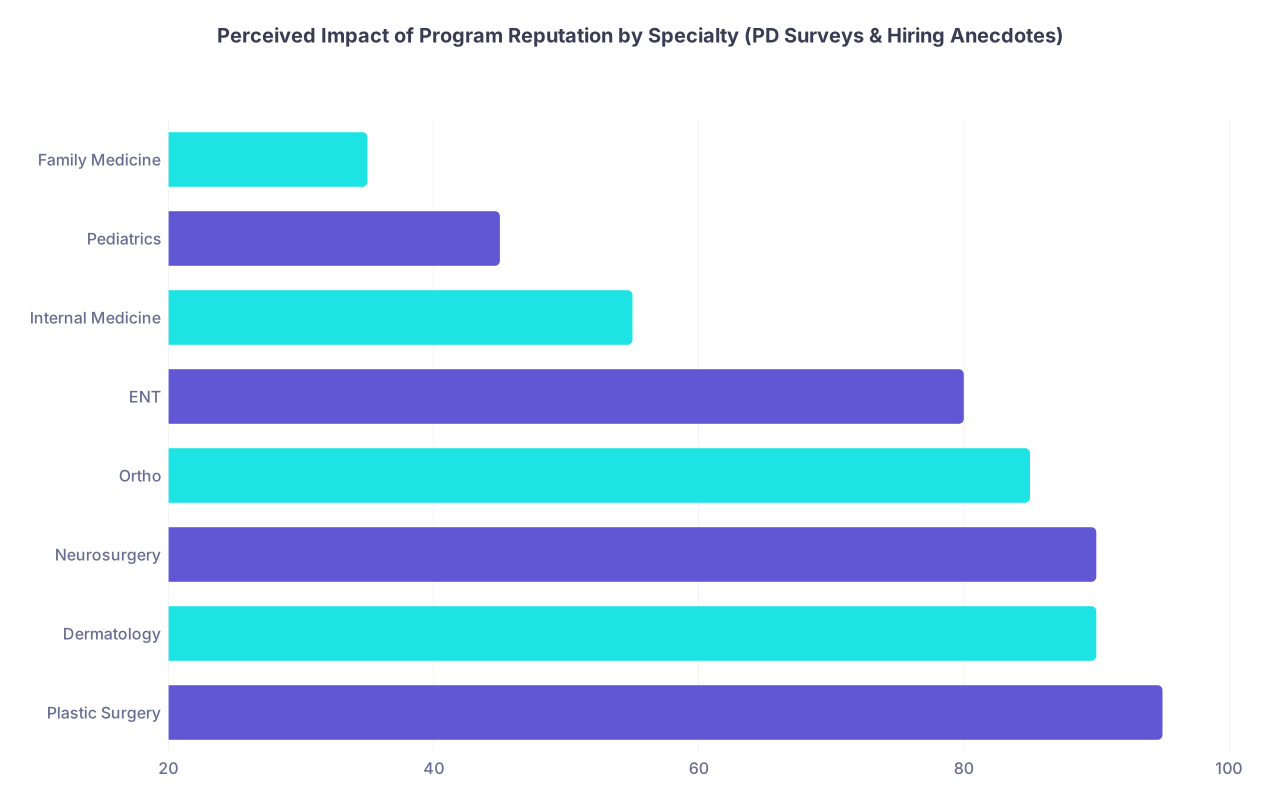
| Category | Value |
|---|---|
| Plastic Surgery | 95 |
| Dermatology | 90 |
| Neurosurgery | 90 |
| Ortho | 85 |
| ENT | 80 |
| Internal Medicine | 55 |
| Pediatrics | 45 |
| Family Medicine | 35 |
Those numbers aren’t from a single formal study; they’re a mash-up of survey data and what PDs tell each other over beers. They’re directionally right.
Example: ortho vs FM — two different universes
A PD at a major ortho program once said, half-joking: “If I haven’t heard of your program and you’re applying to our sports fellowship, I assume you’re not operating much.” Crass, but real.
Meanwhile, a family medicine group hiring in a mid-sized town? They care if you’re competent, can see 20–24 patients a day, and will stick around. They might barely recognize the difference between “Top 10 IM program” and “solid regional program”—and they don’t need to.
How this shows up in actual decisions
Here’s what happens in real selection or hiring meetings in competitive fields:
The rank list is being finalized for a derm program. Someone says, “She’s from [insert top 10 IM or derm feeder]. You know their residents are strong; they don’t slack on clinicals.” That alone bumps her a few spots.
A plastics fellowship committee looks at two CVs with similar numbers of papers. One is from a no-name community general surgery program. The other is from a mid-tier but known academic place with a strong plastics division. No contest. They trust the internal vetting of the second institution.
In neurosurgery, when a PD sees you trained at a program they consider “soft” (they know who operates and who doesn’t), they assume your case log is inflated with low-complexity cases. They are suspicious from the start.
These aren’t official policies. They’re gut reactions. But gut reactions decide who gets the interview, the “yes,” the mentorship, the fellowship spot.
When Reputation Mostly Stops at the Door
Now look at internal medicine (non-competitive fellowships), pediatrics, family medicine, psychiatry, pathology, PM&R (for many roles), and to some degree anesthesia unless you’re chasing very specific fellowships or elite private groups.
Here, once you’ve cleared the “are you trained and competent?” bar, the name of your residency fades fast.
Why it matters less
The dynamics change in these fields.
They’re larger specialties. Way more programs. Way more graduates. Employers can’t possibly know every program in detail. So they go by other signals: board pass rates, interview vibe, references, productivity.
And many jobs are service-based. A big multi-specialty clinic hiring a family doc is not doing a brand analysis. They want someone who will show up, chart, and not anger patients.
Yes, there are academic or subspecialty exceptions—cardiology, GI, heme/onc, NICU, PICU, child psych, etc. But that’s fellowships and major academic career tracks, not basic employability.
| Specialty Group | Reputation Weight (Real-World) |
|---|---|
| Integrated Plastics, Derm, Neurosurg | Extremely High |
| Ortho, ENT, Ortho Sports, Spine | Very High |
| Cards, GI, Heme/Onc Fellowships | High |
| Anesthesia, EM, Radiology (academic) | Moderate |
| General IM/Peds/FM/ Psych (community) | Low |
You won’t see this table on any official site. But this is how people talk about it in actual hiring and fellowship meetings.
What PDs actually say in these fields
I’ve heard variations of this in IM multiple times: “If they passed boards, trained at an accredited place, and the program director isn’t warning me off, I don’t really care if it’s [top 5] or [regional affiliate].”
For pediatrics: “I care more that they don’t crumble on nights and that they aren’t a nightmare to work with. Their program name doesn’t see the patient; they do.”
This doesn’t mean reputation is worthless. A big-name IM residency will absolutely help you for cards or GI fellowship. But if you just want to be a solid hospitalist in a good market? The marginal value of that brand drops sharply.
The Role of Fellowships: Where Name Really Cashes Out
Here’s the more nuanced part almost everyone misses: the “real” payoff of a big-name residency or department in many competitive fields is not your first job. It’s your fellowship.
In tight fellowship markets—sports ortho, hand, spine, microplastics, Mohs, complex spine neurosurgery, interventional radiology, advanced GI, structural heart—the selection process is incestuous. Same names show up again and again.

| Step | Description |
|---|---|
| Step 1 | Med School |
| Step 2 | Residency |
| Step 3 | Reputation Critically Important |
| Step 4 | Reputation Secondary |
| Step 5 | Top Fellowship Odds Boosted |
| Step 6 | Local Jobs Accessible |
| Step 7 | High End Academic or Private Jobs |
| Step 8 | Is Field Highly Competitive? |
If you train at a place that reliably sends people to these fellowships, you’re not just getting “brand name.” You’re getting:
- Mentors who literally trained the fellowship directors.
- LORs that get read differently because the sender is known.
- Faculty who will pick up the phone and say, “Take this one, she’s the real deal.”
I’ve sat in rank meetings where someone reads a lukewarm letter from a famous chair and it does more damage than three glowing letters from unknowns can repair. That’s the double edge of prestige: the signal is stronger, good or bad.
In contrast, a resident from a small, unknown program may be excellent but their PD’s letter is an unknown currency. Committees are cautious with unknown currencies.
Academic vs Community: Different Games, Different Stakes
You also need to separate two very different markets: academic and community.
Academic careers: reputation is the scaffolding
If you want to be faculty, especially in a competitive surgical subspecialty or derm, the prestige ladder is real:
- Big-name residency makes it easier to land a big-name fellowship.
- Big-name fellowship makes it easier to get a junior faculty role at an academic center with real research infrastructure.
- That environment makes it easier to generate papers, grants, national talks.
The CV builds on the foundation. If the foundation is a place nobody in the field knows, you can absolutely climb—but you’re doing it with a weight vest on.
In several fields, when faculty spots open up, the short list is almost entirely people from a known cluster of programs. It’s not a conspiracy. It’s intellectual inbreeding plus risk aversion.
Community practice: personality and productivity dominate
Community hospitals and private groups are not sitting around comparing NCCN guideline talks you gave at a conference. They’re asking:
- Will you bring in RVUs?
- Will patients like you?
- Are you going to suddenly leave in 18 months?
- Are you normal enough that colleagues won’t dread call with you?
A respected, known program helps a bit—the “oh nice, you trained there” effect—but it’s not the gatekeeper. A mediocre resident from a top 10 place gets filtered out quickly once they show up in person. I’ve watched it happen.
In community EM or hospitalist IM, I’ve seen hires from mid-tier residencies beat out top-tier grads because they interviewed like grown adults and not like they were entitled to a throne.
So: big name opens more doors on paper. But the stakes are much higher in academic / niche fellowship paths than in general community practice.
The Hidden Variable: Internal Hierarchies Within a Specialty
Another thing you will never see published: within each specialty, everyone knows which programs are “actually strong,” which are “research factories but clinically soft,” and which are “workhorses but academically quiet.”
There are reputational tiers inside the specialty that have almost nothing to do with generic rankings or Doximity nonsense.
For example:
In neurosurgery, some programs are known as “cranial powerhouses,” others as “spine mills,” others as “light on cases but heavy on papers.” That shapes how their grads are viewed when applying for specific fellowships.
In plastics, there are programs whose alumni completely dominate certain fellowship lists (e.g., hand, micro) for a decade straight. Everyone sitting on those committees knows this.
In ortho, certain residencies are synonymous with “we know their grads hit the ground running in the OR.” Others… not so much.
You, as a student, usually have no real map for this. You see a USNWR rank or a big-name hospital and think you understand the landscape. You don’t. Not fully.
Talk to recent grads in the field. Ask them: “If you see someone from Program X, what do you assume about them?” Watch their face. The tiny smirk or grimace tells you more than any brochure.
Where Students Overestimate and Underestimate Reputation
Let me be blunt about the two big errors I see:
1. Overestimating reputation in lifestyle/community-heavy fields
Every year, I meet students gunning for family medicine or general pediatrics who are agonizing over whether they can get into a “top 10” residency. They’re willing to stack on debt or move somewhere miserable “for the name.”
In most cases, this is wasted anxiety.
Unless you specifically want an academic career, a fellowship-heavy path, or a highly competitive urban job market, your long-term outcomes are much more determined by your own competence, how early you sign a contract, and personal preferences.
Your future employer is not ranking residencies by prestige. They’re checking:
- Board certification.
- No red flags.
- References that don’t hint at drama.
That’s it.
2. Underestimating reputation in ultra-competitive, small-network fields
On the other side, I see people say things like, “I love neurosurgery, I’ll just go where I match, name doesn’t matter, I’ll prove myself.”
You can prove yourself. But understand: if you end up at a program that is known to be clinically weak, or has poor fellowship placement, you’re making your future self fight uphill—for spine, for skull base, for any prestigious path.
Same for integrated plastics. Pretending all integrated plastics programs are equal just because they’re all “plastics” is naïve. The people in that field absolutely do not see them as equal.
In these specialties, if you have a strong enough application to choose between a well-known, well-connected program and a lesser-known one in a more desirable city or with a lighter call, you are making a career-defining choice. People pretend it’s not. It is.
How to Actually Use This Knowledge
So what do you do with all of this, practically?
First, be honest about your trajectory. Not what sounds impressive at a preclinical interest group. What you can actually see yourself doing at 35.
If you’re genuinely aiming for:
- Neurosurgery, integrated plastics, derm, ortho, ENT
- Or you know you want a high-end fellowship (sports, hand, micro, complex spine, Mohs, advanced cards/GI)
Then program reputation is not a vanity metric. It’s part of the scaffolding.
- You should weigh reputation and fellowship placement heavily when ranking.
- You should ask direct questions: “Where have your grads gone for fellowship in the last 5 years?” and “Which fields are harder to get from here?”
- You should look around and see: are the faculty active nationally? Do people at other places actually know them?
If instead you’re thinking:
- General IM hospitalist
- Outpatient peds
- Family med
- Psych mostly for clinical practice
- EM in a non-oversaturated market
Then focus less on the name etched on the door. Pay more attention to:
- How well they train you clinically.
- The culture and burnout level.
- Location, support, schedule, and fit.
Because in those fields, you won’t get extra years of happiness out of a brand that nobody in your eventual job market cares about.
FAQ (Exactly 4 Questions)
1. If I’m unsure about fellowship, should I still chase a big-name residency?
If you’re even seriously considering a competitive fellowship (cards, GI, heme/onc, advanced ICU, surgical subspecialties), a stronger-name residency gives you flexibility you might be grateful for later. But do not sacrifice your sanity and support system for a tiny prestige bump if you’re leaning strongly toward general practice. Marginal reputation gains past a certain point don’t compensate for a toxic environment.
2. Can a resident from a lesser-known program still match top fellowships in competitive fields?
Yes, but it’s rare and usually requires exceptional individual performance: real research output with known names, strong away rotations, PDs and faculty who actively pick up the phone. You have to be clearly better than peers from name-brand places to overcome the “unknown program” bias. I’ve seen it happen. But it’s swimming upstream.
3. Does medical school reputation matter as much as residency reputation?
For most specialties, residency reputation ultimately matters more for your long-term trajectory. Med school prestige can help you get into better residencies initially, and in a few elite circles it carries lifelong weight, but fellowship and hiring committees tend to focus on where you trained last and who trained you directly. In surgery-heavy and procedure-heavy fields especially, residency/fellowship names dominate.
4. How can I quickly assess a program’s real reputation inside a specialty?
Ignore generic rankings. Instead: look at their last 5–10 years of fellowship placements, ask attendings in that field (not just your school), and talk to PGY-3+ residents who matched into competitive fellowships—ask where their co-residents have gone and how often they get interviews at the places you care about. The unofficial reputational map lives in those conversations, not on any website.
Key takeaways: some specialties run on brand and connections; others run on competence and availability. Figure out which world you’re entering, then rank and plan accordingly. And stop pretending all residencies are equal when the people holding the keys very clearly do not see them that way.